Asian
J.
Arts
Cult.
2026;
26(3):109
Cultural Diplomacy through Storytelling: An Ontology-Based Semantic Framework for Cross-Cultural Understanding
Briti Deb1,* and Tirumal2
1Department of Computer Science, Surana College, Bengaluru, Karnataka 560004, India
2Department of Samskrita, Surana College, Bengaluru, Karnataka 560004, India
(*Corresponding author’s email: britideb@gmail.com)
Received: 29 September 2025, Revised: 11 November 2025, Accepted: 4 December 2025, Published: 30 December 2025
Abstract
This paper explores how two foundational Indian story-based texts, the Panchatantra and the Ramayana, have influenced and continue to influence global political, educational, and cultural systems through centuries of translation, adaptation, and reinterpretation. Drawing on translation studies, cultural exchange, and semantic ontology, it shows that these texts functioned not only as literature but also as tools of soft power, spreading ideas on ethics, governance, and leadership across cultures. To represent this process, the study develops a preliminary ontology framework for story-based texts, aligned with cultural heritage standards such as CIDOC CRM and FRBRoo. Using the Resource Description Framework (RDF) and Web Ontology Language (OWL), the framework encodes narratives, agents, and media as machine-readable data, tracing story transmission from manuscripts to modern adaptations. A prototype demonstrates how multimodal and multilingual variants — such as Panchatantra → Kalila wa Dimna → Directorium Humanae Vitae — can be modelled to show semantic continuity and cultural transformation. Preliminary findings suggest that the ontology supports digital preservation and enables new interpretive and computational approaches. In AI, it provides culturally balanced training data; in diplomacy, it supports heritage-based storytelling; and in education, it informs ontology-driven curricula that integrate ethical and philosophical diversity. The study highlights classical narratives as active digital resources for technology, diplomacy, and global cultural understanding.
Keywords: Digital heritage, Heritage documentation, Heritage ontology, Indian knowledge systems, Storytelling
Introduction
In today’s world - where cultural narratives influence politics and artificial intelligence (AI) shapes public knowledge through large language models (LLMs) - it is essential to represent ancient story-based texts clearly and accessibly, ensuring that humanity can continue to engage with and learn from these knowledge systems. Unless a modern semantic modelling framework for these ancient knowledge systems is developed, global AI infrastructures risk biased training data and misrepresentations of historical contributions, among many other challenges (Gattupalli et al., 2023). While the global popularity of these story-based texts is well acknowledged, many existing studies tend to rely on ad hoc methodologies (Varadarajan et al., 2023), suggesting the need for further research into semantic or ontological models of ancient knowledge systems. In addition, some European observer measures Eastern architectures (e.g., Ayutthaya, Thailand) by European aesthetic standards (e.g., simplicity, proportion), suggesting that the architecture may have appeared elaborate or unfamiliar when viewed through a European aesthetic lens (Ogleby, 1999).
While numerous literary and cultural studies have examined the narrative and ethical dimensions of these texts, few have developed a structured ontological framework to trace their transmission and reinterpretation across cultures. This study proposes an ontology-based semantic model, in which an ontology (Guarino et al., 2009) is a formalized knowledge system capturing relationships among concepts, to systematically represent and interconnect narratives across time, languages, and regions. To do this, the study explores two foundational ancient Indian storytelling texts - the Panchatantra, a collection of fables teaching practical life lessons (known as niti in Sanskrit language) (Ryder, 1949, Cohen, Simona, and Housni Alkhateeb Shehada 2017, Sarkar, 2025, Olivelle, 1999), and the Ramayana, an epic conveying moral, social, and spiritual values, known as dharma in Sanskrit language (Mathur, 1992, Brockington, 2004, Debroy, 2017, Blackburn, 1981) - not as fixed historical manuscripts, but as dynamic, living traditions digitally modelled through ontologies.
Historically, these texts served many purposes - supporting rulers, teaching ethics, aligning with local beliefs, and storytelling in general. As they spread through languages like Arabic, Persian, Hebrew, and Latin, they were adapted as educational materials such as Kalila wa Dimna in Abbasid royal courts (Gutas, 2012, Puntoni, 1884, Kinoshita, 2008, London, 2008, Hameen-Anttila, 2021), as national narratives in Southeast Asia such as Rama as Dharmaraja to justify rule (Khongmun, 2023), through Jataka-themed murals (Long, 2005), via animal characters including parrots in storytelling (Shuka Saptati: Seventy Tales of the Parrot, Mehri, 2020), and as tools for religious and colonial instruction across Asia (Ryder, 1949) (Table 1). These adaptations reflect changing ethical, political, and educational values shaped by ancient texts like the Ramayana and the Panchatantra.
The motivation for using the Panchatantra and the Ramayana comes from the fact that they teach two key ideas from ancient Indian thought - niti (नीति), which means practical wisdom (Ryder, 1949, Cohen, Simona, and Housni Alkhateeb Shehada, 2017, Sarkar, 2025), and dharma (धर्म), which means doing what is right (Mathur, 1992, Brockington, 2004, Debroy, 2017). Niti, found in the Panchatantra, teaches how to act wisely in daily life, especially in politics, friendship, and leadership. In contrast, dharma, a central idea in the Ramayana, means moral duty and living in harmony with the natural and social order. The story of Rama in Ramayana shows how to follow one’s responsibilities as a son, king, and person - even in difficult times. Dharma connects personal behaviour with a bigger moral purpose and supports values like truth, loyalty, and justice (Brockington, 2004). Together, niti and dharma reflect two sides of Indian ethics - one flexible and focused on real-life success, the other idealistic and based on doing what is right in all situations.
The ontology model we propose captures some of the key elements of ancient knowledge transmission and adaptation - events (e.g., translations, performances, political commissions), agents (e.g., translators, kings, artists), expressions (e.g., Kalila wa Dimna), and media forms (e.g., manuscripts, murals, oral traditions, performances). It not only provides a method and tool to digitally preserve ancient knowledge in general, but also offers researchers in AI, cultural policy, and education a new way to trace and apply ancient intellectual heritage across global contexts.
Materials and methods
Theoretical framework: Storytelling as diplomacy and moral statecraft
Translating important texts like the Panchatantra and the Ramayana is more than just changing words from one language to another. It is a way to share ideas, shape values, and influence culture. Translation has often been guided by power, politics, and specific goals. Historical examples such as Ibn al-Muqaffa’s Kalila wa Dimna (Arabic, Abbasid Caliphate) (Rosenthal, 1992), Ziya’ al-Din Nakhshabi’s Persian adaptations of the Panchatantra (Persian, Delhi Sultanate) (Foltz, 2014), and King Rama I’s Ramakien (Thai, Siam) (Kerdarunsuksri, 2003) show how ancient Indian ideas were reshaped to fit new settings - whether in Islamic courts, Thai rituals, or Persian storytelling (Table 1). These translations helped spread Indian thinking about ethics, leadership, and social order to many parts of the world.
To model how these changes happened over time, this study uses concepts from popular heritage ontologies such as CIDOC CRM and FRBRoo (Doerr, 2003, Doerr et al., 2008, Theodoridou et al., 2016). CIDOC CRM helps describe important parts of cultural heritage such as texts, people, events, and places, and explains how they connect. From an ontological perspective, CIDOC CRM’s Event class enables representation of ritualized transmissions, capturing performances, adaptations, and artistic creations as key nodes in a structured heritage network. This helps track cultural events like translations and adaptations by treating them as Events. FRBRoo breaks down a work into different levels: the original idea (Work), its different versions or languages (Expression), the physical form (Manifestation), and individual copies (Item). Modelling using these ontologies is expected to help us follow heritage across different languages, cultures, and time periods. Overall, they support heritage documentation, provide data for AI fine-tuning, and help researchers, teachers, and technology developers better use the Indian Knowledge System (IKS).
Table 1 Overview of Panchatantra and Ramayana manuscripts
Title |
Language |
Region |
Patronage / Uses |
Panchatantra (Ryder, 1949) (original by Vishnu Sharma) |
Sanskrit |
India (Bharat) |
Moral and political instruction for young princes; teaching statecraft, diplomacy, and ethics |
Kalila wa Dimna (Translation by Ibn al-Muqaffa) (Gutas, 2012) |
Arabic |
Abbasid Caliphate (Iraq) |
Used in Abbasid court, ethical governance, Islamic moral teaching through fables |
Directorium Humanae Vitae (John of Capua translator from Hebrew to Latin) (Puntoni, 1884) |
Latin |
Iberia / Europe |
Christian moral instruction; taught in medieval universities and monastic schools |
Ramayana (Original Valmiki) (Pollock, 2006, Debroy, 2017) |
Sanskrit |
India |
Taught ideals of dharma (righteous conduct), loyalty, truthfulness, and self-sacrifice. |
Ramakien (King Rama 1 adaptation) (Ghosh & Jayadat, 2017) |
Thai |
Siam (Thailand) |
National and royal identity building, Cultural and artistic expression, Moral instruction through performance |
Jataka Tales (Buddhist Monks) (Shanmugapriya & Christopher, 2023) |
Pali / Sanskrit |
India, South-east Asia, Tibet, China, Japan |
Buddhist moral education; showing Buddha's past lives to teach values like compassion, sacrifice |
Panchatantra: Storytelling as diplomacy
The Panchatantra, an ancient Sanskrit collection of animal fables, was created to teach niti - practical wisdom, ethics, and leadership - through stories told by a wise Brahmin to three princes. Its influence grew through the 8th-century Arabic version Kalila wa Dimna by Ibn al-Muqaffa (Gutas, 2012), which adapted Indian political ideas to fit Abbasid Islamic values, influencing Arabic education and culture. Later, the Panchatantra was adapted into Persian and Ottoman forms, often with illustrations and local moral lessons (Cohen & Housni, 2017). It also reached Europe through Hebrew (Refael-Vivante, 2013) and Latin (Puntoni, 1884) translations, shaping European fable traditions (Zafiropoulos, 2017, Cohen & Housni, 2017). Despite cultural changes, many of its ideas stayed consistent, showing its power to share knowledge across regions.
To teach niti, Panchatantra uses a frame story, where a wise Brahmin named Vishnu Sharma teaches three princes through many smaller stories. This structure helps make the lessons clear and easy to remember. The original text mixes Sanskrit prose and poetry, where the prose tells the story and connects parts, while the verses highlight important morals (e.g., न तादृग्जायते सौख्यनमपि स्वर्गे शरीरिणाम् । दारिद्रेsपि हि यादृक्स्यात्स्वदेशे स्वपुरे गृहे ॥). This mix helps people remember and recite the stories, especially in oral traditions. By using entertaining animal fables and layered stories, the Panchatantra turns complex ideas about ethics and politics into simple, memorable lessons in an engaging way.
Panchatantra also uses a structured frame narrative known as katha-pravrtti (unfolding of the story), where numerous smaller tales are embedded within a central story, making the lessons clear, memorable, and easy to follow. The text blends Sanskrit prose (gadya) and verse (padya), with prose connecting the narrative and verse highlighting key morals, thereby supporting oral transmission and aiding memory. By using entertaining animal fables (पशुकथाः) and nested storytelling, the Panchatantra simplifies complex ethical and political ideas into accessible and engaging lessons. Its design promotes learning about leadership (नेतृत्वं), diplomacy (कूटनीतिः), governance (शासनं), ethics (नीतिशास्त्रं - लोकनीतिः and राजनीतिः), and social behaviour (सामाजिकव्यवहारः) in a way that is both enjoyable and instructive. This storytelling style not only entertains but was also effective in teaching rulers and leaders’ useful lessons that matter across different times and cultures (Table 2).
Table 2 Reframing of Niti in translations
Translation / Version |
Language |
Reframed Term / Concept |
Cultural-Political Context |
Interpretive Shift in Niti |
Kalila wa Dimna (Gutas, 2012) |
Arabic |
Adab (ادب) |
Abbasid Caliphate (Baghdad) |
Courtly ethics and moral etiquette |
Anvar-i Suhayli (Shahbaz, 2019) |
Persian |
Hikmat (wisdom), Adab |
Timurid court culture |
Moral-philosophical ethics for administrators |
Hebrew Translations (Refael-Vivante, 2013) |
Hebrew |
Musar (מוסר) |
Medieval Jewish ethical instruction |
Religious and moral discipline |
Directorium Humanae Vitae (Puntoni, 1884) |
Latin |
Prudentia, Virtus |
Christian scholastic Europe |
Moral virtue and political prudence |
Colonial English Translations (Ryder, 1949) |
English |
Native wisdom, folklore |
British India |
Cultural exoticism, decontextualized moral tales |
Ramayana: Storytelling as moral statecraft
The Ramayana, written in Sanskrit and attributed to sage Valmiki, is one of the world’s longest story-based texts. It teaches dharma or moral and cosmic order (धर्मः) through the life of Rama, the ideal king or dharma raja. Rama’s story shows that a true ruler must follow dharma in all situations, even at personal cost. His rule, known as rajya dharma, is based on ethics, sacrifice, and justice, making him a model of righteous leadership. (धर्मज्ञः सत्यसन्धश्च प्रजानां च हिते रतः). The epic goes beyond storytelling and functions as a guide to political and social order in Indian thought. In this view, the king or rajan (राजन्) must follow dharma (धर्मः) and govern justly. He is not above the law and must use danda (दण्ड) or fair punishment to protect society. This idea, from dandaniti (ethics of governance), shows that power should serve justice, not personal gain. The balance of rajan, dharma, and danda in the Ramayana has shaped ideas of ethical kingship across South and Southeast Asia (Mathur, 1992).
As the Ramayana spread across Asia, it was adapted to local beliefs and customs. In Thailand, King Rama I’s 18th-century Ramakien reshaped the story to fit Thai Buddhism and royal values. It was shared through murals, dance, and temple shows, making it both a sacred tale and a guide for rulers, helping kings show their link to dharma (Kerdarunsuksri, 2003, Deb, 2022) (Table 3). The Ramayana also spread through oral storytelling, visual art, puppetry, and dance (Deb, 2022). In Indonesia it was adapted into shadow puppet theatre (Wayang Kulit), in Cambodia and Laos into temple murals and performance traditions, and in Java and Bali into classical theatre dance-dramas (Wayang Wong, Kakawin Ramayana) and Kamasan painting, making the epic accessible across cultures and social classes. The Jataka tales (Long, 2005) spread in similar ways bringing Buddhist teachings to Tibet, China, Japan, and beyond.
Heritage ontology modelling
This research takes inspiration from the CIDOC CRM and FRBRoo ontologies to model diverse forms of cultural transmission (Doerr, 2003, Doerr et al., 2008, Theodoridou et al., 2016) (Table 4). Leveraging both vocabularies, this study builds a heritage ontology to trace how Indian texts such as the Panchatantra and Ramayana have been shared, adapted, and used for cultural exchange (Pollock, 2006). As this ontology is under development, certain concepts and relationships may be provisional or not yet fully supported in existing formal vocabularies. The model can also be used for metadata annotation - such as time, place, and source - via RDF reification, allowing further contextualization of individual triples. The current version of the heritage ontology is available at https://github.com/debbdeb/NarrateAStory/blob/master/classical_Indian_text_heritage_ontology.owl
The ontology model proposes the following classes and relations inspired from the CIDOC CRM (Doerr, 2003, Theodoridou et al., 2012):
Event and activity
E5 Event: general occurrences in space and time.
E7 Activity (subclass of E5): used to model intentional cultural acts such as translation, adaptation, or performance.
Place and time
E53 Place – captures the spatial location associated with an event or activity.
E52 Time-Span – captures the temporal extent of an event or activity.
E5 Event and E7 Activity are linked to these classes via:
P7 took place at → E53 Place
P4 has time-span → E52 Time-Span
Agent
E39 Actor: represents individuals or institutions involved in cultural activities.
Linked to: P14 carried out by → E39 Actor
Relationships (properties)
P7 took place at (used for location): E5 Event → E53 Place
P4 has time-span (used for duration): E5 Event → E52 Time-Span
P14 carried out by (used for who performed the activity): E7 Activity → E39 Actor
P16 used specific object (used for object used in the activity): E7 Activity → E70 Thing
P2 has type (used for classification): E1 CRM Entity → E55 Type
P128 carries (used for information carrier): E84 Information Carrier → E73 Information Object
The model also incorporates classes inspired from the FRBRoo (Doerr et al., 2008)
F1 Work: abstract conceptual content (e.g., Panchatantra).
F2 Expression: realization of a Work in a language or context (e.g., Kalila wa Dimna).
F3 Manifestation: physical embodiment of an Expression (e.g., manuscript).
Other relationships (informal)
wasTranslatedBy, wasAdaptedAs, hasExpression, wasUsedIn - represent cultural processes such as translation and adaptation. These can be modeled formally using CIDOC CRM events (e.g., E7 Activity) that connect FRBRoo entities.
Cross-ontology modelling: CIDOC CRM × FRBRoo
FRBRoo entities (F1, F2, F3) can be linked via CIDOC CRM Events (E7 Activity) to model cultural transmission (e.g. translation, adaptation):
Example:
TranslationActivity (E7) → was Performed By P14 → Translator (E39)
P14 carried out by → E39 Actor (translator)
P16 used specific object → E70 Thing (manuscript)
P7 took place at → E53 Place
P4 has time-span → E52 Time-Span
Table 3 Performative modes of Ramayana transmission
Sanskrit Term |
Thai Equivalent in Ramakien |
Literal Meaning (Sanskrit) |
Buddhist or Thai Inflection |
Cultural/Political Role in Ramakien |
Rama (राम) |
Phra Ram (พระราม) |
Divine prince; incarnation of Vishnu |
Interpreted as bodhisattva; moral ruler aligned with Buddhist dhamma |
Symbol of ideal Buddhist kingship; used to legitimize Thai monarchy |
Raksasa (राक्षस) |
Thotsakan (ทศกัณฐ์) |
Demon; antagonist |
Retold as powerful but deluded king; often shown seeking merit (punya) |
Represents avidya (ignorance); serves as moral foil to Phra Ram |
Ayodhya (अयोध्या) |
Ayutthaya (อยุธยา) |
Unconquerable city |
Mapped onto real Thai capital; Buddhist sacred geography |
Ayutthaya becomes sacred Thai space linked to royal and national identity |
Dharma (धर्म) |
Dhamma (ธรรม) |
Righteousness; cosmic law |
Core Buddhist principle; denotes king's ethical duties (Ten Royal Virtues) |
Political theology of Thai kingship; Phra Ram upholds dhamma |
Hanuman (हनुमान्) |
Hanuman (หนุมาน) |
Devotee of Rama; vanara hero |
Seen as ksatriya embodying loyalty and strength; not divine but heroic |
Figure of courtly valour and comic-relief; serves the state loyally |
Laksmana (लक्ष्मण) |
Phra Lak (พระลักษมณ์) |
Rama’s brother; loyal aide |
Embodies parami (perfections) such as patience, service |
Secondary ideal of royal virtue and fraternal duty |
Table 4 Proposed ontology mapping of Sanskrit concepts
Ontology Concept |
Related CIDOC CRM / FRBRoo Entity |
Approximate Sanskrit Term |
Semantic Field |
Conceptual Category / Type |
E55_Type (CIDOC CRM) |
Prakara (प्रकार) |
Classification, genre |
Expression (Ideological Realization) |
F2 Expression (FRBRoo) |
Abhivyakti (अभिव्यक्ति) |
Linguistic variant, stylistic form |
Individual Text or Artifact Copy |
F5 Item (FRBRoo) |
Pustaka (पुस्तक), lekhya (लेख्य) |
Material document |
Author / Translator / Patron |
E21_Person (CIDOC CRM) |
Kṛt (कृत), anudita (अनूदिता) |
Agent performing action |
Transmission Event |
E5_Event (CIDOC CRM) |
Saṃkramaṇa (सङ्क्रमण), vyavahara (व्यवहार) |
Cultural action / transaction |
Performance Context |
E7_Activity (CIDOC CRM) |
Prayoga (प्रयोग) |
Performance, enactment |
Place of Origin / Usage |
E53_Place (CIDOC CRM) |
Desa (देश), sthana (स्थान) |
Geographic origin or location |
Material and performative forms of texts
In modelling ancient knowledge systems such as the Panchatantra and the Ramayana, this ontology represents their diverse material and performative forms, acknowledging that these works have existed as both textual and embodied cultural expressions. Tangible forms such as palm-leaf and paper manuscripts, illustrated codices, printed or digital editions can be represented as E84 Information Carrier in CIDOC CRM, linked to their corresponding F2 Expression in FRBRoo. Intangible and performative forms, including oral storytelling and recitation traditions, theatrical and dance performances (e.g., Ramakien enactments), and temple murals or sculptural reliefs, can be represented as E7 Activity or E92 Spacetime Volume, linked to the F2 Expression they convey. This modelling approach enables the ontology to trace how ethical and philosophical ideas - such as niti (practical wisdom) and dharma (moral order) - were transmitted across multiple media and historical contexts, thereby operationalizing ancient text-based epistemologies in technological (AI and digital heritage systems), diplomatic (cultural exchange and soft power), and educational (curricular and comparative studies) applications.
Implementation and data preparation
To operationalize the ontology, a small illustrative dataset like Table 5 was prepared to test the modelling framework. The dataset includes manually curated triples (subject - relation - object) representing key relationships among texts, media, and cultural transmission events. In addition, a publicly accessible application has also been developed for collecting heritage data in triples format and finally converted into an RDF/OWL ontology (Deb, 2024) (similar to the triples like in Table 5 and Figure 1). However, as this research remains in its preliminary phase and limited crowdsourced data is currently available, the small sample dataset of triples was manually compiled, with English-to-non-English term alignments generated using a translator. The languages of the triple components obtained using the application (Deb, 2024) can be identified - within current technological limitations - using Python libraries such as langid. In future when sufficient data will be available, it is expected to show more exhaustively how meanings in the ancient texts evolved when transmitted - from niti in the original text to adab in the adapted or translated texts, or dharma in the original text to dhamma in adapted or translated texts - across time and geography.
Table 5 Illustrative ontology triples expressing relationships among texts, media, and performances of the Panchatantra and Ramayana
Subject |
Relation (predicate) |
Object |
Panchatantra |
isa |
FI_Work |
Panchatantra_Expression |
Shows_features_of |
Panchatantra |
Panchatantra_PamlLeafManuscript |
carries |
Panchatantra_Expression |
Panchatantra_PalmLeafManuscript_ |
has_type |
PalmLeafManuscript |
Panchatantra |
teaches |
Practical_Wisdom |
Panchatantra |
shared_through |
Animal_Fables |
Kalila wa Dimna |
translated_from |
Panchatantra |
Ramayana |
isa |
F1_Work |
Ramayana_TempleMural |
carries |
Ramayana_Expression |
RamayanaTempleMural |
has_type |
Mural_Depiction |
Ramayana_Performance |
carried_out_by |
Ayodhya_Dance_Troupe |
Ramayana_Performance |
took_place_at |
Ayodhya_Temple |
Ramayana |
expresses |
Moral_Duty |
Ramayana |
performed_as |
Dance_Drama |
Ramakien |
adapted_from |
Ramayana |

Figure 1 Snapshot of input data used to develop the heritage ontology
Use case: Encoding textual transmission and semantic complexity
1. Cross-linguistic transmission of the Panchatantra
The following is a sample use case to show how triples (separated by a dash) can be formed for constructing the ontology: The Panchatantra was translated into Arabic as Kalila wa Dimna (Panchatantra – translated into – Arabic as Kalila wa Dimna) by Ibn al Muqaffa (Translation of Panchatantra – done by – Ibn al Muqaffa) during the Abbasid Caliphate (Translation of Panchatantra – occurred during – Abbasid Caliphate); it later influenced Latin texts like the Directorium Humanae Vitae (Panchatantra – influenced – Directorium Humanae Vitae) and Persian collections such as the Shukasaptati (Panchatantra – influenced – Shukasaptati), adapted by Ziya’ al Din Nakhshabi (Shukasaptati – adapted by – Ziya’ al Din Nakhshabi).
2. Modelling adaptation and moral frameworks
An internal adaptation of the Panchatantra is the 11th-century Kannada-language version by Durgasimha (Narasimhacharya, 1988), a Sandhi Vigrahi (minister of war and peace) in the Chalukya court. This version, known as the Durgasimha Panchatantra, was composed around 1031 CE and is considered the earliest known vernacular version of the text. Ontologically, this can be modeled as an adaptation event (E7 Activity) carried out by the actor Durgasimha (E39 Actor), resulting in a new expression (F2 Expression) in Kannada. The text is written in the champu style (a blend of prose and verse) and includes 60 stories, of which 13 are original additions by Durgasimha. Unlike other versions based on Brahmanical or Islamic ethics, this one reflects a Jain moral framework, showing the Panchatantra’s adaptability across religious and cultural contexts. Table 6 models the adaptation of the Panchatantra into Kannada by Durgasiṃha using CIDOC CRM and FRBRoo–aligned constructs. This adaptation can be represented through triples such as:
Table 6 CIDOC CRM–inspired representation of Durgasiṃha’s Kannada adaptation of the Panchatantra
Triple |
Ontological Class / Property |
Description |
Adaptation_of_Panchatantra_by_Durgasimha → P14 carried out by → Durgasimha |
E7 Activity → P14 carried out by → E39 Actor |
The adaptation activity is carried out by Durgasimha. |
Adaptation_Process → created → new_expression_in_Kannada |
E7 Activity → R17 created → F2 Expression |
The Kannada text is the expression resulting from the adaptation. |
Durgasimha_Panchatantra_in_Kannada → classified_as → Jain_ethics |
F2 Expression → P2 has type → E55 Jain_ethics |
The expression shows a Jain moral framework. |
3. Challenges in encoding Sanskrit texts
Working with Sanskrit texts is challenging because of the language’s special grammar, the grammatical systems of Paṇini, Vararuuci, and Patanjali (पाणिनीयं वाररुचीयं पातञ्जलं च त्रिमुनिव्याकरणम्). One key issue is sandhi, where words are joined together by sound rules, such as Ramo avasat (रामोऽवसत्) meaning Ramaḥ avasat (रामः अवसत्), making it hard to determine where one word ends and another begins. In our ontology, we propose that sandhi-split forms are normalized and mapped to distinct RDF/OWL entities to preserve meaning. For instance:
Rama → performs → stay_action
stay_action → occurs_at → forest
Another difficulty is Sanskrit’s flexible word order and agglutinative style (संयोजकशैली), which makes sentence segmentation and meaning detection more complex. An example of this is the Sanskrit sentence Ramaḥ Sitam vanam nayati (रामः सीतां वनं नयति), meaning “Rama takes Sita to the forest.” Because of Sanskrit’s free word order, the same sentence can also appear as Vanam Sitam nayati Ramaḥ (वनं सीतां नयति रामः) or Sitam Ramaḥ nayati vanam (सीतां रामः नयति वनम्), and all of these convey similar meaning, since in Sanskrit, meaning derives from word endings or inflections rather than word order (शब्दान्ताः विभक्तयः न तु शब्दक्रमः।). Table 7 demonstrates a CIDOC CRM-compliant RDF modeling of such a narrative event, in which semantic roles are explicitly encoded as triples, thereby decoupling meaning from surface word order.
Table 7 CIDOC CRM–inspired RDF representation of a narrative action event
Triple |
Equivalent RDF/CIDOC CRM Mapping |
Explanation |
Rama → performs → action_nayati |
ex:Rama crm:P14_carried_out_by ex:Action_Nayati |
Rama is the actor performing the action “nayati” |
action_nayati → has_object → Sita |
ex:Action_Nayati crm:P16_used_specific_object ex:Sita |
The action “nayati” has Sita as its object (patient) |
action_nayati → occurs_at → forest |
ex:Action_Nayati crm:P7_took_place_at ex:Forest |
The action takes place at the forest |
Polysemy is another challenge that further complicates encoding texts. Certain words can have multiple meanings depending on context; for example, names (like Dasaratha) can mean both a person like Rama’s father (रामस्य पिता) and a general type like a warrior or charioteer (योद्धा वा रथः), so identifying exact meanings is not always easy. In the ontology, such polysemous terms can be represented by creating distinct instances for the same lexical form (Dasaratha) depending on context. Table 8 illustrates a CIDOC CRM-aligned distinction between an individual actor (Dasaratha as Rama’s father) and a conceptual role (Dasaratha as a warrior type), linking both to the Ramayaṇa to demonstrate the separation of personhood, typology, and textual attestation within role and identity-based semantic modeling.
Table 8 CIDOC CRM Representation of Individual and Role-Based Identity of Dasaratha in the Ramayaṇa
Subject |
Predicate |
Object |
Explanation |
Dasaratha_RamaFather |
instance_of |
E39 Actor |
Represents Dasaratha specifically as Rama’s father |
Dasaratha_Warrior |
instance_of |
E55_Type |
Represents Dasaratha as a general warrior/charioteer type |
Dasaratha_Warrior |
mentioned_in |
Ramayana |
Links the warrior type of Dasaratha to the Ramayana text |
4. Ontological framework for Sanskrit story-based texts
All these challenges inspired the creation of this ontological framework for ancient Indian story-based texts, designed to support the development of annotated Sanskrit texts (तात्विकसंरचना-आधारित-ग्रन्थसमूहविवरणम्) (Maheshwari, Ajmera, & Dharamdasani, 2023. By systematically encoding sandhi-normalized forms, semantic roles, and polysemous instances, the proposed ontology model aims to represent Sanskrit texts’ meaning and structure. This approach is aimed at automated reasoning and consistent semantic analysis across diverse textual expressions, supporting semantic reasoning, AI training, cultural heritage modelling, and cross-linguistic comparisons.
Results
The preliminary heritage ontology demonstrates a systematic representation of ancient Indian story-based texts, such as the Panchatantra and Ramayana, across textual, performative, and material forms. It captures complex semantic relationships, models cultural transmission, and supports applications in AI, digital heritage, and comparative studies.
Texts, expressions, and media
The ontology distinguishes between works, their expressions, and associated media. Tangible forms - including palm-leaf manuscripts, illustrated codices, and printed editions - are represented as E84 Information Carriers, linked to F2 Expressions, while intangible forms - such as oral recitations, dance performances, and temple murals - are modelled as E7 Activities or E92 Spacetime Volumes. The conceptual ontology schema is shown in Figure 2 and Figure 3, a snapshot of the ontology structure is shown in Figure 4, a part of the ontology RDF/OWL file is shown in Figure 5. The relationships among works, expressions, agents, and transmission events are visualized as a semantic network in Figure 6.
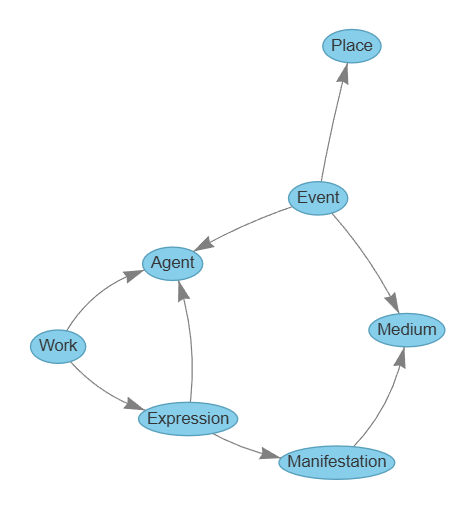
Figure 2 Ontology schema graph showing principal classes and their relationships
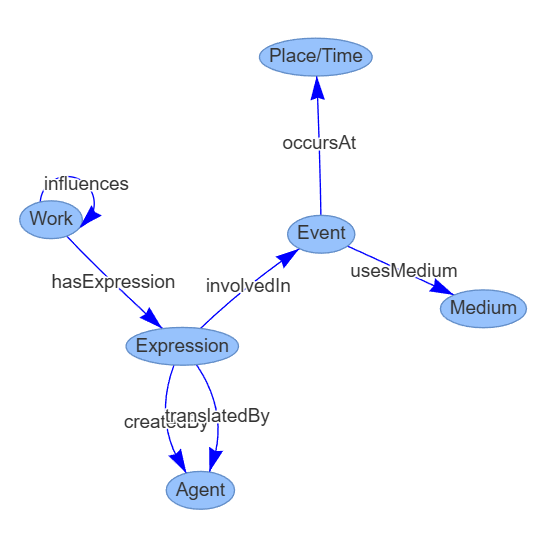
Figure 3 Conceptual graph of the ontology schema, showing core class relationships used to model the transmission of the story-based texts.
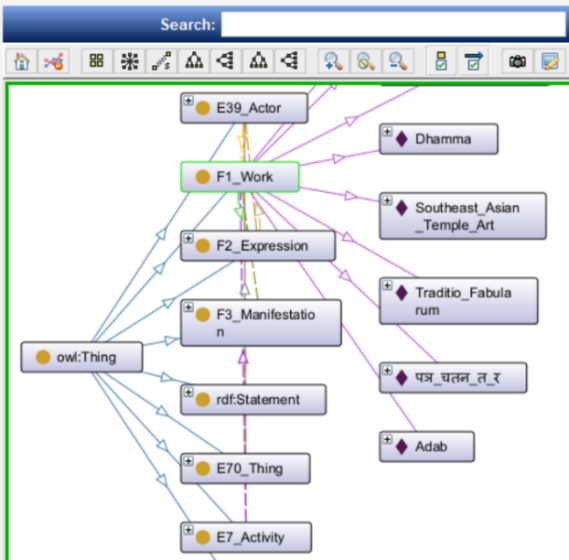
Figure 4 Snapshot of the ontology viewed in Protege
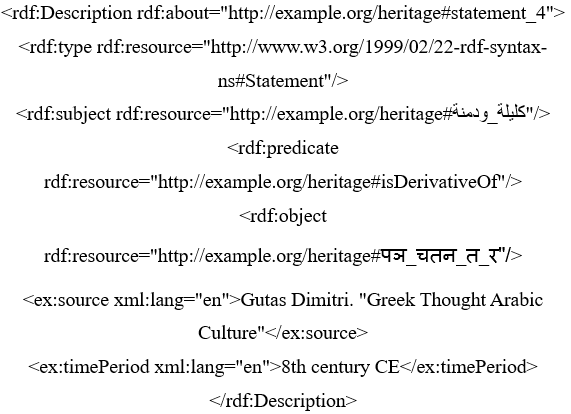
Figure 5 The heritage ontology RDF/OWL file showing a snapshot of the subject, predicate, and object.
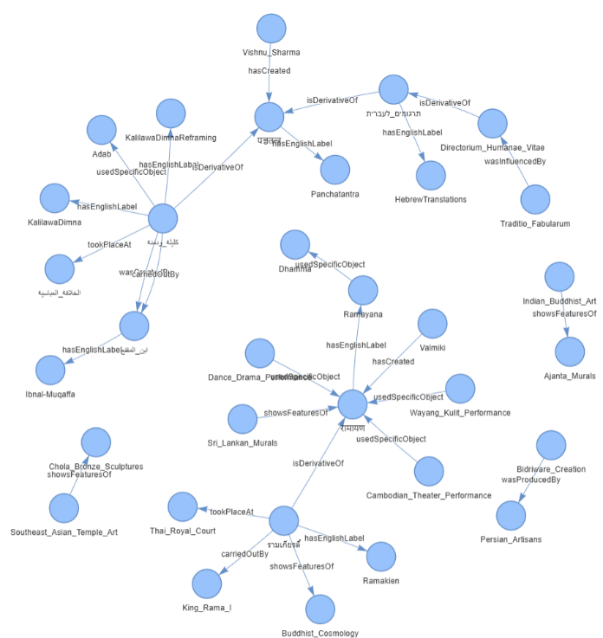
Figure 6 Network showing semantic relationships among textual works, expressions, agents, and cultural transmission events within the heritage ontology.
Adaptation and cultural transmission
Adaptations and translations are encoded as structured triples, enabling detailed tracking of semantic and cultural transformations. The Panchatantra’s Kannada-language adaptation by Durgasimha is represented as an E7 Activity resulting in a new expression with a Jain ethical framework, while translations into Arabic (Kalila wa Dimna) and influences on Latin and Persian texts are similarly captured. Figure 7 presents sample SPARQL query results, highlighting the ontology’s capacity for retrieving structured relationships. These results illustrate how ethical concepts such as niti and dharma are transmitted, transformed, and localized across time, space, and linguistic contexts.
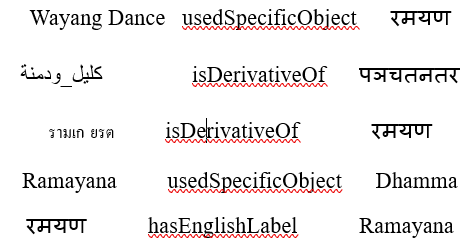
Figure 7 Sample SPARQL query results extracted from the heritage ontology, showing structured triples.
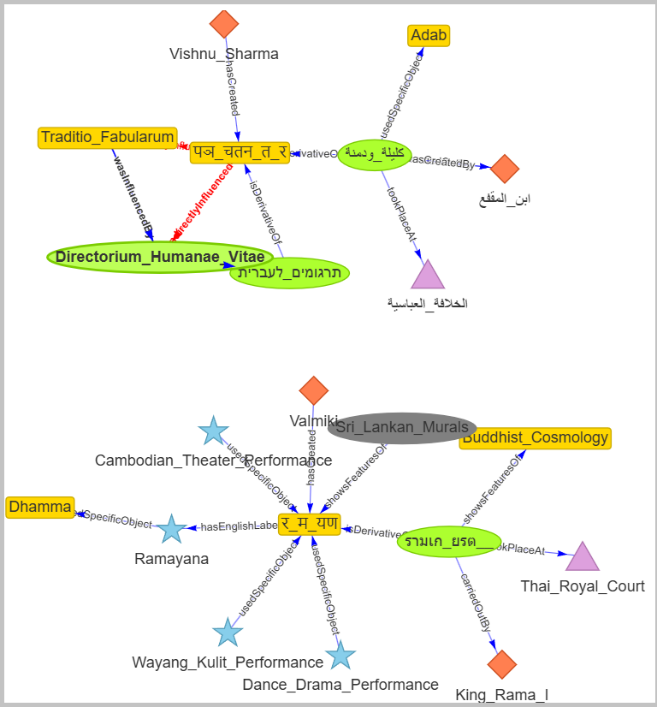
Figure 8 Semantic network visualization illustrating some of the core ontology entities (e.g., Works, Expressions, Agents, Events, Places, Manifestations, and Mediums) and their relationships within the heritage transmission framework. New knowledge obtained from the inferred relationships (via transitive closure) are shown in red edges and red labels.
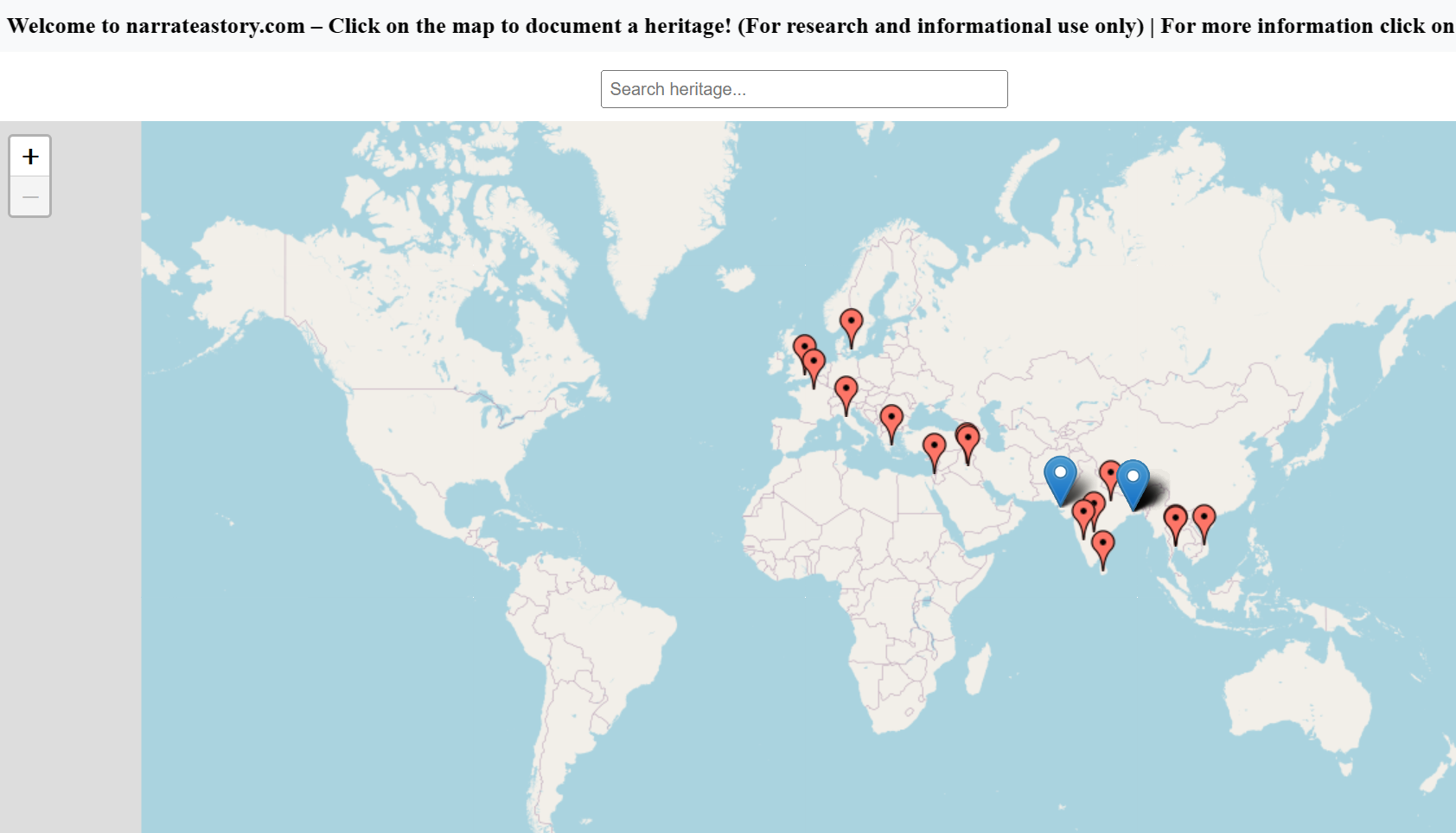
Figure 9 The application (www.narrateastory.com) (Deb, 2024) visualizing the transmission of Indian story-based texts, showing subject-relation-object ontology triples across time and place based on latitude and longitude.
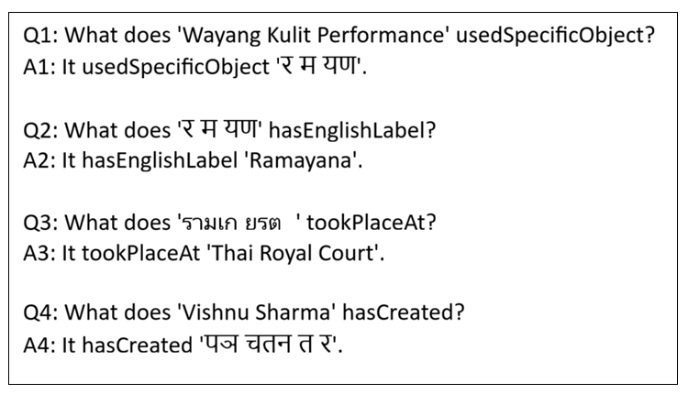
Figure 10 Sample Question-Answer pairs obtained from the ontology using a SPARQL query, which can be used to train language models.
Linguistic challenges and semantic encoding
The ontology addresses some of the challenges in encoding Sanskrit texts such as sandhi, flexible word order, and polysemy. Sandhi-normalized forms are mapped to distinct RDF/OWL entities, and semantic roles are encoded explicitly in triples to decouple meaning from word order. Polysemous terms, such as “Dasaratha,” are represented with separate contextual instances, allowing precise identification of actors, types, and textual mentions. These mechanisms ensure the accurate semantic representation of Sanskrit texts, supporting automated reasoning and cross-linguistic comparisons.
Visualization and inference
Semantic network visualizations (Figure 8) reveal both explicit and inferred relationships among works, expressions, agents, events, places, and media. Inferred knowledge, highlighted in red, indicating the reasoning ability of the ontology. A web application (Figure 9) visualizes story transmission geographically and temporally based on latitude and longitude, while Figure 10 illustrates the generation of ontology-based question-answer pairs suitable for visualization, reasoning, AI model training, and pedagogical applications.
Discussions
The results of this study demonstrate the potential of a semantic heritage ontology to systematically model the transmission, adaptation, and transformation of classical Indian story-based texts, particularly the Panchatantra and the Ramayana, across time, geography, and cultural contexts. The manually curated RDF/OWL triples, mapped to CIDOC CRM and FRBRoo classes (Figures 4-5), provide a structured representation of complex textual adaptations, translations, and transmission events. This structured representation enables insight into how meanings, ethical frameworks, and narrative forms evolved across languages and societies. Importantly, the ontology captures historical pathways of transmission, showing how texts travelled across regions, were adapted into local languages, and reflected diverse cultural and religious frameworks.
The study also contributes to postcolonial digital heritage ethics. Classical Eastern texts have historically been interpreted through colonial or Western-centric perspectives, which risk marginalizing indigenous epistemologies. By “repositioning” these texts in an ontological framework, this work highlights Indian knowledge systems, preserving linguistic, ethical, and narrative complexity. This approach advances epistemic equity, ensuring that AI systems, digital archives, and educational platforms recognize culturally situated knowledge rather than perpetuating biased interpretations.
The ontology captures multiple layers of textual and cultural information, including expressions (F2 Expression), adaptation activities (E7 Activity), actors (E39 Actor), and transmission events (E5 Event). For instance, the Durgasimha adaptation of the Panchatantra, represented as a new Kannada-language expression reflecting a Jain ethical framework, illustrates how regional, religious, and stylistic variations can be formally encoded in RDF/OWL (Figures 4-6). By linking actors, texts, and events systematically, the ontology highlights both continuity and transformation in narrative traditions, revealing patterns not easily traceable through conventional textual study. Additionally, it accounts for linguistic complexities of Sanskrit, such as sandhi and free word order, ensuring meanings encoded in textual inflections are correctly represented. Polysemous terms, like “Dasaratha,” are represented with separate contextual instances to capture actor roles, general types, and textual mentions.
From an AI perspective, the ontology generates semantically rich, culturally inclusive datasets. Question-answer pairs derived from the triples (Figure 10) can fine-tune large language models (LLMs), promoting epistemic equity in AI systems. Embedding ancient textual knowledge into machine-readable ontologies reduces cultural bias, enhances interpretive accuracy, and broadens representation of non-Western epistemologies, including the nuanced semantics of Sanskrit texts.
For diplomacy and soft power, the ontology offers a strategic tool for governments and cultural institutions to document, preserve, and promote heritage narratives on global platforms. Policymakers can trace historical influences, leverage heritage knowledge in cultural exchanges, and engage with initiatives such as UNESCO’s heritage classification systems (Figures 3, 6, 8, 9). Similarly, in education, interactive and visualizable resources (Figures 8, 9) allow students to explore how ethical values, narrative structures, and literary styles adapted across cultures. This integration promotes inclusive curricula highlighting global connections and the historical significance of ancient texts.
This work also includes postcolonial digital heritage ethics by highlighting ancient Eastern epistemologies that have historically been marginalized or interpreted through Western-centric lenses. By repositioning classical texts like the Panchatantra and Ramayana within a semantically structured framework, the ontology preserves linguistic, ethical, and narrative complexities, ensuring that computational, AI, and educational applications reflect the original cultural knowledge as closely as possible rather than perpetuating interpretive bias.
Limitations
Limited dataset size: The current ontology includes a manually curated subset of adaptations and translations.
Manual curation: While ensuring accuracy, manual triple creation constrains scalability and automation.
Lack of multilingual SPARQL query integration: Complex cross-lingual queries remain a future enhancement.
Preliminary visualizations: Figures 2 and 8 serve as proof-of-concept demonstrations; interactive or large-scale visualization requires further development.
Despite these limitations, this work establishes a methodologically grounded foundation for representing ancient textual knowledge computationally. By combining postcolonial ethical framing with ontology modelling, it highlights the interplay between traditional scholarship, digital heritage, and AI-enabled analysis.
Conclusions
This study advances the exploration of Cultural Understanding within Cultural Diplomacy through Storytelling by developing an ontology-based semantic framework that models the transmission of ancient story-based texts such as the Panchatantra and the Ramayana. The ontology digitally documents and reveals patterns of cultural negotiation, translation, and adaptation across historical, linguistic, and geographic contexts, demonstrating how ancient textual epistemologies were reframed and localized globally while preserving conceptual integrity.
By bridging traditional scholarships and computational methods, the framework produces culturally inclusive AI datasets, supports heritage-informed diplomatic strategies, and enables interactive educational platforms. Linguistic and ethical complexities of Sanskrit texts are represented digitally, showing that ancient epistemic structures can be computationally modeled and digitally preserved.
Importantly, the study highlights postcolonial digital heritage ethics. By repositioning classical Indian texts within global digital infrastructures, it challenges historically Western-centric interpretations, emphasizes indigenous epistemologies, and ensures that narrative heritage serves as a dynamic instrument of cultural understanding. Ontological modeling transforms static textual archives into ethically grounded, actionable digital resources, connecting traditional knowledge systems with contemporary technological, educational, and diplomatic paradigms.
Declaration of generative AI in scientific writing
During the preparation of this manuscript, the authors used Google Search to assist with language improvement and readability. The authors have reviewed the output and take full responsibility for the content of this publication.
CRediT author statement
Briti Deb: Conceptualization, Methodology, Software, Writing – Original Draft, Visualization, Investigation, Writing – Review & Editing. Tirumal: Investigation, Writing – Review & Editing.
References
Blackburn, S. H. (1981). Epic transmission and adaptation. Michigan Papers on South and Southeast Asia, 105. Ann Arbor, MI: University of Michigan.
Cohen, S., & Shehada, H. A. (2017). From the Panchatantra to La Fontaine: Migration of didactic animal illustrations from India to the West. Artibus Asiae, 77(1), 5-68.
Deb, B. (2022). The role of philately in art storytelling: The case of Ramayana. In Proceedings of the 10th International Digital Storytelling Conference, Loughborough, UK: University of Loughborough
Deb, B. (2024). Collaborative heritage mapping through publicly sourced triplets. Primitive Tider, 26, 95-103.
Debroy, B. (2017). The Valmiki Ramayana (Vol. 3). New Delhi, India: Penguin Random House India.
Doerr, M. (2003). The CIDOC conceptual reference module: An ontological approach to semantic interoperability of metadata. AI Magazine, 24(3), 75.
Doerr, M., Bekiari, C., LeBoeuf, P., & Bibliothèque nationale de France. (2008). FRBRoo, a conceptual model for performing arts. In Proceedings of the 2008 Annual Conference of CIDOC. Athens, Greece: ICOM Greece.
Foltz, R. (2014). Animals in Islamic tradition and Muslim cultures. New York, USA: Simon & Schuster.
Gattupalli, S., Gattupalli, S., & Talluri, G. (2023). Enhancing Indic children’s tales with DALL·E 3 AI imagery: Panchatantra: The story of the crows and the owls. Amherst, USA: University of Massachusetts Amherst.
Ghosh, L., & Jayadat, K. (2017). Thai language and literature: Glimpses of Indian influence (pp. 135-160). In Ghosh, L. (Ed.). India–Thailand cultural interactions: Glimpses from the past to present. Singapore: Springer.
Guarino, N., Oberle, D., & Staab, S. (2009). What is an ontology? (pp. 1-17). In Staab, S., & Studer, R. (Eds.). Handbook on ontologies. Berlin, Germany: Springer Berlin Heidelberg.
Gutas, D. (2012). Greek thought, Arabic culture: The Graeco-Arabic translation movement in Baghdad and early ʿAbbasaid society (2nd–4th/5th–10th c.). London, UK: Routledge.
Hämeen-Anttila, J. (2021). Translations of historical works from Middle Persian into Arabic. Quaderni di Studi Arabi, 16(1-2), 42-60.
Kerdarunsuksri, K. (2003). Ramakian in modern performance: A way to cope with a cultural crisis. Manusya: Journal of Humanities, 6(3), 24-46.
Khongmun, P. K. (2023). The king as a dharmaraja: Buddhist perspectives on righteous rule and patronage. BUDDHO, 2(2), 35-44.
Kinoshita, S. (2008). Translatio/n, empire, and the worlding of medieval literature: The travels of Kalila wa Dimna. Postcolonial Studies, 11(4), 371-385.
London, J. (2008). How to do things with fables: Ibn al-Muqaffaʿ’s frank speech in stories from Kalila wa Dimna. History of Political Thought, 29(2), 1-28.
Long, J. B. (2005). Jataka tales and Ajanta murals: Sacred beauty in Buddhist words and images. Hsi Lai Journal of Humanistic Buddhism, 6, 119-145.
Maheshwari, A., Ajmera, R., & Dharamdasani, D. K. (2023). A comprehensive guide to natural language processing in Sanskrit with named entity recognition (pp. 1-9). In Proceedings of the 5th International Conference on Information Management & Machine Intelligence. Jaipur, India: Poornima Institute of Engineering & Technology.
Mathur, S. (2024). Governance and leadership in the Ramayana: Insights from ancient India (p. 17-24). In Mathur, S., & Saxena, R. (Eds.). Women and leadership in ancient epics. Kota, India: Career Point Ltd.
Mehri, F. (2020). Parrot’s role in Indian storytelling and mystical theme creation in Persianate texts. Classical Persian Literature, 11(1), 255-281.
Narasimhacharya, R. (1988). History of Kannada literature. New Delhi, India: Asian Educational Services.
Ogleby, C. L. (1999). From rubble to virtual reality: Photogrammetry and the virtual world of ancient Ayutthaya, Thailand. The Photogrammetric Record, 16(94), 651-670.
Olivelle, P. (Ed.). (1999). Pañcatantra: The book of India’s folk wisdom. Oxford, UK: Oxford University Press.
Pollock, S. (2006). The language of the gods in the world of men: Sanskrit, culture, and power in premodern India. Berkeley, USA: University of California Press.
Puntoni, V. (1884). Directorium humanae vitae: Alias, parabolae antiquorum sapientum. Retrieved from https://archive.org/details/directoriumhuma00unkngoog/page/n17/mode/2up
Refael-Vivante, R. (2013). The influence of Kalila and Dimna on medieval Hebrew fable literature. ALIENTO – Échanges sapientiels en Méditerranée, 3, 45-79.
Rosenthal, F. (1992). The classical heritage in Islam. London, UK: Psychology Press.
Ryder, A. W. (1949). Panchatantra (Vol. 9773). Mumbai, India: Jaico Publishing House.
Saptati, S. (2009). Seventy tales of the parrot. (A. N. D. Haksar, Trans.). New Delhi, India: Rupa & Company.
Sarkar, P. K. (2025). Timeless wisdom of the Panchatantra: Lessons in morality and governance. International Journal of English Language, Education and Literature Studies, 4(4), 567-620.
Shahbaz, P. (2019). Persian Monshi, Persian Jones: English translations of Saʿdi’s Golestan from the late eighteenth to the mid-nineteenth centuries. Iranian Studies, 52(5-6), 739-760.
Shanmugapriya, K., & Christopher, G. (2023). Eco-philosophy of Indian classical fables. Ecocycles, 9(1), 100-106.
Theodoridou, M., Bruseker, G., Daskalaki, M., & Doerr, M. (2016). Methodological tips for mappings to CIDOC CRM (pp. 89-102). In Proceedings of the 44th Conference on Computer Applications and Quantitative Methods in Archaeology. Oslo, Norway: University of Oslo.
Varadarajan, U., Bagchi, M., Tiwari, A., & Satija, M. P. (2023). GOMME: A generic ontology modelling methodology for epics. Journal of Information Science Theory and Practice, 11(1), 61-78.
Zafiropoulos, C. A. (2017). Ethics in Aesop’s fables: The Augustana collection (Vol. 216). Leiden, The Netherlands: Brill.