Asian
J.
Arts
Cult.
2026;
26(3): 98
A Critical Analysis of Artistic Language and Humanistic Culture in the Thai Free Verse ‘No Women in Poems’
Sirisira Chokthawikit
Faculty of Humanities, Ramkhamhaeng University, Bangkok 10240, Thailand
(Corresponding author’s e-mail: [email protected])
Received: 21 May 2025, Revised: 8 October 2025, Accepted: 15 December 2025, Published: 19 December 2025
Abstract
The current study aims to discuss the poetic-ness of the free verse manner in the poetry ‘No Women in Poems’ through an innovative concept of artistic-linguistic discursiveness. The theoretical approach to studying the poetic-ness of free verse is employed by the idea of Fairclough’s three CDA dimensions of examining hidden worldviews in texts. The findings are divided into, first, ‘No Women in Poems’ composed of the free verse form as a whole reflecting several free flows of thought and pointing out the quality of poetic-ness. Marvelously, the book of entire free verse enclosed plenty of artistic applications. Not only is creative in the free verse story but it is also communicative in terms of life, philosophy and truth. Second, ‘No Women in Poems’ holds the form of free verse which is associated with a life way in each area experienced by the poet. The last outreach of poetic-ness of the poetry ‘No Women in Poems’ supported by the components of correlation, comprehension, and context deserves universal attention to both local and global readers. It adequately makes humanistic culture reasonably diverse, particularly in Thai society or the homeland. The discussion of the integrated approach assists in explaining humans, minds, practices, and language use through poetic writing. The application can be a vision of ‘close reading’ skills.
Keywords: Critical analysis, Free verse, Poetic-ness, CDA, Artistic language, Humanistic culture, Thai
Introduction
Poetry is a creative medium that expresses civic social meaning. It has been composed in diverse, structured patterns and passed down through generations. When a society gladly receives a legacy, it preserves it. However, influences from world literature have entered Thailand, leading to borrowing, adaptation, mixing, and new applications. One form that is important and has an influence on the Thai poetry industry is free verse. Sajjapun (2005) accepts both Thai and International impacts on contemporary literature while Nagavajara (1994) comprehends the Western references may equip Thai literature with cultural contexts and comparative consequences.
In 2010, the poetry penned ‘No Women in Poems’ by Zakariya Amataya (Amataya, 2015) won the Thai ‘S.E.A. Write’ Award of the poetry genre which is judged in Thailand’s supreme literature contest. The highlight of the poetry book is that it is written entirely in free verse which is contrary to traditional poetry that has received the same award. Even after that poetry, it is still conventional, modified or mixed in many ways. It is not the total form of free verse like this book.
As mentioned above, it is appropriate to investigate the qualitative manner of the free verse book ‘No Women in Poems’ among acceptance and acquaintance of traditional poetry. How to manage the story through poetic texts embedded in societal separation between spirit and space is a great assertion of discovering the world of worlds and views. Reasonably, it is necessary to bring in the notion of critical discourse analysis (CDA) because of the power, desire, change, hope and determination that is intended to be achieved through the use of language in poetry.
The development is novel and interesting which embroils readers and learners in continuing and configuring the discursive poetic findings from the book ‘No Women in Poems’.
Objectives
1. to analyze the free verse of ‘No Women in Poems’ in terms of the concepts of poetic-ness and critical discursive dissemination of qualified contents.
2. to identify and describe recurring poetic discourses in ‘No Women in Poems’, focusing on themes of life, thought, and culture, and to explain how these discourses reflect humanistic and cultural values.
Literature review
1. Previous related studies
Chokthawikit (2018) analyzed the language used in the same poetry with the translated name ‘No Women in Poetry’ (aka ‘No Women in Poems’ in the current article) depended on a literary linguistic perspective, and found that the poet communicated several figurative languages and had the art of playing line patterns, the showcase of word puns and his poetic styles in a dazzlingly dramatic way. Absolutely, the poetry also contains profound life and philosophical contents.
In the previous study, Chokthawikit (2018) followed the theoretical approach of Tung (1994), who uttered his apparatus, ‘the four linguistic spaces of poetry’ containing 1) sounds, 2) shapes, 3) senses, and 4) situations. Those are the 4s model for reading poetic texts. Every poetry has an alphabetic system representing sounds in any language or the real sound pronouncing poetic expressions. The body arrangement of writing produces various shapes. The poem tells a story that has a sense of action. Finally, no matter how poetry plays a role in social performance of a situation that is happening. This notion that I had ever brought up in my paper published – Chokthawikit’s (2018) ‘A Literary Linguistic Perspective on Free Verse: A Case Study of ‘No Women in Poetry’, which studied the same source but I, in this day and age, develop it in the other perspective on CDA which is next about to elaborate.
Later on Chokthawikit and Jansem (2021, p. 92) synopsize the poetry ‘No Women in Poetry’ as the only part of democratic discourse, that is, ‘[t]he discourse of diversity in life has been prominent in reviewing the thinking process of whether to survive’. It establishes a diverse democracy which people must rethink. It opens the academic gap in focus on humanistic culture with reference to life, philosophy, nature and gratitude to the homeland.
Not only the most related articles are reviewed above, but the following works also are read. Kulchytska and Malyshivska (2022) disclose the comparison in how American and Ukrainian participants perceived contemporary free verse which was attested by the perspectives of ‘[i]ntertextual, infratextual and intratextual context dimensions’. The first intertextual context was reminded of reflecting social reality and metaphoric content by the majority in both groups of participants but the differences in views on the infratextual context reflected the variability of functions performed by the initial/intermediate/closing parts of the poems. In the last intratextual context, the similarities in views on the imagery, constructed worlds in poems, emotional responses, interpretations, and encountered difficulties were applicably salient. Fascinatingly, the intratextual context suggests that ‘[s]ome poems may drive readers’ interpretations to reduce the role of culture in their reception’.
The benefit of Kulchytska, & Malyshivska’s article on trial strengthens my present analysis in restoring the previous basics and illustrating the upcoming verdicts about the artistic language but the only tool of intertextual context. Still, the differences between the article and my study are classifications of intertextuality and context of status. I control intertextuality as an artistic technique and impel context to be a concept of poetic-ness in the next topic. In spite of that, the issue from Kulchytska, & Malyshivska’s article is the ‘intratextual context’ (without my research) to decrease the role of culture against participants’ reception. I postulate that cultural power may affect people who are playing roles of readers, learners and areal citizens. Unless academicians are conversant with culture, it is tough to embrace society, negotiation and policy. The involvement in people, power and poetry is the macro-community in concordance with the social practice dimension by Fairclough’s CDA in the next part. Notwithstanding, the scrutinizing construal to be reanalyzed is the viewpoint of humanistic culture that is deviant from the previous works which are studied in the traditional speculations. For this reason, it should be reconstructed the academia of Thai poetry, language use, intention and effect on idea, value and life. These are in the concept of humanistic culture which is disclosed hereinafter.
2. Poetic-ness
Jakobson (1987) said ‘poeticity’ is the poetic function sui generis or the specific role expressing the quality of poetry. Poeticity can be pieced into elements. Although it is sometimes partial, it can transform and determine all the debris of the whole. The way of superintending poeticity establishes qualitative poetry is to be found in a spectrum of significance, substance and society by theoretical supports.
However, the author prefers a coinage of ‘poetic-ness’ to ‘poeticity’ because it is productively enlarged to face and feature texts in the author’s article. I shall share the word and sequence of ‘poetic-ness’ when the quality and state of free verse will be identified.
The characteristics of poetic-ness herewith are composed of three components of 1) correlation, 2) comprehension and 3) context. First of all, the correlation is about forms and symbols to represent sounds, voices, tones, intonations, alphabets including pictures, diagrams, signs and everything that constructs visual, aural and sensual abstractness into concreteness. Secondly, the comprehension construes story and meaning. This is factual and non-fictitious which is derived from fiction like poetry. At last, the context is dependent on all factors to decide possibilities, more explicitly, each situation rises to the occasion beyond literal meaning. It is germane to forecast the ongoing discourses through language, culture, philosophy and life.
The created approach to critiquing and forecasting the poetic-ness and discursiveness is synthesized by the author’s learning experience and knowledge. As having merged by the poetic-ness’ three components of correlation, comprehension and context in addition to the artistic language theme (to be proactively described) and the CDA’s three dimensions (to be presented next) is majestically novel notion of ‘artistic-linguistic discursiveness’. This can be applied to examine the overall of poetic textual analyses.
3. Free verse
The kind of free verse poetry arranged to ‘[t]he cadences of speech and image patterns rather than according to a regular metrical scheme. It is “free” only in a relative sense… its rhythms are based on patterned elements such as sounds, words, phrases, sentences, and paragraphs, rather than on the traditional prosodic units of metrical feet per line’. A free verse style is a faraway model of ‘[m]uch of the artificiality and some of the aesthetic distance of poetic expression’. The characteristic of free verse starts to replace ‘[a] flexible formal organization suited to the modern idiom and more casual tonality of the language’. (The Editors of Encyclopaedia Britannica, & Lotha, 2019)
Baumann et al. (2018) emphasize the collaboration between modern and post-modern free verse poetry ranges distinct and manifold poetic prosodic continuums from a more fluent to a more disfluent and choppy style beyond conquering rhythmic and metric regulations of writing. It is ‘[c]reating a free verse spectrum that calls for new analyses of prosodic forms’ including ‘[p]arlando to lettristic decomposition by their gradual differentiation’. That exemplificative emphasis on the style of free verse pieces in the latest era covered the poetic genre at the early stage of action as though speaking, singing, reading until the last-staged decay of letters were used in composition. It assures that Cooper (1998, p. 67) copes with and cuts chunks into lines as a mandate for a discourse to be recognized as a poem; otherwise, other kinds of writing and/or printing came between lines, namely ‘[g]rocery lists, price sheets, computer programs, and so on. This does not mean that they are all free verse’. The poetic process and pleasure are essentially and emotionally exposing poems.
The research data, nevertheless, keeps considering the poems but accepts the spectrum of free verse writing style, management of the divided-poetic structure, essence, and value that can be the concordant quality of poetry in the next artistic language unit reproducing previous poetic-ness enhanced. The factors of mental-humanistic culture and nature of each community then supplement the elegance of free verse characteristic with contemporary norms. For this reason, the Thai culture and nature of poetry with respect to global innovation and ideas characterize the status of free verse which is adapted in the domain of Thai literature.
4. Artistic language
The Thai language is significant in Thailand and is popularized among ASEAN (Chokthawikit, 2020). Nonetheless, the Thai language in contemporary poetry has splendid artificial aesthetics. The artistic language for analyzing textual philosophy, authority, life and emancipation should be associative with discursiveness. The pertinent idea of Verschueren (1999) raises the technique of linguistic context including cohesion, intertextuality, sequencing, and necessary tools embodying artistic language as same as figurative language. The linguistic context considers poetic texts coherently.
The figurative language tools are effectively learned, interpreted, and summarized in poetic texts, each figure is fine-grained which is difficult to utilize in each poem although Ruiz de Mendoza Ibáñez and Masegosa (2014) categorize the rearrangement of figurative language, those are not applied to integrate academic-critical battles with socio-politic and philosophical life filming in poetry. The author synthesizes and creates a possibly innovative spectacle of studying literary works and poetic-ness. The approach consists of three components like corporations administrating firmly and smoothly.
That is to say, 1) the concept of correlation is the first fundamental communication with the pace of reading any texts concentrated on internal linguistic elements and factors concerning sound, alphabet, graphic-pictorial writing, pronunciation, singing to audiences compared to the concert with light, melody and color. The cause of fonts and language into wonderful settlements and reflexive ideas comes from the use of figurative languages and tropes. The author therefore defines the profile of figurative language as a part of this element ‘artistic language’ which can answer the question: Why are the principles changed from the earlier presented research for the recent work?, 2) the concept of comprehension is about shared and forthcoming knowledge, sensitivity of ordering and understanding story, and 3) the concept of context is under circumstances and conditions around the text for the sake of real event, deep construal and hidden agenda which are in a curious combination of CDA.
In my former study (Chokthawikit, 2018), the term represents the beauty and language style for estimating poetry was determined as ‘Literary Linguistics’ but now it is explanatory to adjust the term into ‘artistic language’ and sometimes ‘artistic-linguistic’ which is keeping to collide with other words. Inasmuch as ‘Literary Linguistics’ is the top-up umbrella word covering all subtypes and ‘artistic language’ is signified as devices to read a poetic text better, I change the term into the up-to-date conceptual term.
5. Humanistic culture
Humanistic Culture is a concept in this work that aims to step over the spiritual pain and oppression of human beings. The act of language that hopes for bad results or to offer a solution, but rarely finds beauty and goodness. Therefore, it is necessary to learn deeply about the way of thinking among humans that grows into other setups of culture. The nature of this appearance is a unit of integration of language use, aesthetics, intention, philosophy and humanity.
Relevantly, American Humanist Association (2024) pushes through learners to humanism as compared to humanistic culture the organization says ‘a progressive philosophy of life that, without theism or other supernatural beliefs, affirms our ability and responsibility to lead ethical lives of personal fulfillment that aspire to the greater good.’
Moreover, ‘the Humanities, the great books, classical literature, music, art, history are dimensions of the cultural heritage of humanity. (Bobadilla, 2024)’ which is contextually interpreted as the possibility of human dignity, cultivation and civilization can be demonstrated and decentralized through all existences and appearances. Likewise, poetry is a characteristic of the sources for knowledge kneadability’s extension and exploration in cultures of (de)humanization.
6. Critical Discourse Analysis - CDA
The big theory of critical discourse analysis or CDA is the rapprochement of language, meaning impact, indirect belief and massive opening process. Widdowson (2000) asserts that CDA reveals the exhibition of implicit ideologies, prejudices and power manipulations in texts. To illuminate the textual exercises of harmony, hegemony, dispute and discursiveness scrutinizes the methods of language style or artistic-linguistic devices at the start. The language use plays a glittering role in what and how to narrate poetry based on humanistic culture. If we keep an eye on community and culture, we do not miss thoughts of discursiveness made by social members in situations and texts.
Moreover, the components of poetic appreciation and criticism should parallel the phenomena of social stakeholders. The road to destiny between linguistic examination and minds’ impact on entities wrapped up in our life and experience requires the explanation of cultural effects by the outlook of critical discourse analysis. Fairclough’s (1989; 2010) CDA involves considering the forms of texts, including poetry, combining related practices, and leaping to sociocultural factors to deliberate the real world.
According to the synopsized picture below, the three dimensions are like a view to see around and figure out a text for reaching disguised meanings as a discourse. The charming hidden agenda through poetry can develop readers’ and learners’ skills to generate idea collection and completion of society.
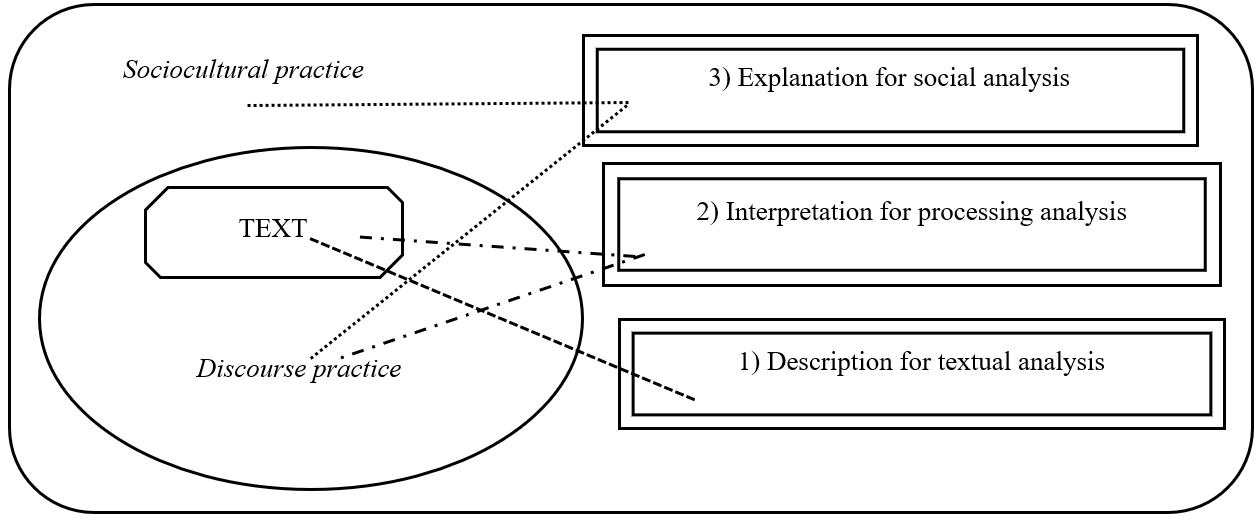
Figure 1 Fairclough’s three dimensions (adapted and drawn by the author)
Source: Fairclough (1989; 2010)
7. Application to poetic texts
All of the theoretical nodes and principles in the preceding three sections are beneficial to evaluate the artistic-linguistic discursiveness and poetic-ness. I overtly integrate the creative codes with the source texts and promulgate hereby a preliminary result.
An example excerpt of investigating poetry from the perspectives between poetic-ness and critical discourse analysis appears in the text quoted from the source that is designated as the scope of the research as follows:
Exemplar: The poem ‘ไม่เห็นดวงตะวัน-Can’t See the Sun’ (Amataya, 2015, p. 29)
ความขี้ขลาดจองจำข้าพเจ้าไว้ใต้ผ้าห่มผืนเก่า
Cowardice imprisons me under an old blanket
ความเศร้าแอบซุกในปลอกหมอนเปื้อนน้ำลาย
Grief disguises in a saliva-stained pillowcase
ขณะที่ดวงดาววิ่งเล่นซุกซนในราตรีกาล
As a constellation of stars plays mischievously at night
ดวงจันทร์ซีดเซียวกำลังจ้องมอง
The bleached moon is gazing
The artistic language found is a personification that makes objects and abstract things equivalent to human behavioral showcases. The process of personifying all non-humans serves as people-like agents, it is performed by verbs, predicative units or nominalization of/allied to humans. The humanistic verbs in the poem are ‘จองจำ-imprisons’, ‘แอบซุก-disguises’, ‘วิ่งเล่นซุกซน-plays mischievously’ and ‘จ้องมอง-is gazing’ and the modification of ‘ซีดเซียว-bleached’ placed before the naturally nocturnal object ‘ดวงจันทร์-moon’ which is acting like an ill man who has a pale face. Increasingly, the nominalization displays related things to humans in daily life by nouns ‘ผ้าห่ม-blanket’ and ‘ปลอกหมอน-pillowcase’ that may imply the sleeping habit. The first-round implicative interpretation leads readers and learners to believe that the perception of livelihood with nature’s influences reminisced about the untrodden and lambent life lessons. An anatomy of this aesthetic artistic writing is partial to the No.1 correlation concept.
The second-round interpretation is to begin with the No.2 comprehension concept to suddenly follow the No.1 step of the first round of reading. This second one of poetic-ness could shed light on the CDA’s discourse practice dimension for getting an insight into the bravery ideology. The character ‘ดวงจันทร์ซีดเซียว-The bleached moon’ functions as the inspector in the dark and dull night. The moon is staring at a person who collects faint-heartedness and sadness in bed. The person is not capable of getting up to fight against fearfulness. Hopefully, the person is someone delegating readers and learners to restart and rehabilitate the individualistic moral, victorious life and humanistic culture. If specifying only the moon, it symbolizes the pilot contributing to the person on a miserable road to the goal.
Beyond the dictionary-based translation, the context concept is the No. 3 stage to forecast societal concealment to recruit criteria, customs and norms for the courage discourse into war-like situations. The philosophy of mankind deprives a personification under the perished blanket beside the dirty pillowcase in bed of self-development to harmonious separation in the homeland. To confirm the brave discursiveness full of artistic languages is exact to the dimension of social practice helps explain the verdict as to why it should be like that.
The critical discourse of uncovered meaning in the poetic exemplar evaluates bravery under the blanket jail and evolves considerably not in a rut of bad wisdom.
Let’s consider as follows: The poetic text ‘ไม่เห็นดวงตะวัน – Can’t See the Sun’, this emotionally dense Thai free verse poem uses a minimalist yet evocative style to explore themes of isolation, mental suffering, and inner fear, juxtaposed against the neutral constancy of nature.
Table 1 Artistic-linguistic techniques with line/imagery and effect/function for ‘ไม่เห็นดวงตะวัน – Can’t See the Sun’.
Line / Imagery |
Artistic Technique |
Linguistic Technique |
Effect / Function |
“ความขี้ขลาดจองจำข้าพเจ้าไว้ใต้ผ้าห่มผืนเก่า” “Cowardice imprisons me under an old blanket” |
Symbolism (blanket = comfort/prison) Personification (cowardice as captor) |
Passive voice; emotional verb “จองจำ” (imprison) |
Conveys emotional paralysis and self-entrapment |
“ความเศร้าแอบซุกในปลอกหมอนเปื้อนน้ำลาย” “Grief disguises in a saliva-stained pillowcase” |
Metaphor (grief hidden in mundane object) Sensory imagery (saliva-stained pillow) |
Alliteration (“แอบซุก”) Colloquial, physical detail |
Makes grief tangible, intimate, and physically close |
“ดวงดาววิ่งเล่นซุกซนในราตรีกาล” “Stars play mischievously at night” |
Contrast (internal stillness vs. cosmic activity) Personification (stars playing) |
Rhythmic flow mimics playfulness |
Emphasizes disconnect between inner suffering and external beauty |
“ดวงจันทร์ซีดเซียวกำลังจ้องมอง” “The bleached moon is gazing” |
Color imagery (ซีดเซียว = pale) Anthropomorphism (moon observing) |
Tense shift to present continuous |
Reflects surveillance or quiet judgment, highlighting loneliness |
CDA dissemination flowchart in Thai free verse poetry
(Critical Discourse Analysis dissemination from the poem)
[Personal Experience of Suffering]
↓
[Use of Domestic Symbolism]
(e.g., blanket, pillowcase)
↓
[Emotional States Personified]
(cowardice, grief, detachment)
↓
[Juxtaposition with Nature]
(stars, moon – objective external world)
↓
[Reader Reflection]
– Awareness of hidden mental health issues
– Critique of societal silence about emotional pain
This flow shows how the poem subtly critiques the invisible weight of emotional affliction through domestic imagery, leading readers to question the cultural silence around mental vulnerability.
Life lesson for humanistic cultural comprehension
Emotional pain is often buried in plain sight — in familiar places like our bedrooms, under blankets, within our daily silence. True empathy means noticing these hidden wounds before they become lifelong scars.
The poetic source is a text for a prototypical approach to analyzing integrated notions. Therefore, all poetic discursive dimensions of the findings are demonstrated.
Methods
1. The free verse style of the poetic book ‘No Women in Poems’ was read, which was created by the poet Zakariya Amataya and won the prize of national and intra-Southeast Asian- regional ‘S.E.A. Write’ Award of the Thai poetry type in 2010. This free verse awarded book has played the splendid role in the field of Thai Poetry and Literature that has been attractively criticized in terms of weird writing, beneficial values, and societal issues.
2. The technique of random purposive sampling is exerted to specify poems in the book. With respect to the method of convenience, it can bring some relevant data necessitating minds, matters, moments and meanings unfolding discourse and humanistic culture with critical analysis.
3. The selection of some proper poems is cogitable by CDA approach to comprehend the linguistic patterns in the text and critically explain the contexts of discourses behind the scenes. The notion of CDA and the claim of poetic-ness help increase findings much more than the old one which was not based on the latest theories and thoughts in the current article.
4. The review of investigation is diagnosed by artistic language and humanistic culture concepts.
5. The conclusion of results is maintained precisely, and the discussion informs the encounter of the CDA paradigm in terms of specifying philosophical interpretations.
Results/Findings
The Behind the curve over the need for scholastically public exploration, the researcher expounds the critical discourse with artistic language and poetic quality of texts by purposive sampling procedures after being kept under constant surveillance. The theory of CDA to analyze the text of poetry titled ‘No Women in Poems’ is in the process of publicizing the key answers to poetic investigation. My latest practical proof is interdisciplinary herein.
At the initial expository demonstration, the author organizes findings by means of the randomly filtered files for enlisting the poems’ names on account of the fact that each poetic text elucidates great empathy with every three theoretical notions, viz. artistic language, poetic-ness and CDA in a nutshell which cannot be divided into parts from each other. Issues on Artistic-Linguistic Discursiveness, Poetic-ness and Critical Discourse are displayed:
1. The poem ‘กุหลาบควรจะอยู่ ณ ที่ใด-Where should the rose be’ (Amataya, 2015, p. 81)
ช่อดอกไม้ที่ยังไม่ได้จัดแต่ง 1 A bouquet not yet decorated
แจกันใบโตบนโต๊ะไม้ยาวตัวเขื่อง A huge vase on a long big wooden table
ดอกไม้หลากสีสันกำจายกลิ่น Colorful flowers spreading scents to smell
ฟุ้งอบอวลในมวลอากาศธาตุ Having clouded through atomic air
ผึ้งและผีเสื้อหลายตัวบินโฉบเฉี่ยว 5 Both bees and butterflies flying bravely
แต่ฉันคิดไม่ออกว่า Still, I hardly think of the thing
กุหลาบควรจะอยู่ ณ ที่ใด Where should the rose be?
คิดจะจัดดอกไม้แบบเซน Framing flowers in Zen-styled artistry
ฉันโง่ ฉันทึ่มและฉันไม่เข้าใจ Stupidity, I am retard to not understand
ครั้นจะจัดแบบตะวันตกคลาสสิค 10 Once choosing the classic Western style
บาโรก เรอเนสซ็องส์ เขลาไปกันใหญ่ Exemplified Baroque, Renaissance, not in a while
กุหลาบควรจะอยู่ ณ ที่ใดหรือ Where should the rose be, eh?
ฉันทุบแจกัน The vase, in case, I destroyed
What readers and learners are willing to consider in the midst of the messages by thought features of the speaker ‘ฉัน-I’, the objects ‘แจกัน-vase’ and ‘กุหลาบ-rose’ along with various styled decorations ‘แบบเซน-Zen-styled artistry’, ‘แบบตะวันตกคลาสสิค-classic Western style’ ‘บาโรก-Baroque’ and ‘เรอเนสซ็องส์-Renaissance’ is signifying interactant and circumvention. Chokthawikit (2018) resolved the problem as a myth in the text that the exit of the entrance of the life’s circle is ‘ฉันทุบแจกัน-The vase, in case, I destroyed’. To be extended, the object ‘แจกัน-vase’ is determined as a quarantine sentenced an execution of life in a limited area for diminishing the only rose and not opening up otherness to divergence and difference. Seeing the world, there is to be no limitation on availability in amounts up to opposite structures and partisans in nature. The citation is, for this reason, the pivotal response of people who are cautious of nature, culture and socio-political temperature. The artificial architecture of flower arrangement would have been a solution, even though destroying something double-faced or fake is to discover the liberal life and truth. Not only does a profited temperature distort humanism but nature also deforms and transforms activity and philosophy to rise alarmingly historically or culturally for keeping an eye on disruption.
The discourse is critiqued by the existence and essence of life’s naturalness aiding in happiness and smartness. Despite the fact that beauty and luxury conform to comfortability and raise the hierarchy in socialization, the process of meditation, mind and soul encourages life quality and resilience so equally nurturing as being humanistic, cultural and environmental by themselves. Seeing that the situation of life is getting better or escaping from steady jails afterward, the character hammered the vase compared to people whose worst things in life are attempting to delete/leave there.
On the other hand, a possibly energetic discourse of corruption instead of interruption and disruption of the environment will dissolve the nation’s nature to destroy layman’s purity in the dimension of moving personnel to the wrong position, which is like changing areas to grow the rose substituting for a symbol of life valued individuals. Other than the discursiveness in philosophy and community is explicit to cast as figures by the inspection of figurative and artistic language relieving the metaphoric rose-person positioning vagueness of CDA.
The artistic language inquires about some answers by interrogating as a clausal structure within the repertoire growing the rose on earth equivalent to all creatures living by themselves in each area of knowledge presupposition or the shared background and expectation is taken for granted in communication (Griffiths, 2006). The rhetoric question is a platform to intensify the sediment of nature. The twice repetition of ‘กุหลาบควรจะอยู่ ณ ที่ใด-Where should the rose be?’ at line 7 as the same poem’s name and the only one of similar sentential structure ‘กุหลาบควรจะอยู่ ณ ที่ใดหรือ-Where should the rose be, eh?’ at line 12 make readers’ comprehension of the origin and originality of life. If analyzed in terms of comparing the structures that appear repeatedly, it was found to be a characteristic of parallelism but it keeps the rhetorical question. Biezma, & Rawlins (2017) guide that identical patterns ‘[s]eem to provide the same information as a parallel assertion’ and trigger ‘[t]he presupposition that the context entails the answer, so if accepted, they would be immediately answered with the dynamics, allows us to explain both the similarities with assertions as well as the differences in their discourse function’. Finally, the language use and the function of arts and behavioral sciences from humans’ actions in culture are discursiveness.
In the meantime, Rohde (2006) evaluates ‘[f]or rhetorical questions… there is no uncertainty about the answer, and, in fact, the answer would be redundant’; however, Rohde makes the connection between text, character, reader, meaning which would be understood in minds. The poetic question ‘กุหลาบควรจะอยู่ ณ ที่ใด-Where should the rose be?’ and another one ‘กุหลาบควรจะอยู่ ณ ที่ใดหรือ-Where should the rose be, eh?’ are rhetorically reduplicated to have the answer philosophically. This goes well along with one of the four classifications of rhetorical question functions, ‘(1) Negative answer e.g. Who lifted a finger to help? (2) Positive answer e.g. Has the educational system been so watered down that anybody who is above average is now gifted? (3) Non-null answer e.g. Who always shows up late to class? (4) Multiple answers e.g. What is going to happen to these kids when they grow up?’. In comparison, the query ‘Where should the rose be?’ of the poetic text judgment should be the feature of non-null answer. The author expects this result to reveal how people take responsibility for not injuring their naturalness, preparedness, inclusivity and exclusivity.
The peak of analysis is the form ‘กุหลาบควรจะอยู่ ณ ที่ใดหรือ-Where should the rose be, eh?’, which is translated by putting an English exclamation word ‘eh’ at the end. If the word ‘หรือ-eh’ is translated literally, it means conjunction ‘or’ in alteration. Seeing as the double query word ‘หรือ-eh’ in Thai has its mood function launching the intensifying confusion whilst the exactly identical forms ‘กุหลาบควรจะอยู่ ณ ที่ใด-Where should the rose be?’ as same as the poem’s name without ‘หรือ-eh’ are a springboard of readers’ and learners’ curiosity to consider the text; likewise, the line 7 pertinent to the name reoccurs for reflecting every man’s consciousness before the line 12 specified by the supplementary ‘หรือ-eh’ serving as an asking unit for reminding everyone of unchanging suitability, goodness and natural origin. Surpassingly, the obligingness of the surprise ‘หรือ-eh’ for readers and learners to no surprise to acknowledge and acquire varying views of worlds where people plant a life symbolized by a rose.
Let’s consider as follows: the poetic text: ‘กุหลาบควรจะอยู่ ณ ที่ใด – Where Should the Rose Be?’. This poem explores the conflict between aesthetic ideals and internal confusion, using flower arrangement as a metaphor for identity, cultural belonging, and intellectual inadequacy. It critiques rigid standards — whether Eastern (Zen) or Western (Baroque, Renaissance) — as limiting frameworks for personal expression.
Table 2 Artistic-linguistic techniques with line/imagery and effect/function for ‘กุหลาบควรจะอยู่ ณ ที่ใด – Where Should the Rose Be?’.
Line / Imagery |
Artistic Technique |
Linguistic Technique |
Effect / Function |
“ช่อดอกไม้ที่ยังไม่ได้จัดแต่ง” “A bouquet not yet decorated” |
Symbolism (unarranged flowers = unformed identity) |
Passive voice (deliberate incompleteness) |
Suggests confusion, search for structure |
“ผึ้งและผีเสื้อหลายตัวบินโฉบเฉี่ยว” “Bees and butterflies flying bravely” |
Contrast (natural freedom vs. internal constraint) |
Alliteration (in Thai); active verbs (บินโฉบเฉี่ยว) |
Highlights life and freedom outside vs. hesitation inside |
“คิดจะจัดดอกไม้แบบเซน…แบบตะวันตกคลาสสิค” |
Cultural juxtaposition (Zen vs. Western art styles) |
Listing (cultural references); tone of intellectual burden |
Reflects indecision, inadequacy in choosing identity |
“ฉันทุบแจกัน” “I destroyed the vase” |
Symbolic destruction (of imposed forms/expectations) |
Short, abrupt syntax; active verb “destroyed” |
Break from tradition, rebellion against perfection |
CDA dissemination flowchart in Thai free verse poetry
(Critical Discourse Analysis dissemination from the poem)
[Struggle with Cultural & Aesthetic Norms]
↓
[Symbolism of Flower Arrangement]
(Flowers = identity, Vase = cultural frameworks)
↓
[Conflict of Eastern vs. Western Ideals]
(Zen minimalism vs. Baroque opulence)
↓
[Internalized Self-Doubt]
(“I am retard... I don’t understand”)
↓
[Act of Defiance]
(Breaking the vase = rejecting imposed values)
↓
[Reader Reflection]
– Challenges rigid cultural dualism
– Advocates personal authenticity over conformity
This chart shows how the poem critiques over-intellectualized cultural standards and urges liberation from prescribed frameworks of identity and creativity.
Life lesson for humanistic cultural comprehension
True beauty doesn’t come from perfect placement within tradition -- it blooms when we break the vase and allow expression to grow wild, honest, and free.
2. The poem ‘กายภาพแห่งความจริง-The Physical Truth’ (Amataya, 2015, pp. 42-43)
ควันแลกลิ่นธูปกำจาย Smoke and smell of incense spread
ผีเสื้อประหลาดของจวงจื้อ Zhuangzi’s strange butterfly
ไร้ชีวิตและเลือดเนื้อ Lack of life and blood
โบยบินหมื่นแสนลี้ Flew ten thousand miles
ฝ่าข้ามห้วงมหาสมุทร Went through several sands and seas
จากตะวันออกสู่ตะวันตก From East to West
จากหุบเขาสงัดเหนือหนองน้ำริมฮวงโห From calm valleys above swamps on the Huang He edge
สู่ทำนองแร็พและกำแพงพ่นสีกลางมหานครนิวยอร์ก To rap melodies and spray-painted walls in the hub of New York City
ยุคแคบปิตอลิสม์โกลบอลไหลเซชั่น The era of capitalism and the run of globalization
ผีเสื้อธรรมดากลายเป็นเทพเจ้า An ordinary butterfly became a god
ในสำนึกธรรมของชาวตะวันตก By Westerners’ conscience in nature rule
ในความมีคือความไม่มี In existence was non-existence
ในความว่างคือความเต็ม In emptiness was fullness
ผีเสื้อไม่ได้เกิดเป็นจวงจื้อ Butterflies were not born as Zhuangzi
เมื่อแวนโก๊ะห์วาดดอกทานตะวัน When Van Gogh painted sunflowers
ดอกทานตะวันทั้งโลกเป็นเช่นนั้น Sunflowers all over the world were like that
เมื่อจวงจื้อเขียนถึงผีเสื้อ When Zhuangzi wrote about butterflies
ผีเสื้อทั้งโลกเป็นเช่นนั้น Butterflies all over the world were like that
This poem uses artistic language to weave a complex tapestry of images and ideas that challenge the reader’s perceptions of culture, identity and reality. Its poetic form improves these ideologies to permit a reflective and meditative engagement with the text. The poem employs wealthily vivid and picturesque language that draws on a broad spectrum of imagery and symbolism. The transformation from tangible images and motions ‘ควันแลกลิ่นธูปกำจาย-Smoke and smell of incense spread’ to intangible philosophy ‘ในความมีคือความไม่มี-In existence was non-existence’ and ‘ในความว่างคือความเต็ม-In emptiness was fullness’ is executed with linguistic finesse. This range of expression is crucial for engaging readers’ and learners’ responses while also encouraging them to explore deeper metaphysical and epistemological definitions.
The juxtaposition of traditional Eastern imagery with modern Western elements such as ‘ผีเสื้อประหลาดของจวงจื้อ-Zhuangzi’s strange butterfly’ plus ‘โบยบินหมื่นแสนลี้-Flew ten thousand miles’ until ‘สู่ทำนองแร็พและกำแพงพ่นสีกลางมหานครนิวยอร์ก-To rap melodies and spray-painted walls in the hub of New York City’ creates a striking liberation by clement cultural concoctions that highlights the poem’s thematic exploration of cultural and existential dichotomies. Such a blending of worlds speaks to the complexity of global identity in contemporary times.
The poetic-ness of this poem leverages several of these aspects of visualization namely the butterfly, a central image throughout, symbolizes transformation and the ephemeral nature of life, drawing from Zhuangzi’s famous parables ‘[h]ad considerable effect on Chinese landscape painting and poetry’ (Encyclopaedia Britannica, 2024) but has now healed intercultural intelligence. This image is expanded to evacuate such cultural exchange in a globalized world.
The symbolic shift of the poetic line ‘ผีเสื้อแปลกประหลาด..-..strange butterfly’ into a god in Western consciousness serves as a metaphor for how ideas and beings are elevated or changed when they cross cultural borders. The tackled scheme is issued with the fluidity and enormity ‘โบยบินหมื่นแสนลี้-Flew ten thousand miles’ and ‘ฝ่าข้ามห้วงมหาสมุทร-Went through several sands and seas’ of the poem’s theme that is the achievement from obstacles and diversity in contrivable community which is allowing more freedom in language and structure to convey complex contrasts.
The poem critically engages with displays of globalization, eccentric imperialism and symbolic-cultural transformation across identities, boundaries and benefits in conflict. It questions the nature of existence and perception through its philosophical musings which tap into Zhuangzi’s and Van Gogh’s thoughts about reality and illusion by evidence of the two sentential parallels ‘ดอกทานตะวันทั้งโลกเป็นเช่นนั้น-Sunflowers all over the world were like that’ and ‘ผีเสื้อทั้งโลกเป็นเช่นนั้น-Butterflies all over the world were like that’.
The references to iconic figures and symbols from various cultures, for instance, Van Gogh’s sunflower and Zhuangzi’s butterfly in the poetic lines ‘เมื่อแวนโก๊ะห์วาดดอกทานตะวัน-When Van Gogh painted sunflowers’ and ‘เมื่อจวงจื้อเขียนถึงผีเสื้อ-When Zhuangzi wrote about butterflies’ invite readers and learners to ponder the ways how cultural artefactual torsion is revisited and revised across different societies. This grasps immaculately both global homogenization and the unique reinterpretation of progressive perspectives in new contexts.
Although the supportive seminal work of the article about the ‘Butterfly Effect’ by Dooley (2009) does not entail my research terminating philosophical operation to life, the theorized thought affects the idealistic development of the metaphor and symbol from ‘ผีเสื้อ-butterfly’. According to Dooley’s discussion, it cultivates a positive mental attitude towards yourself which can reap tremendous benefits with variance that the flap of a butterfly’s wings to cause a tornado conceptualization of metaphor has become part of the common vernacular of Western culture by the Zhuangzi’s butterfly from Eastern philosophy. This theme texture of the poetic discourse of life extinction and expansion relies remarkably on intertextual precept and inextricable premise.
The contextual mention of capitalism and globalization precisely empowers the economic and cultural forces to shape our world which recommends a critical view of how these energies influence fiscal cultural divisions of (de)humanization. Through its critical discourse, the poem opens up conversations about the impact of civilization on cultural identity and the ways in which cultural symbols are transformed across different life-learning landscapes. This critique is rich with philosophical conduct and convoy to make the poem not only a piece of art but also a profound commentary on contemporary global issues.
Many times, Thailand has not been able to overcome the tragedy of the mental trap and transformed into a practical way of moving beyond the old things that may not be beneficial but are kept to maintain power. The discourse in this poem is a reminder to trust and hope for an improvement in people as leaners and every organization that drive the obstacles. As a consequence, Thai society dares to cross the border like the poetic butterfly flying, floating, flaming and flipping over to such a liberal place.
Let’s consider as follows: The poetic text ‘กายภาพแห่งความจริง – The Physical Truth’, this poem transcends time and geography, bridging Eastern philosophy (Zhuangzi) with Western modernity (Van Gogh, New York City, capitalism). It questions the nature of existence, the power of perception, and how symbols (like butterflies or sunflowers) are transformed by context and consciousness.
Table 3 Artistic-linguistic techniques with line/imagery and effect/function for ‘กายภาพแห่งความจริง – The Physical Truth’.
Line / Imagery |
Artistic Technique |
Linguistic Technique |
Effect / Function |
“ผีเสื้อประหลาดของจวงจื้อ” “Zhuangzi’s strange butterfly” |
Allusion to Taoist philosophy; Symbolism of dream/identity |
Juxtaposition of abstract (philosophy) with concrete (butterfly) |
Introduces the central paradox of being/dreaming |
“จากหุบเขาสงัด...สู่กำแพงพ่นสีมหานครนิวยอร์ก” |
Spatial contrast (rural East to urban West) |
Parallel structure; poetic expansion across geography |
Demonstrates cultural globalization and displacement |
“ยุคแคบปิตอลิสม์โกลบอลไหลเซชั่น” |
Neologism; Cultural critique |
Wordplay (“แคบ” = narrow, within "capitalism-globalization") |
Critiques ideological uniformity of global capitalism |
“ในความมีคือความไม่มี” / “ในความว่างคือความเต็ม” |
Paradox; Echo of Taoist philosophy |
Antithetical syntactic structure |
Explores dualities of perception and reality |
“เมื่อจวงจื้อเขียนถึงผีเสื้อ...ผีเสื้อทั้งโลกเป็นเช่นนั้น” |
Repetition; Meta-poetic commentary |
Reflexive structure; universality through singularity |
Highlights how narrative transforms collective perception |
CDA dissemination flowchart in Thai free verse poetry
(Critical Discourse Analysis dissemination from the poem)
[Cultural & Philosophical Symbolism]
(Zhuangzi’s butterfly, Van Gogh’s sunflower)
↓
[Global Shift in Cultural Landscapes]
(East to West; rural to urban; tradition to modernity)
↓
[Ideological Commentary]
(Capitalism, globalization, Western reinterpretation)
↓
[Philosophical Inquiry]
(Existence vs. non-existence; fullness in emptiness)
↓
[Reader Reflection]
– Who controls the meanings of symbols?
– How do cultural narratives colonize perception?
The poem deploys critical discourse analysis by mapping how cultural symbols evolve or get appropriated as they move across time, space, and ideology. It challenges readers to interrogate whose interpretation becomes the truth.
Life Lesson for Humanistic Cultural Comprehension
Ideas, like butterflies, change form depending on the hands that hold them. Seek the essence behind symbols -- for in the truth of emptiness lies the fullness of understanding. This poem is exceptionally rich in intercultural, intertextual, and philosophical layers.
3. The poem ‘ความรู้-Knowledge’ (Amataya, 2015, p. 7)
หนังสือหนึ่งเล่ม 1 Whence is a book!
ต้องใช้อักษรกี่ล้านตัว How many a million of letters inscribed must be
ต้องใช้ความรู้สึกกี่แสนความรู้สึก How many thousands of sensations sent must be
ต้องใช้เหตุผลกี่หมื่นเหตุผล How many a thousand of grounds given must be
ต้องค้นคว้ากี่พันชั่วโมง 5 How many hundreds of hours hung out must be
ต้องกลั่นกรองกี่ร้อยรอบ How many a hundred of times screened must be
ต้องขบคิดกี่ค่ำคืน How many nights contemplated must be
ต้องใช้กระดาษกี่พันหน้า How many hundreds of pages wasted must be
ต้องตัดต้นไม้กี่ร้อยต้น How many a hundred of trees cut must be
ต้องเสียหยาดเหงื่อกี่หยด 10 How many drops of sweat poured must be
เพื่อบรรจุความว่างเปล่าของเรา For maintaining our emptiness
Anaphora is the repetitive chunk at the beginning of each poetic line or each metrical phrase. The poem ‘ความรู้-Knowledge’ collides the artistic word of regulatory request from line 2 to line 10 with the modal verb ‘ต้อง-must’ at all the initial sentential lines except the first and last lines. Not enough, there is the word of measures ‘กี่-how many/much’ existing in lines 2-10 twinning the modality utilizing ‘ต้อง-must’. Chokthawikit (2018) claimed that readers must be aware of the roles and actions of the form of the interrogative clause with the answer was the last line ‘เพื่อบรรจุความว่างเปล่าของเรา-For maintaining our emptiness’.
At present, the ideally calm and humble abstractness ‘ความว่างเปล่า-emptiness’ zeros in on the sense of the poetic text in the circle of life. Everyone is born, aged, suffered and died at the ultimate stage of human breath. The substantive motif is teaching learners the understanding of the social-practical preference to such a useless container like ‘บรรจุ-maintaining’ in the bliss of brain. It keeps a handful of thoughts in a vacuum; it lives and learns in vain.
To control the poem’s head with this sentential poetic line ‘หนังสือหนึ่งเล่ม-Whence is a book!’ is a passionate, vibrant and fiery appetizer for readers’ attention. The poetic sentence overlays the discursive power which incentivizes readers to move forward wholeheartedly to find life in the book. Each book for each person is distinct and distant but whence comes a book at least creates a solution to facing pressure in defiance of tedious oppression.
The context concept is categorized by the author’s synthesis as a theoretical notion that accepts the force majeure that leaves nothing and sustains consciousness in living. However, the last feature of life is to die which is somehow compared to emptiness. So, the ‘What is death?’ and ‘How are we empty?’ frequently asking sentences arise in all social members’ perceptions. Morioka (2017) philosophically replies it should be considered dead but not crystal clear under life, death and nature. It is so critically discursive to calculate the series of times of how many in quantity and how much in ethereal quality affects and applies the humans’ wisdom in the world. The poem conceals the philosophically demonic discourse because the first line’s two states provide a springboard for life; the last line cautions the destination of life against demographic demolishment to soul-destroying.
Derrida’s logic of the supplement overthrowing the dominant concept-related foundations between male and female, mind and matter, inner and outer, nature and culture, speaking and writing, intellectual and sensible (as cited in Habermas, 1998). Derrida’s system annotates the rhetoric domain over the logical message, making poetic discourse literary-stylistic presenting the truths of life. The artistic-linguistic discourse of brain, mind, thinking and life is logically contrastive to the metaphor of [Life Is A Book (Production)].
The metaphorization as [Life Is A book] herein is to be examined by ‘[r]eal-life discourse offers significant insights into the dynamics of metaphor in social life that may also lead to a more social, discursive view of metaphor’ (Gibb, 2014 as cited in Hampe, 2017, p. 3); thus, the metaphorical language is one of the CDA’s three dimensions of textual description that is the first element is looking into a text’s artistic-linguistic forms which bridges the processing analysis on interpreting the text and discourse practice. It is ultimately bound up with the last one of sociocultural practice to explain phenomena.
Let’s consider as follows: The poetic text ‘ความรู้ – Knowledge’, this poem uses a repetitive rhetorical structure to question the human and environmental cost of knowledge production — only to end with a punchline that challenges the assumption that knowledge inherently leads to fulfillment. It serves as a postmodern critique of education, literature, and intellectualism.
Table 4 Artistic-linguistic techniques with line/imagery and effect/function for ‘ความรู้ – Knowledge’.
Line / Imagery |
Artistic Technique |
|
Linguistic Technique |
Effect / Function |
“หนังสือหนึ่งเล่ม” “Whence is a book!” |
Minimalism; Opening question |
|
Archaic/poetic exclamation in English translation |
Provokes inquiry into the origins of knowledge |
Repetition of “ต้องใช้...” “How many...” structures |
Anaphora; Cumulative enumeration |
|
Rhythmic escalation; syntactic repetition |
Builds tension and emphasizes exhaustive effort |
“ต้องตัดต้นไม้กี่ร้อยต้น” “How many trees cut...” |
Environmental symbolism |
|
Physical imagery tied to production |
Draws attention to ecological cost of knowledge |
“เพื่อบรรจุความว่างเปล่าของเรา” “To maintain our emptiness” |
Irony; Existential paradox |
|
Juxtaposition (effort vs. void) |
Questions the meaning/purpose of all accumulated knowledge |
CDA dissemination flowchart in Thai free verse poetry
(Critical Discourse Analysis dissemination from the poem)
[Accumulation of Knowledge]
→ (Books, writing, thought, research)
↓
[Quantified Labor and Sacrifice]
→ (Letters, emotions, time, paper, trees, sweat)
↓
[Environmental and Human Cost]
→ (Excess, exploitation, depletion)
↓
[Philosophical Reflection]
→ (‘To maintain our emptiness’)
↓
[Reader Reflection]
– Is knowledge truly enlightening?
– Or does it become another form of empty ritual?
The poem uses Critical Discourse Analysis (CDA) to deconstruct the power structures around knowledge, challenging assumptions about its inherent virtue by exposing what is sacrificed — and for what.
Life lesson for humanistic cultural comprehension
Knowledge isn’t neutral. Every page carries a cost — human, ecological, emotional. True wisdom is learning not just what we know, but what we sacrifice to know it. This poem is succinct but powerful — a critique on intellectual labor and its perceived emptiness.
4. The poem ‘โพ้นนิพพานกวี-Over the Poet’s Nirvana’ (Amataya, 2015, p. 88)
เขาฆ่าตัวเขาเองด้วยตัวเอง He killed himself by himself
เธอฆ่าตัวเธอเองด้วยตัวเอง She killed herself by herself
ดอกไม้ในเมืองยามค่ำคืน Flowers in the town at night
แมลงปีกเขื่องกลายเป็นฉัน The winged insect became me
บนโค้งขอบโคมไฟริมบาทวิถี On the curved edge of the sidewalk lamp
เฝ้าดูผู้คนอัตวินิบาตกรรม Watching people commit suicide
ทีละคนสองคน – สามคน One person at a time, two suddenly three
คนแล้วคนเล่าล่วงพ้น ลาลับ Person after person passed away, disappeared
ไยโลกไม่น่าอภิรมย์ ถึงเพียงนั้น Why was the world so gloomy to that extent?
ฉันคือสามัญชน I was still a commoner
ปริ่มล้นด้วยแรงปรารถนา Overflowing with desire
จึ่งมิอาจพรากจากดาวเคราะห์สีน้ำเงิน Hence not separated from the blue planet
แลมิหมายโลกหน้าหรือโลกไหน more not mean the next world or another world
สวรรค์นรกพักไว้ที่ปลายทาง Heaven and hell stayed at the destination
ขอโลกนี้ปริ่มเปรมเริงสำราญ May this world be filled with joy and happiness!
เปลื้องพันธนาการขีดเส้นชีวิต! Released the bonds of life!
จากแมลง From an insect
ฉันกลายร่างเป็นเทวีผู้มีปีก I transformed into a winged goddess
สะพรึบพรายคล้ายฟีนิกซ์ในปกรณัม Flashing like a mythic phoenix
โบยบินละลิ่วหายเข้าไปในหมู่ดาว Flew away and lost a way among the stars
เหนือฟากฟ้าฝากรอยเท้าบนปุยเมฆ In the sky, left your footprints on the fluffy clouds
The poem uses straightforward yet evocative language to describe scenes of deep personal and existential crises. The artistic language here is characterized by realistic motions in the poetic line ‘ดอกไม้ในเมืองยามค่ำคืน-Flowers in the town at night’ and in the phrase ‘ปุยเมฆ-fluffy clouds’ which is, in contrast, constructed in the full form of ‘เหนือฟากฟ้าฝากรอยเท้าบนปุยเมฆ-In the sky, left your footprints on the fluffy clouds’ becomes hyperbole. Nobody can leave one’s footprints over the level of land in the air.
It exaggerates the event like the artistic-linguistic device of ‘situational irony’ which is influential in producing the dark themes of suicides and willing changes. The paradoxical imagery serves to enhance the emotional impact of the poem to draw readers and learners into a somber yet mystical atmosphere.
The transformation from a winged insect to a winged goddess coupled with the metaphors of phoenix and stars elevates the language, imbuing the poem with a mythological and timeless quality. The phoenix can be a symbol of resurrection and underscores themes of renewal and escape from suffering. These elements help transcend the initially grim setting. Sooner or later, it makes humans proclaim the discourse of rebirth and escape from worldly despair to imaginative culture.
The poem’s free verse structure allows for a fluid and reflective tone to emphasize individual contemplation and existential questions without the constraints of traditional poetic forms. This poem engages in a critical discourse on experiential melancholy and human harm. The narrator’s initial position as an observer of suicide evokes a sense of detachment and helplessness; conclusively, an observation of human pain on the social conditions and reasons behind such a deeply felt lament is a humanistic-cultural inquiry.
The tendency of suicide in society shockingly increases. The poetic text mirrors human life, damage and value to indicate lessons as contributions, not penalties. Hilaire (2022) ‘[e]xplores and examines suicide attempt survivors’ suicidal discourse… to identify… the survivors’ choice to die’ e.g. guarding oneself to others, the life turbulence and isolation, and an incomplete experience easily seduced.
His result in the suicidal discourse helps intensify my critique of what characters in the poem ‘เขา-he’, ‘เธอ-she’, ‘ผู้คน-people’ and ‘คนแล้วคนเล่า-person after person’ apart from ‘ฉัน-I’ suicided themselves who were not step across regret’s cycle of life accompanied by the reason discover of Hilaire.
The discursive poem envisages people playing roles of ‘สามัญชน-commoner’ and a metaphor of ‘แมลง-insect’ in communicable worlds of performing the innocent for the easy life similar to entering the highest successful-spiritual state or the realm of Nirvana which can be analogous to ‘[i]magining happiness’ as ‘[t]he discourse of felicity’ (Collins, 2010) which appears in the poem’s name ‘โพ้นนิพพานกวี-Over the Poet’s Nirvana’.
The poem asks, ‘ไยโลกไม่น่าอภิรมย์ ถึงเพียงนั้น-Why was the world so gloomy to that extent?’; this rhetorical question points to the universal search for meaning and the struggle to find joy in a seemingly bleak world. Through the visual moments of suicide attached to celestial-angelic metamorphosis of the line ‘ฉันกลายร่างเป็นเทวีผู้มีปีก-I transformed into a winged goddess’ distilled into ‘ฟีนิกซ์ในปกรณัม-a mythic phoenix’, which might have ‘Flew away and lost a way among the stars-โบยบินละลิ่วหายเข้าไปในหมู่ดาว’.
The poem critiques the finality of death and suggests a metaphorical evasion through spiritual or mythical rebirth. This can be seen as a critique of how society handles despair and mental health, lacking the support systems that might prevent such tragedies.
The artistic-linguistic principles found in the poetic-textual analysis above are the central conceit of surrealist discursiveness. O’Rawe (2018) ideates ‘[t]he visionary prowess of the artist in both the visual and verbal arts by the Symbolists in fin de siècle France and a continuity between the avowed spiritual dimension beyond esoteric aesthetics. In doing so, it reveals a neglected, postsecular trajectory in the history of surrealism’.
The essence of O’Rawe’s node verifies the researcher’s resolution on esoteric attitudes towards the discourse of surrealism or by only a small number of people but it is outside the range of large-scale readers and learners testimonialize the surrealistic sovereign of integrative history, philosophy and life over suicidal savagery and turmoil from the meticulous and miraculous productivity and imagination of an insect to an angel, reproducing ambitious anachorism in receipt of commoner discourse.
Let’s consider as follows: The poetic text ‘โพ้นนิพพานกวี-Over the Poet’s Nirvana’, this poem grapples with grief, mass despair, and the hope of transcendence, using imagery that blends insects, gods, and stars to chart a journey from helpless witness to liberated being. The poem reflects both collective trauma and a longing for spiritual ascension.
Table 5 Artistic-linguistic techniques with line/imagery and effect/function for ‘โพ้นนิพพานกวี-Over the Poet’s Nirvana’.
Line / Imagery |
Artistic Technique |
Linguistic Technique |
Effect / Function |
“He killed himself by himself / She killed herself by herself” |
Repetition; stark parallelism |
Minimalist diction; syntactic mirroring |
Establishes emotional numbness, normalization of death |
“Flowers in the town at night” |
Symbolic contrast (beauty amidst darkness) |
Visual imagery; surreal juxtaposition |
Suggests fragile life blooming amid despair |
“Winged insect became me / On the curved edge of the sidewalk lamp” |
Metamorphosis; Insect symbolism |
First-person shift; precise location |
Represents fragility, liminality, and the observer's role |
“Watching people commit suicide… one, two, three…” |
Enumeration; Bleak realism |
Unemotional tone; passive observation |
Evokes numbness in face of repeated trauma |
“I was still a commoner overflowing with desire” |
Contrast (divine vs. human); Humility |
Metaphorical language |
Grounds speaker in earthly longing and suffering |
“From an insect I transformed into a winged goddess” |
Mythic transformation; Empowerment |
Active voice; sudden elevation |
Marks spiritual evolution and reclaiming agency |
“Left your footprints on the fluffy clouds” |
Poetic surrealism; Divine imagery |
Soft, visual language; contrast with earlier lines |
Ends with transcendent grace, hopeful afterlife |
CDA dissemination flowchart in Thai free verse poetry
(Critical Discourse Analysis dissemination from the poem)
[Personal and Collective Despair]
→ (Suicides, societal depression, detachment)
↓
[Symbolism of Observation]
→ (Insect = powerless witness, societal marginalization)
↓
[Reflection on Desire and Earthly Bonds]
→ (“Commoner overflowing with desire”)
↓
[Spiritual or Mythic Transcendence]
→ (Becomes “winged goddess,” evokes phoenix rebirth)
↓
[Reader Reflection]
– What forces drive people to despair?
– Can transformation emerge from passive suffering?
– What does liberation truly mean?
This flow underscores the CDA layer: the poem critiques social apathy toward widespread mental health collapse, while also elevating personal resilience and mythic imagination as forms of rebellion and survival.
Life lesson for humanistic cultural comprehension
When the world becomes unbearable, even the smallest life — an insect — dreams of divinity. Survival is not weakness. It is the first spark of transformation. This poem is especially impactful in its exploration of modern despair and transcendence.
5. The poem ‘อะไรสักอย่าง-Other Things’ (Amataya, 2015, p. 31)
มันต้องมีอะไรสักอย่างในจักรวาลนี้ There must be other things in this universe
ที่พลัดหลงไปจากมิติของกาลเวลา That has strayed from the dimension of time
อะไรสักอย่างที่โคลัมบัสและยูลิสซิสตกสำรวจ Other things Columbus and Ulysses failed to survey
อะไรสักอย่างที่นักดาราศาสตร์กรีกและอาหรับมิได้ค้นพบ Other things Greek and Arab astrologists missed
อะไรสักอย่างที่ศาสดาของโลกลืมเทศนาสั่งสอน Other things world prophets forgot to teach
อะไรสักอย่างที่ขาดหายไประหว่างหลุมดำ Other things that faded away among black holes
มันต้องมีความผิดพลาดบางอย่างเกิดขึ้น There must be something wrong occurring
ระหว่างรอยต่อของเผ่าพันธุ์มนุษยชาติ Between borders of humanistic bloods
ที่พลัดหลงครั้งน้ำท่วมโลก That lost during the world flood
อะไรสักอย่างที่ไม่ได้ไปพร้อมกับเรือโนอาห์ Other things that they never went up on Noah’s ark
อะไรสักอย่างที่พระคัมภีร์โบราณมิได้จารึก Other things that ancient scriptures never to said
อะไรสักอย่างที่นอสตราดามุสคาดไม่ถึง Other things that Nostradamus never expected
มันต้องมีความเข้าใจผิดบางอย่างบนโลกใบนี้ There must be something confusing in this world
ที่สูญหายไปจากฐานข้อมูลของพลโลก That were lost from the world citizens’ database
อะไรสักอย่างที่เพลโตไม่คาดคิด Other things that Plato never assumed
อะไรสักอย่างที่นิทเช่ไม่ได้กล่าวถึง Other things that Nietzsche never cited
อะไรสักอย่างที่ไอสไตน์มิได้คำนวณ Other things that Einstein never calculated
อะไรสักอย่างที่ขาดหายไป Other things that were missing
The uses of language forms in the poem indicate the philosophical study of being or ontology (Smith, 2004). The philosophy behind the idea that things exist or are not caused by humans thinking of the states depends on subjective idealism. The physical world and everything in idealistic people, entities, events and environments are powerless than mental perceptions are established in our own minds. Whether humans experience all things or nothing; regardless of how, the (no)thing is a product of our thinking processes.
All of nothing and things are attached to life always. The philosophical branch especially gives prominence to the essence of the mind in shaping humans’ souls and sensitivities. The dialectical philosophy is brilliant in this poem research; in other words, the one thing refers to anything that does not exist - something is losing. It is a thought that exists in the thinker’s way. In this point, it is scrutinized by the linguistic poetic line ‘อะไรสักอย่างที่ขาดหายไป-Other things that were missing’. Nonetheless, the poet offers alternative modes and manners of believing that something would be alive from overlapped spaces of the two lines ‘ระหว่างรอยต่อของเผ่าพันธุ์มนุษยชาติ-Between borders of humanistic bloods’ connected to ‘ที่พลัดหลงครั้งน้ำท่วมโลก-that lost during the world flood’. These opinions are awaiting dream-hope-truth discursiveness in puzzlement.
Something mislaid out of mind can be conscious to enlighten the road of life because of no need to fear absence. What the other thing is forgotten will be nothing at the moment of a man’s mind. The poet of this poem alludes to persons and objects’ proper names such as Columbus, Ulysses, Noah, Nostradamus, Plato, Nietzsche, and Einstein; besides, persons’ general names -- Greek and Arab astrologists and world prophets failed to survey in order to confirm that these important people and pieces might have their failure to perform, permute and perceive in success. The artistic technique of allusion to others weaves textual stories in entirety to notify commoners of the intertextual time and place from various sources; it is intertextuality as one of the artistic languages pushing up the discourse practice and principle of thoughtful observation.
Like this, commoners could miss something to express and explore. The core content invites readers and learners to increase self-teaching development and acceptance of other things appearing or disappearing. The discourse of remembrance and revision of life between something living and nothing existing decreases bewilderment, credulity, loneliness, fear and pain in humans’ hearts, enlarging the humanistic culture.
Let’s consider as follows: The poetic text ‘อะไรสักอย่าง – Other Things’, this poem explores the missing pieces of human understanding, lamenting how the great thinkers, prophets, scientists, and sages of history have all overlooked some crucial “thing.” It’s a powerful postmodern reflection on the limitations of human knowledge, myth, religion, and even science.
Table 6 Artistic-linguistic techniques with line/imagery and effect/function for ‘อะไรสักอย่าง – Other Things’.
Line / Imagery |
Artistic Technique |
Linguistic Technique |
Effect / Function |
“มันต้องมีอะไรสักอย่างในจักรวาลนี้”“There must be other things in this universe” |
Existential ambiguity; Opening hypothesis |
Modality “must be” = speculative certainty |
Introduces cosmic curiosity and emotional urgency |
Repetition of “อะไรสักอย่าง”(“Other things…”) |
Anaphora; Cumulative layering |
Refrain structure; interrogative tone |
Builds rhythm, reinforces the theme of unknowns |
References to Columbus, Ulysses, prophets, Plato, Einstein |
Intertextuality; Historical allusion |
Cross-disciplinary naming (mythology, science, philosophy) |
Demonstrates universality of human limits |
“ที่ไม่ได้ไปพร้อมกับเรือโนอาห์”“Never went up on Noah’s ark” |
Mythic imagery; Cultural allegory |
Concrete detail from religious narrative |
Symbolizes what is excluded, forgotten, unsaved |
“มันต้องมีความเข้าใจผิดบางอย่าง”“There must be something confusing…” |
Cognitive dissonance; Philosophical tension |
Repetition of “must be” with subtle tonal shift |
Suggests anxiety over loss of truth or reality |
“ที่สูญหายไปจากฐานข้อมูลของพลโลก”“Lost from world citizens’ database” |
Satirical modernization |
Juxtaposition of ancient loss with digital language |
Critiques modern overreliance on data and records |
CDA dissemination flowchart in Thai free verse poetry
(Critical Discourse Analysis dissemination from the poem)
[Recognition of Unknown or Forgotten Truths]
→ (Across history, religion, science, myth)
↓
[Repetition and Intertextual References]
→ (Columbus, Noah, Plato, Einstein, Nietzsche)
↓
[Questioning Human Epistemology]
→ (What is excluded from dominant narratives?)
↓
[Cultural and Cognitive Critique]
→ (Limits of science, failure of myth, memory gaps)
↓
[Reader Reflection]
– What have we collectively failed to remember?
– Are we capable of knowing everything?
– What lies beyond reason, dogma, or data?
Through this flow, the poem becomes a discursive tool: it unsettles fixed truths and invokes Critical Discourse Analysis by exposing what knowledge excludes, how power forgets, and how mystery persists.
Life lesson for humanistic cultural comprehension
Humanity may chart the stars, define atoms, and decode genomes — yet still miss the most vital truths. The most important things may be the ones we forget to ask about. This poem holds extraordinary philosophical depth by confronting the limits of collective memory and knowledge.
6. The poem ‘ที่รัก-My love’ (Amataya, 2015, p. 45)
ฉันไปตลาดมืดค้าอาวุธ I went to war arms black market
เพื่อซื้อนิวเคลียร์ For buying nuclear
มาฝากเธอ Bringing to you
ที่รัก My love
~ ~
ฉันไปตลาดค้าไม้ I went to wood market
เพื่อซื้อโลงศพ For buying coffin
มาฝากเธอ Bringing to you
ที่รัก My love
~ ~
ฉันไปตลาดขายดอกไม้ I went to flower market
เพื่อซื้อดอกไม้ For buying flowers
มาฝากเธอ Bringing to you
ที่รัก My love
~ ~
ฉันไปตลาดค้าอิสรภาพ I went to freedom market
เพื่อซื้อสันติภาพ For buying peace
มาฝากเธอ Bringing to you
ที่รัก My love
~ ~
แต่มันไม่เคยมีขาย! But there is no peace to sell!
An analogical pattern is a similar pictorial outline to help people see, read and consider any poetic texts that are layered before-between-beyond identical shapes. The technique can be so-called parallelism. The paralleled model developed the springboard to come close to the poetic culture for appreciation. It permits readers and learners to notice the artistic ingredients of lyrical writing. Fabb (2017) values that the feature of parallelism can evolve the memory of issues. As long as texts that are longer can stimulate the brain function to read and apply. Chokthawikit (2018) made this poem cautious about humans’ hands in harmony instead of monetary rates and ratios in a greedy world. The description is qualified to support the poetic-ness. Consequently, any hidden discourses filtered are held in the war of peaceful stop which should have been the war stop for authentic and earnest peace.
The beneficiary of the exchanging market signals to the recipient of goods that the things are determined by the Thai pronoun ‘เธอ-you’ in all the third lines of each stanza ‘มาฝากเธอ-Bringing to you’. It is not the specific vocative to address and assure someone; it is used as a generic indexical to induce all people to protect wars from the enemy’s evil mind and action. The artistry of the purposive expression by the verb ‘ฝาก-bring’ with the optionally omitted Thai preposition equivalent to ‘to’ is persuading the audience as you.
The woven writing brings readers to reckon on the text as a picture of inverted pyramid to find out the summary of meaning which is discursive to reconstruct the truth at bottom, in particular to the last line of the poem ‘แต่มันไม่เคยมีขาย!-But there is no peace to sell!’. It mirrors the world of both mental and mortal wars depending on the fanciful abstract morpheme ‘สันติภาพ-peace’.
The first line of every stanza is to be locative of kinds of markets. The business of marketization intervenes with readers’ fiscal and monetary exchanges. The categories of ‘ตลาดมืดค้าอาวุธ-war arms black market, ตลาดค้าไม้-wood market, ตลาดขายดอกไม้-flower market, ตลาดค้าอิสรภาพ-freedom market’ create the pictorial projects of products. Almost goods are present but the only one is the make of liberty which is not constituted as a product to purchase. The discourse of liberal life and equity needs to be practiced globally; additionally, it is patronizing parties’ debate on freedom rather than disputes.
Alonso (2006) pulls out the deep function of parallelism in the two languages of English and Spanish poets John Donne and Lope de Vega. The Spanish poetic parallelism conceit is not familiar with the English sonnet; it is identical to the inspiration in terms of magnetism. In addition to these religious English and Spanish poems, there is a pivotal point of discursiveness persuading several sufferings, repentances, tears, and a demand with the assistance of overcoming sin.
The unhealed upheaval issues in the reviewed work exist in my research. This current consideration is concentrated on poetic-ness and discourse of humanistic culture in Thai and expresses the story in English with equivalence. The concept of religious power responds to the reader’s control to not killing and destroying others. Either bio-life or ethic-life should be free in each lawful community.
Besides, the poet Zakariya Amataya labels the sentence at the end of the poem ‘*แรงบันดาลใจจากบทกวีของ ฌาคส์ เพรแวรต์-*Inspired by the poetry of Jacques Prévert’ on page 45 of the poetry book identified as a footnote telling more information and citation of the poet who cites and combines the philosophical works of Jacques Prévert. The Editors of Encyclopaedia Britannica, Lotha, & Sinha (2023) narrate the surrealist French poet had his expertise in ‘[a]nticlerical, anarchistic, iconoclastic tones, crackling with humor. He lashed out at stupidity, hypocrisy, and war, and he sang of lovers in the street and the metro and of simple hearts’. That was a reason why the Thai poet admires and customizes his stylistic intonation. It is capable of encouraging discursive liberty.
The hypocrisy of some personae in power has broken people’s minds and made them flee. The intention of this poem is not to wait for a legendary knight on a white horse, but to have a moral warrior to create peace and dispel the rhetoric of war in a dignified manner.
Let’s consider as follows: The poetic text ‘ที่รัก-My love’, this short, staccato poem uses market imagery and repeated refrains to interrogate the commodification of everything — even the most intimate or sacred: love, death, violence, and peace. The speaker’s journey through different “markets” (black market for nukes → wood market for coffin → flower market → freedom market) juxtaposes extremes and builds an ironic crescendo that culminates in a stark ethical critique: peace is not a commodity.
Table 7 Artistic-linguistic techniques with line/imagery and effect/function for ‘ที่รัก-My love’.
Passage / Image |
Artistic Technique |
Linguistic Technique |
Effect / Function |
“I went to war arms black market / For buying nuclear” |
Shock juxtaposition; taboo imagery |
Direct diction; elliptical phrasing |
Confronts reader with moral absurdity of buying mass destruction |
“Bringing to you / My love” (refrain) |
Repetition; refrain |
Anaphora; enjambment |
Ironically links intimate devotion to transactions; creates leitmotif |
“I went to wood market / For buying coffin” |
Domestic banalization of death |
Plain, prosaic syntax |
Normalizes death as purchasable, extends commerce metaphor |
“I went to flower market / For buying flowers” |
Conventional romantic trope |
Conventional lexicon; tonal softening |
Contrasts with earlier violence, recalls traditional gift-giving |
“I went to freedom market / For buying peace” |
Neologism/oxymoron (freedom as marketable) |
Conceptual blending; elevated abstraction |
Exposes ideological commodification of liberty and peace |
Final line: “But there is no peace to sell!” |
Irony; epigrammatic closure |
Parataxis; emphatic negation |
Delivers moral punchline: some goods cannot be bought; failure of commodification |
CDA dissemination flowchart in Thai free verse poetry
(Critical Discourse Analysis dissemination from the poem)
[Market Metaphor: commodifying life & values]
↓
[Transaction of Contradictions]
(war, death, beauty, freedom treated as commodities)
↓
[Interpersonal Compression]
(“Bringing to you / My love” — love framed as purchased offering)
↓
[Ideological Critique]
(capitalist market logic intrudes into ethics & intimacy)
↓
[Coda: Ethical Realization]
(“But there is no peace to sell!” — refusal/limit of commodification)
↓
[Reader Reflection]
– How does market logic shape moral imagination?
– What human goods resist commodification?
Life Lesson for Humanistic Cultural Comprehension
Love, dignity, and peace are not items on a market stall. You cannot truly purchase what must instead be cultivated -- shared, protected, mourned, and freely given.
7. The poem ‘ผู้ถูกหลงลืม-Forgotten person’ (Amataya, 2015, pp. 54-55)
ท่ามกลางอัญมณีฉันคือก้อนหิน Amongst jewels I am a rock
ท่ามกลางเม็ดทราย ฉันคือฝุ่นดิน Amongst sand I am dusty
ท่ามกลางบุตรธิดา ฉันคือผู้ที่ตายตั้งแต่ยังเด็ก Amongst children I died from childhood
ท่ามกลางนักรบ ฉันคือผู้ขลาดหนีสงคราม Amongst warriors I fear fleeing from wars
ท่ามกลางคำตอบ ฉันคือคำถาม Amongst answers I am questions
ท่ามกลางคู่รัก ฉันคือเพลิงริษยา Amongst lovers I am of jealous fire
ท่ามกลางนักปราชญ์ ฉันคือคนโง่ Amongst the wise I am a fool
ท่ามกลางกวี ฉันคือคนใบ้ Amongst poets I am dumb
ท่ามกลางพฤกษชาติ ฉันคือวัชพืช Amongst green plants I am weed
ท่ามกลางบุปผชาติ ฉันคือดอกหญ้า Amongst blossoms I am a grass flower
ท่ามกลางดวงดาว ฉันคือดาวตก Amongst stars I am a meteor
ท่ามกลางทรราช ฉันคือขบถ Amongst tyrants I am a revolt
ท่ามกลางชายฝั่ง ฉันคือหินโสโครก Amongst coasts I am a reef
ท่ามกลางมหาสมุทร ฉันคืออ่างน้ำตื้น Amongst oceans I am a shallow pool
ท่ามกลางความงาม ฉันคือความอัปลักษณ์ Amongst glamour I am loathing
ท่ามกลางนักบุญ ฉันคือคนบาป Amongst reverends I am a villain
ท่ามกลางบทเพลง ฉันคือบทสวดศพ Amongst tunes I am a chant of death
ท่ามกลางสัจธรรม ฉันคือความโกหกมดเท็จ Amongst truths I am a lie
ท่ามกลางเสียงอึกทึก ฉันคือความเงียบ Amongst uproar I am silent
ท่ามกลางวันวาร ฉันคือวันที่ยังมาไม่ถึง Amongst days I am a disappearing day
ท่ามกลางศิลปะ ฉันคือกองขยะ Amongst the arts I am trash
ท่ามกลางความศิวิไลซ์ ฉันคืออนารยธรรม Amongst civilizations I am uncivilized
ท่ามกลางการสรรเสริญ ฉันคือการดูแคลน Amongst being admired I am satire
ท่ามกลางประวัติศาสตร์ ฉันคือผู้ถูกหลงลืม Amongst histories I am forgotten
Chokthawikit (2018) informed that the luxurious parallelism of the starting heads of lines occurs with the preposition ‘ท่ามกลาง-amongst, that was literary use exact to the common word ‘among’’ plus something in the first phrase; the second structure is a clause with the first singular calling term ‘ฉัน-I’ as a person substitute (actually Chokthawikit (2018) employed the technical word ‘person deixis’), which we knew who the agent was and the copula verb coming after the subject was one of the Thai ‘verbs to be’ that is ‘คือ-be’ (another copula verb in Thai is ‘เป็น-be’), used with the pronoun ‘ฉัน-I’ in the form of ‘ฉันคือ-I am’ as parallel with the second sentence-initial at lines in the poem.
Chokthawikit’s account was appropriate but the foci of aesthetic-linguistic seminal on the pronoun as an ego-centric character and the qualitative statuses in careers, attributed humans and leveled phenomena are the original perspectives of the researcher’s investigation elaborated. Eventually, the researcher furthers the former thinking by way of artistic language use implementing the poet who selects the pronoun ‘I’ as the delegate for everyone who falls into the mode of the forgotten state.
The heart of construal in the poem is down to the ground events although emotive comparative binaries and beliefs in the former sentences of the first column do not accompany the counterpart beings in the latter of the second one. It is hopeless to fix and shift the past passed by the representative of the surrogate ‘I’ for enforcing all of you also. The nostalgia of each individual could not leap out of dreams dumping ‘I’ and you in plurality out of happiness and hope for real. The nostalgia through the idiomatic form of the word ‘(หลาย)ประวัติศาสตร์-histories’ aligns with an artistic understanding of no time machine returning backward to bygone happenings or complete actions. The discourse of life’s value and prestige is forever keeping the humanistic culture. Among connected areas, people look forward to staying stable with joy but jealousy; contradictively, they live amongst all sorts of men and minds to learn from each other to love. This analysis pinpoints what ethically humanized discourse is and why prestigious life deserves to be remembered as a part of the whole process of making progress in the consciousness of recognizing humanistic history.
An organized integration of parallelism and anaphor demonstrates an artistic-linguistic characteristic to recommend that people live in the same society but not leave someone alone. Nobody desires to be an ineffective person in remembrance of one’s life. As mentioned above, the figurative binary of counterparts disseminates discursive discovery to help relieve tensions of being something. Chokthawikit, & Jansem (2021, p. 95) do not bewilder the twins of approving and believing, unity and discrimination, humanism and dehumanization, the rich and the poor, capitalism and localism, head and foot, etc. They are contrastive couple’s conceptualizations of learning humanistic cultures and subcultural practices.
Briefly, the strongpoint of performing the figure of antithesis in the poem bounces in productivity of pleasant paradox; for instance, ‘ท่ามกลางนักบุญ ฉันคือคนบาป-Amongst reverends I am a villain, ท่ามกลางบทเพลง ฉันคือบทสวดศพ-Amongst tunes I am a chant of death, ท่ามกลางสัจธรรม ฉันคือความโกหกมดเท็จ-Amongst truths I am a lie, ท่ามกลางเสียงอึกทึก ฉันคือความเงียบ-Amongst uproar I am silent, ท่ามกลางวันวาร ฉันคือวันที่ยังมาไม่ถึง-Amongst days I am a disappearing day, ท่ามกลางศิลปะ ฉันคือกองขยะ-Amongst the arts I am trash’. What those samplings from the poem sarcastically ironic to any culture of members in mass may overcome the only one who is the worst that is to say ‘I’. It is complimentary to command the interlocutor ‘you’ among all of you living in the same society to have generosity and benevolence for the lower. Blissfully, the acceptance of legitimate equity in liberty will shine in justice.
Let’s consider as follows: the poetic text ‘ผู้ถูกหลงลืม – Forgotten Person’ is a devastatingly beautiful lament of existential marginalization. It is structured as a list poem, but not just any list: it systematically places the speaker on the periphery of every core human, cultural, intellectual, and emotional domain. This poem is a voice of radical otherness. The speaker repeatedly identifies themselves as the negation or opposite of whatever society considers central, beautiful, or valuable. Each stanza sets up a binary -- and places the speaker in the shadowed half. It’s an anthem of the invisible, the excluded, the devalued -- making it a powerful critique of hierarchy, identity, and power through a poetic form.
Table 8 Artistic-linguistic techniques with line/imagery and effect/function for ‘ผู้ถูกหลงลืม – Forgotten Person’.
Line / Imagery |
Artistic Technique |
Linguistic Technique |
Effect / Function |
“ท่ามกลางอัญมณี ฉันคือก้อนหิน”“Amongst jewels I am a rock” |
Symbolism of worthlessness vs. value |
Juxtaposition; metaphor |
Challenges dominant ideas of intrinsic value |
Repetitive “ท่ามกลาง... ฉันคือ...”“Amongst... I am...” |
Anaphora; Structured inversion |
Parallel structure; rhythmic repetition |
Creates hypnotic contrast; emphasizes alienation |
“ท่ามกลางกวี ฉันคือคนใบ้”“Amongst poets I am dumb” |
Irony; Poetic silence within poetry |
Reflexive negation |
Reveals the speaker’s perceived voicelessness |
“ท่ามกลางความงาม ฉันคือความอัปลักษณ์”“Amongst glamour I am loathing” |
Aesthetic reversal |
Stark contrast; emotional intensity |
Critiques beauty standards and cultural taste |
“ท่ามกลางประวัติศาสตร์ ฉันคือผู้ถูกหลงลืม”“Amongst histories I am forgotten” |
Central existential metaphor |
Full-circle conclusion |
Final affirmation of the poem's core identity: the excluded |
CDA dissemination flowchart in Thai free verse poetry
(Critical Discourse Analysis dissemination from the poem)
[Self-Identification Against Dominant Structures]
→ (Juxtaposition with gems, children, lovers, poets, saints)
↓
[Systematic Deconstruction of Value]
→ (Beauty, heroism, truth, civilization are critiqued)
↓
[Voice of Marginalization]
→ (Speaker becomes the 'Other' in all social categories)
↓
[Cultural & Existential Critique]
→ (Who defines history, beauty, intellect, art?)
↓
[Reader Reflection]
– Who is erased by systems of value?
– Is identity shaped more by presence or absence?
– What does it mean to be ‘forgotten’ in history?
This poem is a masterclass in critical discourse through poetry — it exposes how social narratives exclude, flatten, and forget people who do not conform.
Life Lesson for Humanistic Cultural Comprehension
In a world obsessed with the celebrated, the beautiful, and the powerful, the forgotten carry the wisdom of what’s been lost. They remind us that every jewel began as a stone — and every silence is full of untold songs. This poem echoes the unheard voices of the forgotten across all ages — making it both intensely personal and universally political.
Discussion and conclusion
To sum up, the poetic text titled ‘No Women in Poems’ is an institution of literary performance expressing which has the function of featuring contents from experience and expedition around societal-environmental contexts; the poet Zakariya Amataya traveling in life on the perspective of philosophical awareness and religious inputs tied with artistic-discursive outcomes based on homeland and exotic outsides. The humanistic culture through poetry is in light of the ethically aesthetic exit for souls and spirits. Only to be expected, the free verse writing style of the poetic book received the superb award of ‘S.E.A. Write’ for the Thai poetry genre in 2010. According to the modern vision of the free verse spectrum, the critics Baumann, Hussein, and Meyer-Sickendiek (2018) take their sides of freely writing manners with clear-crystal scopes and criteria. The explanatory reading on free verse poems is grounded in philological and epistemological analysis. It can dig up any disguised discourse from texts as compared to what I have done with these results.
I discussed how to employ artistic language in the poem to construct and combine it as a poetic text. Figurative devices of playing artistic-linguistic roles on stories and situations derived from the correlation concept including sound and alphabetic symbols, pronunciation through reading, uttering, mentioning, singing, and reciprocally listening. While receiving sound, light and color, readers can see around the embodiment of both metrical and non-metrical patterns bridging scenarios into any schemes that are weird, strange, great, nice, lovely, scary, painful and so forth. The internal linguistic texture pulls out the readers’ emotive experience or artistic-linguistic aesthetics beautifies life learning matters; either way social impacts and cultural contexts reflect on humanistic dignity and vanity. Next, a poem contains the concept of comprehension that communicates the formats of directly read and indirectly interpreted meanings. Furthermore, if one of the poems is socio-politically critiqued, e.g., on stages of country administration’s talk and text, anti-government protesters’ demonstration on street and morality in motive procreation and so on.
Critically speaking, the concept of context leads to discourse and manipulation attested by surroundings which are pertinent to the third dimension of Fairclough’s outermost social practice. It is encountered for changes based on conditions and circumstances. As a result, the factor of context is one of the concepts used for any approval of poetic-ness. The latter contextually assumes the careful evaluation, appraisal and censure with the former of two-third components.
As for CDA, the poems analyzed are discursively dismissed because the pattern of free verse writing distinguishes style from the controlled metrical rules of conventional Thai poetry. However, it has a discourse by itself that originates from language use, intent, context, and impact. Although it is merely philosophically discursive power, it can pervade all in society and activate daily life customs. Eventually, free verse’s beauty, sense and value are equally assessed to conventional-patterned verses’ images.
The novel emerging event of borrowing Western free verse-styled patterns in the Thai poetic domain may be in trial or in the mixture of poetic types requiring the stakeholders’ acceptance and patron of the composition of free verse.
By chance, it will be a basis for researching the next proposal about poetic-linguistic critique in language and culture. Ergo, the research’s advantage is notably applicable for all to use it as a model for creative study. To continue the original thing is benefit of the learner who is enthusiastic about delving into not only cross-cultural welfare but also close reading rehearsal through poetry and discourse.
Acknowledgments
This current article has further developed and expanded upon the original story until it appears that academic progress is evident and has references to my original work. It is research that does not involve experiments on humans, animals, or living things; therefore, refrain from submitting research ethics certification applications. It is concordant with the “Announcement by the Civil Service Commission in Higher Education Institutions of Criteria and Methods for Considering the Appointment of Persons to Positions of Assistant Professor, Associate Professor and Professor 2021 (B.E. 2564)”.
My sincere thank goes to my affiliation, the Faculty of Humanities, Ramkhamhaeng University for savoring the real academics in life. It supports my tolerance of working to the best of my ability.
Declaration of generative AI in scientific writing
No Generative AI tools are used to produce the content and language of a manuscript.
CRediT author statement
Sirisira Chokthawikit: the author is the only one researcher who takes all responsibilities for Conceptualization, Methodology, Data collection, Writing- Original draft preparation, Visualization, Investigation, Supervision, Writing- Reviewing and Editing.
References
Alonso, J. C. (2006). Two Examples of Poetic Parallelism between John Donne and Lope de Vega. Retrieved from https://www.semanticscholar.org/paper/Two-Examples-of-Poetic-Parallelism-between-Donne-Vega/7a1dd8691cb9ad12e27b2657aa0f832ab2eadcd5
Amataya, Z. (2015). No women in poems (9th eds.). (in Thai). Bangkok, Thailand: 1001nightseditions.
American Humanist Association. (2024). Definition of Humanism. Retrieved from https://americanhumanist.org/what-is-humanism/definition-of-humanism/
Baumann, T., Hussein, H., & Meyer-Sickendiek, B. (2018). Style Detection for Free Verse Poetry from Text and Speech (pp, 1929-1940). In Proceedings of the 27th International Conference on Computational Linguistics. New Mexico, USA: Santa Fe.
Biezma, & Rawlins, K. (2017). Rhetorical questions: Severing questioning from asking. SALT, 27, 302-322.
Bobadilla, F. (2024). Humanistic culture and flourishing of human dignity: Humanistic knowledge provides depth and breadth to practical knowledge. Retrieved from https://www.exaudi.org/humanistic-culture-and-flourishing-of-human-dignity/
Chokthawikit, S. (2018). A Literary Linguistic Perspective on Free Verse: A Case Study of ‘No Women in Poetry’ (pp. 93-103). In Proceedings of 14th International Conference on Humanities and Social Sciences 2018 (IC-HUSO 2018). Khon Kaen, Thailand: Faculty of Humanities and Social Sciences, Khon Kaen University.
Chokthawikit, S. (2020). The Thai language as lingua franca for trading: The intercultural context of Cambodian and Myanmar neighbor laborers in Thailand. Journal of Language and Culture Mahidol University, 39(2), 84-100.
Chokthawikit, S., & Jansem, A. (2021). Democratic discourses of Thai S.E.A. write award poems in critical literary linguistics. Journal of Mekong Societies, 17(2), 74-98.
Collins, S. (2010). NIRVANA: Concept, imagery, narrative. New York, USA: Cambridge University Press.
Cooper, G. B. (1998). Mysterious music: Rhythm and free verse. Stanford California, USA: Stanford University Press.
Dooley, K. J. (2009). The Butterfly Effect of the “Butterfly Effect”. Nonlinear Dynamics, Psychology, and Life Sciences, 13(3), 111-120.
Encyclopaedia Britannica. (2024). Zhuangzi: Zhuang Zhou, Chinese Daoist philosopher. Retrieved from https://www.britannica.com/biography/Zhuangzi
Fabb, N. (2017). Poetic parallelism and working memory. Oral Tradition, 31(2), 355-372.
Fairclough, N. (2010). Critical Discourse Analysis: The Critical Study of Language (2nd eds.). New York, USA: Routledge.
Fairclough, N. (1989). Language and power. London, UK: Longman.
Griffiths, P. (2006). An Introduction to English Semantics and Pragmatics. Edinburgh, UK: Edinburgh University Press.
Habermas, J. (1998). The Philosophical Discourse of Modernity. Oxford, UK: Blackwell.
Hampe, B. (2017). Embodiment and Discourse: Dimensions and Dynamics of Contemporary Metaphor Theory (pp. 3-23). In Hampe, B. (Ed.), Metaphor: Embodied Cognition and Discourse. Cambridge, UK: Cambridge University Press.
Hilaire, B. (2022). Note to Survivors: An Analysis of Suicide Discourse on Suicide Noted and the Figured World of Suicide (Doctoral dissertation). USA: University of Central Florida at Orlando.
Jakobson, R. (1987). Language in Literature. Cambridge, Massachusetts: The Belknap Press of the Harvard University Press.
Kulchytska, O., & Malyshivska, I. (2022). A contemporary free verse from American and Ukrainian readers’ perspectives. Respectus Philologicus, 42(47), 76-93.
Morioka, M. (2017). Philosophy of life in contemporary society. The Review of Life Studies, 8(October 2017), 15-22.
Nagavajara, C. (1994). Literature in Thai life: Reflections of a native. South East Asia Research, School of Oriental and African Studies, 2(1), 12-52.
O’rawe, R. (2018). The re-enchantment of surrealism: Remedios Varo’s visionary artists. Bulletin of Spanish Studies: Hispanic Studies and Researches on Spain, Portugal and Latin America, 95(5), 533-561.
Rohde, H. (2006). Rhetorical questions as redundant interrogatives. San Diego Linguistics Papers, 2, 134-168.
Ruiz de Mendoza Ibáñez, F. J., & Masegosa, A. G. (2014). Figurative thought and figurative uses of language (pp. 38-57). In Ruiz de Mendoza Ibáñez, F. J., & Masegosa, A. G. (Eds.). Cognitive Modeling: A Linguistic Perspective. Amsterdam, The Netherlands: John Benjamins.
Sajjapun, R. (2005). The legacy of traditional Thai literature and its impact on contemporary children’s literature. Manusya: Journal of Humanities, 8(10), 78-87.
Smith, B. (2004). Ontology (pp. 155-166). In Floridi, L. (Ed.). Blackwell Guide to the Philosophy of Computing and Information. Oxford, UK: Blackwell.
The Editors of Encyclopaedia Britannica, Lotha, G., & Sinha, S. (2023). Jacques Prévert French poet, Arts & Culture. Retrieved from https://www.britannica.com/biography/Jacques-Henri-Marie-Prevert
The Editors of Encyclopaedia Britannica, & Lotha, G. (2019). Free Verse Poetry, Arts & Culture. Retrieved from https://www.britannica.com/art/free-verse
Tung, C. H. (1994). The four linguistic spaces of poetry. Retrieved from https:nchu.edu.tw/~chtung/
Verschueren, J. (1999). Understanding pragmatics. London, UK: Edward Arnold.
Widdowson, H. G. (2000). Linguistics. Shanghai, China: Shanghai Foreign Language Education Press.