
Asian
J.
Arts
Cult.
2026;
26(3):
60
Bridging Ideology and Practice: Ancient Water Management Strategies and Environmental Thought in Sri Lanka and Beyond
Chandana Jayawardana
Department of Mathematics and Philosophy of Engineering, The Open University of Sri Lanka,
Nawala 10100, Sri Lanka
(Corresponding author’s e-mail: gmjay@ou.ac.lk)
Received: 12 November 2025, Revised: 18 December 2025, Accepted: 19 December 2025, Published: 12 January 2026
Abstract
Human interpretations and modifications of the environment are deeply shaped by the ideological frameworks of their respective communities. Instead of a singular concept of ‘environment,’ there exist multiple ‘environments,’ reflecting diverse human perspectives and practices. Water, as a vital resource for all living beings, has historically driven extensive environmental interventions. This paper situates ancient Sri Lankan waterworks within this broader conceptual landscape, examining their purposes, the ideological foundations that motivated them, and the practical measures that translated these ideologies into reality. Analysis of literary and inscriptional sources suggests that the primary aim of these waterworks was to ensure timely rainfall (subhikṣa). The moral justification for this aim was rooted in Buddhist principles emphasizing the welfare of all living beings (lokopakāra). Practically, this ideology was enacted through a sophisticated network of village tanks arranged in cascading systems, integrated with large-scale reservoirs and inter-basin canals to extend and distribute the benefits of rainfall. Comparable conceptual frameworks, similar practices and ethical considerations, can be identified across other ancient Asian societies, indicating that the Sri Lankan example may reflect a broader regional approach to water management and environmental stewardship.
Keywords: Environmental ideologies, World views, Anthropocentrism, Ancient waterworks, Buddhist environmental perspectives
Conscious efforts by humans—both as individuals and as collective communities—to modify their surroundings to sustain life have had profound and lasting impacts on the environment. Such activities encompass diverse forms of land use, including land clearance for cultivation, agriculture and animal husbandry, water harvesting and utilization, food preservation, the use of plants for herbal medicine, gardening and the creation of parklands, industrial applications, the development of urban settlements, and the adaptation of consumer lifestyles. The technological knowledge and related skills that enabled these transformations have been studied extensively, resulting in a substantial body of literature.
Equally important, though perhaps less visible, is the role of ideologies—the moral, ethical, and philosophical foundations of societies—that shape and influence the activities leading to environmental transformations. Despite their significance, ideological dimensions of human–environment interactions remain insufficiently explored in scholarly discourse. Ideologies concerning the living world are shaped by social, material, and spiritual dimensions (Haverkort et al., 2003). The social dimension encompasses all aspects of human social life, including community relations, family ties, ethnic groups, political leadership and organization. The material dimension includes nature in all its forms, while the spiritual dimension encompasses diverse belief systems—ranging from formal religions to spirits, ancestral influences, gods, and deities with distinct functions and roles.
This perspective on the human–environment relationship challenges previously established frameworks connecting three domains: (i) perceptions of the environment, (ii) belief systems, and (iii) modern scientific and technological achievements (White, 1967; Tuan, 1968). It questions the universal interpretation of the term environment and instead proposes environments in the plural—emphasizing the diversity of relationships between human communities and the natural worlds they inhabit (Gilmartin, 1995). This notion of plurality has significantly enriched contemporary environmental discourse from multiple perspectives.
To reconstruct the environmental worldviews embedded in ancient Sri Lankan waterworks, this study employed a content-analytic approach grounded in the primary textual corpus—chronicles, inscriptions, and Buddhist exegetical works compiled around the fifth century CE. These sources possess several characteristics that justify their analytical use for this purpose. First, as contemporaneous primary materials, they offer authentic and credible insights into historical conditions. Second, their local provenance ensures that they reflect the local realities and traditions of the period under study. Third, because these texts were not produced with the explicit intention of explaining water systems, the incidental and unwitting information they contain is relatively free from intentional bias, thereby enhancing its evidentiary value. Fourth, these sources allow the reinterpretation of ancient waterworks beyond the conceptual frames imposed by colonial scholarship, which was shaped by external intellectual and administrative priorities. Given the unwitting nature of the information, no single source could serve as a complete reference; thus, multiple texts and inscriptions were critically examined. Relevant material extracted through this process was then organized in a rational sequence to formulate a coherent interpretative position.
The analysis, however, did not rely solely on textual interpretation. To situate these reconstructed worldviews within a tangible context, the study integrated physical and hydrological evidence. A case study of village tank cascade systems was undertaken to examine their functional characteristics as physical manifestations of the environmental and ideological perspectives identified in the texts. This synthesis of textual and material evidence provided a grounded interpretative framework. The Sri Lankan case was subsequently compared with selected examples from other Asian societies, enabling the study to position its findings within a broader regional discourse on premodern water management and environmental thought.
While this combined method of content analysis and case study offers a strong interpretative foundation, it is not without limitations. Because the primary textual sources were not written with the specific purpose of documenting hydraulic technicalities, utilitarian aspects of the ancient water system may not be fully revealed. Furthermore, the present physical remains of ancient water systems have undergone centuries of modification and intervention, making direct validation of early textual references through current hydrological structures inherently challenging. These constraints were acknowledged and addressed through cross verifying the textual interpretations with multiple lines of evidence, yet they nonetheless shape the interpretative boundaries of the study.
First and foremost, the notion of plurality provided a versatile framework for discussions on anthropocentrism in environmental discourse, emphasizing the significance of environmental worldviews shaped by the belief systems of different communities (Dunlap & Van Liere, 1978; Weigel & Weigel, 1978). In this context, various socio-psychological constructs were introduced, including non-anthropocentrism (Chandler & Dreger, 1993), ecocentrism versus anthropocentrism (Thompson & Barton, 1994), and biocentrism versus anthropocentrism (McFarlane & Boxall, 2000).
Second, the pluralistic approach enabled the incorporation of psychological, situational, and demographic variables into environmental studies, thereby broadening the field’s scope to include the study of pro-environmental behavior (Verdugo et al., 2008). Psychological variables—such as environmental knowledge, pro-ecological attitudes, beliefs, and motives, as well as environmental skills and personality traits—have been identified as positively influencing pro-environmental behavior. Situational factors, including behavioral convenience, the availability of conservation devices, and prevailing normative contexts, were recognized as direct determinants of environmental behavior.
Third, this intellectual trajectory transformed environmental thought into a science of totality, shifting from segmental knowledge toward integrative wisdom (Chaitanya, 1995). A major outcome of this development is the emergence of community-based environmental models in place of universal frameworks (Gudeman, 1986; Gilmartin, 1995). These models challenged the anthropocentric worldviews that had long dominated environmental studies, highlighting instead the importance of collective ideological parameters within diverse communities.
If environments are conceived as community-based models, then the transformation of these environments to suit human needs must also be understood in relation to the fundamental parameters that define such models. Among the most compelling arenas where this interrelationship is manifested are ancient waterworks. Water—an indispensable element for sustaining life—has drawn human attention since time immemorial. Throughout history, various methodologies have been devised to ensure an adequate and timely supply of water. These methodologies, while shaped by technological and ecological considerations, were also deeply influenced by the environmental worldviews of the respective communities.
A major limitation in exploring the ideological underpinnings of such systems, however, lies in the scarcity of direct evidence, owing to the chronological distance between their original construction and the present. Many ancient hydraulic structures have been renovated or reconstructed using methods foreign to their original designs, often resulting in alterations to their functions. Consequently, contemporary interpretations frequently project modern perspectives on water usage onto ancient systems, assuming continuity of purpose. Yet, when such transformations are examined through the appropriate worldview lenses, these interpretations often become contentious. Studies on the Papago Indians and Nabataeans (Pearce, 1992; Hunt, 2004), Balinese hydraulic traditions (Lansing, 1991), Indian subcontinent (Agarwal & Narain, 1997), China (Mendis, 2001), Khmer world (Groslier, 1974, as cited in Acker, 1998; van Liere, 1980; Stott, 1992; Acker, 1998), have revealed the wide range of ecological, soil enrichment, and symbolic purposes of waterworks rather than mere irrigation schemes.
The pragmatic uses of water in these varied contexts were grounded in the respective ideologies that shaped both the meaning of water and its role in fulfilling human needs. The reverence for the monsoon in ancient Indian literary traditions, for instance, reflects an enduring cultural association between rainfall and the renewal of life (Agarwal & Narain, 1997). The monsoon was perceived as the period which granted renewed vitality to all beings. Ritual purification with water marked virtually every important life event—birth, marriage, and death—underscoring water’s sacred status (Vatsyayan, 1995). In some cases, the design of hydraulic systems itself has been attributed to ideological preferences. The Min River Diversion Scheme at Dujiangyan, initiated around 270 BCE, exemplifies this connection, reflecting Taoist principles of harmony with nature (Mithen, 2013).
Despite above studies, certain regions with rich hydraulic heritages remain understudied in this regard. Sri Lanka—whose recorded history of water management extends at least to the fifth century BCE—stands as a notable example where the ideological foundations underlying such achievements have yet to be systematically examined. The following section therefore examines the hydrological manifestations of these ideologies in ancient Sri Lanka, tracing how ethical and moral principles were actualized through the historical development and functional design of waterworks.
Historicity of Sri Lankan waterworks
Sri Lanka (known as Ceylon prior to 1972), the southernmost landmass of the South Asian subcontinent, is an island situated in the Indian Ocean between latitudes 5°55′ and 9°51′ N and longitudes 79°41′ and 81°53′ E. The island is traditionally divided into three principal climatic zones based on annual rainfall: the wet zone (receiving over 2,500 mm), the intermediate zone (1,750–2,500 mm), and the dry zone (below 1,750 mm) (Sirikumar, 2021).
A well-established network of man-made waterworks is particularly evident in the dry zone of the island, which may be categorized into two main strata. The first comprises large-scale reservoirs interconnected through canal systems situated within major watersheds. The second consists of cascades of small-scale, village-level reservoirs that feed distribution canals located within minor watersheds. List of tanks and interbrain canals are illustrated in Tables 1 and 2 respectively. The origins and developmental patterns of these hydraulic systems have been hypothesized by historians to date back to around the third century BCE, although this remains to be conclusively verified through archaeological evidence (Nicholas, 1955; Brohier, 1935; Gunawardana, 1971; Gunawardana, 1978; Bohingamuwa & Bandaranayake, 1998; Myrdal-Runebjer, 1996; Abeywardana et al., 2018; Abeywardana et al., 2019).
Table 1 Present day identifications of the ancient tanks which existed by the time of texts under consideration, 5th century CE. Although the irrigable area and the gross capacities are the present values and may not reflect original configurations, they indicate the relative scale and infrastructural significance. (Nicholas, 1960; Irrigation Department, 2025)
Period of original construction |
Name of the tank |
District |
Irrigable Area (sq. km) |
Gross Capacity (MCM) |
5th to 4th century BCE |
Abhaya väva |
Anuradhapura |
1.55 |
2.065 |
3rd century BCE |
Thisa väva |
Anuradhapura |
3.65 |
4.300 |
1st century CE
|
Thissa väva |
Hambanthota |
11.13 |
4.300 |
Yoda väva |
Hambanthota |
14.16 |
10.300 |
|
1st to 2nd century CE |
Mahawilachchiya väva |
Anuradhapura |
10.78 |
40.099 |
Manankattiya väva |
Anuradhapura |
4.25 |
6.000 |
|
Nachchaduwa väva |
Anuradhapura |
28.33 |
55.700 |
|
3rd century CE |
Minneriya väva |
Polonnaruwa |
90.96 |
135.699 |
Kaudulla väva |
Polonnaruwa |
75.34 |
128.299 |
|
Hurulu väva |
Anuradhapura |
42.09 |
67.799 |
|
Mahakandarawa väva |
Anuradhapura |
24.69 |
47.390 |
|
Magalla väva |
Kurunegala |
28.33 |
9.201 |
|
Mora väva |
Trincomalee |
19.43 |
42.899 |
|
4th to 5th century CE |
Yoda väva |
Mannar |
126.83 |
38.216 |
Kala väva |
Anuradhapura |
253.54 |
103.908 |
Table 2 Present day identification of the inter-basin canals which existed by the time of texts under consideration, 5th century CE. This table illustrates ancient canals, identifiable in present and highlights diversions from perennial rivers that supplied tanks across multiple river basins. (Nicholas, 1960)
Period of original construction |
Name of the canal |
Starting and ending sites |
Length (km) |
|
Start |
End |
|||
3rd century CE |
Elahera äḷa |
Elahera diversion site in Amban gaṇga river basin |
Kaudulla väva in Kaudulu oya river basin |
48.3 |
|
Elahera äḷa (augmented) |
Elahera diversion site in Amban gaṇga river basin |
Minneriya väva in Amban ganga river basin |
41.0 |
4th to 5th century CE |
Jaya gaṇga |
Kala väva in Kala oya river basin |
Thisa väva in Malwathu oya river basins |
86.9 |
|
Thekkama-Yoda väva canal |
Thekkama in Malwathu oya river basin |
Yoda väva in Malwathu oya river basin |
27.4 |
Having discussed the times and the scales of some storage structures and canal networks, it is necessary to examine the purpose fulfilled by those waterworks, the central theme of this study. The discussion thus turns to textual evidence, drawing from ancient sources to illuminate how ethical principles and moral imperatives framed waterworks in ancient Sri Lanka.
Purpose of ancient Sri Lankan waterworks
This vast complex of waterworks—comprising major reservoirs interconnected through an extensive canal network and a mosaic of smaller village tanks linked to those larger systems—was traditionally described in scholarly literature up to the 1980s as an irrigation system. It was this so-called “irrigation system” that brought Sri Lanka into the global limelight in discourses on early civilizations (Carnagie, 1884; Toynbee, 1960; Groslier, 1960; Needham, 1970; Basham, 1971; Goldsmith & Hildyard, 1985). These studies primarily emphasized the physical infrastructure of ancient hydraulic works, arguing that such constructions could only have been realized through sophisticated knowledge of hydraulics and irrigation engineering.
Subsequent scholarship, however, introduced alternative conceptualizations, referring to the system as an aquatic ecosystem, an irrigation ecosystem, or a water-and-soil conservation ecosystem (Madduma Bandara, 1985; Mendis, 1986; Mendis, 1994). Yet, a closer examination of historical sources reveals that these waterworks may have served purposes extending beyond irrigation or agricultural productivity.
Textual evidence—both inscriptional and literary—plays a vital role in reconstructing Sri Lanka’s historical landscape. Among these, the inscriptions (dating from the third century BCE onward) are generally regarded as the earliest available sources for historical inquiry (Perera, 1959). The Buddhist Commentaries, originally compiled in the vernacular language Sīhaḷa and later translated into Pāli (possibly in the fifth century CE), also form an important body of material for understanding early Sri Lankan society (Jayawardana & Bohingamuwa, 2021). Nevertheless, the two major chronicles—the Mahāvaṃsa1 (compiled around the sixth century CE) and its continuation, the Cūlavaṃsa2 (compiled in the twelfth century CE)—remain the most comprehensive sources for reconstructing the island’s history. Although these chronicles primarily focus on ecclesiastical narratives, a substantial amount of secular information concerning ancient waterworks can be discerned through careful analysis.
The Mahāvaṃsa first refers to major waterworks during the reign of King Vasabha (65–109 CE), describing the construction of twelve tanks and twelve canals intended to make the country subhikkha—prosperous and fertile (Geiger, 2003; Wikramagamage, 2012). Similarly, during the reign of King Mahasen (276–303 CE), sixteen tanks were built with the same objective (Geiger, 2003; Wikramagamage, 2012). King Vijayabahu I (1055–1110 CE) undertook several hydraulic projects with the ultimate goal of achieving subhikkha (Geiger & Rickmers, 1996: Part I; Wikramagamage, 2015), while the extensive works of King Parakramabahu I (1153–1186 CE) were motivated by his vision of eradicating dubhikkha, or scarcity (Geiger & Rickmers, 1996:Part II; Wikramagamage, 2015)3.
These chronicle accounts raise two immediate concerns. First, the purposes of the waterworks are not explicitly articulated as planned project outcomes. Given the literary and religious nature of these texts, such explicitness may not be expected. Consequently, one could argue that the terms subhikkha (subhikṣa in Sinhala) and dubhikkha (durbhikṣa in Sinhala) were used rhetorically—to extol the virtues of the respective monarchs—rather than as literal expressions of economic or agricultural objectives.
Second, the modern English translations of the Mahāvaṃsa and the Cūlavaṃsa exhibit considerable variation, reflecting the interpretive preferences of individual translators rather than a standardized lexicon for the Pāli terms subhikkha and dubhikkha. For example, subhikkha has been translated as “to make the land fruitful” (Geiger, 2003), “to ensure the plentiful supply of food” (Guruge, 1989), and “abundance of food” (Childers, 1875; Rhys Davids, 1921–25). Similarly, dubhikkha has been rendered as “to put away the suffering of famine” (Geiger, 1996) or simply “famine” (Childers, 1875; Rhys Davids, 1921–25). Although inconsistent as literal translations, these interpretations may be seen as functionally convergent when viewed through their underlying processes: for instance, “making the land fruitful” serves as a prerequisite for “ensuring a plentiful supply of food.”
The above references from the chronicles can be further contextualized by comparing them with inscriptional evidence, which records waterworks undertaken by contemporary rulers. In these inscriptions, the purposes of such constructions are mentioned—albeit briefly and often incidentally—providing valuable, if fragmentary, insights into the ideological and functional intentions behind ancient Sri Lanka’s hydraulic achievements.
By attending facilities for the cultivation of fields by means of tanks, he [the king] dispelled the fear of famine (sā-biyanivay) in prosperous Lanka. (recorded during early tenth century CE) (Wickremasinghe, 1994)
He [the king] repaired the dilapidated tanks and ponds and by means of the water thus supplied he put an end to scarcity of famine (dubik nivay) in the Island of Lanka. (recorded during early 11th century CE) (Wickremasinghe, 1994)
He [the king] dispelled the famine (durbbhikśabhayaduru-koṭä) by the construction of many canals, embankments and tanks (recorded during late twelfth century CE) (Wickremasinghe, 1928)
When the aforementioned chronicles and inscriptional references are considered collectively, a general understanding of the purpose behind ancient waterworks can be discerned—namely, the establishment of a strategy aimed at ensuring timely rainfall (subhikkha) and averting the absence of rain (dubhikkha). Although one might argue that irrigation itself serves a similar purpose, the notions of subhikkha and dubhikkha extend far beyond the mere management of water for agriculture. They embody broader ideological and cosmological dimensions concerning prosperity, moral order, and environmental harmony. The Visuddhimagga4 (compiled in Sri Lanka around the fifth century CE) provides valuable grounds for analyzing these concepts within their contemporary local context.
Truth of suffering (dukkha) is like a famine (dubbhikkha), the truth of origin (samudaya) is like a draught (dubbūṭhi), the truth of cessation (nirodha) is like plenty (subhikkha), and the truth of the path (magga) is like timely rain (suvuṭhi). (Buddhadatta, 2006; Ñāṇamoli, 2010)
The reference in the Visuddhimagga carries multifaceted significance. First, the Visuddhimagga is regarded as the principal non-canonical authority in the Theravāda tradition, serving as the central and comprehensive exegetical framework for interpreting the Tipiṭaka (Ñāṇamoli, 2010). Second, the cited passage elaborates upon the Four Noble Truths (ariyasacca)—the core of Buddhist teaching (Rahula, 2006)—and therefore the example employed must have been selected with deliberate care. Third, this suggests the extent to which the concepts of dubhikkha (scarcity) and subhikkha (abundance) were deeply embedded in the local consciousness of the fifth century CE. Fourth, the passage provides a valid basis for situating four types of natural phenomena—famine (dubbhikkha), drought (dubbūṭhi), plentiful supply (subhikkha), and timely rain (suvuṭhi)—within an interrelated conceptual framework.
Most importantly, the text emphasizes that timely rain functions as the crucial means of averting dubhikkha and ensuring subhikkha. This is precisely the purpose attributed to the ancient man-made waterworks, as reflected in the chronicler and inscriptional narratives discussed earlier. When these textual sources are considered together, it becomes evident that the ultimate aim of ancient hydraulic systems was to secure the occurrence of timely rainfall. However, since waterworks are human-made constructs and rainfall is a natural phenomenon, their interrelation reveals an intriguing dichotomy. The pragmatic notion of achieving timely rain through human intervention in water management thus warrants deeper examination.
Subhikṣa view – Physical and ritual manifestations
Rainwater that falls upon the land surface follows two primary pathways: surface runoff and subsurface percolation. The surface runoff contributes to blue water repositories such as rivers, lakes, and reservoirs, while percolation recharges underground aquifers. It has been observed that small-scale water storage systems within limited catchment areas are capable of retaining a proportionally higher volume of surface runoff than medium- or large-scale reservoirs. This principle was well recognized in ancient Israel, where thriving urban settlements—with their own agricultural and water management systems—were established amid the arid expanses of the Negev Desert (Evenari et al., 1982).
Comparable findings have been reported in studies conducted across the Indian subcontinent. Research by the Central Soil and Water Conservation Research and Training Institute in Dehra Dun corroborated the Israeli results (Agarwal et al., 2001). Similar outcomes were recorded in investigations carried out at Agra, Bellary, Kota, and Shillong by the same institution. A long-term study in a semi-arid region of Arizona, conducted over two decades by the U.S. Department of Agriculture, revealed that with every tenfold increase in catchment area, the average annual runoff decreased by approximately 36 percent (Agarwal, Narain & Khurana, 2001).
Beyond capturing surface flow, small-scale water storage also possesses the capacity to intercept percolation flows. Field studies of the tank cascade systems in Sri Lanka’s Dry Zone have demonstrated that seepage from upstream tanks replenishes downstream reservoirs, thereby sustaining the overall water balance within the watershed (De Silva, 2003).
It is reasonable to infer that ancient Asian communities possessed a clear understanding—whether intuitive or empirical—of these rainwater harvesting dynamics. This awareness is reflected in their extensive construction of small village-level reservoirs within minor watersheds. The phenomenon is well illustrated in South India, where the 1985–86 census recorded approximately 120,000 village tanks across the southern states of Andhra Pradesh, Tamil Nadu, and Karnataka, and a total of around 208,000 tanks (including those no longer in use) throughout India as a whole (Sivasubramaniyan, 2006). A parallel situation is observed in Sri Lanka, where the number of village tank cascade systems is currently estimated at approximately 15,000.
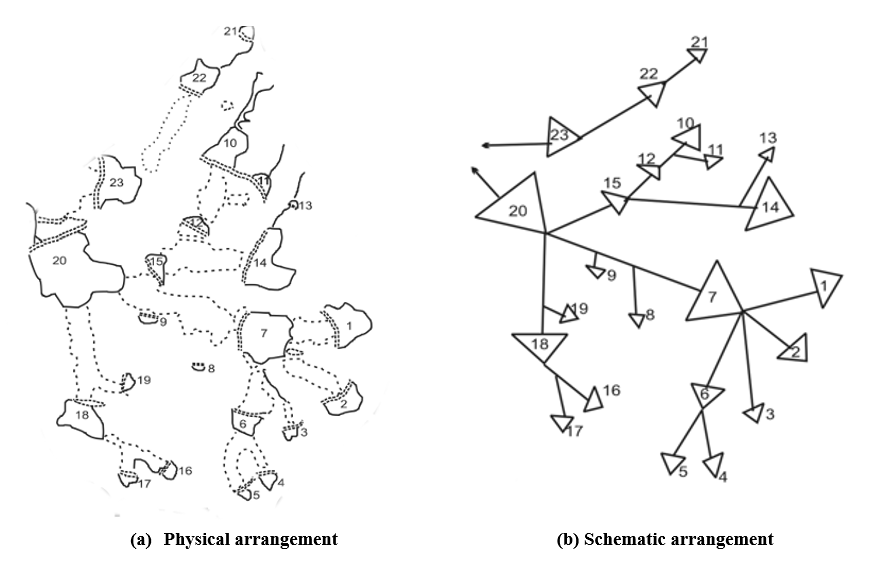
A tank cascade comprises a series of interconnected small reservoirs, each associated with its own meso-catchment basin. During the rainy season, surplus water from the upper tanks is conveyed to those situated downstream, creating a sequence of successive water bodies (Panabokke, 2009). This arrangement enabled the continuous reuse and redistribution of water within the meso-catchments, effectively mitigating the effects of spatial and temporal variability in rainfall (see Figure 2).
The construction of thousands of such village tanks over successive generations reflects a sophisticated understanding of hydrological processes within small watersheds. This practice facilitated the optimal capture of rainwater—both as surface runoff and through percolation—demonstrating a systematic and sustainable approach to water management in ancient Sri Lanka.
|
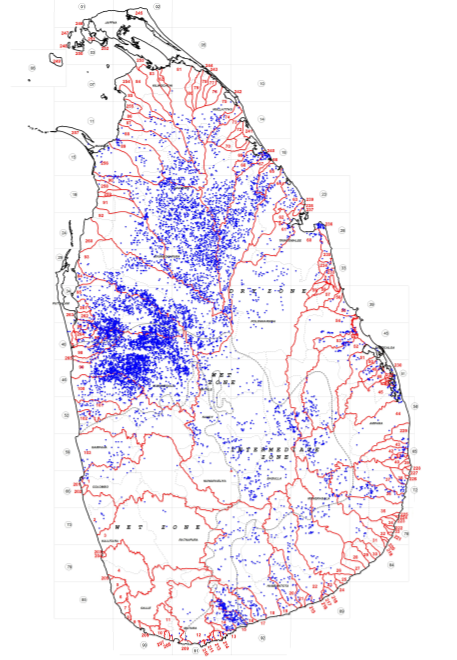
Figure 1 Village tank distribution in Sri Lanka. The map illustrates major river valleys (in red) alongside the distribution of village tanks (in blue), highlighting their spatial concentration. The highest density of village tanks is observed in the North-Western and North-Central Provinces, both situated within the dry zone.
Source: Department of Agrarian Development (2011).
In this water-use strategy, no clear boundary exists between the water received directly from rainfall and that collected or managed through human-made waterworks. This integration effectively dissolves the dichotomy between “rain-fed agriculture” and “irrigated agriculture.” A comparable approach has been observed in discussions on the impact of colonialism on indigenous water conservation and irrigation techniques in African regions (Pacey, 1991). There, irrigation often appeared inconspicuous, primarily because it relied on the utilization of natural irrigation—that is, the moisture retained in floodplains, valley bottoms, and swamps. Within that context, irrigation has been broadly defined as “any process other than natural precipitation which supplies water to crops” (Pacey, 1991).
Following such a definition, the enrichment of land through man-made waterworks and the harnessing of moisture from surface runoff and percolation flows may be seen as functionally equivalent processes. Both replicate the natural effects of rainfall, effectively achieving the same outcome—ensuring the timely rain through human ingenuity.
Beyond this pragmatic interpretation, an idealistic dimension can also be discerned in the efforts to secure timely rainfall. Historical records describe various occasions on which rituals such as sacca-kiriyā—a “solemn asseveration of truth”—were performed during times of famine to invoke rain (Godakumbura, 1970; Disanayaka, 2000; Vitharana, 1996). These rituals emphasized virtuous human conduct as a moral and spiritual qualifier for inducing rainfall in appropriate measures and time. Rooted in a metaphysical worldview in which outcomes lay beyond human control, the success of such practices would have been inherently uncertain and subject to perceived randomness.
Names of the tanks:
Palippothana wewa
Iehalwetuna wewa
Hendegama wewa
Ihala kolongas wewa
Pahala kolongas wewa
Kuda thambalagollewa wewa
Thambalagollewa wewa
Welpothu wewa
Badugama wewa
Tharama Halmillewa wewa
Hakuruketiyawa wewa
Kirimetiyawa wewa
Kuda wewelketiya wewa
Wewelketiya wewa
Lolugas wewa
Ihalagama ihala wewa
Ihalagama pahala wewa
Balahonda wewa
Balahonda kuda wewa
Pihimbiyagollewa wewa
Veheragala wewa
Urapeenu wewa
Getaweeragollewa wewa
Figure 2 Pihimbiyagollawa cascade, a typical presentation of the village tank cascade. This illustrates the interconnected nature, where overflow from upstream tanks is channeled into downstream tanks, creating a sequential hydrological network. Each tank is integrally linked to a village settlement, demonstrating waterworks and community organization were structured as interdependent mosaics. Some related statistics: approximate cascade area of 34.03 sq.km, total water spread area of 4.26 sq.km, total tank capacity of 4.350 MCM, total command area of 6.77 sq.km.
Source: Panabokke et. al. (2002).
Further examination of the historical records highlights the ethical foundations underlying the ancient waterworks. The Cūlavaṃsa, when describing the extensive works undertaken by King Parakramabahu I (1153–1186 CE), states in Pāli, “[appakampīdise] dese - salilaṃ vuṭṭhisambavaṃ - vinā lokopakarena - jātumāgañchi sāgaraṃ” (Wikramagamage, 2015).
This can be translated as: “In such a country, not even a drop of rainwater should flow into the ocean without lokopakāra.” In this context, lokopakāra signifies “serving all living beings,” introducing non-anthropocentric and holistic dimensions to the ethical framework of Sri Lanka’s ancient waterworks. This principle resonates closely with the Buddhist concept of loving-kindness (mettā), the first of the four sublime states (brahmavihāra).
The Metta Sutta, a widely recognized discourse within Theravāda Buddhism, delineates the classes of beings toward whom humans should extend mettā. These include the weak and strong, the short and long, the large, medium, and small, the subtle and gross, the visible and invisible, those near and far, and beings already born or yet to be born—virtually encompassing all sentient life. Within this broader perspective, mettā is not merely an attitude of goodwill toward others, but a conscious, universal expression of positive love that embraces every sentient being throughout the cosmos. Rooted in this ethical vision, mettā transcends human-centered concerns, extending to all forms of life.
A parallel perspective is evident in the Buddhist concept of the Cakkavatti-Rāja, the ideal sovereign prescribed in Buddhist statecraft. One of the primary duties of the Cakkavatti-Rāja is the provision of “righteous care” (rakkha) for all under his domain, including the household, military, nobles, vassals, religious teachers, urban and rural populations, and even animals such as beasts and birds (miga-pakkhisu) (Rhys Davids, 1977; Walshe, 1996; Jayatillake, 2009). Rakkha is further elaborated as administering care with patience (khanti), non-violence (avihiṃsā), loving-kindness (mettā), and sympathy (anuddayatā) (Boruggamuwe, 2008). The explicit inclusion of animals alongside human groups underscores a rejection of anthropocentrism, granting non-human beings moral consideration and equitable treatment.
When the Cūlavaṃsa narrative is interpreted within this ethical and philosophical context, it becomes evident that the moral foundation of ancient Sri Lankan waterworks extended to all living beings, not humans alone. Environmental transformations were guided by a holistic worldview that promoted the welfare of the entire biosphere, rather than a narcissistic or human-exclusive perspective. A human-centered dimension of this ethical stance is further reflected in the inscriptional records, which document practical applications of this principle, such as:
His Majesty, Nissanka Malla Kalinga Parakramabahu Cakravarti promoted the interests of the Buddhist Order and the State; and ruling in accordance with the ten principles of regal duty (dasarājadharma). He quenched the fire of poverty with showers of gifts of gold, silver, kahavuṇu pearls, precise stones, cloths, jewellery, etc., and being pleased when he beheld the prosperity of the people [so benefitted], in great compassion and wisdom, he reflected, ‘We have rendered lokopakāra, for such is the native disposition of our Kāliṅga dynasty’ (recorded during 1187-1196 CE) (Wickremasinghe, 1928)
Another accomplishment of which the conceptual base is closely connected with the lokopakāra is loväḍa (actions leading to the benefit of the world). Several inscriptional records to that effect could be noted as:
Lord Budal of Sitnaru-bim, increased the welfare of the world (loväḍa vaḍā) by bringing up His Majesty, in his tender age, protected the life of the whole world (muḷulo) by protecting the entire royal family together, nurtured the whole world (muḷulo) by nurturing the His Majesty with the sustenance of the edible roots, proclaimed the whole world (muḷulo) by proclaiming His Majesty in his own sovereignty. (recorded during 1055-1110) (Paranavitana and Godakumbura, 1963)
Thereafter his majesty visited Anuradhapura and made magnificent offerings with and outlay of wealth amounting to forty lacks. The divine beings (devata) observing this, manifested them [in bodily form] and uttered shouts of praise, saying thus indeed should duties for the benefits of the world and Buddhist Order (lo väḍa sasun väḍa) be performed. (recorded during 1187-1196 CE) (Wickremasinghe, 1928)
In various places, both in Dambadiva and in Lanka, he established alms-houses and expended countless wealth on beggars who came from diverse lands. And not contended with these (acts of generosity), he gave away every year four tulabhara weight of gold, jewels, cloths, and ornaments, and dispelled the poverty of the people. Thus, he promoted the interests of the Buddhist Order and the world (lo sasun väḍakoṭa). (recorded during 1187-1196 CE) (Wickremasinghe, 1928)
By creating a council of wise, brave and faithful ministers she has freed her own kingdom from the dangers [arising] from the other kingdoms and [thus] placing the world and the Buddhist Order (loka sāsana) in a peaceful state. Her Majesty reigns in accordance with the ten virtues belonging to royalty (dasa rāja dharma) (recorded during 1197-1200) (Wickremasinghe, 1994)
In the endeavour which is being made by these two brothers for the benefit of the world and the order (losasunväḍa) in Lakdiva, Lord Nātha of Senkaḍagala and the Deity of Nā tree came to their assistance. (recorded during 1380-1381) (Paranavitana, 1943)
Lokopakāra parallels in other Asian societies
In terms of these ideological frameworks, Sri Lanka was not an isolated case but part of broader Asian intellectual and cultural traditions. Several parallels to the concept of lokopakāra can be observed across Asian societies, both in conceptual thought and practical application. Vedic literature, for instance, contains numerous references linking individual actions to the pursuit of the common good. According to the Bhagavad Gītā, the practice of lokasamgraha—concern for the welfare of the whole—is a means by which the truth inherent in humans (Satya) aligns with the ultimate truth of reality (Sat). The text further asserts that an individual who identifies with all created beings (sarvabhutātma-bhutātma) and acts for the happiness of all (sarvabhuta-hiterata) attains harmony (sādharmaya) with the divine (Chaitanya, 1992).
A parallel perspective is evident in Mahayana Buddhist thought. The Suvarṇaprabhāsottama Sūtra advocates that governance (rāja-śāstra) should be structured to promote the welfare of all beings (sarvahitaṃkara) (Jayatillake, 2009).
A comparable principle is embedded in the Balinese Subak system, the traditional communal organization for managing irrigation and crop cultivation. This system is grounded in the concept of Tri Hita Karana, which outlines three paths to a harmonious and fulfilling life: (i) parhyangan—harmony between humans and the divine; (ii) pawongan—harmony among humans; and (iii) palemahan—harmony between humans and the natural environment. By applying these principles to all activities, the Subak system serves as both the core and buffer of Balinese culture, exemplifying a model of societal harmony that supports sustainable livelihoods (Sriratha et al., 2017).
Ancient Sri Lankan waterworks have often been described as components of an “irrigation system,” a characterization that reflects a modern extrapolation rather than an accurate understanding of their original purpose. A careful examination of historical texts, including chronicles and inscriptional records, suggests that the primary objective of these works was to ensure the condition of timely rain (subhikṣa). While both irrigation and timely rain may appear to serve the same functional goal, they differ significantly in conceptual and pragmatic terms. Irrigation represents an anthropocentric, agriculture-oriented, and usage-driven phenomenon, whereas timely rain embodies a non-anthropocentric, holistic, and supply-oriented vision. Rain, as a natural occurrence, cannot be guaranteed by human effort alone; however, the effects of rainfall could be extended and optimized, a goal achieved by the ancient waterworks of Sri Lanka.
This was accomplished through a well-integrated network of village tank cascades within meso-catchment basins, connected to major reservoirs and inter-basin canal systems, forming an extensive infrastructure that ensured perennial water availability. The water so managed was not intended solely for human use but for the benefit of all living beings (lokopakāra), reflecting Buddhist ethical principles such as loving-kindness (mettā), compassion (karuṇā), the sublime abodes (brahmavihāra), and the duties of the ideal ruler (dasa-rājadharma). These moral foundations extended the human-environment interaction far beyond anthropocentric concerns, encompassing all sentient beings, including those yet to be born.
Parallels to Sri Lanka’s ancient waterworks and the ideological frameworks underpinning them can be observed in other Asian societies. Village-level tank cascade systems were widespread in South India, illustrating the broad diffusion of similar hydraulic practices. Conceptual parallels are also evident in the principles of lokasamgraha in India (recorded since Vedic times) and Tri Hita Karana in Bali, both of which closely resonate with the Sri Lankan notion of lokopakāra.
The findings of this study are subject to several limitations, arising both from the nature of the subject and the methods employed. First, the study addresses the ideological foundations of ancient waterworks, which are inherently cognitive and experiential. The chronological distance between the construction of these works and the present limits the possibility of conclusive determinations regarding such a conceptual domain. Second, the analysis relies primarily on textual sources—Buddhist scriptures and inscriptional records—which were not originally intended to document the specific subject matter of this study. These sources provide “unwitting testimonies,” and the conclusions drawn from them must be understood within that context. Further, due to this gap between the focal themes of the texts and the subject matter of this study, the utilitarian aspects of the ancient water system may not be fully revealed through the textual content analysis. Consequently, the findings remain open to further discussion, refinement, confirmation, or challenge.
Declaration of competing interests
The authors declare that they have no known competing financial interests or personal relationships that could have appeared to influence the work reported in this paper.
Declaration of generative AI in scientific writing
ChatGPT was employed as a language-support tool to assist in rephrasing and improving the clarity of the text. The author carefully reviewed and edited all outputs, ensuring the accuracy and integrity of the final manuscript.
CRediT author statement
Chandana Jayawardana: Conceptualization, Methodology, Validation, Formal analysis, Investigation, Resources, Data Curation, Writing - Original Draft, Writing - Review & Editing, Visualization, Project administration.
References
Abeywardana, N., Bebermeier, W., & Schütt, B. (2018). Ancient water management and governance in the dry zone of Sri Lanka until abandonment, and the influence of colonial politics during reclamation. Water, 10(12), 1-28.
Abeywardana, N., Pitawala, H. M. T. G. A., Schütt, B., & Bebermeier, W. (2019). Evolution of the dry zone water harvesting and management systems in Sri Lanka during the Anuradhapura kingdom: A study based on ancient chronicles and lithic inscriptions. Water History, 11(1), 75-103.
Acker, R. (1998). New geographical tests of the hydraulic thesis at Angkor. South East Asia Research, 6(1), 5-47.
Agarwal, A., & Narain, S. (1997). Dying wisdom: Rise, fall and potential of India’s traditional water harvesting systems. New Delhi, Inida: Centre for Science and Environment.
Agarwal, A., Narain, S., & Khurana, I. (2001). Making water everybody’s business: Practice and policy of water harvesting. New Delhi, Inida: Centre for Science and Environment.
Bandaranayake, S. (2012). Continuities and transformations: Studies in Sri Lankan archaeology and history. Colombo, Sri Lanka: Social Scientists’ Association.
Basham, A. L. (1971). The wonder that was India: A survey of the history and culture of the Indian sub-continent before the coming of the Muslims. Calcutta, India: Rupa Co.
Boruggamuwe, S. R. (2008). Sumangalāvilasinī: The commentary to the Dīgha Nikāya of the Sutta Pitaka (Original work published 1925). Colombo, Sri Lanka: Simon Hewavitarne Bequest.
Brohier, R. L. (1935). Ancient irrigation works in Ceylon. Colombo, Sri Lanka: The Ceylon Government Press.
Buddhadatta, P. (2006). Visuddhi-magga. Colombo(Original work published 1919). Colombo, Sri Lanka: Simon Hewavitarne Bequest.
Carnagie, A. (1884). Round the world. New York: Charles Scribner’s Sons.
Chaitanya, K. (1992). The earth as sacred environs (pp. 35-48). In Sen, G. (Ed.). Indigenous vision: Peoples of India – Attitudes to the environment. New Delhi, India: India International Centre.
Chandler, E. F., & Dreger, R. M. (1993). Anthropocentrism: Construct validity and measurement. Journal of Social Behavior and Personality, 8(2), 169-188.
Childers, R. C. (1875). A dictionary of the Pali language. London: Trübner & Co.
Corral-Verdugo, V., Carrus, G., Bonnes, M., Moser, G., & Sinha, J. B. P. (2008). Environmental beliefs and endorsement of sustainable development principles in water conservation: Toward a new human interdependence paradigm scale. Environment and Behavior, 40(6), 703-725.
De Silva, C. S. (2003). Importance of water balance studies for efficient use of water resources in the tank cascade systems of Sri Lanka: A case study in Meegassagama (pp. 55-61). In De Silva, R. P. (Ed.). Water resources research in Sri Lanka. Peradeniya, Sri Lanka: Postgraduate Institute of Agriculture.
Department of Agrarian Development. (2011). Watersheds of Sri Lanka: Detail maps of all river basins in Sri Lanka. Colombo, Sri Lanka: Department of Agrarian Development.
Disanayaka, J. B. (2000). Water heritage of Sri Lanka (Original work published 1992). Colombo, Sri Lanka: Ministry of Mahaweli Development.
Dunlap, R. E., & Van Liere, K. D. (1978). The “New environmental paradigm.” Journal of Environmental Education, 9(4), 10-19.
Evenari, M., Shanan, L., & Tadmor, N. (1971). The Negev: The challenge of a desert. Oxford: Oxford University Press.
Geiger, W. (Ed.). (2003). Mahāvaṃsa. Dehiwala (Original work published 1912). Sri Lanka: Buddhist Cultural Centre.
Geiger, W., & Rickmers, C. M. (Eds.). (1996). Cūlavaṃsa: Being the more recent part of the Mahāvaṃsa (Original work published 1928). Delhi, India: Motilal Banarsidass Publishers.
Gilmartin, D. (1995). Models of hydraulic environment: Colonial irrigation, state power and community in the Indus basin (pp. 210-236). In Arnold, D., & Guha, R. (Eds.). Nature & culture & imperialism. New Delhi: Oxford University Press.
Godakumbura, C. E. (1970). Sinhalese festivals: Their symbolism, origins and proceedings. Journal of Royal Asiatic Society Ceylon Branch, ns, 14, 91-133.
Goldsmith, E., & Hildyard, N. (1985). The social and environmental effects of large dams. San Francisco: CA, USA: Sierra Club Books.
Groslier, B. (1960). Our knowledge of Khmer civilization: A re-appraisal. Journal of the Siam Society, 48(1), 1-28.
Groslier, B. (1974). Agriculture et religion dans l'empire angkorien. Etudes Rurales, 53-56.
Gudeman, S. (1986). Economics as culture: Models and metaphors of livelihood. London: Routledge & Kegan Paul.
Gunawardana, R. A. L. H. (1971). Irrigation and hydraulic society in early medieval Ceylon. Past and Present, 53(1), 3-27.
Gunawardana, R. A. L. H. (1978). Social function and political power: A case study of state formation in irrigation society. Indian Historical Review, 4(2), 259-273.
Guruge, A. W. P. (Trans.). (1989). Mahavamsa – The great chronicle of Sri Lanka: Chapters one to thirty-seven: An annotated new translation with prolegomena. Colombo, Sri Lanka: Associated Newspapers of Ceylon.
Haverkort, B., van ‘t Hooft, K., & Hiemstra, W. (2003). Ancient roots, new shoots: Endogenous development in practice. London: Zed Books.
Hunt, C. E. (2004). Thirsty planet: Strategies for sustainable water management. London: Zed Books.
Irrigation Department, Sri Lanka. (2025). Reservoir Status – Major Reservoir Status. Retrieved from https://slirrigation.maps.arcgis.com/apps/dashboards/97be51156fa84712851286408eb09c45
Jayatillake, K. N. (2009). The principles of international law in Buddhist doctrine (pp. 371-482). In Smart, N., & Nyanatusita, B. (Eds.). Facets of Buddhist thought. Kandy, Sri Lanka: Buddhist Publication Society.
Jayawardana, C., & Bohingamuwa, W. (2021). Pāli commentaries and Sri Lanka society: An introductory note. Colombo, Sri Lanka: The Royal Asiatic Society of Sri Lanka.
Jayawardhana, S. (1994). Handbook of Pali literature. Colombo, Sri Lanka: Karunaratne & Sons.
Lansing, J. S. (1991). Priests and programmers: Technologies of power in the engineered landscape of Bali. Princeton, NJ, USA: Princeton University Press.
Madduma Bandara, C. M. (1985). Catchment ecosystems and village tank cascades in the dry zone: A time-tested system of land and water resource management. GeoJournal, 10(1), 99-113.
McFarlane, B. L., & Boxall, P. C. (2000). Factors influencing forest values and attitudes of two stakeholder groups: The case of the Foothills Model Forest, Alberta, Canada. Society and Natural Resources, 13(8), 649-661.
Mendis, D. L. O. (1986). Evolution and development of irrigation eco-systems in ancient Sri Lanka. Transactions of the Institution of Engineers, Sri Lanka, 1, 1-13.
Mendis, D. L. O. (1994). The value of indigenous knowledge: The case of water and soil conservation ecosystems of Sri Lanka (pp. 95-112). In Smith, P. B., Okoye, S.E., de Wilde, J., & Deshingkar, P. (Eds.), The world at the crossroads: Towards a sustainable, equitable and liveable world. London: Earthscan.
Mendis, D. L. O. (2001). Evolution and development of water and soil conservation ecosystems – From ancient dry zone forest garden to modern Jaffna market garden. Colombo, Sri Lanka: Sri Lanka Pugwash Group.
Mithen, S. (2013). Thirst; Water and power in the ancient world. London: Orient Books.
Myrdal-Runebjer, E. (1996). Rice and millet: An archaeological case study of a Sri Lankan transbasin irrigation system. Gothenburg, Sweden: Göteborg University.
Ñāṇamoli (Trans.). (2010). The path of purification (Original work published 1956). Kandy, Sri Lanka: Buddhist Publication Society.
Needham, J., Ling, W., & Djen, L. G. (1970). Science and civilisation in China (Vol. 4). Cambridge: Cambridge University Press.
Nicholas, C. W. (1954–1955). The irrigation works of king Parakramabahu. Ceylon Historical Journal, 5(2), 52-62.
Nicholas, C. W. (1960). A short account of the history of irrigation works up to the 11th century. Journal of the Royal Asiatic Society of Ceylon, 7(1), 43-69.
Pacey, A. (1991). Technology in world civilization: A thousand-year history. Cambridge, MA: MIT Press.
Panabokke, C. R. (2009). Small village tank systems of Sri Lanka: Their evolution, setting, distribution and essential functions. Colombo, Sri Lanka: Hector Kobbekaduwa Agrarian Research and Training Institute.
Panabokke, C. R., Sakthivadivel, R., & Weerasinghe, A. D. (2002). Evolution, present status and issues concerning small tank systems in Sri Lanka. Colombo, Sri Lanka: International Water Management Institute.
Paranavitana, S. (Ed.). (1943). Epigraphia Zeylanica – Being lithic and other inscriptions of Ceylon (Vol. IV). London: Oxford University Press.
Paranavitana, S., & Godakumbura, C. E. (Eds.). (1963). Epigraphia Zeylanica – Being lithic and other inscriptions of Ceylon (Vol. V, Part 2). Colombo, Sri Lanka: Archaeological Department.
Pearce, F. (1992). The dammed: Rivers, dams, and the coming world water crisis. London: The Bodley Head.
Perera, L. S. (1959). The sources of Ceylon history (pp. 46-73). In Ray, H. C. (Ed.). History of Ceylon. Colombo, Sri Lanka: Ceylon University Press.
Rahula, W. (1959/2006). What the Buddha taught. Dehiwala, Sri Lanka: Buddhist Cultural Centre.
Rhys Davids, T. W. (Trans.). (1977). Dialogues of the Buddha: Translated from the Pali of the Digha Nikaya. London: Pali Text Society.
Sivakumar, S. S. (2021). Water resources and water policy initiatives in Sri Lanka. Retrieved from https://www.researchgate.net/publication/350725882
Sivasubramaniyan, K. (2006). Sustainable development of small water bodies in Tamil Nadu. Economic and Political Weekly, 41(26), 2854-2863.
Sriatha, P., Jampel, N., Widiana, W., & Wesnawa, G. A. (2017). Local wisdom of Subak as a model of character building for social studies learning in schools. Advances in Social Science, Education and Humanities Research, 134, 114-120.
Stott, P. (1992). Angkor: Shifting the hydraulic paradigm (pp. 47-58). In J. Rigg (Ed.), The gift of water: Water management, cosmology and the state in South East Asia. London: School of Oriental and African Studies, University of London.
Thompson, S., & Barton, M. (1994). Ecocentric and anthropocentric attitudes towards the environment. Journal of Environmental Psychology, 14(2), 149-157.
Toynbee, A. J. (1960). A study of history (Vol. 1, Somervell’s abridgement). London: Oxford University Press.
Tuan, Y. (1968). Discrepancies between environmental attitude and behavior: Examples from Europe and China. Canadian Geographer, 12(3), 176-191.
van Liere, W. J. (1980). Traditional water management in the lower Mekong Basin. World Archaeology, 11(3), 265-280.
Vatsysyan, K. (1992). Ecology and Indian myth (pp. 157-182). In G. Sen (Ed.), Indigenous vision: Peoples of India – attitudes to the environment. New Delhi, India: India International Centre.
Vitharana, C. (1996). Sri Lanka: The geographical vision – Environment, land and settlement in classical Sinhala literature. Colombo, Sri Lanka: Department of Educational Publications.
Walshe, M. (Trans.). (1996). The long discourses of the Buddha: A translation of the Digha Nikaya. Somerville, MA: Wisdom Publications.
Weigel, R. H., & Weigel, J. (1978). Environmental concern: The development of a measure. Environment and Behavior, 10(1), 3-15.
White, L. (1967). The historical roots of our ecological crisis. Science, 155(3767), 1203-1207.
Wickremasinghe, D. M. De Z. (1994). Epigraphia Zeylanica – Being lithic and other inscriptions of Ceylon (Vol. I) (Original work published 1912). New Delhi, India: Asian Educational Services.
Wickremasinghe, D. M. De Z. (1928). Epigraphia Zeylanica – Being lithic and other inscriptions of Ceylon (Vol. II). London: Oxford University Press.
Wikramagamage, C. (2012). Mahāvaṃsa (Vol. 1). Dehiwala, Sri Lanka: Buddhist Cultural Centre.
Wikramagamage, C. (2015). Mahāvaṃsa (Vol. 2). Dehiwala, Sri Lanka: Buddhist Cultural Centre.
1Mahāvaṃsa is the chronicler text originally written in the language of Pali and contains the continuous history of Sri Lanka since the sixth century BCE. This is generally considered to be compiled during fifth century CE, by a Buddhist bhikkhu named Mahanama. Mahāvaṃsa consists of several eras, the first is termed as Mahāvaṃsa itself.
2Cūlavaṃsa is the second part of Mahāvaṃsa. This was compiled during twelfth century CE, by a Buddhist bhikkhu named Dhammakitti and covers the history of Sri Lanka from fourth century CE to twelfth century CE. (Jayawardhana, 1994)
3 Here, the terms subhikkha and dubhikka are in the language of Pali, the original language in which the Mahāvaṃsa was compiled. These terms were not translated into English at this stage, as more epistemological considerations are to follow.
4 Visuddhimagga is a compendium of Buddhism, originally written in the language of Pali, and contains the essentials of Buddhist doctrine drawn from Tipitaka and the ancient Sinhala Commentaries on them. This is generally considered to be compiled during fifth century CE, by a Buddhist bhikkhu named Buddhaghosa, while his stat in Sri Lanka.