Asian J. Arts Cult. 2026; 26(4): 129
Cultivating Cultural Capital: Artist Professionalism among Arts Graduates in Indonesia within the Sustainable Development Goals Framework
Wening Hesti Nawa Ruci*, Muchlis Arif, Nur Hidayatno Wakhid and Fathoni Setiawan
Faculty of Languages and Arts, State University of Surabaya, Surabaya 60213, Indonesia
(*Corresponding author’s e-mail: weningruci@unesa.ac.id)
Received: 3 January 2026, Revised: 17 February 2026, Accepted: 24 February 2026, Published: 6 March 2026
Abstract
This study addresses the low legitimacy and professionalism of artists in Indonesia, particularly among arts graduates, which impacts economic stability, social cohesion, and psychological well-being. The purpose of this research is to analyze how the development of artist professionalism can be strengthened through the utilization and integrity of cultural capital in supporting the achievement of the Sustainable Development Goals (SDGs). The study employs a qualitative approach using Systematic Literature Review (SLR) and Focus Group Discussions (FGDs) involving artists, academics, and members of art communities from five Indonesian art universities. The findings indicate that artist professionalism is shaped through the integration of cultural capital—embodied, objectified, and institutionalized—which enhances creative capacity, social legitimacy, emotional well-being, and economic competitiveness. The results demonstrate that the integrity of cultural capital, as a manifestation of artist professionalism, directly contributes to artists’ mental well-being and the sustainability of creative ecosystems, as well as by strengthening the role of the arts in building inclusive and empowered cultural communities. Consequently, the development of sustainable-oriented professionalism among arts graduates not only enhances the competitiveness of the cultural sector but also positions the arts as a key pillar of national development, making a tangible contribution to the achievement of the SDGs.
Keywords: Cultural capital, Artist professionalism, Arts graduates, Sustainable development goals
Introduction
Artist professionalism in Indonesia reflects a gap between the social role of artists and the formal legitimacy recognized by society (Setianik & Siswati, 2020). Although artists contribute significantly to the development of national culture, the reinforcement of
collective identity, and the growth of the creative economy, this profession is often perceived as a non-formal activity dependent on individual talent rather than a career with established competency standards and institutional recognition (Pramono et al., 2025). Many artists practice their craft independently without adequate institutional support, such as legal protection, income security, or access to social and economic facilities. This condition makes artists vulnerable to economic and social uncertainty, weakening their professionalism in navigating the dynamics of the global creative industry (Svensson, 2015). Therefore, strengthening legitimacy and professional structures in the arts is crucial to ensuring the sustainability of artists’ careers and their contributions to sustainable development.
This situation underscores that enhancing artist professionalism holds strategic significance not only for individual career sustainability but also in supporting the achievement of the Sustainable Development Goals (SDGs) more broadly. This relevance includes SDG 8 (Decent Work and Economic Growth), SDG 3 (Good Health and Well-being), and SDG 11 (Sustainable Cities and Communities), positioning artists as multidimensional actors in sustainable development—not merely as producers of aesthetic works but also as social and economic agents (Benison et al., 2025; Bennett et al., 2014; Spiro et al., 2023). In the context of SDG 8, strengthening professionalism is key to creating a fair, sustainable, and equitable work ecosystem. Many arts graduates and practitioners still face limited access to employment opportunities, income instability, and economic disparities within the creative sector (Baldini, 2022; Coda Moscarola et al., 2025; Kerrigan et al., 2023). Consequently, a more systematic approach is required to position artistic work as an integral part of a sustainable creative economy, in which the arts function not only as aesthetic expression but also as a productive contribution to economic growth and social welfare.
Meanwhile, the link between artist professionalism and SDG 3 highlights the urgency of protecting the physical and mental health of artists, which is often threatened by economic pressures, market competition, and limited social support. Professional uncertainty may generate prolonged stress, emotional exhaustion, and reduced creative motivation, ultimately affecting productivity and the sustainability of artistic practice. In this context, artist well-being should be understood as part of human-centered sustainable development, where psychological welfare is a prerequisite for sustaining cultural innovation and expression (Benison et al., 2025; Spiro et al., 2023). Furthermore, SDG 11 positions artists as key elements in building sustainable cities and communities by contributing to the strengthening of local cultural identity, revitalization of public spaces, and development of participatory creative ecosystems (Bursiewicz, 2025; Zeng et al., 2025; Zhou et al., 2024). Therefore, artist professionalism cannot be understood solely in economic terms but must be considered a multidimensional foundation supporting individual welfare, social cohesion, and the sustainability of cultural ecosystems in a dynamic global era.
The link between artist professionalism and sustainable development as reflected in SDG 3, SDG 8, and SDG 11 indicates that individual capacity building needs to be complemented by strong institutional support, including through formal education. In this context, higher education in the arts plays a strategic role in developing a sustainable foundation of artist professionalism by fostering reflective capacity, professional identity, and social awareness of cultural responsibilities (Pennill et al., 2022; Wang et al., 2025). However, curricula in Indonesia still tend to emphasize aesthetic and technical skills, while the socio-economic dimensions of the arts profession receive limited attention. This imbalance affects graduates’ readiness to navigate the realities of the creative industry, which demand adaptability, cross-disciplinary collaboration, and professional competitiveness (Iswahyudi, 2024; Hendri et al., 2024). Thus, integrating principles of sustainability literacy, entrepreneurial mindset, and cultural capital cultivation becomes an urgent necessity for higher arts education to produce individuals who are not only artistically creative but also innovative, resilient, and oriented toward sustainable socio-economic development for both individual and collective well-being (Kuznetsova-Bogdanovitsh & Ranczakowska, 2025; Wong & Chan, 2024).
Efforts to strengthen artist professionalism in higher arts education cannot be separated from the development of cultural capital as a social and symbolic foundation supporting professional legitimacy. The concept of cultivating cultural capital is relevant here because it emphasizes that an artist’s success is determined not only by artistic ability but also by the capacity to manage values, knowledge, and social networks as strategic resources (Grau Pérez, 2025; Vigerland & Borg, 2018). According to Bourdieu (1986), cultural capital comprises a set of competencies, values, social relations, and habitus that allow individuals to gain position and recognition within the social field. In the context of arts education and practice in Indonesia, strengthening cultural capital means equipping artists with the ability to integrate aesthetic, ethical, and social values as effective professional resources. This process requires a transformation of higher arts education toward more contextual and collaborative approaches, strengthening networks among creative communities, and achieving institutional legitimacy of the arts profession in public policy (Kurniawan, 2019; Putra et al., 2024). Hence, cultivating cultural capital not only reinforces artists’ professional identity but also serves as a conceptual strategy to integrate cultural, economic, and social dimensions within sustainable development.
The strengthening of cultural capital cannot stand alone without systemic support from a sustainable arts ecosystem. Efforts to build artist professionalism through education, social networks, and cultural legitimacy must be accompanied by the creation of an environment that structurally supports sustainable artistic practice. A sustainable approach to the arts ecosystem requires close synergy between educational institutions, creative communities, and public policy to ensure that the arts sector can grow inclusively and resiliently (Heras et al., 2021; Komorowski & Lewis, 2023; Zeng et al., 2025). A healthy arts ecosystem cannot rely solely on individual creativity but must be supported by cultural infrastructure, equitable financing systems, and policies ensuring career continuity for artists. In this context, understanding artist professionalism is key to maintaining a balance between economic productivity, social cohesion, and artists’ mental well-being (Cicchiello et al., 2023; Yan & Liu, 2023). Integrating sustainability principles into arts governance will strengthen the cultural sector’s position as a pillar of national development and a significant contributor to achieving the Sustainable Development Goals.
However, despite the growing recognition of sustainable approaches within the art ecosystem, a significant research gap remains regarding the relationship between artist professionalism and the Sustainable Development Goals (SDGs), particularly Goal 8 (Decent Work and Economic Growth), Goal 3 (Good Health and Well-being), and Goal 11 (Sustainable Cities and Communities). Most studies, especially in Indonesia (Aritenang, 2025; Jaohari et al., 2025; Manurung & Rohmiyati, 2019; Nirwana et al., 2024; Pertiwi & Yakti, 2023; Setianik & Siswati, 2020), have focused primarily on the creative economy or cultural preservation without directly linking artist professionalism as a key actor in achieving these three goals. Strengthening the professional ethos of artists, however, has the potential to foster inclusive creative economic growth (SDG 8), enhance the well-being and mental health of artists (SDG 3), and reinforce the sustainability of cultural communities in both urban and rural areas (SDG 11). Therefore, research that integrates the dimension of artist professionalism within the framework of sustainable development is needed so that the contributions of the art sector can be strategically recognized and measured in the implementation of the SDGs in Indonesia.
Based on this gap, this study emphasizes the need for a deeper examination of the relationship between artist professionalism and the achievement of the Sustainable Development Goals (SDGs) in the context of sustainable development. The lack of studies explicitly linking artist professionalism with decent work, well-being, and sustainable cultural communities indicates that this aspect remains insufficiently integrated in both academic discourse and cultural policy. Accordingly, this research seeks to investigate issues related to: (1) the development of artist professionalism among arts graduates through the utilization of cultural capital; (2) the integrity of cultural capital as a manifestation of artist professionalism in supporting the SDG agenda; and (3) strategies for enhancing professionalism among arts graduates post-graduation as a basis for policy recommendations supporting SDG achievement. The findings are expected to contribute theoretically to the study of artist professionalism within a sustainable development framework and offer practical recommendations for policy formulation and higher arts education that is more responsive to the SDG agenda.
Methods
The study employed a qualitative approach combining Systematic Literature Review (SLR) and Focus Group Discussion (FGDs) to gain a comprehensive understanding of artist professionalism among arts graduates within the framework of the Sustainable Development Goals (SDGs). A qualitative approach was chosen because it allows for an in-depth exploration of values, experiences, and socio-cultural dynamics (Creswell & Poth, 2018; Denzin & Lincoln, 2018; Flick, 2022) that shape the reality of artist professionalism for arts graduates in Indonesia. Through this approach, the study aims to explore the relationships between artist professionalism among arts graduates, the development of cultural capital, and its contribution to the SDGs. Furthermore, this approach enables the researcher to understand the complex interactions between cultural capital, artist professionalism, and their contributions to social, economic, and cultural resilience in sustainable development—insights that are difficult to capture solely through quantitative methods (Silverman, 2024; Tracy, 2020).
The first phase of the study employed a Systematic Literature Review (SLR) to describe issues related to the development of artist professionalism among arts graduates through the utilization of cultural capital and the integrity of cultural capital as a manifestation of professionalism in supporting the SDGs. Literature searches were conducted in major academic databases, including Scopus, Web of Science, and Google Scholar, enabling access to both international and national publications with high validity (Falagas et al., 2008; Mongeon & Paul-Hus, 2016). Google Scholar was used as a complementary source to capture grey literature and local publications relevant to the Indonesian context (Martín-Martín et al., 2018). The selection process followed the stages of identification, screening, eligibility, and inclusion, with primary criteria covering articles addressing artist professionalism, higher education in the arts, cultural capital, and the SDGs. The findings from the SLR were then used to construct a conceptual framework illustrating how artist professionalism is shaped through cultural capital and how these practices contribute to the achievement of the SDGs.
The subsequent phase employed Focus Group Discussions (FGDs) to address issues related to the development of professional strategies for arts graduates after graduation, providing a basis for policy recommendations to support SDG achievement. FGDs involved participants including artists, curators, arts community practitioners, and faculty members from five universities: Universitas Negeri Surabaya (UNESA), Universitas Negeri Semarang (UNNES), Institut Seni Indonesia (ISI) Yogyakarta, ISI Surakarta, and Institut Kesenian Jakarta (IKJ). Participants were selected based on their active involvement in artistic practice, creative communities, and professional work in the arts. The discussions aimed to explore the development of professional strategies for arts graduates, including practices, challenges, and efforts in utilizing cultural capital for social, economic, and cultural contributions. FGDs data were thematically analyzed using NVivo software, allowing systematic and transparent coding, categorization, and interpretation of the data (Jackson & Bazeley, 2013). The FGDs findings were then integrated with the SLR results to form a comprehensive understanding of artist professionalism within the sustainable development framework. This combined approach produced a strategic model that is contextual, credible, and applicable as a basis for policy recommendations for higher education arts programs and the Ministry of Culture in supporting SDG achievement.
Furthermore, the participant names presented in the findings are not real identities but pseudonyms used to protect informants’ confidentiality. In qualitative research traditions, safeguarding identity through anonymity and confidentiality is regarded as an ethical obligation of researchers to prevent participants from being recognized by external parties (Creswell & Poth, 2018). This procedure was implemented by removing or masking all identifying information, including personal names, positions, and specific institutional affiliations, so that the data cannot be traced back to particular individuals. The use of pseudonyms also reflects the principle of respect for persons, which emphasizes the protection of participants’ privacy, safety, and dignity throughout the research process (Orb et al., 2001). Through this measure, interview and FGDs excerpts can be presented analytically without exposing participants to potential social or professional risks, while also demonstrating the study’s compliance with established research ethics standards.
Results and discussion
Development of artist professionalism among arts graduates through the utilization of cultural capital
The development of artist professionalism among arts graduates is strongly influenced by the individual’s ability to utilize the cultural capital they possess. Bourdieu (1986) categorizes cultural capital into three forms: embodied, objectified, and institutional. Embodied cultural capital includes knowledge, skills, and internal dispositions developed through education, practical experience, and social interaction, shaping creativity, aesthetics, and the professional identity of artists. Objectified cultural capital refers to cultural objects such as artworks, portfolios, or other creative assets that tangibly express competence, build prestige, and create economic and social legitimacy opportunities. Institutionalized cultural capital encompasses degrees, certifications, or official awards that provide formal recognition, strengthen credibility, expand access to employment and professional networks, and serve as the foundation for sustainable creative career strategies. The utilization of these three forms of cultural capital enables artists to develop professionalism, build reputation, and manage their careers strategically. Based on this understanding, the following strategies and practices are recommended for developing artist professionalism among arts graduates through the utilization of cultural capital.
Domain-specific practice forms the foundational basis for developing professional skills among artists, particularly for graduates of art academies and universities. This practice encompasses intensive creation of artworks, experimentation with techniques and media, and critical reflection on the creative process. Puppe et al. (2020) emphasize that domain-specific practice, such as hands-on creation and deep reflection, represents the most significant and challenging activity in building professionalism, as it reinforces technical skills, creativity, and professional identity. Svensson (2015) supports this finding by demonstrating that sustained practice allows artists to internalize experiences, evaluate the quality of their work, and develop embodied cultural capital as a foundation for long-term creative productivity. In addition to domain-specific practice, mentoring and engagement in artistic communities are also crucial. Azagra-Caro et al. (2022) highlight that mentor support and participation in professional communities help artists balance the demands of research, production, and commercialization while expanding networks and collaborative opportunities. Haugsevje and Heian (2024) further note that mentoring and community involvement contribute to social resilience and the sustainability of creative careers, thereby strengthening embodied cultural capital while supporting professional development.
Table 1 Embodied cultural capital in artist professional development
Aspects |
Key activities / strategies |
Supporting research |
Domain-Specific Practice |
Intensive creation of artworks and reflective practice to enhance professional skills |
Puppe et al. (2020); Svensson (2015) |
Monitoring and Community |
Guidance and support from lecturers, professional artists, or mentors to develop skills and expand networks |
Azagra-Caro et al. (2022); Haugsevje and Heian (2024) |
Feedback and Peer Interaction |
Receiving constructive feedback from peers and instructors to refine artistic techniques |
Puppe et al. (2020); Azagra-Caro et al. (2022) |
Motivation and Psychological Resilience |
Maintaining intrinsic motivation and mental resilience to sustain long-term creative productivity |
Borowiecki and Law (2025); Haugsevje and Heian (2024) |
Peer and instructor feedback complements practice and mentoring as a means of professional growth. Puppe et al. (2020) found that feedback helps artists refine techniques, broaden creative perspectives, and improve the quality of their work. Azagra-Caro et al. (2022) add that engagement in academic communities and receiving critical input expand professional networks, open collaboration opportunities, and promote career sustainability. Intrinsic motivation and psychological resilience also determine long-term productivity. Borowiecki and Law (2025) emphasize the importance of psychological capital—self-efficacy, motivation, and resilience developed through creative experiences—in maintaining consistent creativity and managing emotional and financial pressures. Haugsevje and Heian (2024) show that mentoring and community networks strengthen mental resilience, sustain intrinsic motivation, and support career continuity. Thus, domain-specific practice, mentoring, peer interaction, as well as motivation and psychological resilience collectively constitute embodied cultural capital, which forms the core of professional development for artists.
Table 2 Objectified cultural capital in artist professional development
Aspects |
Key activities / strategies |
Supporting research |
Artworks and Creative Assets |
Creation, curation, and management of artworks, portfolios, and other creative outputs as tangible expressions of symbolic capital |
Vigerland & Borg (2018); Noonan (2021); Wyszomirski & Chang (2017) |
Documentation and Presentation |
Developing professional portfolios, exhibitions, and online showcases to communicate artistic identity and capabilities |
Azagra-Caro et al. (2022); Wong & Chan (2024) |
Entrepreneurship and Commercialization |
Leveraging artworks and creative outputs to generate income, build reputation, and engage in creative business activities |
Puppe et al. (2020); Wong & Chan (2024) |
The development of objectified cultural capital among artists heavily relies on the creation, curation, and management of artworks and portfolios, which serve as tangible expressions of skills, creativity, and professional identity. Vigerland and Borg (2018) emphasize that managing artworks as measurable and presentable assets enables artists to systematically demonstrate their artistic abilities while gaining recognition within professional communities. Noonan (2021) adds that a well-structured and documented portfolio not only functions as a tool for self-reflection and evaluation but also enhances legitimacy in the eyes of the public and art institutions. Meanwhile, Wyszomirski and Chang (2017) highlight that consistent management of creative outputs serves as an indicator of professional competence, helping to establish the artist’s position within the art ecosystem and optimize the symbolic capital they possess.
Beyond managing artworks and portfolios, creative documentation and presentation through exhibitions, professional portfolios, or online platforms are essential strategies for communicating artistic capabilities and strengthening an artist’s reputation. Azagra-Caro et al. (2022) demonstrate that public exposure to creative works increases professional recognition and opens opportunities for collaboration. Wong and Chan (2024) further note that leveraging online platforms and digital media allows artists to reach broader audiences, enhance professional image, and build creative networks effectively. Puppe et al. (2020) emphasize that engagement in entrepreneurship and commercialization of artistic outputs enables artists to generate income while reinforcing their reputation, making objectified cultural capital a strategic instrument for professional development and long-term career sustainability. Thus, the systematic and strategic management and creation of creative assets constitute the core of strengthening objectified cultural capital, balancing artistic expression, prestige, and economic opportunities.
Table 3 Institutionalized cultural capital in artist professional development
Aspects |
Key activities / strategies |
Supporting research |
Degrees and Certifications |
Obtaining formal degrees, diplomas, and professional certifications in arts to validate skills and knowledge |
Woronkowicz (2024); Puppe et al. (2020) |
Employment and Income Opportunities |
Leveraging formal credentials to access job opportunities, higher income, and professional roles within the arts sector |
Wong & Chan (2024); Wyszomirski & Chang (2017) |
Career Development and Sustainability |
Utilizing institutionalized qualifications to strengthen professional reputation, network access, and long-term career sustainability |
Svensson (2015); Puppe et al. (2020) |
The development of institutionalized cultural capital among artists emphasizes the importance of formal legitimacy obtained through academic degrees, certifications, and professionally recognized qualifications. Woronkowicz (2024) explains that an arts degree is not merely a symbol of academic achievement but also serves as formal recognition of an artist’s competence, creativity, and technical skills. Such degrees or certifications provide measurable credibility, enhance the artist’s standing within professional communities, and serve as a basis for evaluating the quality of work by institutions and the public. Puppe et al. (2020) further note that obtaining formal qualifications reflects an artist’s commitment to sustained professional development. This not only shapes perceptions of professionalism but also provides a structured framework for managing career trajectories strategically, building academic portfolios, and leveraging formal learning opportunities to expand artistic capacity. Therefore, institutionalized cultural capital becomes a critical instrument for asserting professional standing, building broadly recognized credibility, and providing a foundation for long-term professional development.
Beyond formal legitimacy, institutionalized cultural capital plays a significant role in creating practical opportunities for career advancement, including access to employment, increased income, and expanded professional networks. Wong and Chan (2024) emphasize that academic qualifications and certifications enable artists to access strategic professional positions, gain institutional recognition, and strengthen reputation within competitive art ecosystems. Wyszomirski and Chang (2017) add that these credentials allow artists to leverage institutional capital to optimize the economic potential of their work, create collaborative opportunities, and facilitate participation in larger-scale professional projects. Svensson (2015) affirms that formal recognition through degrees and certifications reinforces the cultural capital possessed by artists, balancing professional legitimacy, prestige, and economic opportunities throughout their careers. Consequently, institutionalized cultural capital functions not only as a symbol of academic status but also as a strategic mechanism to ensure sustainable professional development, expand networks, and enhance the competitiveness of artists within the contemporary art world.
Cultural capital integrity as a manifestation of artist professionalism among arts graduates in supporting the SDGs agenda
The professional development of artists among arts graduates depends not only on the mastery of cultural capital—embodied, objectified, or institutional—but also on the integrity in utilizing that capital as a manifestation of professionalism. Cultural capital integrity is reflected in an artist’s ability to consistently internalize skills and creative values (embodied capital), strategically manage artworks and creative assets (objectified capital), and leverage formal legitimacy to strengthen reputation and professional networks (institutional capital). This practice of integrity enables artists to balance artistic expression, professional prestige, and socio-economic contributions, making their professionalism not merely a measure of individual competence but also a means to support the SDGs agenda. Thus, cultural capital integrity serves as a strategic bridge between personal professional development and broader social responsibility in advancing the SDGs. Based on this framework, the following discussion will explore how cultural capital integrity reflects the professionalism of arts graduates in contributing to the achievement of SDG targets.
Cultural capital integrity in advancing SDG 8 emphasizes the importance of integrating cultural values, professionalism, and digital innovation in creating a fair, productive, and sustainable arts work ecosystem. A study by Pratono et al. (2023) demonstrates that social enterprises in Indonesia’s creative sector can enhance artists’ economic sustainability through four main strategies: digitization of creative works, strengthening cultural identity, collaborative social networks, and inclusive community governance. These strategies promote artist professionalism grounded in social and cultural values while expanding access to equitable economic resources. Furthermore, Killingsworth (2021) highlights that cultural engagement and creativity not only generate economic value but also enhance psychological well-being and collective awareness of social sustainability—serving as an ethical foundation for decent work in the arts sector. This perspective is reinforced by Wyszomirski and Chang (2017), who introduced the concept of self-structuring portfolio professions, emphasizing artists’ ability to manage careers independently, flexibly, and ethically as a form of creative professionalism adaptive to the 21st-century economy.
Meanwhile, Yan and Liu (2023) propose a flexible cultural governance model that integrates six cultural dimensions—cultural democracy, innovation, industrialization, vitality, policy, and sustainability—to strengthen the connection between creativity, employment, and creative economic growth. This aligns with Kalfas et al. (2024), who found that the creative industry in Europe significantly contributes to job creation (74.4%) and regional GDP growth (71.4%), indicating that strengthening artist professionalism through cultural capital has tangible economic impacts. In the context of higher education, Salvador and Comunian (2024) assert that universities serve as centers for developing artists’ professional capacities and ethics through cross-sector collaborations among academics, creators, and industry. This synergy generates spillover effects, enhancing competitiveness and social awareness in professional arts practice. Additionally, Malisiova and Kostopoulou (2024) emphasize the importance of social capital and cultural networks in sustaining the creative industry in peripheral regions, where social legitimacy and cultural integrity become the main drivers of local economic growth.
Table 4 Cultural capital integrity in supporting decent work and economic growth (SDG 8)
Aspects |
Integrity of Cultural Capital in SDG 8 |
Supporting research |
Cultural Capital Utilization |
Cultural capital serves as a foundation for generating fair economic value and creative employment opportunities through the transformation of cultural heritage and local knowledge into productive creative resources. |
Kalfas et al. (2024); Malisiova & Kostopoulou (2024) |
Creative Industry Sustainability |
Integrity of cultural capital sustains creative careers and industry resilience through ethical work practices, portfolio-based professionalism, and adaptive cultural ecosystems that support long-term creative work. |
Wyszomirski & Chang (2017); Yan & Liu (2023) |
Socio-Cultural Economic Integration |
Integration of social, cultural, and economic values reinforces inclusive creative economies, empowering communities while promoting social wellbeing and decent creative work. |
Pratono et al. (2023); Killingsworth (2021) |
Adaptive Cultural Governance |
Cultural capital integrity is strengthened through flexible and participatory governance that aligns cultural democracy, innovation, and sustainable policy collaboration between cultural and economic sectors. |
Yan & Liu (2023); Kalfas et al. (2024) |
Higher Education Collaboration |
Higher education institutions cultivate ethical and intellectual integrity through interdisciplinary collaboration, research-based learning, and creative innovation supporting professional capacity-building. |
Salvador & Comunian (2023); Killingsworth (2021) |
Cultural Identity and Well-being Linkage |
The professionalism of artists is rooted in the integration of cultural identity, emotional wellbeing, and collective prosperity, reflecting the humanistic value of cultural capital in sustainable creative development. |
Newman et al. (2013); Malisiova & Kostopoulou (2024) |
Table 5 Cultural capital integrity in supporting Good Health and Well-being (SDG 3)
Aspects |
Integrity of Cultural Capital in SDG 3 |
Supporting research |
Arts-based Health Promotion |
Integration of cultural and artistic practices supports mental and emotional wellbeing, functioning as a non-pharmacological intervention that enhances public health outcomes. |
Golden et al. (2024); Dow et al. (2023) |
Creative Well-being and Social Value |
Cultural capital fosters creative wellbeing by connecting social, cultural, and economic dimensions that reduce social inequalities and improve overall life satisfaction. |
Ganga et al. (2023); Rajabi Gilan et al. (2023) |
Participatory Arts and Social Capital |
Engagement in participatory arts strengthens social capital and collective resilience, shaping wellbeing through shared creativity and community participation. |
Daykin et al. (2020); Ganga et al. (2023) |
Intergenerational Health and Creativity |
Arts and creativity interventions improve physical, mental, and social wellbeing, especially among older adults, demonstrating the sustainable value of cultural participation. |
Crealey et al. (2023) |
Digital Cultural Transformation |
Digitalization of creative works promotes accessibility, identity expression, and social inclusion, enhancing community wellbeing through equitable creative opportunities. |
Pratono et al. (2023) |
Living Heritage and Place-based Identity |
Preservation of living heritage reinforces a sense of belonging and cultural authenticity, which contributes to collective wellbeing and mental health. |
Nursanty & Susilowati (2023) |
Cultural and Creative Industries for Wellbeing |
The integration of cultural capital in creative industries stimulates innovation, symbolic value, and cultural participation, serving as a driver for individual and collective wellbeing. |
Sanjuán (2024) |
Cultural capital integrity in supporting SDG 3 demonstrates that artists’ well-being depends not only on mental or physical health but also on economic stability, social recognition, and adequate government policy support. Golden et al. (2024) emphasize that active engagement in arts and culture serves as an effective means to maintain mental and emotional health, particularly for young artists facing career pressures and creative industry competition. When artists have social support and healthy spaces for expression, stress levels decrease, productivity increases, and psychological well-being is maintained. Meanwhile, Sanjuán (2025) highlights that the cultural and creative industries play a significant role in enhancing artists’ subjective well-being, as economic stability through symbolically and commercially valued creative activities strengthens life meaning and self-satisfaction. Thus, artist professionalism is determined not only by artistic skill but also by the ability to manage cultural capital as an economic resource that supports life balance.
From a social and structural perspective, Daykin et al. (2021) and Ganga et al. (2025) demonstrate that artists’ participation in collective arts ecosystems expands social capital, strengthens a sense of community, and reduces social isolation and stress often caused by economic uncertainty in the creative sector. When artists have collaborative spaces and strong community support, their mental and emotional well-being can be achieved. However, these conditions cannot be fully realized without policy interventions that recognize artists as integral to national well-being systems. Dow et al. (2023) highlight the importance of cross-sector partnerships between government, health institutions, and arts organizations to develop policies integrating arts into public health strategies. The government plays a strategic role in ensuring sustainable artist careers through economic incentives, mental health facilities, and creative funding support. With such backing, artists can maintain a balance between economic success, psychological stability, and social well-being—realizing cultural capital integrity as a foundation of professionalism that directly contributes to Good Health and Well-being (SDG 3).
Gilan et al. (2023) reinforce these findings with empirical evidence showing that cultural capital positively affects life satisfaction through healthy lifestyles and stable economic status. In other words, when artists have financial well-being, they are more capable of maintaining physical and mental health while contributing more significantly to the arts community and society at large. Locally, Pratono et al. (2023) show that the digitization of cultural works in Indonesia opens new opportunities for artists to earn fair income while strengthening identity and resilience amid industry disruptions. As emphasized by Nursanty (2024), the preservation of living cultural heritage in the City of Cirebon, a coastal city in West Java Province, Indonesia, also provides psychological stability through attachment to identity and pride in local heritage. Therefore, cultural capital integrity forms the basis of holistic artist well-being—integrating economic, psychological, and social dimensions—with government support acting as a catalyst to ensure that arts practices meaningfully contribute to individual well-being and sustainable societal development.
Cultural capital integrity reflects artist professionalism, particularly among arts graduates, in supporting sustainable urban development in line with SDG 11. The preservation of cultural heritage and local identity, including place authenticity and living heritage cities, not only strengthens social cohesion but also empowers local communities by enhancing economic capacity and cultural participation. Nursanty (2024) shows that heritage preservation in Cirebon enhances city competitiveness while maintaining the sustainability of its cultural identity. Suriyankietkaew et al. (2025) highlight the role of creative tourism in community empowerment and strengthening social networks, while Naheed and Shooshtarian (2022) emphasize the importance of cultural heritage management as a foundation for inclusive, safe, and sustainable urban development. In this context, artist professionalism is reflected not only in their ability to create aesthetic works but also in their capacity to navigate social, economic, and public policy interactions to leverage cultural capital as a strategic tool for urban development.
Artist professionalism becomes increasingly evident through engagement in community arts programs and citizen participation, such as murals, street art, art camps, and other community-based initiatives. Hansen (2022) emphasizes how street art can serve as a medium for education and community empowerment, while Ibrahim et al. (2023) demonstrate the significant social and economic impacts of citizen involvement in community arts. Suriyankietkaew et al. (2025) further note that artist participation in creative tourism strengthens multi-stakeholder collaboration and community networks, reflecting professionalism in contemporary art practice. Artists’ creativity and innovation in urban planning, including through concepts such as creative tourism and creative cities, enable the integration of cultural capital with socio-economic development, enhancing public space quality, reinforcing city identity, and supporting holistic community well-being (Cerisola & Panzera, 2021; Gueniffey & Sakamura, 2025; Rodrigues & Franco, 2018). Thus, artist professionalism emerges as a combination of technical expertise, social sensitivity, and strategic capacity to maximize the socio-cultural impact of their artistic works.
Moreover, collaboration with diverse stakeholders, contributions to urban regeneration, and the enhancement of community well-being reinforce the role of artists as professional change agents. El Faouri and Sibley (2024), Kalfas et al. (2024) and Suriyankietkaew et al. (2025) underscore the importance of synergy among artists, communities, government, and the creative industry to achieve inclusive, safe, and sustainable cities. Adaptive creative practices can also facilitate urban regeneration without triggering gentrification, social exclusion, or cultural degradation (Casals-Alsina, 2024; Kirchberg & Kagan, 2013). Artists’ contributions to social well-being, community cohesion, and urban quality of life demonstrate that cultural capital integrity is not merely an indicator of artistic quality but a foundational element of professionalism that directly supports the achievement of SDG 11. Studies by Mycoo and Bharath (2021), Rausell-Köster et al. (2022) and Sanjuán (2025) confirm that artist engagement in sustainable urban development constitutes a tangible manifestation of cultural capital integrity, linking aesthetics, economy, and social dimensions within the context of inclusive and competitive cities.
Table 6 Cultural capital integrity in supporting Sustainable Cities and Communities (SDG 11)
Aspects |
Integrity of Cultural Capital in SDG 11 |
Supporting research |
Heritage Preservation |
Maintaining living heritage, place authenticity, and strengthening local identity enhances urban sustainability, empowers communities, and supports social cohesion. |
Nursanty & Susilowati (2024); Suriyankietkaew et al. (2025); Naheed & Shooshtarian (2022) |
Community Arts and Citizen Participation |
Community-based arts programs (e.g., murals, street art, art camps) encourage citizen engagement, raise environmental awareness, strengthen social networks, and support sustainable urban development. |
Hansen (2025); Ibrahim et al. (2023); Suriyankietkaew et al. (2025) |
Creativity and Innovation in Urban Planning |
Arts and creative activities in cities (creative tourism, creative city) link cultural, economic, and social capital, provide innovative opportunities, and improve public spaces and community quality of life. |
Gueniffey & Sakamura (2025); Cerisola and Panzera (2021); Rodrigues and Franco (2018) |
Collaboration and Stakeholder Networks |
Synergy between artists, communities, governments, and creative industry actors maximizes cultural capital to support inclusive, safe, resilient, and sustainable urban development goals. |
Suriyankietkaew et al. (2025); Kalfas et al. (2024); El Faouri & Sibley (2024) |
Creativity for Urban Regeneration |
Arts and cultural activities drive urban regeneration, reduce social and environmental degradation, and balance economic, social, and cultural development within urban communities. |
Casals-Alsina (2023); Kirchberg & Kagan (2013) |
Arts and Community Well-being |
Creative and participatory activities enhance social, mental, and cultural well-being and strengthen community capacity to respond to sustainable development challenges. |
Sanjuán (2024); Rausell-Köster et al. (2022) |
Policy and Sustainable Planning Strategies |
Integrating arts and culture into city policies and regional planning helps achieve SDG 11 by improving access, inclusivity, and community participation in decision-making processes. |
Mycoo & Bharath (2025) |
Development of artist professionalism strategies among arts graduates as a basis for policy recommendations to support the achievement of the SDGs
The development of artist professionalism strategies among arts graduates should focus on the holistic integration of cultural capital—embodied, objectified, and institutional—guided by principles of integrity that uphold ethical, social, and economic values. This strategy encompasses strengthening individual creative capacities through the internalization of artistic skills and values, strategic management of artworks and creative assets, and leveraging formal legitimacy to expand professional networks and reputation. Additionally, cross-sector collaboration among higher education institutions, government, communities, and the creative industry is essential for building a sustainable, adaptive, and equitable professional ecosystem. Such collaboration enables artists to generate decent work (SDG 8), support mental and social well-being (SDG 3), and enhance inclusive urban and community development (SDG 11). Policy recommendations based on this strategy emphasize the importance of digitalizing creative works, preserving cultural identity, strengthening social networks, and fostering participatory community governance. Consequently, artist professionalism is measured not only by artistic quality but also by tangible contributions to sustainable development goals.
The discussion on developing artist professionalism strategies among arts graduates as a foundation for policy recommendations to support SDG achievement is based on findings from Focus Group Discussions (FGDs) involving arts graduates and faculty from five leading higher education institutions: Universitas Negeri Surabaya (UNESA), Universitas Negeri Semarang (UNNES), Institut Seni Indonesia (ISI) Yogyakarta, ISI Surakarta, and Institut Kesenian Jakarta (IKJ). This approach enables a contextual and practice-based analysis, taking into account the direct experiences, challenges, and professional aspirations of young artists, alongside academic perspectives that provide theoretical and pedagogical foundations. Through interaction among FGDs participants, concrete strategies are expected to be identified that strengthen the integrity of cultural capital, expand professional capacities, and establish creative practices that are sustainable, adaptive, and aligned with the sustainable development objectives in the domains of Good Health and Well-being (SDG 3), Decent Work and Economic Growth (SDG 8), and Sustainable Cities and Communities (SDG 11).
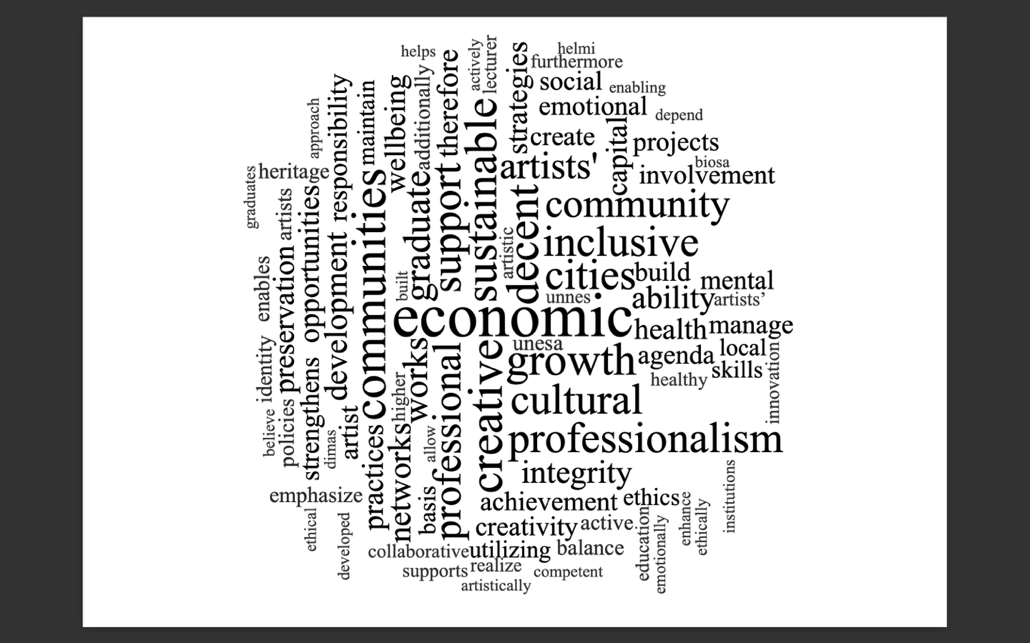
Figure 1 Word Cloud result
The words appearing in the word cloud visualization above were generated from the qualitative data analysis process, which focused on the roles of artists, graduates, and creative communities in promoting sustainable and inclusive professional practices. This visualization highlights dominant words such as “economic,” “community,” “creative,” “professionalism,” “cultural,” “growth,” and “sustainable,” representing key discussions on cultural integrity, emotional well-being, the creative economy, and community empowerment. These keywords reflect how cultural professionalism and creative innovation intersect with the Sustainable Development Goals (SDGs), particularly SDG 3 (Good Health and Well-being), SDG 8 (Decent Work and Economic Growth), and SDG 11 (Sustainable Cities and Communities). Based on the analysis results, the words can be grouped into five main themes as follows.
Table 7 Emerging subthemes
No |
Supporting keywords |
Emerged subtheme |
1 |
“professionalism,” “integrity,” “ethics,” “achievement,” “responsibility,” “education” |
Cultural Capital Integrity as the Basis of Professionalism – Culturally rooted professionalism emphasizes the importance of integrity, work ethics, and social responsibility. Graduates and artists are expected to use cultural values as moral foundations in their creative and professional contributions to society. |
2 |
“emotional,” “mental,” “wellbeing,” “social,” “healthy,” “creative practices” |
Mental and Emotional Well-being through Creative Practices (SDG 3) – Creative activities play a vital role in maintaining mental health and emotional balance. Through artistic expression, individuals can manage social pressures, foster happiness, and enhance their overall sense of well-being. |
3 |
“economic,” “growth,” “creative,” “skills,” “decent,” “projects,” “employment” |
Creation of Creative Economic Opportunities and Decent Work (SDG 8) – The creative economy opens new pathways for sustainable economic growth and the creation of decent employment. Innovation and skill development are key to fostering ethical and productive work opportunities within creative sectors. |
4 |
“community,” “inclusive,” “cities,” “sustainable,” “heritage,” “preservation,” “empowerment” |
Cultural Preservation and Community Empowerment (SDG 11) – Sustainable cities and creative communities require collaboration across sectors to safeguard cultural heritage, strengthen local identity, and create inclusive, empowered spaces for collective development. |
5 |
“creativity,” “balance,” “ethics,” “responsibility,” “integrity,” “innovation” |
Balancing Creativity, Ethics, and Social Responsibility – Creativity must coexist with ethical values and social responsibility. Artists and creative professionals are expected to produce works that are not only innovative but also contribute to moral, social, and ecological balance in society. |
The words that appeared in the word cloud above reflect qualitative data analysis focusing on the roles of artists, graduates, and creative communities in promoting sustainable and inclusive professional practices. These terms are related to integrity values, emotional well-being, the creative economy, and community empowerment. This perspective is supported by informants from various Indonesian higher arts institutions, including UNESA, UNNES, ISI Yogyakarta, ISI Surakarta, and IKJ. In the theme of cultural capital integrity as the basis of professionalism, Curator 1 (UNESA graduate) emphasized that artists’ professionalism is determined not only by technical skills but also by moral responsibility in managing their practice, artworks, and professional networks. According to him, integrity forms the foundation for credibility and sustainable artistic careers (FGD, 2025). Artist 1 (UNNES graduate) added that professionalism should be grounded in honesty and ethical awareness, with artists understanding the social value of their works and committing to responsible creation for positive societal impact (FGD, 2025). Lecturer 1 (UNESA) further highlighted the importance of higher education institutions instilling integrity institutionally, noting that art education should produce graduates who are not only artistically competent but also ethical and socially oriented (FGD, 2025).
In the context of mental and emotional well-being through creative practices, FGDs results indicate that creative practice plays a critical role in maintaining artists’ mental and emotional balance. Artist 2 (ISI Yogyakarta graduate) explained that reflective creative processes provide a contemplative space for artists to understand themselves, express emotions, and achieve inner balance. Sustained artistic practice enables artists not only to produce work but also to maintain psychological stability that benefits individual and social well-being (FGD, 2025). Similarly, Artist 3 (ISI Surakarta graduate) emphasized the importance of collaborative dimensions in creative practice for maintaining mental health and building empathy among artists. Collaborative creative processes strengthen social bonds, foster mutual support, and contribute to collective well-being in the arts community (FGD, 2025). This aligns with SDG 3 – Good Health and Well-being, which emphasizes psychological well-being through positive and collaborative activities.
Regarding the creation of creative economic opportunities and decent work, the FGDs results show that artist professionalism is also determined by managerial skills, work management, and sustainable professional networking. Curator 1 (UNESA graduate) stressed that artists’ ability to manage works and build professional networks is key to generating creative economic opportunities. He emphasized that contemporary artists need business awareness so that their work holds not only aesthetic value but also economic significance supporting career sustainability (FGD, 2025). Artist 4 (IKJ graduate) added that generating creative economic opportunities is crucial for providing decent work for artists. Combining creativity with entrepreneurship can drive inclusive and productive economic growth, in line with SDG 8 – Decent Work and Economic Growth (FGD, 2025). Lecturer 1 (UNESA) highlighted that ethical work management is essential for sustainable professionalism, emphasizing that creative economic success should be grounded in integrity, social responsibility, and respect for copyright to ensure fair and ethical growth in the arts ecosystem (FGD, 2025).
In the context of cultural preservation and community empowerment, the FGDs highlights the role of artists as social agents in community development and cultural preservation. Artist 1 (UNNES graduate) stressed the importance of artist involvement in community-based art activities to strengthen local cultural identity. Artistic practice, she noted, is not only about individual expression but also about maintaining the continuity of traditional values amid societal change (FGD, 2025). Artist 3 (ISI Surakarta graduate) emphasized that participation in community art projects serves as a means of social empowerment, facilitating collaboration between artists and communities to create inclusive, safe, and sustainable cities and communities, aligning with SDG 11 – Sustainable Cities and Communities (FGD, 2025). In the context of balancing creativity, ethics, and social responsibility, Artist 4 (IKJ graduate) asserted that artists’ professionalism must be grounded in social responsibility so that works are not only aesthetically pleasing but also ethically sound (FGD, 2025). Artist 2 (ISI Yogyakarta graduate) emphasized that balancing ethics, integrity, and creativity safeguards professional sustainability and ensures that artistic contributions support the achievement of the Sustainable Development Goals (FGD, 2025).
Overall, this discussion underscores that the development of post-graduation artist professionalism cannot be separated from the role of higher arts education institutions and government policy support. The integration of integrity values, emotional well-being, creative economic capacity, and commitment to cultural preservation should form the foundation for establishing a sustainable professional ecosystem. This effort requires synergy between arts education institutions, creative communities, and the Ministry of Culture to create career development systems, professional networks, and affirmative policies that strengthen competitiveness and enable artists to contribute meaningfully to the achievement of the Sustainable Development Goals (SDGs). Based on these findings, the following policy recommendations are proposed as strategic directions for developing post-graduation artist professionalism in support of SDGs:
The proposed strategic recommendations reflect an integrated framework to strengthen the professionalism of arts graduates through the enhancement of cultural capital integrity in alignment with the Sustainable Development Goals (SDGs). This approach emphasizes a balance between professional ethics, emotional well-being, creative economic empowerment, and socio-cultural sustainability. Strengthening arts education and curricula oriented toward integrity and professional ethics, as highlighted by Kalfas et al. (2024) and Malisiova & Kostopoulou (2024), can generate equitable economic value when supported by ethical professionalism and an adaptive cultural ecosystem. In line with this, Salvador and Comunian (2024) assert that ethics- and professionalism-based arts education fosters intellectual integrity and creative accountability, forming the foundation for the creation of decent and socially equitable creative work, while simultaneously supporting SDG 4 (Quality Education) and SDG 8 (Decent Work and Economic Growth).
Artists’ emotional and psychological well-being also constitutes a crucial aspect in reinforcing human-centered professionalism. Golden et al. (2024) and Dow et al. (2023) highlight the role of artistic practice as an effective non-pharmacological intervention for mental health, while Newman et al. (2013) explain that the interconnection between artistic expression and psychological well-being reflects the achievement of SDG 3 (Good Health and Well-being). Moreover, the sustainability of the creative economy and cultural funding policies form part of strengthening an independent and innovative arts ecosystem. Pratono et al. (2023) and Yan and Liu (2023) emphasize the importance of cultural capital integrity in maintaining the resilience of the creative industry through ethical governance and innovation. Developing creative incubators, artist grant systems, and access to sustainable funding are concrete strategies to support SDG 8 and SDG 9 (Industry, Innovation, and Infrastructure) through the integration of social innovation and cultural responsibility.
Table 8 Strategic policy recommendations
No |
Strategic aspects |
Policy recommendation |
1 |
Arts Education and Curriculum |
Encourage the renewal of arts curricula based on professional competence, work ethics, and socio-cultural sensitivity to prepare graduates for the dynamics of the creative industry and community needs. |
2 |
Strengthening Integrity and Professional Ethics |
Establish ethical standards and professional certification for artists to reinforce social responsibility, artistic honesty, and the credibility of arts graduates in the workforce. |
3 |
Emotional and Psychological Well-being Support for Artists |
Provide psychological counseling and art therapy programs to help graduates maintain emotional balance when facing professional and creative pressures. |
4 |
Empowerment of Creative Economy and Arts Entrepreneurship |
Develop an artistic entrepreneurship ecosystem through creative business training, art incubators, and partnerships with the creative industry to strengthen the economic independence of young artists. |
5 |
Empowerment of Arts Communities |
Strengthen the role of arts graduates in social development through community-based art projects and the preservation of local cultural values in a collaborative manner. |
6 |
Cultural Policy and Funding |
Formulate incentive policies and sustainable funding schemes for emerging artists while encouraging cross-institutional collaboration to ensure equitable access to artistic and cultural resources. |
7 |
Arts-based Research and Innovation |
Reinforce artistic research addressing social and environmental issues, and promote artistic innovation as a creative solution supporting the Sustainable Development Goals (SDGs). |
8 |
Strengthening Collaboration and Professional Networks |
Establish professional networks among alumni, art institutions, and the creative industry to expand employment opportunities, knowledge exchange, and global collaborations for Indonesian artists. |
Furthermore, the empowerment of arts communities, preservation of cultural heritage, arts-based research, and the strengthening of professional networks play strategic roles in realizing social and collaborative sustainability. Nursanty (2024) and Suriyankietkaew et al. (2025) indicate that the preservation of living heritage and community participation reinforce local identity while supporting SDG 11 (Sustainable Cities and Communities). Casals-Alsina (2023) adds that artists act as agents of creative regeneration and cultural value preservation. In the context of cross-institutional collaboration, El Faouri and Sibley (2024) along with Kalfas et al. (2024) assert that flexible and participatory cultural governance can expand the reach of creative partnerships, supporting SDG 17 (Partnerships for the Goals). Overall, these strategies strengthen the interconnections between ethical professionalism, emotional well-being, sustainable innovation, cultural preservation, and cross-sector collaboration, positioning cultural capital as a collective force for building an inclusive, resilient, and sustainable arts ecosystem—and providing a foundation for higher arts education and cultural policies that comprehensively support the achievement of the SDGs.
Conclusion
The professionalism of artists among arts graduates in Indonesia is rooted in the integration of three forms of cultural capital—embodied, objectified, and institutional—which shape creative capacity, social legitimacy, and career sustainability. The integrity of cultural capital serves as a key mechanism linking aesthetic value with social responsibility and professional ethics, ensuring that artistic practice not only produces aesthetically valuable works but also contributes to the psychological, economic, and social well-being of society. In the context of the Sustainable Development Goals (SDGs), artist professionalism supports SDG 3 (Good Health and Well-being) by enhancing mental and emotional well-being; SDG 8 (Decent Work and Economic Growth) by creating fair and sustainable creative work ecosystems; and SDG 11 (Sustainable Cities and Communities) through cultural preservation and the empowerment of inclusive creative communities.
This study highlights the need for strategic efforts to strengthen artist professionalism based on cultural capital integrity and cross-sector collaboration. Higher arts education institutions play a strategic role in instilling professional ethics, creative entrepreneurial competencies, and social awareness among graduates, enabling them to adapt to the dynamics of the global creative industry. Public policy support in the form of sustainable funding, professional certification systems, and incentives for community-based art projects is crucial for building a resilient and equitable arts ecosystem. Therefore, the development of sustainability-oriented artist professionalism not only strengthens the competitiveness of the cultural sector but also positions the arts as a pillar of national development, contributing directly to the achievement of the Sustainable Development Goals (SDGs).
Despite its conceptual and practical contributions, this study has several limitations. The qualitative design using FGDs with participants from five higher arts education institutions in Indonesia limits the generalizability of the findings to other contexts. The data rely on participants’ perceptions and may be influenced by subjective interpretation, and the integration of SLR and FGDs does not quantitatively examine causal relationships between cultural capital and SDG outcomes. Future research should involve broader participant groups, including independent artists, policymakers, and creative industry stakeholders, and apply quantitative or mixed-method approaches to assess measurable impacts on economic sustainability, mental well-being, and community development. Longitudinal studies are also recommended to examine the evolution of cultural capital and the role of institutional support in sustaining artists’ professional trajectories within the SDG framework.
Declaration of Generative AI in Scientific Writing
Generative AI tools were used only to improve the readability and language quality of this manuscript. The tools assisted in manuscript translation, grammar checking, language polishing, sentence paraphrasing, terminology consistency, and transitional sentence construction during the manuscript preparation process. The estimated contribution of AI-assisted language support was approximately 15%, limited solely to language editing and technical writing assistance. All AI-assisted outputs were carefully reviewed and edited by the authors with full human oversight and control. The authors remain fully responsible for the content of this manuscript. Generative AI tools were not used in the research design, data collection, data analysis (including NVivo processing), interpretation of results, or the formulation of conclusions, and no AI tools are listed as authors or co-authors.
CRediT Author Statement
Wening Hesti Nawa Ruci: Conceptualization, Methodology, Formal analysis, Investigation, Writing- Original draft preparation, Project administration. Muchlis Arif: Investigation, Data curation, Writing- Reviewing and Editing. Nur Wakhid Hidayatno: Methodology, Validation, Visualization, Writing- Reviewing and Editing. Fathoni Setiawan: Resources, Supervision, Writing- Reviewing and Editing.
References
Aritenang, A. F., & Nathania, F. (2025). Pentahelix in the creative city: the case of fine arts development in South Jakarta, Indonesia. Creativity Studies, 18(2), 433-452.
Azagra-Caro, J. M., Benito-Amat, C., & Planells-Aleixandre, E. (2022). Academic artists’ engagement and commercialisation. The Journal of Technology Transfer, 47(4), 1273-1296.
Baldini, A. (2022). Artists as workers: Rethinking creativity in a post-pandemic world. Rivista di Estetica, 79, 33-48.
Benison, T., Le, T., & Grimes, A. (2025). Wellbeing and the arts: A concise survey with new findings. Applied Research in Quality of Life, 20, 1975–1989.
Benison, T., Le, T., & Grimes, A. (2025). Wellbeing and the arts: A concise survey with new findings. Applied Research in Quality of Life. Advance online publication.
Bennett, D., Reid, A., & Petocz, P. (2014). Creative workers’ views on cultural heritage and sustainability. Journal of Aesthetics & Culture, 6, 24476.
Borowiecki, K. J., & Law, M. T. (2025). Psychological capital, effort costs, and creativity: the trajectories of artistic careers. Journal of Cultural Economics. Advance online publication.
Bourdieu, P. (1986). The forms of capital. In J. G. Richardson (Ed.), Handbook of theory and research for the sociology of education (pp. 241–258). New York, NY: Greenwood Press.
Bursiewicz, N. (2025). Artist-led regeneration in Polish cities: Shaping community through public art. Arts, 14(5), 103.
Casals-Alsina, È. (2024). Can the ‘creative city’ be sustainable? Lessons from the Sant Martí district (Barcelona). International Journal of Cultural Policy, 30(4), 511-528.
Cerisola, S., & Panzera, E. (2021). Cultural and creative cities and regional economic efficiency: Context conditions as catalyzers of cultural vibrancy and creative economy. Sustainability, 13(13), 7150.
Cicchiello, A. F., Gallo, S., & Monferrà, S. (2023). Financing the cultural and creative industries through crowdfunding: the role of national cultural dimensions and policies. Journal of Cultural Economics, 47(1), 133-175.
Coda Moscarola, F., Ricci, A., & Vecco, M. (2026). Should I stay or should I go? Early stages in performing artistic careers. Journal of Cultural Economics, 50(1), 81–103.
Creswell, J. W., & Poth, C. N. (2018). Qualitative inquiry and research design: Choosing among five approaches (4th eds.). Thousand Oaks, CA: SAGE Publications.
Daykin, N., Mansfield, L., Meads, C., Gray, K., Golding, A., Tomlinson, A., & Victor, C. (2021). The role of social capital in participatory arts for wellbeing: findings from a qualitative systematic review. Arts & Health, 13(2), 134-157.
Denzin, N. K., & Lincoln, Y. S. (Eds.). (2018). The SAGE handbook of qualitative research (5th eds.). Thousand Oaks, CA: SAGE Publications.
Dow, R., Warran, K., Letrondo, P., & Fancourt, D. (2023). The arts in public health policy: progress and opportunities. The Lancet Public Health, 8(2), e155-e160.
El Faouri, B. F., & Sibley, M. (2024). Balancing social and cultural priorities in the UN 2030 sustainable development goals (SDGs) for UNESCO world heritage cities. Sustainability, 16(14), 5833.
Falagas, M. E., Pitsouni, E. I., Malietzis, G. A., & Pappas, G. (2008). Comparison of PubMed, Scopus, Web of Science, and Google Scholar: strengths and weaknesses. The FASEB Journal, 22(2), 338-342.
Flick, U. (2022). An introduction to qualitative research (7th eds.). Thousand Oaks, CA: SAGE Publications.
Ganga, R. N., Davies, L., Wilson, K., & Musella, M. (2025). The social value of place‐based creative wellbeing: A rapid review and evidence synthesis. Sociology of Health & Illness, 47(1), 1-23.
Gilan, N. R., Mohamadi, J., Irankhah, A., Khezeli, M., & Zangeneh, A. (2023). Review of the effect cultural capital and subjective socioeconomic status on life satisfaction in Iran: the mediating role of health-promoting lifestyle and the moderating role of ethnicity. BMC Public Health, 23(1), 2563.
Golden, T. L., Ordway, R. W., Magsamen, S., Mohanty, A., Chen, Y., & Ng, T. W. C. (2024). Supporting youth mental health with arts-based strategies: A global perspective. BMC Medicine, 22(1), 1-7.
Grau Pérez, G. (2025). Cultural and creative networks as enabling contexts for artistic research. European Journal of Cultural Management and Policy, 14, 13061.
Gueniffey, B., & Sakamura, K. (2025). Operationalization of the creative city concept in Japan: A comparative review with a special focus on kanazawa and environmental sustainability. Sustainability, 17(13), 6127.
Hansen, S. (2022). The role of street art in sustainable development: Art and social change. Street Art & Urban Creativity, 8(2), 132-143.
Haugsevje, Å. D., & Heian, M. T. (2024). Sustainable creative careers through mentoring: Understanding social resilience in the art field. Poetics, 107, 101930.
Hendri, Z., Tu, J. C., Creativani, K., & Setiaji, R. S. (2024). University- creative industry linkages in art and design higher education: Insights from Indonesia and Taiwan. Journal of Higher Education Theory and Practice, 23(20), 206-215.
Heras, M., Galafassi, D., Oteros-Rozas, E., Ravera, F., Berraquero-Díaz, L., & Ruiz-Mallén, I. (2021). Realising potentials for arts-based sustainability science. Sustainability Science, 16(6), 1875-1889.
Ibrahim, D., Mohd Ghani, K., Mohd Yusof, M. Y., Yunos, Y., & Supar, M. S. (2023). Community-based art program: Integrating SDG’s elements as context in community empowerment. International Journal of Academic Research in Business and Social Sciences, 13(12), 426-442.
Iswahyudi. (2024). Accountability of fine arts and design education graduates in Indonesia in responding to the needs of the job market in the second decade of the 21st century. Journal of Social and Political Sciences, 7(3), 26-35.
Jackson, K., & Bazeley, P. (2013). Qualitative data analysis with NVivo. Thousand Oaks, CA: SAGE Publications.
Jaohari, E. J., Karyono, T., & Purwanto, A. (2025). Pola asuh seniman Sunda dalam pembentukan profesionalisme mahasiswa musik. Grenek Music Journal, 14(1), 27-37.
Kalfas, D., Kalogiannidis, S., Ambas, V., & Chatzitheodoridis, F. (2024). Contribution of the cultural and creative industries to regional development and revitalization: A European perspective. Urban Science, 8(2), 39.
Kerrigan, S., Grushka, K., Chand, A., Street, K., Shadbolt, J., & Lawry, M. (2023). Creative industries careers: shifting aspirations and pathways from high school to university—a NSW case study. The Australian Educational Researcher, 50(5), 1663-1681.
Killingsworth, J. (2021). Unifying sustainable development goals: How cultural and creative engagement are the missing links to advancement. European Journal of Sustainable Development, 10(3), 291.
Kirchberg, V., & Kagan, S. (2013). The roles of artists in the emergence of creative sustainable cities: Theoretical clues and empirical illustrations. City, Culture and Society, 4(3), 137-152.
Komorowski, M., & Lewis, J. (2023). The creative and cultural industries: Towards sustainability and recovery. Sustainability, 15(13), 9923.
Kurniawan, M. N. (2019). Rethinking art, design, and cultural history for the Indonesian design education and creative economy. Humaniora, 10(2), 135-143.
Kuznetsova-Bogdanovitsh, K., & Ranczakowska, A. M. (2025). Knowledge co-creation in arts universities: the role of entrepreneurial mindset and communities of practice. European Journal of Cultural Management and Policy, 14, 13872.
Malisiova, S., & Kostopoulou, S. (2024). Synergies of cultural–creative industries and development in peripheral areas: Networking, social capital, and place. Heritage, 7(8), 4500-4519.
Manurung, R. U., & Rohmiyati, Y. (2019). Kontribusi arsip seni bagi pengembangan profesi seniman di Indonesian Visual Art Archive (IVAA) Yogyakarta. Jurnal Ilmu Perpustakaan, 8(3), 49-58.
Martín-Martín, A., Orduna-Malea, E., Thelwall, M., & Delgado López-Cózar, E. (2018). Google Scholar, Web of Science, and Scopus: A systematic comparison of citations in 252 subject categories. Journal of Informetrics, 12(4), 1160-1177.
Mongeon, P., & Paul-Hus, A. (2016). The journal coverage of Web of Science and Scopus: A comparative analysis. Scientometrics, 106(1), 213-228.
Mycoo, M. A., & Bharath, K. (2021). Sustainable development goal 11 and a new urban agenda for Caribbean Small Island Developing States: Policy, Practice, and Action. Frontiers in Sustainable Cities, 3, 554377.
Naheed, S., & Shooshtarian, S. (2022). The role of cultural heritage in promoting urban sustainability: A brief review. Land, 11(9), 1508.
Newman, A., Goulding, A., & Whitehead, C. (2013). How cultural capital, habitus and class influence the responses of older adults to the field of contemporary visual art. Poetics, 41(5), 456-480.
Nirwana, A., Mukhlis, I., Murwani, F. D., & Nugroho, D. P. (2024). Instrumentalism, utilitarianism, arts entrepreneurship, and digital cosmopolitanism as a global perspective of Indonesian emerging artists. Scholars Journal of Arts, Humanities and Social Sciences, 12(04), 134-146.
Noonan, D. S. (2021). Arts and cultural entrepreneurship. Small Business Economics, 57(2), 635-638.
Nursanty, E. (2024). Cultural sustainability, uniqueness and the power of productive living heritage in Cirebon, Indonesia. Journal of Urban Culture Research, 28, 3-17.
Orb, A., Eisenhauer, L., & Wynaden, D. (2001). Ethics in qualitative research. Journal of Nursing Scholarship, 33(1), 93-96.
Pennill, N., Phillips, K., & Phillips, M. (2022). Student experiences and entrepreneurship education in a specialist creative arts HEI: a longitudinal approach. Entrepreneurship Education, 5(4), 399-423.
Pertiwi, L. C., & Yakti, P. D. (2023). Management and improvement of human resources oriented to global market competition: Case of Indonesia artist certification and professional standardization policy. Dia, 21(01), 435-448.
Pramono, S., Azmir, A. F., Aditia, Mahdania, H., & Rahmi. (2025). Arts and culture as a national competitive advantage in Indonesia: a systematic literature review. Discover Sustainability, 6, 639.
Pratono, A. H., Nawangpalupi, C. B., & Sutanti, A. (2023). Achieving sustainable development goals through digitalising creative works: some evidence from social enterprises in Indonesia. Digital Economy and Sustainable Development, 1, 11.
Puppe, L., Jossberger, H., Stein, I., & Gruber, H. (2020). Professional development in the visual arts. Vocations and Learning, 13(3), 389-417.
Putra, Z. A. W., Muryasari, D., & Medilianasari, R. (2024). Integrating ethnopedagogy and cultural arts education: Preserving Indonesia’s heritage in the globalized era. Indonesian Journal of Educational Research and Review, 7(3), 709-718.
Rausell-Köster, P., Ghirardi, S., Sanjuán, J., Molinari, F., & Abril, B. (2022). Cultural experiences in the framework of “cultural cities”: measuring the socioeconomic impact of culture in urban performance. City, Territory and Architecture, 9, 40.
Rodrigues, M., & Franco, M. (2018). Measuring the performance in creative cities: Proposal of a multidimensional model. Sustainability, 10(11), 4023.
Salvador, E., & Comunian, R. (2024). Why and how higher education is so important for cultural and creative industries’ sustainable development? Industry and Higher Education, 38(1), 6-13.
Sanjuán, J. (2025). How do cultural and creative industries shape wellbeing? A multidisciplinary review. European Journal of Cultural Management and Policy, 15, 14774.
Setianik, A. E., & Siswati, S. (2020). Pengalaman menjalani karier sebagai seniman lukis: sebuah interpretative phenomenological analysis. Jurnal Empati, 8(4), 748-757.
Silverman, D. (2024). Interpreting qualitative data (6th ed.). London, UK: SAGE Publications Ltd.
Spiro, N., Shaughnessy, C., Waddell, G., Perkins, R., Campbell, A., & Williamon, A. (2023). Modelling arts professionals’ wellbeing and career intentions within the context of covid-19. PLOS ONE, 18(10), e0292722.
Suriyankietkaew, S., Krittayaruangroj, K., Thinthan, S., & Lumlongrut, S. (2025). Community capitals framework for sustainable development: A qualitative study of creative tourism in Ban Chiang World Heritage Site. Sustainability, 17(8), 3311.
Svensson, L. G. (2015). Occupations and professionalism in art and culture. Professions and Professionalism, 5(2), 1-14.
Tracy, S. J. (2020). Qualitative research methods: Collecting evidence, crafting analysis, communicating impact. Hoboken, NJ: John Wiley & Sons, Inc.
Vigerland, L., & Borg, E. A. (2018). Cultural capital in the economic field: A study of relationships in an art market. Philosophy of Management, 17(2), 169-185.
Wang, J., Huang, L., & Zhang, Y. (2025). The important role of higher art education in promoting the sustainable development of aesthetic education in Chinese universities. Asia Pacific Education Review. Advance online publication.
Wong, H. Y. H., & Chan, C. K. Y. (2024). Conceptualising arts entrepreneurship education: bridging the arts and entrepreneurship within higher education settings. Entrepreneurship Education, 7(1), 21-40.
Woronkowicz, J. (2024). The value of an arts degree: Career success and inequality. American Behavioral Scientist, 68(11), 1536-1553.
Wyszomirski, M., & Chang, W. (2017). Professional self-structuration in the arts: Sustaining creative careers in the 21st century. Sustainability, 9(6), 1035.
Yan, W.-J., & Liu, S.-T. (2023). Creative economy and sustainable development: Shaping flexible cultural governance model for creativity. Sustainability, 15(5), 4353.
Zeng, X., Ortner, F., & Tunçer, B. (2025). Systematic review of the role of arts places in fostering urban sustainability and resilience. Sustainability, 17(5), 2076.
Zhou, Y., Sanz-Hernández, A., & Hernández-Muñoz, S. M. (2024). Artistic interventions in urban renewal: Exploring the social impact and contribution of public art to sustainable urban development goals. Societies, 14(10), 204.