
Trends
Sci.
2026;
23(11):
13096
Stability of Red Palm Oil Encapsulated with Spirulina Protein Concentrate-Carrageenan Conjugates
Ayu Aprilia, Arima Diah Setiowati* and Chusnul Hidayat
Departement of Food and Agriculture Product Technology, Faculty of Agricultural Technology, Universitas Gadjah Mada, Yogyakarta 55281, Indonesia
(*Corresponding author's e-mail: [email protected])
Received: 19 December 2025, Revised: 16 January 2026, Accepted: 26 January 2026, Published: 30 May 2026
Abstract
Red palm oil (RPO) is rich in carotenoids but is highly susceptible to oxidative degradation during processing and storage. This study investigated the use of a spirulina protein concentrate-carrageenan conjugate as a wall material for the spray-drying microencapsulation of RPO. The effect of oil-to-wall material ratio on encapsulation efficiency and storage stability was evaluated. The highest encapsulation efficiency was achieved at an oil-to-wall material ratio of 1:3, where microcapsules prepared with conjugates showed significantly higher encapsulation efficiency (72.13%) than those prepared with a simple mix (51.69%). During 42 days of storage at 30, 40, and 50 °C, conjugate-based microcapsules exhibited better carotenoid retention and antioxidant stability. Carotenoid degradation followed a zero-order kinetic model, with the longest half-life (83 days) observed at 30 °C. In situ intestinal perfusion analysis demonstrated high carotenoid absorption from the microcapsules, with approximately 88% absorbed. Overall, the results indicated that the SPC–CG conjugates improved wall material performance by enhancing encapsulation efficiency, storage stability, and carotenoid bioavailability. This study demonstrated the potential application of spirulina protein concentrate and carrageenan conjugates as effective wall materials for stabilizing lipid-soluble bioactive compounds in functional food systems.
Keywords: Spirulina protein, Carrageenan, Maillard reaction, Microencapsulation, Red palm oil, Carotenoid degradation
Abbreviations: RPO: Red palm oil; SPC: Spirulina protein concentrate; CG: Carrageenan; SPC-CG Conjugate: SPC-CG SM; SM: Simple mix; MR: Maillard reactions; EE: Encapsulation efficiency; EA: Activation energy; MCJ: Microcapsule with SPC-CG conjugate; MSM: Microcapsule with simple mixture of SPC-CG.
Introduction
The plant-based food industry has experienced rapid growth in recent years [1]. This development has encouraged the exploration of plant-derived ingredients with functional properties, one of which is Spirulina platensis, a cyanobacterium rich in proteins, vitamins, minerals, and pigments such as chlorophyll and phycocyanin, known for its antioxidant activity [2-3]. In addition to its nutritional value, Spirulina has attracted increasing attention as a sustainable protein source for food applications due to its rapid growth and high protein yield [4-5].
However, despite being rich in essential amino acids, Spirulina protein is difficult to digest in its raw form (biomass) [6]. Therefore, processing techniques such as extraction are needed to improve its quality. A previous study by Purdi et al. [7] showed that ultrasound-assisted extraction (UAE) increased the protein content of Spirulina up to 76.83%, compared to the initial content in the biomass (46% - 55%), and simultaneously improved its digestibility. This process also enhanced the techno-functional properties of Spirulina, including water-holding capacity (WHC) and emulsifying ability [8].
As a protein, spirulina protein serves as a natural emulsifier, playing an important role in stabilizing emulsions by adsorbing at the oil-water interface and forming a protective layer around the oil droplets [9] To further strengthen emulsion stability, Spirulina protein can be modified through interactions with other polymers such as carrageenan [10]. Carrageenan is a hydrophilic polysaccharide commonly used to form stronger gel structures, increase viscosity, and act as a stabilizing agent for oil-in-water emulsions. When used as a single-component stabilizer, carrageenan has been reported to be less effective, as it can promote droplet aggregation and lower emulsion stability compared to mixed or composite systems. The interaction between proteins and carrageenan leads to the formation of a robust outer layer that prevents droplet aggregation of the encapsulated particles [11-13]. However, protein-polysaccharide systems formed through non-covalent interactions are often sensitive to environmental conditions such as pH and ionic strength, which may reduce emulsion stability [14].
This limitation can be overcome by forming covalent protein-polysaccharide conjugates via the Maillard reaction, which involves reactions between protein amino groups and polysaccharide carbonyl groups under controlled heating conditions. The resulting conjugates exhibit improved solubility, thermal stability, and emulsifying capacity [15-16]. These conjugates are amphiphilic, with the hydrophobic region of the protein attaching to oil droplets and forming an elastic interfacial layer, while the polysaccharide acts as a barrier against flocculation and coalescence [17]. Kusumastuti et al. [18] reported that Spirulina protein-carrageenan conjugates produced emulsions with small, more uniform droplet sizes and enhanced thermal and physical stability. Moreover, Maillard reaction products provide effective protection against lipid oxidation [19].
Red palm oil (RPO) is a natural source of carotenoids, including β-carotene and α-carotene, two provitamin A compounds [20]. RPO contains high levels of natural carotenoids with provitamin A and antioxidant activity. However, their conjugated double-bond structure makes them highly susceptible to oxidation and isomerization under oxygen, light, and heat during processing and storage [21]. Several studies have been conducted to preserve carotenoid stability in RPO, including microencapsulation techniques [22]. Microencapsulation is an effective method to protect bioactive compounds in oils from degradation during storage and processing by entrapping them within a protective matrix. This method creates a physical barrier between the core material and the external environment, forming small particles with diameters ranging from 1 to 100 μm [23-26]. The selection of an appropriate wall material is a critical factor determining the effectiveness and stability of microencapsulated systems. The use of protein-polysaccharide conjugates as wall materials has been shown to improve storage stability compared to a simple mix due to stronger interfacial layers that are more resistant to oxidation [17,27]. Microencapsulation of palm oil also improves the bioavailability of carotenoids in food products and reduces carotenoid loss during encapsulation processes [28]. Among the various microencapsulation methods, spray drying is the most used due to its efficiency, cost-effectiveness, and ability to enhance carotenoid stability [29]. Lee et al. [30] reported that microencapsulation of red palm oil using spray drying achieved an encapsulation efficiency of up to 79%, indicating that most of the oil was successfully entrapped in the protective matrix. In addition, spray drying has been reported to provide better protection of microcapsule color stability during storage than freeze-drying [31]. Understanding the degradation behavior of carotenoids during storage is essential for predicting shelf life and assessing the practical applicability of RPO microcapsules in food systems.
Although various proteins, such as soy protein isolate, whey protein, and pea protein, have been widely used as wall materials in microencapsulation [32-34], the application of Spirulina protein as a coating material remains limited. Previous studies involving spirulina protein have mainly focused on protein extraction, functional modification, and emulsion stabilization, rather than its application as a wall material for oil microencapsulation. Furthermore, based on the authorʼs literature review, no study has specifically reported the microencapsulation of red palm oil using Spirulina protein concentrate-carrageenan conjugates as the encapsulating wall material. In particular, there is a lack of studies evaluating the effects of wall material-to-oil ratio and storage conditions on the storage stability of carotenoid-containing microcapsules.
Therefore, this study aimed to investigate the microencapsulation of red palm oil (RPO) using Spirulina protein concentrate-carrageenan conjugates as wall materials via spray drying. The effects of oil-to-wall material ratio on the physicochemical characteristics, encapsulation efficiency, and stability of the microcapsules were evaluated. In addition, the storage stability of carotenoids in the microcapsules was investigated at different temperatures (30, 40, and 50 °C) to evaluate degradation behavior over time and to predict shelf-life.
Materials and methods
Material
Dried spirulina biomass was purchased from Paring, Yogyakarta, and stored at 4 ℃. Carrageenan powder was obtained from Indogum, Jakarta, Indonesia. Red palm oil (RPO) was purchased from a local market. Sodium dodecyl sulfate (SDS), beta-carotene standard, aquades, deionized water, HCL 1 N, NaOH 1 N, H₂SO₄ (Merck), indicator phenolphthalein, boric acid, OPA (Ortho-phthalaldehyde), methanol, ethanol absolute, buffer borax, β-mercaptoethanol, L-lysine, indicator BCGMR, sodium thiosulfate, catalyst (CuSO4 + K2SO4), and buffer phosphate pH 7 used in this study were all analytical grades. Rats (180 - 220 g, 8 - 12 weeks old) were used for the experiment and maintained under standard laboratory conditions.
Extraction of spirulina (Arthrospira platensis) protein
Protein extraction from spirulina powder (Arthrospira platensis) was carried out based on a modified method from Purdi et al. [7]. The extraction process used ultrasound-assisted extraction (UAE) with a probe-type sonicator (UP200St, Hielscher, Germany). The first step was to prepare the suspension solution. 8 g of dried spirulina biomass was mixed with deionized water until the total weight reached 60 g. The solution was stirred using a magnetic stirrer until fully homogeneous. The pH was adjusted to 12 with 1 N NaOH, and then water was added to bring the final weight to 100 g. Ultrasound extraction was performed using the sonicator at 80% amplitude and 60% duty cycle for 30 min, with the temperature set to 4 °C. After extraction, the solution was centrifuged at 7,000 rpm for 15 min to collect the supernatant. The supernatant was then adjusted to pH 3 with 1 N HCl and incubated overnight to precipitate the protein. The precipitated protein was collected by centrifugation and then neutralized to pH 7 using 1 N HCl and 1 N NaOH. Finally, the spirulina protein extract was dried using a spray dryer at 100 °C.
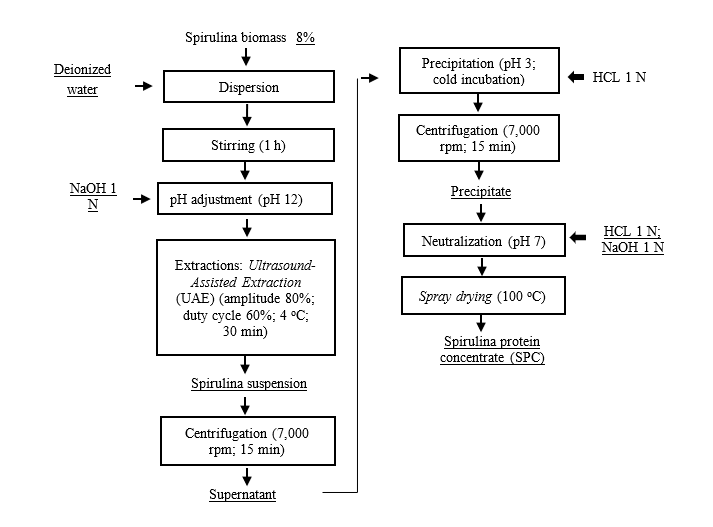
Figure 1 Flow diagram Spirulina biomass extraction process.
Preparation of SPC and carrageenan conjugate
The conjugation process between spirulina protein concentrate (SPC) and carrageenan (CG) was carried out using a wet-dry (hybrid) method developed in our previous study [18]. The ratio of SPC-CG used was 2:1. Both were dissolved in deionized water to obtain a 5% (w/w) hydrocolloid concentration (based on dry weight). The solution was then homogenized by stirring with an overhead stirrer at ± 35 °C and 750 rpm for 1 h. After homogenization, the pH was adjusted to 7.0 with 1 N HCl and 1 N NaOH to control the reaction better. Afterward, the mixture was dried using a food dehydrator (Wirastar FDH-8, WIRATECH) at 50 °C for 5 h. After drying, the conjugate was ground in a grinder, sieved, and stored under refrigeration prior to further analysis. For comparison, a physical SPC-CG mixture was prepared by blending SPC and CG without heat treatment. This physical mixture was formulated using the SPC:CG ratio that exhibited the optimal properties.
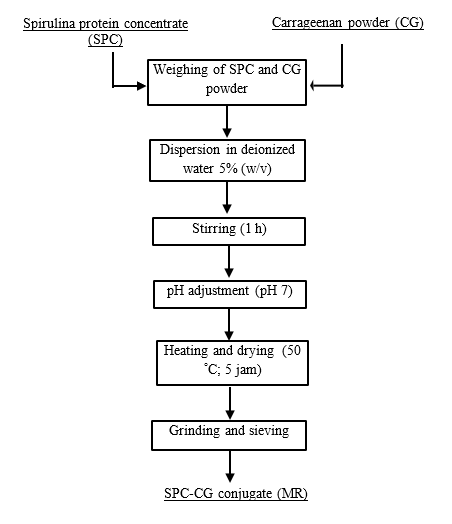
Figure 2 Flow diagram of SPC-CG conjugate preparation.
Determination of glycation degree (DG)
The ortho-phthalaldehyde (OPA) method was applied to evaluate the reduction in free amino groups of spirulina protein concentrate (SPC) during conjugation, which indicates the degree of glycation (DG) [35]. In this method, 40 mg of OPA was dissolved in 2 mL of methanol, then combined with 50 mL of 0.1 M borax buffer (pH 9.7), 5 mL of 20% (w/w) SDS solution, and 0.2 mL of β-mercaptoethanol. The mixture was then diluted with deionized water to a final volume of 100 mL. For analysis, 200 μL of conjugate solution (5 mg/mL) was added to 4 mL of OPA reagent, incubated at 35 °C for 2 min, and the absorbance was recorded at 340 nm using a UV-Vis spectrophotometer (UV-1800, Shimadzu, Kyoto, Japan). A standard curve of L-lysine was used to quantify the free amino group content, and the degree of glycation was calculated accordingly. The degree of glycation was calculated using the following Eq.(1)

where A0 represents the free amino group content of an unheated (simple mix of SPC-CG) (initial) and At represents the free amino group content of conjugates (MR) (heated, final reaction).
Emulsifying activity index (EAI) and emulsifying stability index (ESI)
The emulsifying properties of the conjugate samples were evaluated using a slightly modified method [18]. A solution of the conjugate with a concentration of 1 mg/mL (using a fixed protein-to-polysaccharide ratio of 2:1) was prepared by dissolving the conjugate in deionized water until the total weight reached 22.5 g. Then, 7.5 g of red palm oil (RPO) was added, and the mixture was homogenized using a digitas homogenizer (Ultra-Turrax T50, IKA, Staufen, Germany) at 10,000 rpm for 5 min to form a coarse emulsion. A 50 μL emulsion sample was collected from the bottom of the container at 0- and 10-minute using a pro pipette. Each sample was mixed with 5 mL of 0.1% SDS solution in a test tube. The absorbance was measured at 500 nm using a UV-VIS spectrophotometer (Shimadzu UV-Vis 1800), with 0.1% SDS as the blank control. The EAI and ESI values were calculated using the following Eqs. (2) - (3)
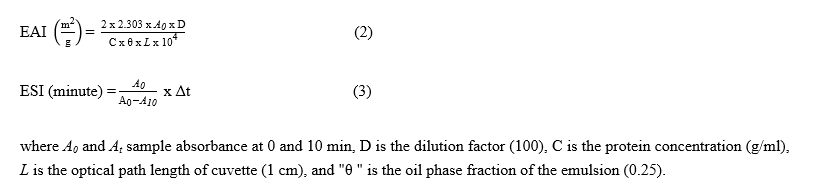
Thermal properties
The thermal properties of the sample conjugates and microcapsules were analyzed using differential scanning calorimetry (DSC) to observe structural changes and thermal stability of proteins during conjugation following a modified method from [36]. A sample of SPC-CG conjugates obtained via Maillard reaction (MR), a simple mixture of SPC-CG (SM), and native SPC were analyzed using a DSC instrument (DSC-60 Plus, Shimadzu, Japan). Each sample (3.0 mg) was placed in a hermetically sealed aluminium pan, while an empty sealed pan was used as the reference. Thermal analysis was carried out by heating the samples from 25 to 180 °C at a rate of 10 °C/min. For microcapsule samples, the method was adapted from Kaur et al. [37] with slight modifications. All microcapsule powder was analyzed at a heating rate of 10 °C/min under a nitrogen flow of 20 mL/min. Approximately 4 mg of each sample was accurately weighed and placed in a hermetically sealed aluminium pan, while an empty sealed pan was used as the reference. The samples were heated from room temperature 25 to 250 °C during the analysis.
Fourier-transform infrared spectrometer (FTIR)
FTIR analysis was carried out following the method of Chen et al. [38]. Powdered samples were directly analyzed using an ATR-FTIR spectrometer (Thermo Scientific Nicolet iS10, USA) without additional chemical treatment. Ethanol was used as the background to correct the spectra. The infrared spectra were recorded in the wavenumber range of 4,000 - 400 cm⁻¹ at a resolution of 4 cm⁻¹ with 64 scans per measurement. Each sample was analyzed in triplicate to ensure spectral reproducibility. Baseline correction was applied prior to spectral interpretation.
Microencapsulation of red palm oil (RPO)
Microencapsulation of red palm oil (RPO) was initiated by emulsification, followed by spray drying. First, emulsions were prepared by mixing RPO with an aqueous phase containing wall material (maillard reactions/simple mix) (3% w/w in deionized water) at oil-to-wall material ratios of 1:1, 1:2, and 1:3. The two phases were combined and stirred using a magnetic stirrer at 800 rpm for 1 h to ensure homogeneous dispersion. The resulting mixture underwent two-stage homogenization, first pre-homogenization using an Ultra-Turrax homogenizer (Ultra-Turrax T50, IKA, Staufen, Germany) at 10,000 rpm, 15 min at room temperature, followed by high-pressure homogenization (HPH), two stages at 350 bar (first stage) and 70 bar (second stage) to form a stable oil-in-water (O/W) emulsion [39]. The fine emulsion was then spray-dried at an inlet temperature of 200 °C to obtain the microencapsulated powder as reported in previous studies. The final product was stored in light-protected containers at 4 °C for further use.
Microcapsule stability during storage
The microencapsulated powder exhibiting the highest encapsulation efficiency was selected for storage stability evaluation over 42 days (6 weeks). The samples were stored in amber glass bottles at three temperatures (30, 40, and 50 °C) to simulate accelerated degradation scenarios and assess storage stability and degradation kinetics. Microcapsules prepared using the simple mixture of SPC-CG (MSM) were included for comparison. Samples were collected at 7-day intervals to evaluate total carotenoid content, antioxidant activity, and moisture content, thereby assessing storage stability [40]. All measurements were performed in duplicate.
Encapsulation efficiency analysis
Efficiency encapsulation (EE) was determined using the method described by Jarunglumlert et al. [41]. The carotene was extracted using hexane. 0.1 g of dried powder was dispersed in 10 mL of hexane and stirred. The absorbance of the solution was then measured using a UV-visible spectrophotometer (Shimadzu UV-Vis 1280). The absorbance after stirring the powder in hexane for 5 min at 100 rpm was used to determine the amount of free carotene, while the absorbance measured after 5 h of stirring at 800 rpm was used to determine the total amount of encapsulated carotene. The calculation of encapsulation efficiency was performed using equations reported by Anand et al. [42]:

Scanning electron microscopy (SEM)
The morphology and surface structure of the microcapsule powder were analyzed using Scanning Electron Microscopy (SEM, Model JSM-6510LA, JEOL, Japan) equipped with an Energy Dispersive X-Ray Spectroscopy (EDX) system. The instrument has a resolution range of 1 - 10 nm and a magnification capability of up to 5,500 .
Particle size distribution and zeta potential of the rehydrated microcapsules
The particle size distribution of microcapsule RPO was determined using Dynamic Light Scattering (DLS) instrument (Litesizer 700, Anton Paar, Germany). A suspension of microcapsule RPO was prepared by dispersing 10 mg of powder in 10 mL phosphate buffer solution pH 7, followed by stirring 15 min. The instrument provided data on the average particle size, particle distribution, and zeta potential of the samples.
Determination of antioxidant activity
The antioxidant activity was determined using the 1,1-diphenyl-2-picrylhydrazil (DPPH) free radical method with slight modification [43]. The sample was first dissolved in methanol to a final concentration of 5 mg/5mL. Subsequently, 1 mL of this solution was mixed with 1 mL of 0.1 mM DPPH solution. The mixture was incubated in the dark for 30 min, and the absorbance was then measured at 517 nm using a UV-Vis spectrophotometer. The DPPH radical scavenging activity was calculated using Eq. (5), in which A is the absorbance, and RSA is the radical scavenging activity.

In situ intestinal absorption study
The in-situ bioavailability test was carried out based on a modified version of the method with slight modifications [44]. Rats were anesthetized using ketamine, and a segment of the small intestine, around 10 cm long, was carefully isolated and cannulated at both ends using plastic tubing. During the procedure, a heat lamp was used to maintain the rats body temperature. The intestinal segment was flushed with 0.9% NaCl solution until the outflow appeared clear. Then, the segment was connected to a perfusion system using a peristaltic pump set at a flow rate of 0.25 mL/min. The perfusion fluid was prepared by dissolving 0.75 g of the microcapsule powder in 30 mL of solution. After the perfusion process was completed, the outflow fluid was collected and centrifuged at 4,000 rpm for 10 min at 4 °C. The supernatant was then analyzed using a UV-Vis spectrophotometer at 450 nm to determine the amount of carotene absorbed and assess the in-situ bioavailability.
Statistical analysis
All experiments were conducted in triplicate, and the results were expressed as mean ± standard deviation. Data were analyzed using SPSS statistical software (version 25.0, IBM Corp., Armonk, NY, USA). One-way analysis of variance (ANOVA) followed by Tukeyʼs post hoc test was used to determine significant differences among the mean values at a 95% confidence level (p < 0.05).
Results and discussion
Characteristics of wall materials
In the first stage of this study, the conjugate and physical mixture were characterized by evaluating emulsifying activity, emulsion stability, and degree of glycation, as presented in Table 1.
Table 1 EAI, ESI and DG of SPC-CG conjugates (MR) and a simple mixture of SPC-CG (SM).
| Sample | EAI (m2/g) |
ESI (minute) |
Degree of Glycation (%) |
|---|---|---|---|
| MR | 123.51 ± 0.81b | 25.89 ± 0.06a | 33.39 ± 5.95 |
| SM | 96.85 ± 0.14a | 20.54 ± 0.15b |
Data are presented as mean ± standard deviation (n=3). Different superscript letters indicate significant differences (p < 0.05).
SPC-CG conjugate (MR) showed a DG of 33.39%, consistent with the findings of [20]. According to Martinez-Alvarenga et al. [45], the temperature is the most influential factor in the Maillard reaction, followed by humidity and reaction time, while the molar ratio of protein to polysaccharide has comparatively less effect. In this study, MR significantly (p < 0.05) increased EAI and ESI to 123.51 ± 0.81 m²/g and 25.89 ± 0.06 min, respectively, suggesting enhanced interfacial adsorption and resistance to droplet coalescence [46-47]. Protein-polysaccharide conjugates can effectively adsorb at the oil-water interface due to their amphiphilic properties [15], with improved solubility and interfacial stability compared to pure proteins [18].
This conjugation also promotes steric and electrostatic stabilization in emulsions, preventing flocculation and coalescence [48]. Ba et al. [49] emphasized that such amphiphilic conjugates form a stable physical barrier at the oil-water interface. Additionally, smaller oil droplets generated by conjugated proteins contribute to better emulsion stability due to increased surface area for interfacial interaction [39]. Thus, the observed improvements in EAI and ESI confirm that Maillard-based conjugation is an effective strategy to enhance the emulsifying function of natural proteins.
The enhanced DG correlated with a significant improvement in both the Emulsifying Activity Index (EAI) and Emulsion Stability Index (ESI), indicating that glycation effectively improved the interfacial activity and emulsion-forming capability of the protein. This improvement is attributed to structural changes in the protein that increase its hydrophilicity and surface activity, enabling more efficient adsorption at the oil-water interface. Similar enhancements have been reported by Wen et al. [50], who showed that soy protein glycation with lentinan under wet-heating conditions improved both foam and solubility properties, especially when combined with ultrasound treatment to further increase glycation.
FTIR (fourier transform infrared spectroscopy)
FTIR analysis was used to elucidate the structure of the wall materials and microcapsules. Molecular interactions between functional groups can be identified through spectral changes, such as the appearance of new peaks, shifts in peak positions, or changes in absorption band intensity [51]. This analysis was conducted to confirm the occurrence of chemical interactions between Spirulina protein concentrate and carrageenan during conjugation, as well as to evaluate the successful incorporation of red palm oil into the microcapsule matrix. The FTIR spectrum illustrates the functional groups of the wall materials and provides evidence of chemical interactions within the microcapsule matrix.
CG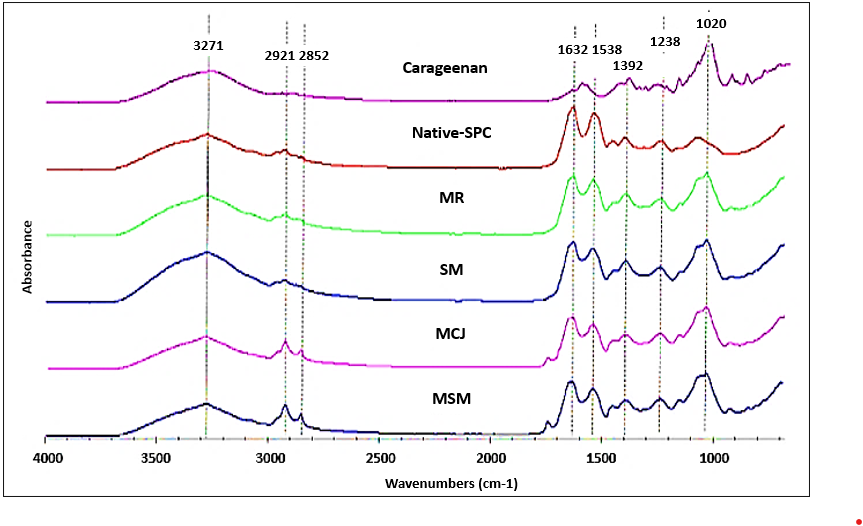

Figure 3 FTIR spectra of CG, native SPC, SPC-CG conjugates (MR), simple mixture of SPC-CG (SM), microcapsule prepared with MR (MCJ), and microcapsule prepared with SM (MSM).
All samples exhibited a strong absorption band in the region of 3,200 - 3,400 cm⁻¹, corresponding to the stretching vibrations of -OH and -NH groups, which are characteristic of polysaccharides and proteins [52]. In the MR sample, the broad band at 3,200 - 3,400 cm⁻¹ shifted and increased in intensity, likely due to strengthened hydrogen bonding between -OH and -NH groups. This suggests the formation of new hydrogen bonds between the amino groups (-NH₂) of Spirulina protein and the carbonyl groups (C=O) of carrageenan [53]. The increased intensity of the amide I (~1,632 cm⁻¹) and amide II (~1,538 cm⁻¹) bands in MR also suggests the formation of covalent C=N (Schiff base) bonds, which are commonly associated with the Maillard reaction between amino and carbonyl groups, as reported by [54-55]. In addition, bands at 1,392 and 1,238 cm⁻¹, attributed to symmetric stretching of C-O or COO⁻ groups, which are characteristic of carboxyl and sulfate ester groups of carrageenan, were more evident in MR, indicating the involvement of carboxyl groups in conjugate formation [56]. The presence of the band at 1,392 cm⁻¹ in both MR and SM indicates the involvement of carboxyl groups, although no notable difference in intensity was observed.
In addition to the main bands of the wall materials, another significant spectral region is the aliphatic C-H stretching band observed at 2,852 - 2,921 cm⁻¹. This band appeared more clearly in the MCJ and MSM microcapsule samples. It is associated with the C-H stretching of saturated and unsaturated fatty acids present in red palm oil (RPO), indicating the successful encapsulation of lipids into the matrix. This finding is consistent with Fallahasghari et al. [57], who reported that shifts in the methylene bands at 2,921 and 2,852 cm⁻¹ reflect hydrophobic interactions between lipid components (such as fatty acids or carotene) and wall materials. The absence of new characteristic peaks related to lipid oxidation or chemical modification in the microcapsule spectra suggests that RPO was physically entrapped within the wall matrix without undergoing significant chemical degradation during spray drying.
Overall, the observed peak shifts and intensity changes in the MR sample confirm the successful formation of conjugates through hydrogen bonding and Maillard-type covalent interactions, supporting the enhanced functionality of the conjugated wall material.
Characterization of red palm oil microcapsule
Characterization of red palm oil microcapsules prepared using the SPC-CG conjugate (MCJ) and simple mixture of SPC-CG (MSM) methods was performed by measuring encapsulation efficiency (to determine the optimum ratio), moisture content, and total carotenoid content in both the emulsion and the microcapsules. The results are presented in Table 2.
Table 2 Effect of oil-to-wall material ratio on microcapsule prepared with SPC-CG conjugates (MCJ) and simple mixture of SPC-CG (MSM) properties.
| Sample | Ratio (Oil-WM) | EE (%) | Moisture content |
|---|---|---|---|
| MCJ | 1:1 | 22.59 ± 3.62a | 3.17 ± 0.61a |
| 1:2 | 41.65 ± 11.26b | 4.39 ± 0.59ab | |
| 1:3 | 72.13 ± 1.41c | 5.67 ± 1.34b | |
| MSM | 1:3 | 51.69 ± 1.23d | 6.04 ± 0.71b |
Data are presented as mean ± standard deviation (n=3). Different superscript letters indicate significant differences (p < 0.05).
Encapsulation efficiency (EE)
The effectiveness of microencapsulation is measured by the ability of the core material to be trapped within the microcapsule and to minimize its presence on the surface, known as encapsulation efficiency (EE). This efficiency is important for determining the amount of oil trapped within the wall matrix [58-60]. Encapsulation efficiency was calculated based on total and surface carotene content, and the results are presented in Table 2. Among all formulations, the microcapsule SPC-CG conjugate at a 1:3 ratio showed the highest encapsulation efficiency of 72.13 ± 1.41%, which was significantly higher (p < 0.05) than the 1:1 and 1:2 ratios.
This result indicates that increasing the proportion of wall material relative to oil enhances oil core protection, as reflected by higher encapsulation efficiency. The oil-to-wall ratios of 1:1 - 1:3 were selected, while maintaining a constant wall material concentration (3% w/w) to allow comparison of encapsulation performance. Our preliminary study revealed that a higher proportion of wall material did not produce good results (data not shown). Although higher ratios improved oil coverage, further increases to 1:5 did not yield additional improvement in encapsulation efficiency and adversely affected powder solubility (data not shown). Notably, the encapsulation efficiency of MCJ at a ratio of 1:3 was significantly higher than that of MSM at the same ratio (p < 0.05). The EE reflects how well the oil is protected within the microcapsules and is influenced by several factors, especially inlet air temperature and wall material type [61]. According to Hussain et al. [62] and Lia et al. [63], increasing the wall materials significantly increased EE, as sufficient and effective wall material formed a protective layer that prevents oil from escaping the protective matrix during drying. Similarly, Aghbashlo et al. [64] emphasized that a compact wall structure plays a crucial role in minimizing oil migration during drying. This suggests that the higher EE observed at the 1:3 ratio was mainly due to the greater amount of wall material available to form a thicker encapsulating layer, rather than other external factors such as inlet temperature.
Protein-carbohydrate conjugation through the Maillard reaction improves the techno-functional properties of wall materials and enables them to adsorb and stabilize oil-water interfaces, which is essential for microcapsule stability [65]. This conjugation enhances migration to the oil-water interface, forms a thicker interfacial layer, and prevents coalescence during emulsification, ultimately improving encapsulation efficiency [66]. This explains why the MSM (1:3) had an EE of only 51.69%, despite having the same wall-to-oil ratio. The wall material produced from protein-polysaccharide conjugates forms a thicker and more compact protective layer around oil droplets [67], thereby increasing the EE of red palm oil microcapsules.
Furthermore, good emulsion stability also contributes to higher EE. According to Barbosa et al. [68], the more stable an emulsion, the higher the encapsulation efficiency. Meanwhile, the stability of microcapsules greatly depends on the type of wall material [69]. This explains the better EE of MR compared to SM, which had significantly better EAI and ESI (Table 1). The combination of two or more wall materials with complementary properties is effective in improving encapsulation efficiency. Compatible polymer blends produce more uniform and smooth microcapsules, forming a good protective layer, slowing the release of core compounds, and improving stability [70-72]. Selim et al. [73] reported that when maltodextrin (MD) was used as a single-wall material, the resulting encapsulation efficiency (EE) is relatively low. However, adding whey protein as a wall material significantly increases encapsulation efficiency. This indicates that most of the oil is effectively trapped within the carrier matrix, while only a small amount is adsorbed on the microcapsule surface.
Moisture content
Moisture content is a key indicator of microcapsule performance, and it also influences the shelf life of dried food product [74,63]. The results in Table 2 showed that the moisture content increased with higher concentrations of wall materials. Microcapsules with a 1:3 ratio had significantly higher moisture content than those with a 1:1 ratio (p < 0.05) (Table 2). A similar trend was reported by Hussain et al. [64], who found that the highest moisture content was obtained with the highest concentration of wall material. This might be attributed to the greater amount of wall material, which potentially enhanced water retention during drying. These findings suggested that the ratio of wall material to core material (oil) significantly influenced the moisture content of the microcapsules [75].
Additionally, the increase in moisture content can be attributed to the chemical structure of the wall materials used [76]. According to Correia et al. [77] a higher protein content leads to increased moisture levels in the final powder due to the greater water holding capacity of proteins in their amorphous state. In this state, the protein structure is disordered and contains numerous open regions or polar sites that can interact with water molecules, thereby enhancing the proteinʼs ability to absorb and retain moisture within the microcapsule matrix. This finding suggested that increasing the concentration of wall materials promoted greater water retention in the matrix, resulting in higher moisture content. In this study, the moisture content of the microcapsules ranged from 3.17% to 6.04%, which falls within the recommended moisture range for dry food products (3% - 10%) to maintain stability during storage [78].
Thermal properties
DSC analysis was performed to evaluate the thermal stability of the wall materials and microcapsules by measuring the thermal transition temperatures (Tonset, Tpeak, and Tendset) and the transition enthalpy (ΔH). The data are presented in Table 3.
Table 3 Thermal properties of SPC, SPC-CG conjugate (MR), simple mixture of SPC-CG (SM), microcapsule prepared with MR (MCJ 1:1, 1:2, and 1:3), microcapsule prepared with SM (MSM).
| Sample | TOnset (°C) | TPeak (°C) | TEndset (°C) | ΔH (j/g) |
|---|---|---|---|---|
| SPC | 147.33 ± 4.23a | 149.47 ± 4.00a | 156.70 ± 2.86a | ‒167.189 ± 19.25abc |
| MR | 145.05 ± 5.66a | 148.38 ± 3.40a | 155.58 ± 3.37a | ‒224.89 ± 15.51ab |
| SM | 148.57 ± 3.87a | 150.10 ± 2.87a | 157.41 ± 2.60a | ‒267.68 ± 62.69a |
| MCJ 1:1 | 115.37 ± 21.66a | 131.17 ± 21.16a | 145.27 ± 19.11a | ‒41.28 ± 6.18c |
| MCJ 1: 2 | 157.39 ± 9.84a | 163.69 ± 5.01a | 169.04 ± 1.84a | ‒199.14 ± 1.58ab |
| MCJ 1: 3 | 162.25 ± 4.62a | 163.01 ± 5.40a | 169.19 ± 5.95a | ‒147.88 ± 1.87abc |
| MSM | 131.38 ± 36.50a | 140.90 ± 23.25a | 152.14 ± 15.71a | ‒108.06 ± 61.12bc |
The different superscript letters indicate a significant difference within the same column (p < 0.05). n=2.
Differential Scanning Calorimetry (DSC) analysis was conducted to evaluate the thermal stability of microcapsules and wall materials by measuring the thermal transition temperatures (Tonset, Tpeak, Tendset) and the transition enthalpy (ΔH). According to statistical analysis (Table 3), no significant differences (p > 0.05) were observed in Tonset, Tpeak, and Tendset among all samples. All DSC thermograms exhibited a single endothermic peak within a transition temperature range of approximately 130 - 160 °C, indicating that only one dominant thermal transition occurred. This transition is likely associated with protein denaturation and the initial thermal degradation of the wall matrix. The absence of additional peaks suggests that the thermal event occurred uniformly and was not complex. These results are consistent with the findings of Anandharamakrishnan et al. [79], who reported a single transition peak in whey protein isolate within the temperature range of 74.9 - 75.8 °C. Based on the results obtained, the Tpeak value of SPC was higher than that of whey protein, indicating that SPC had better thermal stability and greater potential to be used as a wall material in microencapsulation processes.
In contrast, the transition enthalpy (ΔH) showed significant differences among the samples (p < 0.05). The highest ΔH was recorded in the MCJ 1:2 microcapsules (−267.68 ± 62.69 J/g), while the lowest was observed in the control sample SM 1:3 (−41.28 ± 6.18 J/g). Post hoc analysis confirmed a significant difference between the highest (MCJ 1:2) and the lowest (SM 1:3) values. A higher ΔH indicates that more energy is required to induce the thermal transition, reflecting a more ordered and thermally stable matrix structure. In this context, ΔH reflects the energy required for protein unfolding. Savadkoohi and Farahnaky [80] reported that increasing protein concentration results in higher denaturation enthalpy, as the system becomes denser and requires more energy for disruption. This is in line with the molecular association theory proposed by Johnson [81], which states that the thermal stability of a protein or complex system depends on the degree of order in its native structure; the more ordered the system, the greater the energy required for denaturation.
The increase in ΔH observed in MCJ 1:2 is likely due to the formation of a denser and more interconnected matrix structure resulting from the higher conjugate ratio. This compact encapsulation network may contribute to improved thermal resistance. This mechanism is further supported by Madhusankha et al. [82], who stated that an increased number of hydrogen bonds in a microcapsule system can reinforce the matrix and enhance its resistance to thermal degradation.
Significantly, the ΔH of MCJ 1:2 did not show a statistical difference with MCJ 1:3 (p > 0.05), suggesting that increasing the conjugate ratio beyond 1:2 provides marginal gains in thermal stability. Microcapsules with high thermal stability are particularly advantageous in the formulation of functional foods or delivery systems for bioactive compounds, especially for applications requiring resistance to thermal processing [83].
Morphological properties of encapsulated red palm oil
Red palm oil (RPO) microcapsules formulated using SPC-CG conjugates and dried by spray drying showed different particle morphologies depending on the wall material ratio used (Figure 4). The morphology of the microcapsules was strongly influenced by the drying mechanism of the emulsion droplets, which involves heat transfer, solvent diffusion, and the characteristics of the wall materials. When droplets are exposed to hot air, the surface solvent (water) evaporates rapidly and forms a solid outer shell composed of protein-polysaccharide complexes. However, the rate of heat penetration into the droplet is faster than the rate of solvent diffusion from the inner core, resulting in an accumulation of vapor pressure inside the particle. This pressure may cause the shell to stretch, become thinner, and even form pores or protrusions on the particle surface [69,84]. This phenomenon was observed in the morphology of microcapsules MCJ 1:1 and in the control (MSM), which showed many indentations, uneven surfaces, and irregular particle shapes. These features suggest that the shell structure formed was not stable enough to withstand internal pressure during the rapid drying process, causing partial collapse or deformation due to rapid water vapor release and internal pressure imbalance. In contrast, at the 1:3 conjugate ratio, the particles appeared more compact, spherical, and smooth, with more uniform particle size (± 5.04 μm). The shell structure formed at this ratio appeared more stable, making it more effective in maintaining particle shape and protecting the encapsulated oil.
Particle size, polydispersity index, and zeta potential of the reconstituted microcapsule powder
Based on Table 4, the wall material ratio (SPC:CG) significantly affected particle size, PDI, and zeta potential (p < 0.05). The particle size of the conjugated microcapsules (MCJ) increased significantly with higher wall material ratios, from 0.46 ± 0.00 µm (MCJ 1:1) to 0.63 ± 0.01 µm (MCJ 1:3). Post hoc analysis showed that MCJ 1:3 differed significantly from MCJ 1:1 and 1:2, while MCJ 1:1 and 1:2 were not significantly different from each other (p > 0.05). Particle size and zeta potential were measured in a solution by reconstituting the powder in buffer.
Table 4 Average size, particle distribution, and zeta potential of reconstituted MCJ and MSM.
| Sample | Particle size (µm) | Polydispersity index | Zeta potential (mV) |
|---|---|---|---|
| MCJ 1:1 | 0.46 ± 0.00a | 0.23 ± 0.01a | ‒20.97 ± 0.81a |
| MCJ 1:2 | 0.48 ± 0.01a | 0.24 ± 0.02a | ‒17.07 ± 0.76b |
| MCJ 1:3 | 0.63 ± 0.01b | 0.29 ± 0.00b | ‒11.10 ± 0.53c |
| MSM | 0.67 ± 0.01c | 0.31 ± 0.01b | ‒12.73 ± 0.64c |
Data are presented as mean ± standard deviation (n=3). Different superscript letters indicate significant differences (p < 0.05).
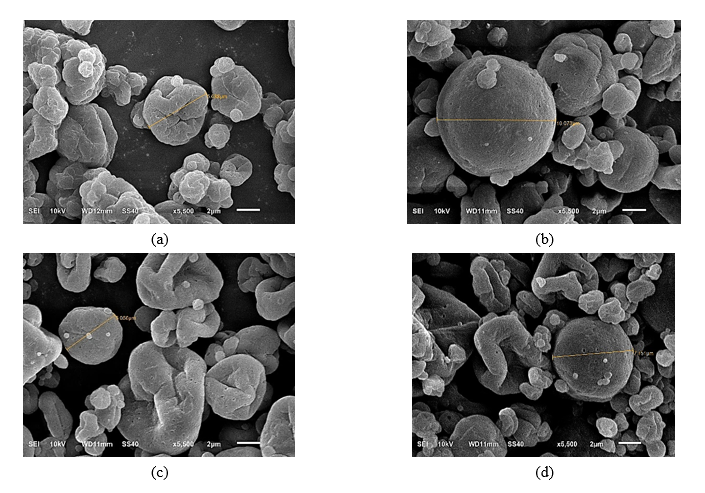
Figure 4 SEM images of microcapsule prepared using SPC-CG conjugates (MCJ) at oil-to-wall ratios of 1:1 (a), 1:2 (b), 1:3 (c), and prepared using a simple mixture of SPC-CG (MSM 1:3) (d) with 5500× magnifications.
The increase in particle size at a higher wall material ratio (1:3) is presumed to be associated with particle agglomeration during the spray drying process [85]. Microcapsule powders might agglomerate due to interparticle interactions, which can be further triggered by increased moisture content. This finding is consistent with Kou et al. [86], who reported that residual moisture in microcapsules can lead to agglomeration through the formation of liquid bridges between particles. Consequently, when the powder is redispersed in buffer, the particles that had agglomerated during drying tend to be poorly dispersed. This leads to the formation of aggregates that are detected as larger particles in PSA measurements.
Nevertheless, larger particle size and potential agglomeration after aggregation did not necessarily reduce encapsulation efficiency. In fact, MCJ 1:3 exhibited the highest encapsulation efficiency among the tested ratios, indicating that increasing the amount of wall material could form a more effective protective matrix. This aligns with the statement by Tonon et al. [87], which noted that there is no direct correlation between particle size and encapsulation efficiency.
The zeta potential also decreased with increasing wall material ratio, from −20.97 ± 0.81 mV (MCJ 1:1) to −11.10 ± 0.53 mV (MCJ 1:3). This reduction suggests a decrease in the electrostatic repulsive forces between particles, thereby increasing the likelihood of flocculation or agglomeration [88]. This reduced stability was also reflected in the increased PDI value for MCJ 1:3, potentially due to aggregation, indicating a broader particle size distribution. Although MCJ 1:3 showed increased particle size and PDI, along with a reduced zeta potential compared to MCJ 1:1, these values were still lower than those of the MSM system (Table 4). In simple mix systems such as MSM, interactions are limited to weak electrostatic forces, particularly at pH values near the isoelectric point, thereby increasing the risk of flocculation and particle size enlargement [89].
In situ intestinal absorption
Carotenoids such as β-carotene are known to have low water solubility and are prone to degradation during digestion, thereby requiring a delivery system that protects them until they reach the small intestine, where primary absorption occurs [90]. Several previous studies have demonstrated that encapsulating carotene can enhance its bioavailability and reduce genotoxicity compared to its free form, while also improving its solubility and release during digestion [91-92].
In this study, RPO microcapsules formulated with conjugates were evaluated using an in situ intestinal perfusion method with an open-loop system to assess carotene absorption in the small intestine directly. This technique involves perfusing a solution through a cannulated segment of the rat small intestine, where the incoming solution is not recirculated but rather collected for concentration analysis. This approach enables accurate estimation of the absorbed compound by comparing its concentration at the inlet and outlet points of perfusion [93-94]. The results showed that the initial carotene concentration in the microcapsules was 166.46 ppm, with only 19.93 ppm remaining at the end of the perfusion, corresponding to an absorption rate of approximately 88%. This value is considered high, as carotene absorption efficiency is generally reported to range between 3% and 90% [95]. These findings suggest that the use of conjugates as wall materials significantly improved the intestinal absorption efficiency of carotene.
The effectiveness of this conjugate system is further supported by Setyani et al. [96], who reported that red palm oil encapsulated with a soy protein concentrate-carrageenan conjugate achieved intestinal carotene absorption of approximately 82% in an in-situ model. Other results have been reported by Zhang et al. [97], who found that protein-polysaccharide complex coacervates based on Spirulina protein successfully protected canola oil during the oral and gastric phases. The microcapsules maintained structural integrity and released only a small amount of surface oil. This indicates enhanced resistance of the wall matrix to early digestive degradation, enabling controlled release in the intestine. A similar phenomenon was reported by Liu et al. [98], who demonstrated that protein-based nanoparticles provided physical protection for carotene during digestion, with gradual release linked to enzymatic degradation in the intestinal phase.
Stability of microcapsules during storage
To evaluate storage stability, microencapsulated samples were stored at 30, 40, and 50 °C for 42 days. During storage, both physical (moisture content) and bioactive parameters (antioxidant activity and total carotene content) were monitored.
Moisture content
Moisture content is one of the critical parameters that influence the storage stability of dried powders. During 42 days of storage at 30, 40, and 50 °C, the moisture content of both MCJ and MSM showed slight fluctuations within the range of approximately 7% - 11% (Figure 5). Based on statistical analysis, the moisture content of MCJ did not show significant differences across storage temperatures or durations (p > 0.05). In contrast, for MSM, both temperature and storage time had statistically significant effects (p < 0.05).
This result implies that although there was a tendency for changes in moisture content, the high data variability or small differences between groups led to non-significant outcomes. The small changes in moisture content among conjugate-based microcapsules reflected the moisture stability provided by the conjugate wall structure. This finding aligns with the report by Purnamayati et al. [99], which showed that similar protein-polysaccharide wall systems could maintain low and stable moisture levels, even when exposed to different inlet temperatures during drying. In addition, the results showed that during the storage evaluation in this study, water content was not the critical parameter that determines the shelf life of the microcapsules. It was suggested that carotene content was the most determining factor.
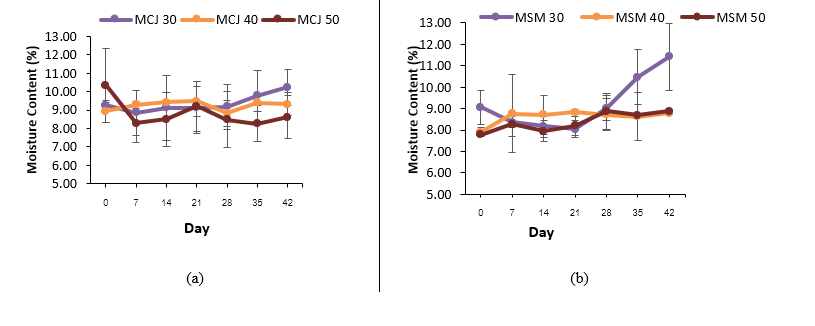
Figure 5 Changes in moisture content of microcapsules prepared with SPC-CG conjugates (MCJ); (a) and with the simple mixture of SPC-CG (MSM) (b) during storage.
Antioxidant Activity (%RSA)
The antioxidant activity of red palm oil (RPO) microcapsules, expressed as the percentage of DPPH radical scavenging activity (%RSA), generally decreased during 42 days of storage at 30, 40, and 50 °C. In general, higher storage temperatures accelerated the decline in antioxidant activity, with the highest activity retained at 30 °C and the lowest at 50 °C (Figure 6).
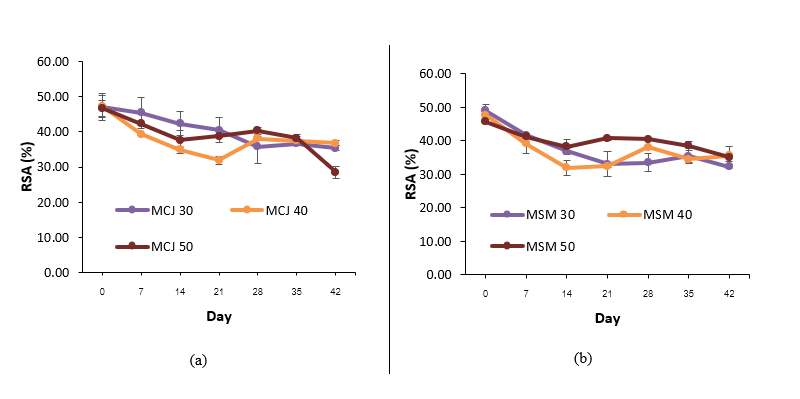
Figure 6 Antioxidant activity of microcapsules prepared with SPC-carrageenan conjugates (MCJ) (a) and the simple mixture of SPC-CG (MSM) (b) during storage.
Although antioxidant activity generally declined during storage, several samples exhibited non-linear patterns. In addition to temperature, storage duration also played an important role. The longer the microcapsules were stored, the higher the likelihood of oxidative reactions, particularly when the protective wall structure weakened due to physical or chemical changes during storage [100]. These findings are consistent with the report by Lyu et al. [101], which stated that antioxidant stability significantly decreases at elevated temperatures due to the increased oxidation rates of bioactive compounds. Overall, MCJ and MSM showed a similar trend in %RSA reduction across all storage temperatures.
Total Carotenoid
A consistent decrease in relative total carotenoids was observed over 42 days of storage in all microcapsule samples, both in MCJ and MSM (Figure 7). Statistical analysis confirmed that both temperature and storage duration significantly affected carotenoid degradation (p < 0.05).
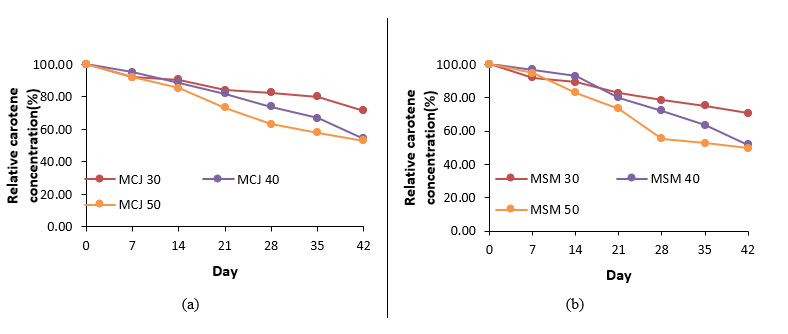
Figure 7 Total carotenoid content of microcapsules prepared with SPC-CG conjugates (MCJ) (a) and the simple mixture of SPC-CG (MSM) (b) during storage.
The higher the storage temperature, the faster the rate of carotenoid loss. This thermal degradation pattern is consistent with previous findings by Chen et al. [102], who reported that β-carotene content in emulsions was almost completely depleted after 30 days at 50 °C. A similar trend was observed in this study, that in MSM, the relative carotenoid content declined to approximately 50% of its initial value after 42 days at 50 °C.
In contrast, microcapsules with conjugate wall material (MCJ) showed better retention, maintaining about 71% at 30 °C and 53% at 50 °C. This decrease indicated that degradation still occurred even though the carotenoids were encapsulated. However, the SPC-CG conjugate provided better protection against thermal degradation, particularly at higher temperatures. This suggested that the wall material structure formed by the Maillard reaction could reduce the degradation rate of active compounds.
This finding is consistent with the study of [103], who reported that WPI-pectin conjugates formed interfacial layers in emulsions that significantly enhanced both physical and chemical stability. These conjugate-based systems demonstrated the ability to protect functional compounds, such as carotenoids, against degradation during processing and storage. Although the matrix used in their study was different, the principle of active compound protection is similar to that observed in the SPC-CG microcapsules used in this study. This result is further supported by Jiang et al. [104], who showed that microcapsules formed from Maillard-type conjugates of WPI and galactose showed greater stability during storage than physical mixtures. Altogether, these results reinforce the potential of conjugate systems as effective wall materials to improve the thermal stability of encapsulated compounds.
Kinetic degradation of carotene
The degradation behavior of carotenoids during storage was investigated to evaluate the stability of the microcapsule system and to support shelf-life prediction under different storage temperatures. As shown in Table 5, carotenoid degradation data were evaluated using kinetic methods by determining the reaction order (zero-, first-, and second-order models). Moreover, to determine the Ea of carotenoid degradation, the degradation rate constants were fitted to the Arrhenius model. The Arrhenius equation is widely used in stability studies to describe the relationship between temperature and the rate constant, enabling the estimation of the shelf life of a product during the development phase [105].
During the investigated storage period, carotenoid degradation exhibited approximately linear time dependence at all storage temperatures. This behavior suggests that the degradation rate remained relatively constant and was primarily governed by external factors such as temperature and oxygen availability rather than by the remaining carotenoid concentration. The calculated activation energies (Ea) obtained from the zero-order model were 6,614 kJ/mol for MCJ and 6,713 kJ/mol for the MSM, indicating similar temperature sensitivity for both systems. During storage, oil diffuses through the wall matrix by molecular diffusion [106]. The encapsulation matrix likely acted as a physical barrier that restricted oxygen diffusion into the microcapsules, thereby controlling the oxidation process and resulting in near-linear degradation behavior over time.
Data showed that, based on the zero-order model, MCJ exhibited longer half-life (t₁/₂) values than MSM. At 30 °C, the half-life of MCJ reached 83.32 ± 0.82 days, whereas MSM showed a shorter half-life of 74.42 ± 2.33 days, indicating that conjugated wall materials were more effective in retarding carotenoid degradation (Table 5). However, a pronounced reduction in half-life was observed at 50 °C, where the half-life decreased to 42.40 ± 1.13 days for MCJ and 37.28 ± 0.96 days for MSM. This decline was caused by the acceleration of oxidative reactions at elevated temperatures due to increased molecular mobility and enhanced oxygen permeability.
Similar degradation behavior has been reported in previous studies involving encapsulated carotenoid systems. Chuyen et al. [107] and Lima et al. [108] observed near-linear degradation patterns consistent with zero-order behavior during the storage of carotenoid-rich oils encapsulated by spray drying. Šeregelj et al. [109] reported that the stability of carotenoids in encapsulated carrot pomace extract decreased markedly with increasing storage temperature, with degradation progressing almost linearly over time. These findings indicate that, in encapsulated systems, carotenoid degradation behavior is strongly influenced by the protective matrix and storage temperature rather than by carotenoid concentration alone. Furthermore, Drosou et al [110] demonstrated that β-carotene encapsulated using a whey protein isolate-pullulan system exhibited nearly double the half-life compared to its free form, highlighting the importance of effective barrier properties in extending shelf life. Wardana et al. [111] also emphasized that carotenoid degradation behavior varies significantly depending on the delivery system and matrix structure.
Overall, the similar activation energy values for MCJ and MSM suggested comparable temperature dependence, while the longer half-life of MCJ highlighted the role of wall material structure in enhancing storage stability. Protein-carrageenan conjugates formed via the Maillard reaction are known to produce a more compact and cohesive wall [104], which is more effective in limiting oxygen diffusion and slowing oxidative degradation. These results demonstrate that matrix-controlled mechanisms govern carotenoid degradation in red palm oil microcapsules and that kinetic-based modeling provides a useful framework for predicting shelf-life performance under different storage conditions.
Table 5 Coefficient of determination (R²) of zero-, first-, and second-order kinetics of carotene degradation of MCJ (1:3) and MSM (1:3).
| Zero-order | ||||||||
| Sample | T (℃) | R² | k (%/day) | intercept | t₁/₂ | Arrhenius | ||
|---|---|---|---|---|---|---|---|---|
| Day | Month | Ea (kj/mol) | R2 | |||||
| MCJ | 30 | 0.88 ± 0.02 | 0.60 ± 0.01 | 98.44 ± 2.50 | 83.32 ± 0.82 | 2.78 ± 0.03 | 6,614 | 0.82 |
| 40 | 0.98 ± 0.00 | 1.07 ± 0.02 | 102.53 ± 0.24 | 46.88 ± 0.82 | 1.56 ± 0.03 | |||
| 50 | 0.98 ± 0.00 | 1.18 ± 0.03 | 99.73 ± 0.73 | 42.40 ± 1.13 | 1.41 ± 0.04 | |||
| MSM | 30 | 0.98 ± 0.01 | 0.67 ± 0.02 | 98.20 ± 0.86 | 74.42 ± 2.33 | 2.48 ± 0.08 | 6,713 | 0.89 |
| 40 | 0.97 ± 0.00 | 1.18 ± 0.02 | 104.42 ± 0.69 | 42.24 ± 0.60 | 1.41 ± 0.02 | |||
| 50 | 0.96 ± 0.01 | 1.34 ± 0.04 | 100.83 ± 0.17 | 37.28 ± 0.96 | 1.24 ± 0.03 | |||
| First-order | ||||||||
| Sample | T (℃) | R² | k (/day) | intercept | t₁/₂ | Arrhenius | ||
| Day | Month | Ea (kj/mol) | R2 | |||||
| MCJ | 30 | 0.88 ± 0.02 | 0.88 ± 0.02 | 0.01 ± 0.00 | ||||
| 40 | 0.95 ± 0.01 | 0.95 ± 0.01 | 0.01 ± 0.00 | |||||
| 50 | 0.99 ± 0.00 | 0.99 ± 0.00 | 0.02 ± 0.00 | |||||
| MSM | 30 | 0.96 ± 0.00 | 0.96 ± 0.01 | 0.04 ± 0.05 | ||||
| 40 | 0.95 ± 0.00 | 0.95 ± 0.00 | 0.02 ± 0.00 | |||||
| 50 | 0.96 ± 0.01 | 0.96 ± 0.01 | 0.02 ± 0.00 | |||||
| Second-order | ||||||||
| Sample | T (℃) | R² | k (1/%·day) | intercept | t₁/₂ | Arrhenius | ||
| Day | Month | Ea (kj/mol) | R2 | |||||
| MCJ | 30 | 0.88 ± 0.02 | 0.00 ± 0.00 | 0.22 ± 0.01 | ||||
| 40 | 0.93 ± 0.01 | 0.01 ± 0.00 | 0.21 ± 0.00 | |||||
| 50 | 0.99 ± 0.00 | 0.01 ± 0.00 | 0.21 ± 0.01 | |||||
| MSM | 30 | 0.96 ± 0.00 | 0.00 ± 0.00 | 0.22 ± 0.00 | ||||
| 40 | 0.93 ± 0.01 | 0.01 ± 0.00 | 0.21 ± 0.00 | |||||
| 50 | 0.96 ± 0.01 | 0.01 ± 0.00 | 0.21 ± 0.00 | |||||
Conclusions
This study demonstrated that Maillard reaction-derived Spirulina protein-carrageenan conjugates (MR) were effective wall materials for the microencapsulation of red palm oil. At an oil-to-wall material ratio of 1:3, MR achieved the highest encapsulation efficiency (72.13%) and superior carotenoid retention compared to SM. Thermal analysis revealed a single transition peak for all microcapsules, while high transition enthalpy values confirmed enhanced thermal resistance of the conjugated system. In situ absorption analysis revealed a relatively high value (82%). Storage evaluation showed that MCJ exhibited slower carotenoid degradation and longer half-lives at all storage temperatures. The longest half-life was observed at 30 °C (83.32 days), whereas accelerated degradation occurred at 50 °C. However, it should be noted that even though MCJ 1:3 had the highest EE and good stability during storage. Upon rehydration, MCJ 1:3 had a larger particle size and PDI, but a lower zeta potential than those at the 1:1 and 1:2 ratios. Therefore, a further study on the physical stability of these microcapsules in beverage application (liquid system) is needed. Overall, these findings highlighted the significance of protein-polysaccharide conjugation in improving the encapsulation performance, thermal protection, and storage stability of lipophilic bioactive compounds. In addition, the results demonstrated that spirulina protein is a good candidate for a wall material in encapsulation applications. The developed microencapsulation system shows strong potential for use in functional food products that require good heat stability and extended shelf life. Lastly, future studies should focus on evaluating the sensory impact, the scalability of the process, and the in vivo bioavailability of carotenoids to support broader industrial applications.
Acknowledgements
The first author acknowledges the Beasiswa Unggulan scholarship provided by the Ministry of Education, Culture, Research, and Technology, which covered tuition fees during her study.
Ethical approval
Ethical approval was obtained from the Research Ethics Committee of Universitas Ahmad Dahlan, Yogyakarta (Approval No. REC-UAD/02/02/02-2025/046).
Declaration of Generative AI in Scientific Writing
The authors acknowledge the use of generative AI tools (e.g., Grammarly) in the preparation of this manuscript, specifically for language editing and grammar correction. No content generation or data interpretation was performed by AI. The authors take full responsibility for the content and conclusions of this work.
CRediT Author Statement
Ayu Aprilia: Writing-original draft, Funding acquisition, Formal analysis, Investigation, Visualization Arima Diah Setiowati: Conceptualization, Methodology, Writing-reviewing draft, Supervision, Data curation, Validation Chusnul Hidayat: Supervision, Writing-reviewing, Data curation.
References
[1] M Henchion, M Hayes, AM Mullen, M Fenelon and B Tiwari. Future protein supply and demand: Strategies and factors influencing a sustainable equilibrium. Foods 2017; 6(7), 53.
[2] A Kumar, D Ramamoorthy, DK Verma, A Kumar, N Kumar, KR Kanak, BM Marwein and K Mohan. Antioxidant and phytonutrient activities of Spirulina platensis. Energy Nexus 2022; 6, 100070.
[3] TJ Ashaolu, K Samborska, CC Lee, M Tomas, E Capanoglu, Ö Tarhan, B Taze and SM Jafari. Phycocyanin, a super functional ingredient from algae; properties, purification characterization, and applications. International Journal of Biological Macromolecules 2021; 193, 2320-2331.
[4] NS Parimi, M Singh, JR Kastner, KC Das, LS Forsberg and P Azadi. Optimization of protein extraction from Spirulina platensis to generate a potential co-product and a biofuel feedstock with reduced nitrogen content. Frontiers in Energy Research 2015; 3, 30.
[5] HS Lozober, Z Okun and A Shpigelman. The impact of high-pressure homogenization on thermal gelation of Arthrospira platensis (Spirulina) protein concentrate. Innovative Food Science and Emerging Technologies 2021; 74, 102857.
[6] S Bleakley and M Hayes. Algal proteins: Extraction, application, and challenges concerning production. Foods 2017; 6(5), 33.
[7] TS Purdi, AD Setiowati and A Ningrum. Ultrasound-assisted extraction of Spirulina platensis protein: Physicochemical characteristic and techno-functional properties. Journal of Food Measurement and Characterization 2023; 17, 5474-5486.
[8] X Yang, Z Lv, C Han, J Zhang, Y Duan and Q Guo. Stability and encapsulation properties of daidzein in zein/carrageenan/sodium alginate nanoparticles with ultrasound treatment. International Journal of Biological Macromolecules 2024; 262(1), 130070.
[9] L Böcker, P Bertsch, D Wenner, S Teixeira, J Bergfreund, S Eder, P Fischer and A Mathys. Effect of Arthrospira platensis microalgae protein purification on emulsification mechanism and efficienc. Journal of Colloid and Interface Science 2021; 344-353.
[10] H Xu, L Yang, P Xie, Q Zhou, Y Chen, E Karrar, H Qi, R Lin, Y Zhu, J Jin, Q Jin and X Wang. Static stability of partially crystalline emulsions : Impacts of carrageenan and its blends with xanthan gum and / or guar gum. International Journal of Biological Macromolecules 2022; 223, 307-315.
[11] T Udo, G Mummaleti, A Mohan, RK Singh and F Kong. Current and emerging applications of carrageenan in the food industry. Food Research International 2023; 173(2), 113369.
[12] Z Li, Y Zheng, Q Sun, J Wang, B Zheng and Z Guo. Structural characteristics and emulsifying properties of myofibrillar protein-dextran conjugates induced by ultrasound Maillard reaction. Ultrasonics Sonochemistry 2021; 72, 105458.
[13] Z Yang, L Chen, C Zeng, Z Guo, W Zhang, Tian, Z Huang and L Jiang. Encapsulation and characterization of soy protein-based ω-3 medium- and long- chain triacylglycerols microencapsulated with diverse homogenization techniques for improving oxidation stability. Food Chemistry 2024; 444, 138601.
[14] AD Setiowati, W Wijaya and PV der Meeren. Whey protein-polysaccharide conjugates obtained via dry heat treatment to improve the heat stability of whey protein stabilized emulsions. Trends in Food Science & Technology 2020; 98, 150-161.
[15] MS Martinez-Alvarenga, EY Martinez-Rodriguez, LE Garcia-Amezquita, GI Olivas, PB Zamudio-Flores, CH Acosta-Muniz and DR Sepulveda. Effect of Maillard reaction conditions on the degree of glycation and functional properties of whey protein isolate - Maltodextrin conjugates. Food Hydrocolloids 2014; 38, 110-118.
[16] H Chutia and L Mahanta. Clean label physical conjugates of protein-based bio-emulsifiers for food applications. Food Chemistry Advances 2023; 3, 1000469.
[17] X Kan, G Chen, W Zhou and X Zeng. Application of protein-polysaccharide Maillard conjugates as emulsifiers: Source, preparation and functional properties. Food Research International 2021; 150, 110740.
[18] MR Kusumastuti, S Yuliani, C Hidayat and AD Setiowati. Modification techno-functional properties of spirulina protein concentrates (Arthrospira Platensis) as O/W emulsifier by conjugation and electrostatic complexations. Innovative Food Science and Emerging Technologies 2024; 95, 103727.
[19] JX Zheng, H Yin, CC Shen, L Zhang, DF Ren and J Lu. Functional and structural properties of spirulina phycocyanin modified by ultra-high-pressure composite glycation. Food Chemistry 2020; 306, 125615.
[20] C Zhu, Y Cai, ER Gertz, MRL Frano, DJ Burnett and BJ Burri. Red palm oil-supplemented and biofortified cassava gari increase the carotenoid and retinyl palmitate concentrations of triacylglycerol-rich plasma in women. Nutrition Research 2015; 35 (11), 965-974.
[21] ZM Jiang, LN Bai, N Yang, Zb Feng and B Tian. Stability of β-carotene microcapsules with Maillard reaction products derived from whey protein isolate and galactose as coating materials. Journal of Zhejiang University-SCIENCE B) 2017; 18(10), 867-877.
[22] WJ Lee, CP Tan, R Sulaiman, YY Hee, and GH Chong. Storage stability and degradation kinetics of bioactive compounds in red palm oil microcapsules produced with solution-enhanced dispersion by supercritical carbon dioxide: A comparison with the spray-drying method. Food Chemistry 2020; 304, 125427
[23] A Gharsallaoui, G Roudaut, O Chambin, A Voilley and R Saurel. Applications of spray-drying in microencapsulation of food ingredients: An overview. Food Research International 2007; 40(9), 1107-1121.
[24] S Yuliasari, D Fardiaz, N Andarwulan and S Yuliani. Karakteristik enkapsulat minyak sawit merah dengan pengayaan β-karoten characteristics of red palm oil encapsulates enriched with β-carotene. Informatika Pertanian 2016; 25(1), 107-116.
[25] HD Ananda, Nuralang, IL Tarigan, NCA Susanto and Nelson. Microencapsulation of fermented red palm oil with L. casei as Nutracetical Source. Jurnal Rekayasa Kimia & Lingkungan 2022; 17(2), 138-151.
[26] N Choudhury, M Meghwal and K Das. Microencapsulation: An overview on concepts, methods, properties and applications in foods. Food Frontiers 2021; 2(4), 426-442.
[27] CX Ren, YJ Wang, XF Lin, F Yang, J Chen, HQ Song, K Shi, JS Song, F Chen, SH Zhang and WT Guan. Palm oil encapsulated by homogenizing and spray drying enhances nutrient digestibility and attenuates diarrhoea of piglets. Animal Feed Science and Technology 2020; 266, 114503.
[28] JK Rutz, CD Borges, RC Zambiazi, MM Crizel-Cardozo, LS Kuck and CPZ Noreña. Microencapsulation of palm oil by complex coacervation for application in food systems. Food Chemistry 2017; 220, 59-66.
[29] C Drosou and M Krokida. A Comparative Study of Encapsulation of β-Carotene via Spray-Drying and Freeze-Drying Techniques Using Pullulan and Whey Protein Isolate as Wall Material. Foods 2024; 13.
[30] WJ Lee, CP Tan, R Sulaiman, RL Smith and GH Chong. Microencapsulation of red palm oil as an oil-in-water emulsion with supercritical carbon dioxide solution-enhanced dispersion. Journal of Food Engineering 2018; 222, 100-109.
[31] TO Hay, JR Nastasi, S Prakash and MA Fitzgerald. Comparison of Gidyea gum, gum Arabic, and maltodextrin in the microencapsulation and colour stabilisation of anthocyanin-rich powders using freeze-drying and spray-drying techniques. Food Hydrocolloids 2024; 163, 111023.
[32] N Ozdemir, A Bayrak, T Tat, F Altay, M Kiralan and A Kurt. Microencapsulation of basil essential oil: Utilization of gum arabic/whey protein isolate/maltodextrin combinations for encapsulation efficiency and in vitro release. Journal of Food Measurement and Characterization 2021; 15, 1865-1876.
[33] LD Giorgio, PR Salgado and AN Mauri. Encapsulation of fish oil in soybean protein particles by emulsification and spray drying. Food Hydrocolloids 2019; 87, 891-901.
[34] Y Hu, J Tu, C Li, J Peng, Z Xiao, L Wen, Y Chen, S Xie, S Liu and J Xiao. Microencapsulation of camellia seed oil by spray drying with pea protein and maltodextrin. LWT 2024; 203, 116348.
[35]. Z Zhang, G Holden, B Wang and B Adhikari. Maillard reaction-based conjugation of Spirulina protein with maltodextrin using wet-heating route and characterisation of conjugates. Food Chemistry 2022; 406, 134931.
[36] D Li, G Wu, H Zhang and X Qi. The soy protein isolate-Octacosanol-polysaccharides nanocomplex for enhanced physical stability in neutral conditions: Fabrication, characterization, thermal stability. Food Chemistry 2020; 322, 126638.
[37] P Kaur, A Elsayed, J Subramanian and A Singh. Encapsulation of carotenoids with sucrose by co-crystallization: Physicochemical properties, characterization, and thermal stability of pigments. Lwt 2021; 140, 110180.
[38] W Chen, X Ma, W Wang, R Lv, M Guo, T Ding, X Ye, S Miao and D Liu. Preparation of modified whey protein isolate with gum acacia by ultrasound maillard reaction. Food Hydrocolloids 2019; 95, 298-307.
[39] RGS Candraningrum, AD Setiowati and C Hidayat. Electrostatic-maillard formation of coconut protein concentrate-pectin conjugate for oil-in-water emulsion: Effects of ratio, temperature, and pH. Journal of the Saudi Society of Agricultural Sciences 2023; 22(1), 18-24.
[40] LC Corrêa-Filho, DI Santos, L Brito, M Moldão-Martins and VD Alves. Storage stability and in vitro bioaccessibility of microencapsulated Tomato (Solanum Lycopersicum L.) pomace extract. Bioengineering 2022; 9(7), 311.
[41] T Jarunglumlert, K Nakagawa and S Adachi. Influence of aggregate structure of casein on the encapsulation efficiency of β-carotene entrapped via hydrophobic interaction. Food Structure 2015; 5, 42-50.
[42] V Anand, V Ksh, A Kar, E Varghese, S Vasudev and C Kaur. Encapsulation efficiency and fatty acid analysis of chia seed oil microencapsulated by freeze-drying using combinations of wall material. Food Chemistry 2023; 430, 136960.
[43] M Mohammadi, H Hamishehkar, DJ McClements, R Shahvalizadeh and A Barri. Encapsulation of Spirulina protein hydrolysates in liposomes: Impact on antioxidant activity and gastrointestinal behavior. Food Chemistry 2023; 400, 133973.
[44] B Shao, C Cui, H Ji, J Tang, Z Wang, H Liu, M Qin, X Li and L Wu. Enhanced oral bioavailability of piperine by self-emulsifying drug delivery systems: In vitro, in vivo and in situ intestinal permeability studies. Drug Delivery 2015; 22(6), 740-747.
[45] MS Martinez-Alvarenga, EY Martinez-Rodriguez, LE Garcia-Amezquita, GI Olivas, PB Zamudio-Flores, CH Acosta-Muniz and DR Sepulveda. Effect of Maillard reaction conditions on the degree of glycation and functional properties of whey protein isolate - Maltodextrin conjugates. Food Hydrocolloids 2014; 38, 110-118.
[46] L Dumitrașcu, D Borda and I Aprodu. Alternative processing options for improving the proteins functionality by Maillard Conjugation. Foods 2023; 12(19), 3588.
[47] M Nooshkam, M Varidi, Z Zareie and F Alkobeisi. Behavior of protein-polysaccharide conjugate-stabilized food emulsions under various destabilization conditions. Food Chemistry: X 2023; 18, 100725.
[48] AS Doost, MN Nasrabadi, J Wu, Q A’yun, and PVD Meeren. Maillard conjugation as an approach to improve whey proteins functionality: A review of conventional and novel preparation techniques. Trends in Food Science & Technology 2019; 91, 1-11.
[49] F Ba, AV Ursu, C Laroche and G Djelveh. Haematococcus pluvialis soluble proteins: Extraction, characterization, concentration/fractionation, and emulsifying properties. Bioresource Technology 2016; 200, 147-152.
[50] C Wen, J Zhang, W Qin, J Gu, H Zhang, Y Duan and H Ma. Structure and functional properties of soy protein isolate-lentinan conjugates obtained in Maillard reaction by slit divergent ultrasonic assisted wet heating and the stability of oil-in-water emulsions. Food Chemistry 2020; 331, 127374.
[51] X Sun, H Wang, S Li, C Song, S Zhang, J Ren and CC Udenigwe. Maillard-type Protein-polysaccharide conjugates and electrostatic Protein-polysaccharide complexes as delivery vehicles for food bioactive ingredients: Formation, types, and applications. Gels 2022; 8(2), 135.
[52] MM Han, Y Yi, HX Wang and F Huang. Investigation of the Maillard reaction between polysaccharides and proteins from longan pulp and the improvement in activities. Molecules 2017; 22(6), 938.
[53] P Guerrero, JP Kerry and K de la Caba. FTIR characterization of protein-polysaccharide interactions in extruded blends. Carbohydrate Polymers 2014; 111, 598-605.
[54] X Zhang, D Wang, L Liu, W Jiang, W Xiang, Q Zhang and J Tang. Microencapsulation of Zanthoxylum schinifolium essential oil through emulsification followed by spray drying: Microcapsule characterization and functional evaluation. Colloids and Surfaces A: Physicochemical and Engineering Aspects 2024; 687, 133484.
[55] AK Srivastava, AK Pandey, S Jain and N Misra. FT-IR spectroscopy, intra-molecular C-H⋯O interactions, HOMO, LUMO, MESP analysis and biological activity of two natural products, triclisine and rufescine: DFT and QTAIM approaches. Spectrochimica Acta Part A: Molecular and Biomolecular Spectroscopy 2015; 136, 628-689.
[56] MR Kusumastuti, S Yuliani, C Hidayat and AD Setiowati. Modification techno-functional properties of spirulina protein concentrates (Arthrospira Platensis) as O/W emulsifier by conjugation and electrostatic complexations. Innovative Food Science and Emerging Technologies 2024; 95, 103727.
[57] EZ Fallahasghari, MH Lynge, EE Gudnason, K Munkerup, AC Mendes and IS Chronakis. Carbohydrate core-shell electrosprayed microcapsules for enhanced oxidative stability of vitamin a palmitate. Pharmaceutics 2023; 15(11), 2623.
[58] A Halahlah, F Abik, H Suhonen, H Räikkönen, V Piironen, KS Mikkonen and TM Ho. Combination of carboxymethylcellulose and wood hemicelluloses to enhance encapsulation efficiency and microcapsule wall thickness. Future Foods 2024; 9, 100366.
[59] SC Chew, CP Tan, K Long and KL Nyam. Effect of chemical refining on the quality of kenaf (hibiscus cannabinus) seed oil. Industrial Crops and Products 2016; 89, 59-65.
[60] F Alfrecha and KL Nyam. Microencapsulation of red palm oil and its stability during accelerated storage. Malaysian Journal of Nutrition 2018; 24(4), 597-605.
[61] G Gallardo, L Guida, V Martinez, MC López, D Bernhardt, R Blasco, R Pedroza-Islas and LG Hermida. Microencapsulation of linseed oil by spray drying for functional food application. Food Research International 2013; 52(2), 473-482.
[62] A Hussain, M Hussain, W Ashraf, K Ali, A Hussain, HM Phyo, MU Khalid, M Hussain and Z Lianfu. Encapsulation, optimization, and characterization of lycopene using soy protein isolate-peach gum conjugate as wall material. Food Bioscience 2024; 62, 105548.
[63] C Lia, J Wang, J Shi, X Huang, Q Peng and F Xueb. Encapsulation of tomato oleoresin using soy protein isolate-gum aracia conjugates as emulsifier and coating materials. Food Hydrocolloids 2015; 45, 301-308.
[64] M Aghbashlo, H Mobli, A Madadlou and S Rafiee. Influence of wall material and inlet drying air temperature on the microencapsulation of fish oil by spray drying. Food and Bioprocess Technology 2013; 6, 1561-1569.
[65] YY Lee, TK Tang, ET Phuah, N Alitheen, C Tan and O Lai. New functionalities of maillard reaction products as emulsifier and encapsulating agent and its processing parameters: A brief review. Journal of the Science of Food and Agriculture 2016; 97(5), 1379-1385.
[66] B Muhoza, JD Harindintwali, B Qi, S Zhang and Y Li. Conjugation induced by wet-heating of gelatin and low methoxyl pectin improves the properties and stability of microcapsules prepared by complex coacervation. Food Biophys 2023; 18, 95-106.
[67] M Nooshkam and M Varidi. Maillard conjugate-based delivery systems for the encapsulation, protection, and controlled release of nutraceuticals and food bioactive ingredients: A review. Food Hydrocolloids 2019; 100, 105389.
[68] MIMJ Barbosa, CD Borsarelli and AZ Mercadante. Light stability of spray-dried bixin encapsulated with different edible polysaccharide preparations. Food Research International 2005; 38(8-9), 989-994.
[69] JB Eun, A Maruf, PR Das and SH Nam. A review of encapsulation of carotenoids using spray drying and freeze drying. Critical Reviews in Food Science and Nutrition 2020; 60(21), 3547-3572.
[70] CS Favaro-Trindade, AS Santana, ES Monterrey-Quintero, MA Trindade and FM Netto. The use of spray drying technology to reduce bitter taste of casein hydrolysate. Food Hydrocolloids 2010; 24(4), 336-340.
[71] E Drozińska, A Kanclerz and MA Kurek. Microencapsulation of sea buckthorn oil with β- glucan from barley as coating material. International Journal of Biological Macromolecules 2019; 131, 1014-1020.
[72] MA Kurek, M Moczkowska, E Pieczykolan and M Sobieralska. Barley β D glucan - modified starch complex as potential encapsulation agent for fish oil. International Journal of Biological Macromolecules 2018; 120, 596-602.
[73] KA Selim, SS Alharthi, AM Abu El-Hassan, NA Elneairy, LA Rabee and AG Abdel-Razek. The effect of wall material type on the encapsulation efficiency and oxidative stability of fish oils. Molecules 2021; 26(20), 6109.
[74] JJ Fu, DW Fu, GY Zhang, ZH Zhang, ZW Shao, ZH Ma, Y Tang, DY Zhou and L Song. Oxidative stability and in vitro release behaviour of microencapsulated Antarctic krill oil and fish oil: The effect of lipid class composition. International Journal of Food Science & Technology 2022; 57(12), 7634-7643.
[75] K Sridhar, P Hamon, J Ossemond, S Bouhallab, T Croguennec, D Renard and V Lechevalier. Plant and animal protein mixed systems as wall material for microencapsulation of Mānuka essential oil: Characterization and in vitro release kinetics. Food Research International 2024; 187, 114419.
[76] J Du, ZZ Ge, Z Xu, B Zou, Y Zhang and CM Li. Comparison of the efficiency of five different drying carriers on the spray drying of persimmon pulp powders. Drying Technology 2014; 32(10), 1157-1166.
[77] R Correia, MH Grace, D Esposito and MA Lila. Wild blueberry polyphenol-protein food ingredients produced by three drying methods: Comparative physico-chemical properties, phytochemical content, and stability during storage. Food Chemistry 2017; 235, 76-85.
[78] FH dos Santos, BMP e Silveira, LL de Souza, AKC Duarte, MC Ribeiro, KC Pereira and JMG da Costa. Influence of wall materials on the microencapsulation of pequi oil by spray drying. Brazilian Journal of Food Technology 2020; 23, 2019132.
[79] C Anandharamakrishnan, CD Rielly and AGF Stapley. Effects of process variables on the denaturation of whey proteins during spray drying. Drying Technology 2007; 25(5), 799-807.
[80] S Savadkoohi and A Farahnaky. Dynamic rheological and thermal study of the heat-induced gelation of tomato-seed proteins. Journal of Food Engineering 2012; 113(3), 479-485.
[81] CM Johnson. Differential scanning calorimetry as a tool for protein folding and stability. Archives of Biochemistry and Biophysics 2013; 531(1-2), 100-109.
[82] GDMP Madhusankha, LF Siow, M dos Santos Silva Amaral, SY Lee, PJ Marriott and YY Thoo. Carbohydrate-based co-encapsulation of spice oleoresin blends: Impact on flavor release profiles, storage stability, and sensory acceptance. Food Chemistry 2025; 471, 142767.
[83] CI Piñón-Balderrama, C Leyva-Porras, Y Terán-Figueroa, V Espinosa-Solís, C Álvarez-Salas and MZ Saavedra-Leos. Encapsulation of active ingredients in food industry by spray-drying and nano spray-drying technologies. Processes 2020; 8(8), 889.
[84] G Du, F Ye, H Luo, G Jing, M DOI and F Meng. Modelling drying pathways of an evaporating soft matter droplet. Communications in Theoretical Physics 2022; 74(9), 095605.
[85] B Cuq, E Rondet and J Abecassis. Food powders engineering, between knowhow and science: Constraints, stakes, and opportunities. Powder Technology 2011; 208(2), 244-251.
[86] X Kou, X Zhang, Y Cheng, M Yu, Q Meng and Q Ke. Mannitol is a good anticaking agent for spray-dried hydroxypropyl-beta-cyclodextrin microcapsules. Molecules 2023; 28(3), 119.
[87] RV Tonon, RB Pedro, CRF Grosso and MD Hubinger. Microencapsulation of flaxseed oil by spray drying: Effect of oil load and type of wall material. Drying Technology 2012; 30(13), 1491-1501.
[88] AA Issa and NK Maraie. Fabrication and optimization of prolonged-release microcapsules containing protein drug (Erythropioten). International Journal of Drug Delivery Technology 2022; 12(2), 564-572.
[89] X Kong, C Jia, C Zhang, Y. Hua and Y Chen. Characteristics of soy protein isolate/gum arabic-stabilized oil-in-water emulsions: Influence of different preparation routes and pH. RSC Advances 2017; 7, 31875.
[90] JB Eun, A Maruf, PR Das and SH Nam. A review of encapsulation of carotenoids using spray drying and freeze drying. Critical Reviews in Food Science and Nutrition 2020; 60(21), 3547-3572.
[91] AF Aissa, MLP Bianchi, JC Ribeiro, LC Hernandes, AF de Faria, AZ Mercadante and LMG Antunes. Comparative study of β-carotene and microencapsulated β-carotene: Evaluation of their genotoxic and antigenotoxic effects. Food and Chemical Toxicology 2012; 50(5), 1418-1424.
[92] L Wang and T Boh. Health-promoting food ingredients and functional food processing. Nutrition Well-Being and Health 2012; 9, 201-224.
[93] B Hens, I Gonzalez-Alvarez and M Bermejo. Exploring the predictive power of the in situ perfusion technique towards drug absorption: theory, practice, and applications. Molecular Pharmaceutics 2022; 19(3), 749-762.
[94] J Stappaerts, J Brouwers, P Annaert and P Augustijns. In situ perfusion in rodents to explore intestinal drug absorption: Challenges and opportunities. International Journal of Pharmaceutics 2015; 478(2), 665-681.
[95] E Reboul. Absorption of vitamin A and carotenoids by the enterocyte: Focus on transport proteins. Nutrients 2013; 5(9), 3563-3581.
[96] H Setyani, AD Setiowati, S Rahayoe, C Hidayat and AD Saputro. Microencapsulation of red palm oil with soy protein concentrate - carrageenan conjugates for compound dark chocolate applications. Sustainable Food Technology 2025; 3(6), 2337-2351.
[97] Z Zhang, B Wang, G Holden, J Chen and B Adhikari. Investigating the effectiveness of coacervates produced from conjugated and unconjugated Spirulina protein in delivering unstable oil to the intestinal phase of digestion. Food Bioscience 2023; 56, 103198.
[98] G Liu, Y Zhou and L Chen. Intestinal uptake of barley protein-based nanoparticles for β-carotene delivery. Acta Pharmaceutica Sinica B 2019; 9(1), 87-96.
[99] L Purnamayati, EN Dewi and RA Kurniasih. Phycocyanin stability in microcapsules processed by spray drying method using different inlet temperature. IOP Conference Series: Earth and Environmental Science 2018; 116, 012076.
[100] E Azarpazhooh, P Sharayei, S Zomorodi and HS Ramaswamy. Physicochemical and phytochemical characterization and storage stability of freeze-dried encapsulated pomegranate peel anthocyanin and in vitro evaluation of its antioxidant activity. Food and Bioprocess Technology 2019; 12, 199-210.
[101] X Lyu, Y Wang, S Gao, X Wang, W Cao and CL Cespedes-Acuña. Sea buckthorn leaf extract on the stability and antioxidant activity of microencapsulated sea buckthorn oil. Food Bioscience 2022; 48, 101818.
[102] J Chen, F Li, Z Li, DJ McClements and H Xiao. Encapsulation of carotenoids in emulsion-based delivery systems: Enhancement of β-carotene water-dispersibility and chemical stability. Food Hydrocolloids 2017; 69, 49-55.
[103] D Xu, X Wang, J Jiang, F Yuan and Y Gao. Impact of whey protein - Beet pectin conjugation on the physicochemical stability of β-carotene emulsions. Food Hydrocolloids 2012; 28(2), 258-266.
[104] ZM Jiang, LN Bai, N Yang, ZB Feng and B Tian. Stability of β-carotene microcapsules with Maillard reaction products derived from whey protein isolate and galactose as coating materials. Journal of Zhejiang University-SCIENCE B 2017; 18(10), 867-877.
[105] D Bhangare, N Rajput, T Jadav, AK Sahu, RK Tekade and P Sengupta. Systematic strategies for degradation kinetic study of pharmaceuticals: An issue of utmost importance concerning current stability analysis practices. Journal of Analytical Science and Technology 2022; 13, 7.
[106] WJ Lee, CP Tan, R Sulaiman, YY Hee and GH Chong. Storage stability and degradation kinetics of bioactive compounds in red palm oil microcapsules produced with solution-enhanced dispersion by supercritical carbon dioxide: A comparison with the spray-drying method. Food Chemistry 2020; 304, 125427.
[107] HV Chuyen, PD Roach, JB Golding, SE Parks and MH Nguyen. Encapsulation of carotenoid-rich oil from Gac peel: Optimisation of the encapsulating process using a spray drier and the storage stability of encapsulated powder. Powder Technology 2019; 344, 373-379.
[108] PM Lima, GC Dacanal, LS Pinho, LJ Pérez-Córdoba, M Thomazini, ICF Moraes and CS Favaro-Trindade. Production of a rich-carotenoid colorant from pumpkin peels using oil-in-water emulsion followed by spray drying. Food Research International 2021; 148, 110627.
[109] V Šeregelj, L Estivi, A Brandolini, G Ćetković, VT Šaponjac and A Hidalgo. Kinetics of carotenoids degradation during the storage of encapsulated carrot waste extracts. Molecules 2022; 27(24), 8759.
[110] C Drosou and M Krokida. A comparative study of encapsulation of β-carotene via spray-drying and freeze-drying techniques using pullulan and whey protein isolate as wall material. Foods 2024; 13(12), 1933.
[111] DK Wardana, AD Setiowati and C Hidayat. Influence of oil structuring methods on the application of red palm oil as fat replacer: Emulsion gelation, oleogelation template emulsion, and biphasic gelation. Food Biophysics 2025; 20, 88.