
Trends
Sci.
2026;
23(11):
13763
Interlayer Modification of Montmorillonite and Laponite by Cr(III)/Al(III) Polyhydroxo Species: Adsorption and Photo-Assisted Oxidation of Dyes
Nozim
Mamataliev1,5,*,
Aziza Abdikamalova1,5,
 ,
Alisher Kalbaev1,
Bahodirjon Mamajonov2,
Suhrob Ergashev3,
Izzat Eshmetov1,
,
Dilshod Khaydarov1,
,
Mirtokhir Muratov1,
,
Bobirjon Adizov4,
Mamatalieva Sayyora1
and Bunyodjon Makhkamov6
1Department of Colloid Chemistry and Industrial Ecology, Institute of General and Inorganic Chemistry,
Academy of Sciences of Republic of Uzbekistan, Tashkent 100170, Uzbekistan
2Department of Chemistry, Kokand State University, Kokand 150700, Uzbekistan
3Department of Machinery and Equipment of the Oil and Gas Industry and Pipeline Transport Systems,
Faculty of Oil and Gas, Tashkent State Technical University, Tashkent 100095, Uzbekistan
4Department of Oil and Gas Chemistry, Institute of General and Inorganic Chemistry,
Academy of Sciences of Republic of Uzbekistan, Tashkent 100170, Uzbekistan
5Department of Chemical Engineering, Termez State University of Engineering and Agrotechnologies, Termez 190111, Surkhandarya Region, Uzbekistan
6Division of Natural compounds and applied Chemistry, National University of Uzbekistan,
Tashkent 100174, Uzbekistan
(*Corresponding author’s e-mail: [email protected])
Received: 5 March 2026, Revised: 23 April 2026, Accepted: 30 April 2026, Published: 5 June 2026
Abstract
This study explores the structural modification of layered aluminosilicates through intercalation with Cr(III) and mixed Cr(III)/Al(III) polyhydroxo species. Despite the widespread use of modified clays, the integration of high-capacity adsorption with catalytic mineralization in a single inorganic matrix remains insufficiently addressed. Natural montmorillonite and synthetic laponite were used as host materials to evaluate their adsorption and photo-assisted oxidation performance. Structural and textural changes were investigated using XRD, N2 adsorption, SEM, FTIR, and mass titration. Intercalation significantly increased the BET surface area (up to 211.99 m2/g) and modified the surface charge, shifting the pHpzc of montmorillonite from 10.1 to 4.4. Adsorption experiments demonstrated a significant increase in capacity for the anionic dye Congo red, driven by the neutralization of layer charge and the creation of new binding environments. In addition, Cr-intercalated laponites showed catalytic activity in UV/H2O2-assisted oxidation, facilitated by a photo-Fenton-like pathway at interlayer-fixed Cr centers. The results demonstrate that controlled interlayer modification provides multifunctional sorption-reactive materials where efficient pollutant preconcentration is coupled with rapid oxidative degradation, offering a robust solution for wastewater treatment.
Keywords: Montmorillonite, Laponite, Intercalation, Dye adsorption, Photo-assisted oxidation, Wastewater treatment
Introduction
Efficient removal of synthetic dyes and pharmaceuticals from industrial wastewater remains a challenge due to complex contaminant speciation. Layered silicates, particularly montmorillonite, are promising precursors for advanced adsorbents owing to their high tunability and accessible interlayer space. In recent studies on montmorillonite, advanced
modification routes have been shown to significantly improve textural properties and adsorption performance. In particular, modification with a CoFe2O4/MOF system increased the BET surface area from 13.2 to 365.8 m2/g [1]. For dye-contaminated systems, phosphoric-acid-modified montmorillonite combined with coffee-waste carbon beads has been reported to enhance the removal of methylene blue, while organically modified montmorillonite has demonstrated the ability to capture both resin-derived formaldehyde and acid red 183 [2,3]. Hybridization with biopolymer matrices is also actively explored. Ionic-liquid-modified montmorillonite-chitosan hydrogels have been developed for the efficient adsorption of organic dyes, while a magnetic glyoxal-chitosan Schiff-base composite combined with organo-montmorillonite has been applied for the removal of Reactive Blue 19, highlighting the role of functional groups and composite architecture [4,5].
A major advantage of montmorillonite is the tunability of its interlayer environment via organic or ionic-liquid intercalation, which can alter hydrophilicity, interlayer spacing, and adsorption selectivity. In a study examining the effect of surfactant chain length, bentonite with CEC = 101 mmol/100 g was modified with TDAB, ODAB, and DKAB, leading to an increase in basal spacing from 1.24 nm for the raw material to 1.98, 2.17, and 2.32 nm, respectively. At the same time, the pHpzc shifted from 9.6 to approximately 9.0, while water-vapor adsorption decreased from 0.183 to 0.086 g/g. Under these conditions, the maximum dye uptake reached 10.6 mg/g for methylene blue (ODAB-modified) and 13.6 mg/g for Congo red (TDAB-modified) [6]. Complementary mechanistic analyses indicate that surfactant adsorption proceeds through a staged process (rapid saturation → plateau formation → super-equivalent uptake). Excessive surfactant loading can block the interlayer space and reduce the effective surface area, which ultimately decreases dye removal efficiency [7]. Despite their effectiveness, surfactant-modified organoclays often face limitations, including reduced thermal stability and potential secondary pollution due to surfactant leaching into the treated water. Furthermore, most organo-modified systems serve exclusively as adsorbents without catalytic functionality. Inorganic intercalation with polyhydroxo metal complexes offers a robust alternative, providing both structural stability and the introduction of redox-active sites for integrated pollutant degradation. In this context, the sol-gel preparation of transition metal-based oxides has recently been highlighted as a superior route for achieving high structural homogeneity and optimized electrical properties, which are essential for stable multifunctional applications [8].
Recent studies confirm that surfactant packing and counterion effects play a key role in the performance of organo-montmorillonite materials. Efficient removal of methyl orange using montmorillonite modified with gemini quaternary ammonium surfactants bearing different counterions has been reported [9], while the importance of gemini surfactant structure in methyl orange adsorption has also been emphasized [10]. More general preparation-characterization-application approaches for surfactant-modified montmorillonite in dye adsorption have been described [11], and kinetic as well as equilibrium analyses of surfactant-assisted dye removal have been reported for crystal violet and BR13 [12,13].
Methylene blue remains a widely used model cationic dye in adsorption studies, and several approaches for improving removal efficiency have been reported. Magnetic and charge-modified montmorillonite systems have been investigated for methylene blue adsorption with detailed kinetic, isotherm, and thermodynamic analyses [14], while activated carbon-surfactant modified montmorillonite-alginate composite membranes have been designed for methylene blue removal, demonstrating the importance of interfacial transport control [15]. Composite strategies are also frequently applied. Poly(acrylic acid-co-styrene)/clay nanocomposites have been developed as efficient sorbents for methylene blue [16], and rapid adsorption of this dye has been demonstrated using montmorillonite/graphene oxide composites [17]. Beyond carbon-based hybrids, recent advances in hydrothermal synthesis using varied reactor designs have demonstrated significant potential for optimizing the crystallinity and structural properties of metal oxide nanostructures, which is crucial for environmental applications [18]. Furthermore, novel modification strategies involving eco-friendly laser ablation to dope carbon-based nanofibers with active metal nanoparticles are increasingly applied to enhance catalytic performance, setting a new benchmark for advanced water treatment and monitoring materials [19]. For other dyes, adsorption of malachite green has been reported for a montmorillonite-xanthan gum-alginate hybrid nanocomposite [20], while Orange II removal has been studied using imidazolium ionic-liquid modified montmorillonite, highlighting the influence of alkyl chain length on adsorption behavior [21].
In parallel with dye removal, modified montmorillonite materials have been widely investigated for the adsorption of inorganic ions and pharmaceutical compounds, placing dye adsorption studies within a broader water-treatment framework. Chromium(VI) removal using CPC-modified montmorillonite has been reported [22], and combined systems integrating modified montmorillonite with zero-valent iron have also been examined for Cr(VI) remediation [23]. The uptake of heavy metals such as Pb(II) and Cu(II) has been quantified for arginine-modified montmorillonite [24], while organo-modified montmorillonite has been studied for the recovery of Cr(VI) from aqueous systems [25]. With respect to emerging contaminants, adsorption of ibuprofen metabolites on modified montmorillonite has been investigated [26], and comparative studies of ciprofloxacin adsorption across various adsorbents, including clays, have been reported [27]. Enhanced adsorption of tetracycline hydrochloride has also been demonstrated for an iron-modified montmorillonite composite [28]. In addition, anion adsorption provides insight into charge-dependent interactions; tungstate uptake on cationic gemini surfactant-modified montmorillonite has been analyzed as an example of how interlayer chemistry governs adsorption selectivity [29].
The aim of this work is to establish a unified structure-charge-function relationship for Cr(III) and mixed Cr/Al intercalated silicates. The novelty lies in the comparative evaluation of natural montmorillonite and synthetic laponite as hosts for developing multifunctional sorption-reactive materials. We expect to contribute a robust strategy for adsorption-oxidation coupling, where interlayer modification not only enhances dye capture but also facilitates catalytic mineralization under UV/H2O2 conditions. Building on previously quantified results for organo-montmorillonite systems [6,7] and using waste-derived activated carbon as a porosity benchmark [30], this study addresses the integration of inorganic pillaring with advanced oxidative processes for comprehensive wastewater remediation.
Materials and methods
Materials
An enriched bentonite clay from the Logon deposit (southeastern Fergana region, Uzbekistan) was used as the natural layered precursor. The montmorillonite-rich fraction was isolated from the raw clay and converted into a Na-form prior to intercalation. The chemical composition of the raw Logon bentonite was determined to be (wt.%): SiO2 56.32 ± 0.35; Al2O3 17.87 ± 0.28; Fe2O3 4.11 ± 0.12; TiO2 0.09 ± 0.01; MgO 1.67 ± 0.10; CaO 0.25 ± 0.04; Na2O 1.25 ± 0.05; K2O 2.18 ± 0.09. The minor standard deviations observed across multiple batches confirm the relative stability of the mineral precursor, which is essential for achieving reproducible interlayer modification and final product consistency.
Synthetic montmorillonite-like clay (laponite) was obtained by a sol-gel route (without autoclaving, L1) and by hydrothermal sol-gel synthesis with autoclaving (L2), as described below. For intercalation, chromium(III) and aluminum(III) polyhydroxo cations were generated in aqueous media from CrCl3·6H2O and AlCl3·9H2O using alkaline hydrolysis (NaOH/KOH and/or Na2CO3). Hydrogen peroxide (≥35%) was used for photo-assisted oxidation tests. Mineral acids (HCl, H2SO4, HNO3) and NaCl solutions were applied where required for pH and ionic-strength control. All reagents were of analytical grade or higher and used without further purification. Bidistilled water was used throughout.
Cationic methylene blue (MB) and anionic Congo red (CR) were employed as model adsorbates for batch adsorption. For photo-assisted oxidation tests, dyes of different structural classes were used: reactive red 6C, alizarin yellow, alizarin red, and brilliant green.
Preparation of the Na-form montmorillonite-rich fraction
The raw clay was preliminarily purified to remove mechanical impurities and dispersed in distilled water at a solid-to-liquid ratio of 1:10. Sodium activation was carried out by adding Na2CO3 until pH ≈ 10. To accelerate ion exchange and delamination, the suspension was treated by ultrasonic dispersion (150 W, 37 kHz for 45 min) and then aged under static conditions for 1 - 10 days. The upper (fine) fraction was decanted, centrifuged at 3,500 rpm for 15 min to isolate the <2 μm fraction, and dried at 100 ± 2 °C. The dried material was ground and sieved through a 0.063 mm mesh. The resulting Na-enriched montmorillonite fraction was used as the host for intercalation. The cation exchange capacity (CEC) of the Na-enriched montmorillonite fraction was determined to be 95 meq/100g via the methylene blue titration method in accordance with the ASTM C837 standard. This method was selected for its precision in assessing the active surface area and exchangeable sites of smectite minerals.
Sol-gel synthesis of laponite
Sol-gel synthesis without autoclaving (L1)
Aqueous Mg/Li salt solution was prepared by dissolving 0.11 mol MgCl2·6H2O and 0.006 mol LiOH·H2O in 500 mL of distilled water under continuous stirring to achieve a precise stoichiometric Mg:Li molar ratio of 5.5:0.3, where Li+ ions act as isomorphic substituents for Mg2+ in the trioctahedral sheets, inducing the necessary layer charge. To promote layer growth, NaF was added as a mineralizing agent to enhance crystallization under low-temperature conditions. A base mixture containing 0.01 - 0.02 mol Na2CO3 and 0.005 mol NaOH was introduced dropwise over 1 h to raise pH to 9 - 10 and induce controlled coprecipitation of Mg(OH)2 incorporating Li+ and F-. Without washing, sodium silicate (“liquid glass”, Na2SiO3, 25% - 30% SiO2) was then added slowly under stirring in an amount equivalent to 0.16 mol SiO2. During silicate addition, pH was maintained within 7 - 10 to ensure effective silicate polycondensation. The suspension was aged at 90 °C (heating rate 2 °C/min) under continuous magnetic stirring (500 rpm) for up to 72 h in a sealed reactor equipped with a reflux condenser to prevent evaporation and to ensure the proper crystallization of the synthetic silicate layers. The product was recovered by centrifugation, washed repeatedly with distilled water to remove soluble salts, dried at 90 °C for 4 h, and ground.
Hydrothermal sol-gel synthesis with autoclaving (L2)
A Mg/Li solution was prepared by dissolving 0.06 mol MgCl2·6H2O in 300 mL of distilled water. Separately, 0.006 - 0.01 mol LiOH·H2O was dissolved in 200 mL water. The two solutions were mixed under stirring, and sodium silicate was added gradually (0.1 mol SiO2 in 100 mL water) to form a dense Mg-Li-Si sol/precipitate. The resulting suspension was transferred into a Teflon-lined autoclave (≤80% filling). Hydrothermal treatment was conducted at 150 - 250 °C for 5 - 24 h (autogenous pressure 15 - 25 bar). This elevated pressure and temperature facilitate the dissolution-reprecipitation mechanism, promoting higher crystallinity and better layer ordering compared to ambient-pressure routes. After cooling to 50 - 70 °C and careful depressurization, the product was washed by centrifugation/filtration with distilled water to remove soluble salts, dried at 90 °C, and ground to a fine powder. The L2 sample synthesized at pH ≈ 8.5 was selected as the main synthetic host for intercalation and adsorption/photocatalytic tests.
Synthesis of Cr(III) and Cr(III)/Al(III) polyhydroxo intercalation solutions
Polyhydroxo cation solutions were generated by controlled alkaline hydrolysis of CrCl3·6H2O and/or AlCl3·9H2O in water. The initial metal salt concentration was varied within 0.1 - 1.0 M and the hydrolyzing agent (NaOH/KOH and/or Na2CO3) within 0.1 - 0.5 M. Mixed Cr/Al systems were prepared with Cr3+: Al3+ molar ratios from 1:1 to 1:10. The overall (Cr3+ + Al3+)/OH- ratio was maintained within 1:1 - 1:3 at pH 5.0 ± 0.5. Solution synthesis time was varied from 30 min to 50 h at 20 - 70 °C, depending on the targeted stability/speciation of polyhydroxo complexes. Immediately before intercalation, intercalation solutions were heated to 60 °C.
Intercalation procedures
The modification process is primarily driven by ion exchange, where the large polyhydroxo cations displace the native Na+ ions in the interlayer galleries. Due to the high charge density of Me3+ species, this exchange is accompanied by a structural rearrangement of the layers, leading to the formation of stable pillared-like environments.
Intercalation of natural montmorillonite (MM)
Intercalation was performed by a coprecipitation/intercalation approach. The polyhydroxo cation solution (Cr or Cr/Al) was heated to 60 °C; under continuous stirring and at T ≥ 50 °C, the Na-form montmorillonite-rich fraction was introduced such that 1 - 15 mmol of metal cations (as Me3+ equivalents) corresponded to 1 g of clay. The suspension was stirred for 2 h, then aged at 20 - 25 °C for 1 - 7 days with periodic mixing. After aging, the clarified supernatant was removed by decantation. The solid phase was recovered by centrifugation, washed with distilled water until the washings were free of Cl- (qualitative test), and dried at room temperature or in a drying oven. Samples were stored in a desiccator. The resulting materials are denoted as Cr-MM and Cr/Al-MM.
Intercalation of synthetic laponite (L2)
The intercalant dose for L2 was normalized to its cation-exchange capacity (CEC = 54.3 meq/100 g = 0.543 meq/g). The added amount of hydrolyzed Cr(III) or Cr(III)/Al(III) solutions corresponded to an exchange-equivalent charge basis to ensure comparability between batches. Where needed for reporting, the dose is additionally expressed as the total Me(III) amount introduced (mmol Me3+ per gram), which is a convenient operational normalization and does not imply a unique nuclearity of the polyhydroxo species. For a 0.5 M Me3+ stock, this equals 2.018 mL per gram of L2; for a typical suspension containing 5 g of L2 in 300 mL water, 10.09 mL of Me3+ solution was used. Intercalation temperature and duration were selected based on yield trends, with 40 °C and 10 - 15 h providing high intercalation efficiency. The product was recovered and washed analogously to MM (centrifugation/filtration, washing to remove soluble salts), dried at 90 °C, and ground. Samples are denoted as Cr-L2 and Cr/Al-L2.
Determination of intercalation yield (Cr uptake)
The amount of chromium incorporated into the layered structure was monitored by photometric determination of residual Cr(III) in solution. Calibration solutions were prepared in the 1 - 10 mg/L range from CrCl3·6H2O. After reagent treatment and heating on a water bath for 10 - 15 min, absorbance was recorded at 540 nm and used to build a calibration curve for concentration quantification. Intercalation yield was calculated from the difference between initial and residual chromium concentrations. While this metric reflects total uptake, the successful interlayer incorporation was independently verified by XRD basal spacing shifts and t-plot micropore analysis. The absence of separate bulk oxide phases in XRD confirms that the measured uptake corresponds to stabilized interlayer species rather than external surface precipitation.
Characterization
X-ray diffraction (XRD)
Powder XRD patterns were recorded using a Rigaku Miniflex 600 diffractometer with CuKα radiation. Basal spacing (d001) values were obtained from the (001) reflection. Crystallite sizes (D) were estimated using the Scherrer approach:

where K = 0.9 and λ = 0.15406 nm. To further evaluate the structural disorder, the lattice strain (ε) was estimated using the Williamson-Hall method to distinguish between size-induced and strain-induced broadening [31]. Additionally, the dislocation density (δ), representing the degree of structural defects, was calculated as δ = 1/D2 [32].
Scanning electron microscopy (SEM)
Surface morphology was examined using a JEOL JSM-IT200 SEM. Quantitative particle size analysis and distribution were performed by processing SEM micrographs using ImageJ software, correlating the morphological features with the textural parameters obtained from nitrogen adsorption.
N2 adsorption-desorption
Textural parameters were measured by N2 adsorption at 77 K on a Quantachrome Nova 1000e analyzer (static volumetric). Samples were degassed under vacuum at 100 °C for 12 h prior to analysis. Isotherms were collected over relative pressures P/P0 = 0.005 - 0.995. Specific surface area was calculated by the BET method; total pore volume was taken near P/P0 ≈ 0.995. Micropore volume was estimated by t-plot analysis; mesopore contributions were evaluated by BJH analysis of the desorption branch. The interpretation was focused on distinguishing between intrinsic interlayer porosity and interparticle voids to provide a rigorous pore formation mechanism.
Point of zero charge (PZC)
PZC trends were evaluated by mass titration using water and electrolyte solutions. The equilibrium pH was measured as a function of solid loading, including measurements in 0.01 M NaCl to account for ionic-strength effects. The PZC was assigned from the stabilization region where pH became independent of further increases in solid concentration. The obtained pHpzc values were quantitatively correlated with the adsorption behavior of cationic and anionic dyes to elucidate the role of electrostatic interactions in the removal mechanism.
Batch adsorption experiments (MB and CR)
Adsorption tests were performed in batch mode by contacting a known mass of sorbent with dye solution under controlled temperature and agitation. Time-to-equilibrium was established from kinetic curves; in subsequent equilibrium experiments, the contact time was set to ensure near-constant residual concentration. After adsorption, suspensions were separated by centrifugation, and residual dye concentrations were determined spectrophotometrically at the corresponding absorption maxima. Adsorption capacity was calculated as:

where 𝐶0 and 𝐶𝑡 are dye concentrations (mg/L) at time 0 and time 𝑡, 𝑉 is solution volume (L), and 𝑚 is sorbent mass (g). Equilibrium uptake 𝑞𝑒 was obtained by substituting 𝐶𝑡 = 𝐶𝑒.
Photo-assisted oxidation tests (Cr-L2 and Cr/Al-L2)
Photodecolorization experiments were carried out using Cr-L2 and Cr/Al-L2 under UV irradiation and natural sunlight, with and without addition of H2O2 (≥35%) as an oxidant. Dye solutions (20 mg/L) were prepared for reactive red 6C, alizarin yellow, alizarin red, and brilliant green. Reaction progress was monitored by UV-Vis spectroscopy using the characteristic maxima: 510 nm (reactive red), 425 nm (alizarin yellow), 420 nm (alizarin red), and 625 nm (brilliant green). Decrease in absorbance at λmax was used as an operational measure of decolorization extent.
To ensure the reliability of the results, all adsorption and photo-assisted oxidation experiments were performed in triplicate. The experimental data are presented as mean values, and the associated uncertainties were calculated using standard deviation analysis. Statistical validation was performed to confirm that the observed trends in dye removal and catalytic degradation are significant and reproducible. For the kinetic and isotherm modeling, the goodness-of-fit was evaluated based on the correlation coefficients (R2) and the normalized standard deviation between experimental and predicted capacities.
Results and discussion
Optimization of synthetic laponite (host selection)
The sol-gel route produced laponite-type phases whose yield and structural order were strongly governed by synthesis pH and thermal treatment. The maximum yield was obtained in a weakly alkaline domain (pH 8.5 - 9.0), reaching 81.2% for the non-autoclaved sample (L1) and 88.5% for the hydrothermally treated sample (L2) (Figure 1). The formation of the L2 framework is highly sensitive to the pH, which governs the kinetics of nucleation and subsequent crystal growth. At this optimal pH range, the synthesis proceeds via a two-stage mechanism: first, the rapid hydrolysis of Mg2+ and Li+ ions leads to the formation of brucite-like octahedral precursors; second, these precursors undergo controlled polycondensation with silicate anions (Si-OH + HO-Si → Si-O-Si). At lower pH, incomplete incorporation of Mg and Li into the silicate framework is likely due to insufficient ionization of silicate species, leading to lower crystallinity. Whereas excessively high pH promotes rapid nucleation dominance over growth, causing disordered precipitation and aggregation, resulting in less ordered layered products.
Hydrothermal treatment markedly improved structural regularity. XRD patterns of L2 exhibited sharper reflections and a better-defined basal peak compared to L1 synthesized at comparable pH (Figure 2), indicating improved layer stacking and higher crystallinity. This process can be attributed to the “oriented attachment” mechanism, where hydrothermal energy facilitates the alignment of primary octahedral templates with tetrahedral silicate sheets into a well-ordered 2:1 phyllosilicate structure. The quantitative analysis of the XRD patterns reveals significant structural insights. The broadening of the (001) reflection is primarily governed by a combination of the coherent scattering domain size and a lattice strain component. For the parent Laponite (L2), the average crystallite size was calculated to be 18.4 nm, while for the intercalated MM series, it ranged between 15 and 19 nm. This suggests that the introduction of Cr/Al polyhydroxo species does not lead to the fragmentation of the silicate layers. The lattice strain (ε) was found to be 0.45% for L2 and increased slightly to 0.48% for the Cr/Al-MM samples, reflecting the development of turbostratic disorder due to pillaring. Furthermore, the calculated dislocation density (δ) increased from 1.37×10¹⁵ m−2 (L2) to 1.89×10¹⁵ m−2 (MM), indicating a higher density of defect-associated active sites, which correlates with the improved adsorption performance observed in later sections. SEM observations supported this interpretation: L1 formed compact agglomerates, whereas L2 showed a more open aggregate architecture with visible interparticle voids (Figure 3). The apparent density of these macro-aggregates is reconciled with nitrogen adsorption data, which shows a high internal pore volume (0.240 cm3/g) and a significant micropore contribution (0.058 cm3/g). This confirms that while SEM shows secondary particle clustering, the primary nanostructure remains highly accessible. The combination of enhanced crystallinity and reduced aggregation density suggests improved accessibility of surface and interparticle domains in L2.
Nitrogen adsorption-desorption measurements showed type-IV isotherms for both materials, characteristic of mesoporous solids formed by aggregated plate-like particles (Figure 4). However, L2 consistently exhibited superior textural parameters (Table 1). At pH 8.5, L2 reached SBET = 121.24 m2/g, with Vmicro = 0.0609 cm3/g and Vmeso = 0.1923 cm3/g, and an average hydraulic pore radius of ~5.47 nm. The pore size distribution revealed a micropore contribution centered around 10 - 11 Å superimposed on a mesoporous network attributed primarily to slit-like interaggregate voids.
Importantly, the increase in accessible surface area in L2 is not solely due to intrinsic layer microporosity but also reflects differences in aggregation state. The more open architecture enhances transport accessibility, which is critical for subsequent intercalation and adsorption performance.
Based on structural order, yield, and textural development, L2 synthesized at pH ≈ 8.5 was selected as the principal synthetic host for further modification.
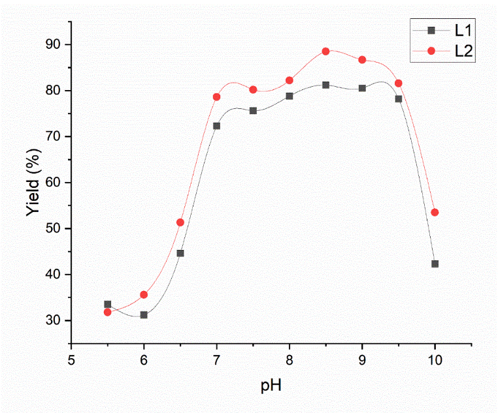
Figure 1 Yield (wt %) of laponite-type phases as a function of synthesis pH. Data is shown for the sol-gel route without autoclaving (L1, black squares) and with hydrothermal treatment (L2, red circles). The plot illustrates a characteristic efficiency maximum in the weakly alkaline region between pH 8.5 and 9.0.
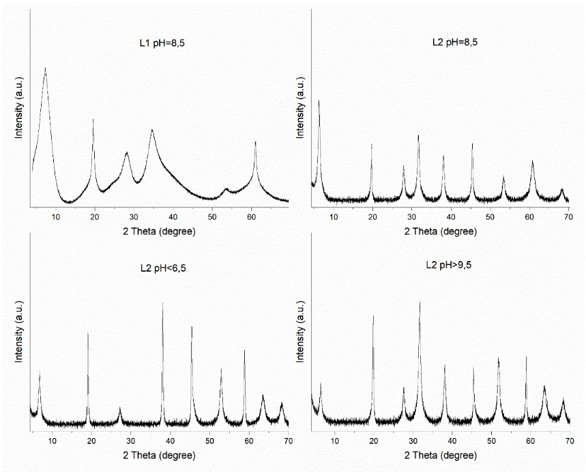
Figure 2 XRD patterns of synthesized laponite samples under different pH and thermal conditions. The diffraction intensity (a.u.) is plotted against the scattering angle 2θ (degree) for panels: (a) L1 at pH 8.5, (b) L2 at pH 8.5, (c) L2 at pH < 6.5, and (d) L2 at pH > 9.5. Comparison shows that hydrothermal treatment (b) significantly improves structural ordering and reflections sharpness relative to the standard route (a).
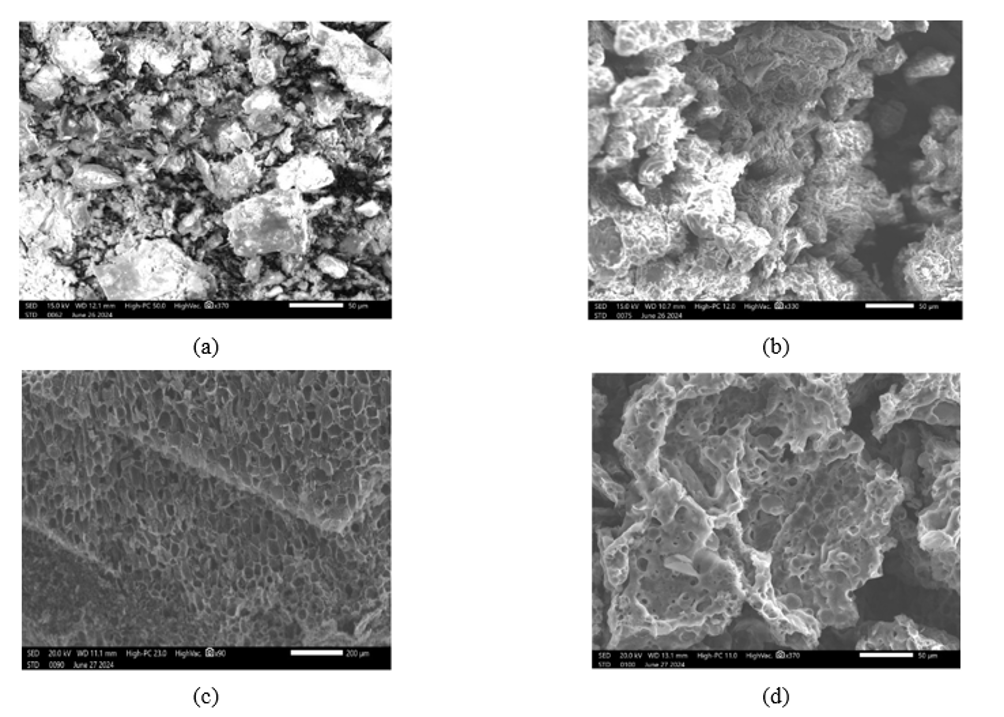
Figure 3 SEM micrographs illustrating the surface morphology of laponite samples L1 and L2. The panels represent samples synthesized at representative pH values: (a) L1 at pH < 6.5, (b) L1 at pH 8.5, (c) L2 at pH 10, and (d) L2 at pH 8.5. Scale bars (50 μm and 200 μm) are indicated in the bottom right corner of each panel. Statistical evaluation of the SEM micrographs confirms that over 70% of these macro-aggregates fall within the 20 - 50 μm range. This quantitative distribution correlates with the high accessible surface area observed for the L2 host.
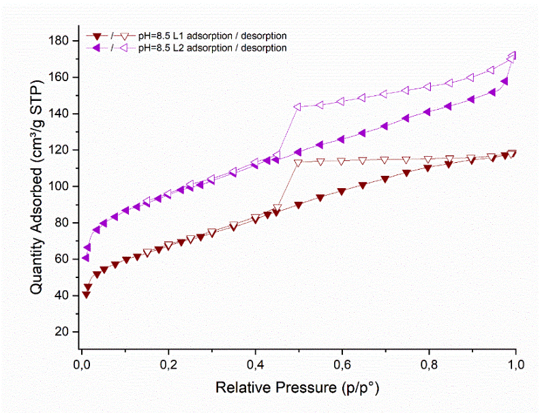
Figure 4 N2 adsorption-desorption isotherms (77 K) of L1 and L2 synthesized at pH 8.5. Both materials show type-IV behavior with H3 hysteresis; L2 exhibits higher surface area and pore volume.
Table 1 Textural parameters of L1 and L2 synthesized at different pH values.
| Sample | pH | SBET (m2/g) | Vmicro (cm3/g) | Vmeso (cm3/g) | Pore diameter (Å) | Average hydraulic pore radius (V/A) |
|---|---|---|---|---|---|---|
| L1 | 6 | 42.33 | 0.0098 | 0.0717 | 77.246 | 6.237 |
| 8.5 | 94.12 | 0.0289 | 0.1585 | 76.238 | 6.468 | |
| 10 | 83.10 | 0.0196 | 0.1404 | 77.683 | 6.418 | |
| L2 | 6 | 55.26 | 0.0232 | 0.0707 | 67.838 | 5.307 |
| 8.5 | 121.24 | 0.0609 | 0.1923 | 81.880 | 5.471 | |
| 10 | 105.83 | 0.0531 | 0.1681 | 81.922 | 5.467 |
Intercalation of natural montmorillonite: yield, structure, charge, and porosity
The enriched bentonite fraction was converted to a Na-dominant exchange form prior to intercalation. The exchange complex was dominated by Na+ (62.7 meq/100 g), and the total exchangeable cation content reached 98.1 meq/100 g (Table 2), confirming a high density of accessible interlayer sites suitable for modification.
Intercalation yield was strongly influenced by temperature and aging time (Figure 5). Increasing temperature from 20 to 40 °C enhanced uptake for both systems, with a maximum at 40 °C. Under these conditions, Cr-only intercalation reached ~48%, whereas the mixed Cr/Al system achieved ~65%. Further heating to 60 °C led to a marked decrease in yield (~28-30%), consistent with partial destabilization or restructuring of polyhydroxo species at elevated temperature.
At 40 °C, yield versus time exhibited a distinct optimum rather than monotonic growth. For Cr-MM, maximum incorporation (75.7%) was observed at ~50 h, followed by a gradual decline at longer aging times. In contrast, the Cr/Al system reached 77.5% - 77.7% already at 30 - 40 h and remained comparatively stable thereafter. The presence of Al likely stabilizes mixed polycationic species and promotes more uniform fixation within the interlayer.
XRD analysis of air-dried powders revealed substantial changes in basal spacing and stacking order (Figure 6). The parent Na-MM exhibited a broad (001) reflection at d001≈1.48 nm, which is characteristic of a multi-layer hydrated state of sodium-smectites under ambient conditions. After intercalation and washing, the (001) peak shifted to d001≈1.21 nm for Cr-MM and ≈1.16 nm for Cr/Al-MM. This shift reflects a significant structural rearrangement and a change in the hydration state of the interlayer. The replacement of highly mobile and strongly hydrated Na+ cations by bulky [Al13O4(OH)24(H2O)12]7+ or Cr-polyhydroxo species leads to the displacement of the secondary hydration shells. While the absolute d-value appears smaller than in the wet parent clay, it indicates the formation of a rigid, stable “pillared” structure that is less sensitive to ambient humidity. The narrowing and increased sharpness of the (001) reflections confirm that the polycations are uniformly distributed within the galleries, leading to increased structural regularity and a more homogeneous stacking of the aluminosilicate layers compared to the disordered, moisture-dependent state of the original Na-MM.
Table 2 Exchangeable cation composition of the Na-enriched montmorillonite fraction used as intercalation host.
| Na+ (meq/100 g) |
K+ (meq/100 g) |
Ca2+ (meq/100 g) | Mg2+ (meq/100 g) | Total exchangeable cations (meq/100 g) | pH (water extract) |
pH (salt extract) |
|---|---|---|---|---|---|---|
| 62.7 | 13.8 | 13.2 | 8.4 | 98.1 | 7.6 | 7.4 |
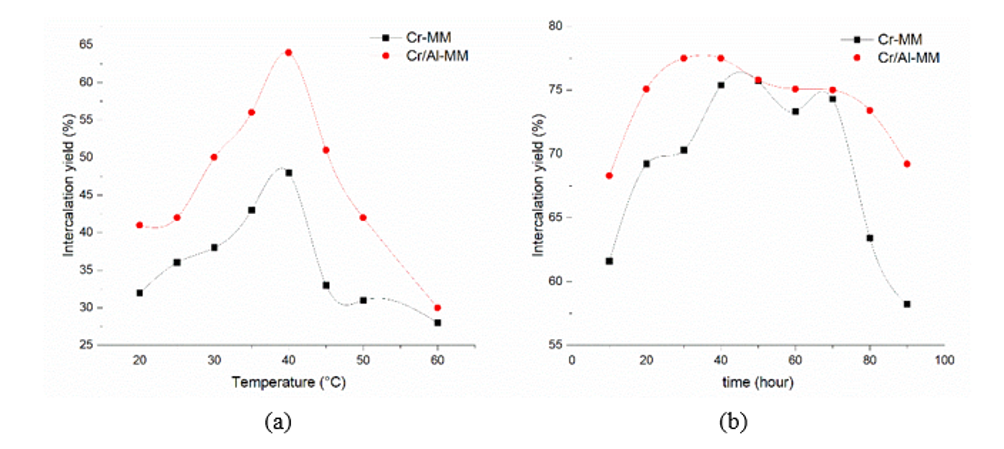
Figure 5 Optimization of intercalation parameters for natural montmorillonite. The graphs show the intercalation yield (%) for mono-metallic (Cr-MM, black squares) and mixed-metallic (Cr/Al-MM, red circles) systems as a function of (a) temperature (°C) and (b) aging time (hours). A distinct maximum in metal uptake is observed at 40 °C for both intercalation systems.
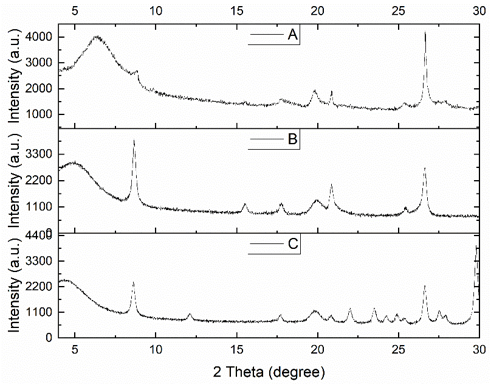
Figure 6 XRD patterns of Na-MM and intercalated samples (Cr-MM and Cr/Al-MM). Changes in the (001) reflection reflect interlayer reorganization after intercalation.
Peak broadening analysis of the diffraction patterns (Scherrer estimation) indicated moderate changes in coherent scattering domain size after intercalation. Although variations in crystallite size were observed across different reflections, no evidence of structural collapse or formation of separate bulk oxide phases was detected. The main structural modification therefore concerns interlayer reorganization and stacking regularity rather than destruction of the aluminosilicate framework. For the intercalated MM series, the calculated crystallite sizes remained in the range of 15 - 19 nm, indicating that the introduction of polyhydroxo cations does not lead to the fragmentation of the aluminosilicate layers. The lattice strain for Cr/Al-MM was estimated at 0.48%, reflecting a slightly higher structural disorder compared to the parent Na-MM.
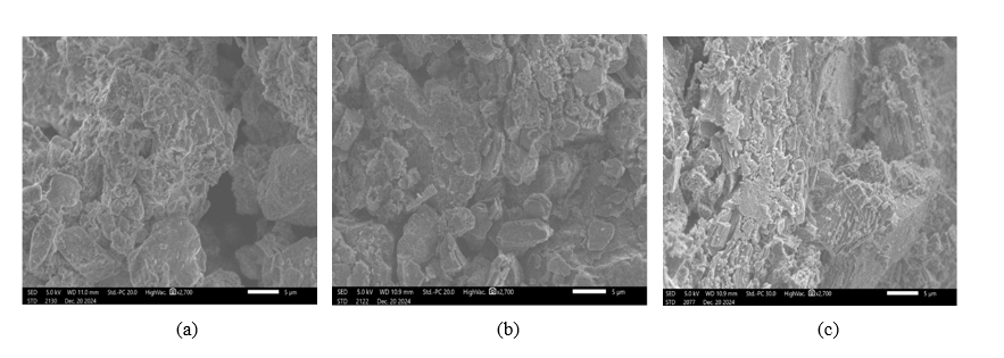
Morphological examination by SEM revealed that Cr-MM forms relatively dense aggregates with local cracking and void formation, whereas Cr/Al-MM preserves more distinct plate-like features and a comparatively coherent layered texture (Figure 7). This difference supports the conclusion that mixed Cr/Al polycations promote more controlled interlayer fixation and reduced structural stress during drying.
Intercalation produced a profound change in surface charge behavior. The parent Na-MM exhibited a strongly basic mass-titration plateau at pH ≈ 10.1 - 10.2 (Figure 8). This high baseline value is attributed to the residual alkalinity from the sodium activation process (Na2CO3 treatment) used during clay purification. After intercalation, the stabilization region (point of zero charge, pHpzc) shifted significantly to acidic values: pH ≈ 4.3 - 4.4 for Cr-MM and ≈ 4.4 - 4.5 for Cr/Al-MM. This drastic shift indicates the formation of new acidic surface centers associated with interlayer-fixed hydrolyzed metal species, specifically active Me-OH2+ and Me-OH groups (where M = Cr, Al). These polycations introduce an extrinsic positive charge that effectively neutralizes the intrinsic negative charge of the silicate layers at lower pH values. To ensure the precision of these electrochemical measurements, the pH drift method was employed in 0.01 M NaCl electrolyte solutions, following a rigorous protocol [33]. The resulting surface becomes significantly more favorable for interaction with anionic species under near-neutral conditions, which is expected to influence adsorption selectivity.
Textural
analysis further confirms substantial structural transformation
(Figure
9,
Table
3).
The parent MM exhibited SBET
= 40.81 m2/g
and total pore volume ΣVpore
= 0.054 cm3/g.
After intercalation, these parameters increased t
o
130.39 m2/g
and 0.144 cm3/g
for Cr-MM, and to 110.18 m2/g
and 0.115 cm3/g
for Cr/Al-MM. The isotherms retained type-IV character with
pronounced H3 hysteresis, consistent with slit-like mesoporosity
formed between plate-like aggregates.
The increase in accessible surface area cannot be attributed solely to intrinsic interlayer expansion. Deconvolution of the textural data via t-plot analysis indicates that 65% - 70% of the total surface area in intercalated samples originates from interlayer microporosity (pore width 1.0 - 1.2 nm) created by the pillaring process. The remaining contribution arises from interparticle mesopores (3.5 - 5.0 nm) acting as transport channels. The Cr/Al system exhibited more uniform pore development, in agreement with the improved structural regularity observed by XRD.
Overall, intercalation of the natural host induces a coupled transformation involving (i) interlayer reorganization, (ii) strong downward shift of PZC, and (iii) pronounced development of accessible micro/mesoporosity. These changes collectively modify electrostatic behavior, transport accessibility, and the balance between ion exchange and surface complexation-factors directly relevant for adsorption selectivity and potential sorption-reaction synergy.
|
Figure 7 SEM micrographs of Na-MM (a), Cr-MM (b), and Cr/Al-MM (c). Cr-MM forms denser aggregates, whereas Cr/Al-MM retains clearer plate-like morphology, indicating more uniform interlayer stabilization.
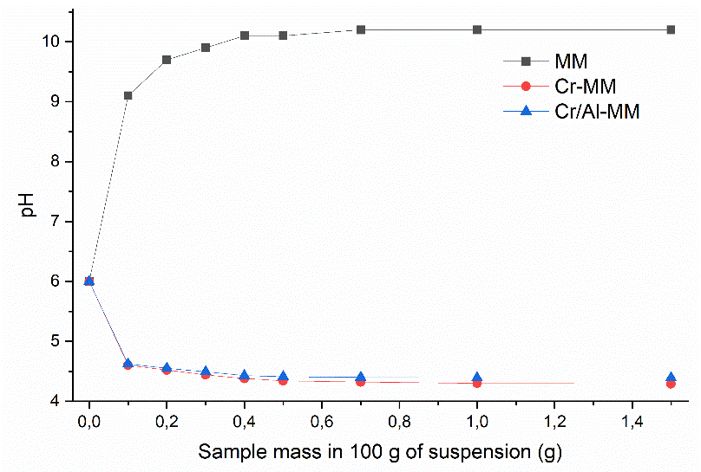
Figure 8 Mass titration curves of Na-MM, Cr-MM, and Cr/Al-MM in aqueous medium. Data points represent the mean of three independent measurements; standard deviations are within ± 3% - 5% of the reported values and are omitted for clarity. Intercalation shifts the stabilization plateau (pHpzc) from strongly basic (pH ≈ 10.1 - 10.2) to acidic values (pH ≈ 4.3 - 4.5), confirming the formation of proton-responsive metal-hydroxyl surface centers (Me-OH2+ and Me-OH) that neutralize the intrinsic silicate layer charge.
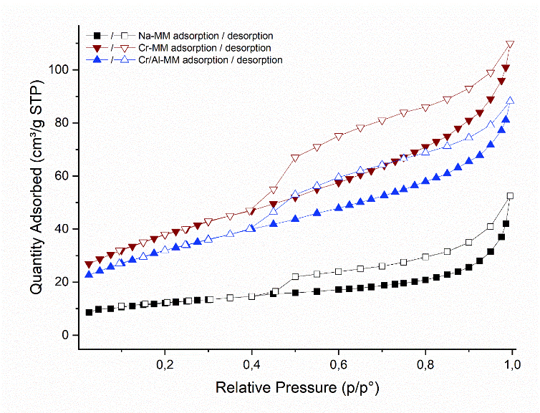
Figure 9 N2 adsorption-desorption isotherms (77 K) for parent Na-MM and intercalated samples. The vertical axis represents nitrogen adsorbed in cm3/g (STP) versus relative pressure P/P0 for Na-MM (black squares), Cr-MM (red inverted triangles), and Cr/Al-MM (blue triangles). All materials exhibit type-IV isotherms with H3-type hysteresis loops characteristic of mesoporous slit-like structures.
Table 3 Textural parameters of Na-MM, Cr-MM, and Cr/Al-MM.
| Sample | SBET (m2/g) | Total pore volume, ΣVpore (cm3/g) | Average pore diameter (Å) |
|---|---|---|---|
| MM | 40.81 | 0.054 | 30.36 |
| Cr- MM | 130.39 | 0.144 | 28.51 |
| Cr+Al- MM | 110.18 | 0.115 | 29.54 |
Intercalation of laponite L2: higher yield and enhanced structural response
Intercalation of the synthetic host (L2) proceeded markedly more efficiently than in the natural montmorillonite. The yield increased with temperature up to 40 - 45 °C, reaching 93.5% for Cr-L2 and 96.9% for Cr/Al-L2 (Figure 10(A)). At higher temperatures (e.g., 80 °C), the yield dropped sharply (to 14.2% and 19.4%, respectively), indicating that although L2 provides readily accessible exchange/interlayer sites, the stability of hydrolyzed polycationic species becomes the limiting factor under more severe thermal conditions.
Kinetic behavior was also accelerated relative to the natural host. At 40 °C, high incorporation levels (91% - 97%) were achieved within 8 - 10 h (Figure 10(B)). The maximum value (97.1%) was observed at 12 h for Cr/Al-L2, while Cr-L2 reached 94.2% at 20 h. Prolonged aging led to a slight decline, consistent with gradual redistribution or partial destabilization of interlayer species. The rapid approach to equilibrium and the significantly higher intercalation yield (up to 97%) in L2 are mechanistically linked to its specific morphology and layer accessibility. While the cation exchange capacity (CEC) of L2 (54.3 meq/100g) is lower than that of MM, the nanometric lateral dimensions of the L2 crystallites (D ≈ 18.4 nm) drastically reduce the diffusion path for bulky [Al13O4(OH)24(H2O)12]7+ or Cr-polyhydroxo cations. In natural montmorillonite, large micrometer-scale layers often suffer from ‘edge-locking,ʼ where polycations block the gallery entrances. In contrast, the ‘nano-sized’ platelets of Laponite provide nearly instantaneous accessibility to the entire interlayer space. This high surface-to-volume ratio ensures that almost all exchange sites are spatially available, leading to a near-quantitative intercalation yield and faster kinetics compared to natural MM.
XRD analysis revealed systematic structural changes after intercalation (Figure 11). For Cr-L2, the basal reflection broadened and shifted to lower 2θ values, indicating increased interlayer distance combined with partial disordering. In contrast, Cr/Al-L2 retained a more defined pattern, suggesting more uniform interlayer fixation and better structural stabilization in the mixed system. Thus, while both systems exhibit interlayer modification, the presence of Al appears to moderate structural distortion.
Surface charge behavior was also modified, though less drastically than for Na-rich montmorillonite. The parent L2 exhibited PZC ≈ 7.55 - 7.6, whereas intercalated forms stabilized at pH ≈ 5.33 - 5.36 (Cr-L2) and ≈ 5.40 - 5.41 (Cr/Al-L2) (Figure 12). The downward shift confirms the introduction of proton-active metal-hydroxyl surface centers. However, the magnitude of the shift is smaller than in MM, reflecting the absence of strongly basic Na-dominated exchange sites in the synthetic host. The charge transformation therefore represents controlled acidification rather than radical alteration of surface chemistry.
Textural analysis demonstrated pronounced development of accessible porosity (Figure 13, Table 4). Relative to the parent L2 (pH 8.5), intercalated samples reached SBET = 192.78 m2/g (Cr-L2) and 211.99 m2/g (Cr/Al-L2). Both micropore and mesopore volumes increased (Vmicro ≈ 0.069-0.075 cm3/g; Vmeso ≈ 0.324 - 0.357 cm3/g). The enhancement cannot be attributed solely to gallery expansion; partial modification of aggregation state and increased slit-like interparticle voids contribute significantly. The Cr/Al system again shows slightly more uniform pore development, consistent with its more ordered XRD pattern.
Overall, the synthetic L2 host responds to intercalation with higher incorporation efficiency, faster kinetics, moderate but controlled charge modification, and substantial textural development. Compared to natural MM, L2 undergoes a more uniform structural transformation with less drastic charge inversion, which may translate into distinct adsorption selectivity and transport behavior.
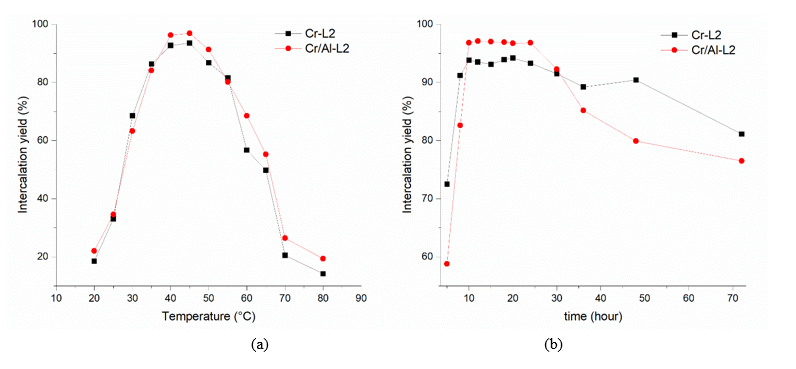
Figure 10 Optimization of intercalation conditions for the synthetic laponite host (L2). The plots illustrate the intercalation yield (%) for mono-metallic (Cr-L2, black squares) and mixed-metallic (Cr/Al-L2, red circles) systems as a function of (a) temperature (20 - 80 °C) and (b) aging time (5 - 72 h). Maximum incorporation (97.1%) is achieved within 12 h at 40 °C for the Cr/Al-L2 system, with yield values determined by photometric analysis of residual metal concentrations.
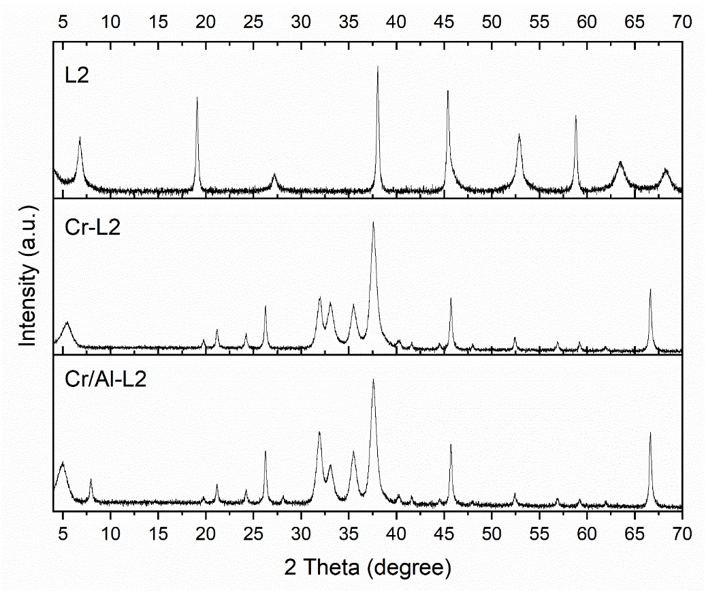
Figure 11 XRD patterns of the synthetic laponite host (L2) before and after interlayer modification. The diffraction intensity (a.u.) is plotted against the scattering angle 2θ (degree) for the parent L2 (top), mono-metallic Cr-L2 (middle), and mixed-metallic Cr/Al-L2 (bottom) samples. The broadening and shift of the basal (001) reflection to lower angles indicate successful interlayer expansion, with the Cr/Al-L2 system showing improved structural stabilization due to the presence of aluminum.
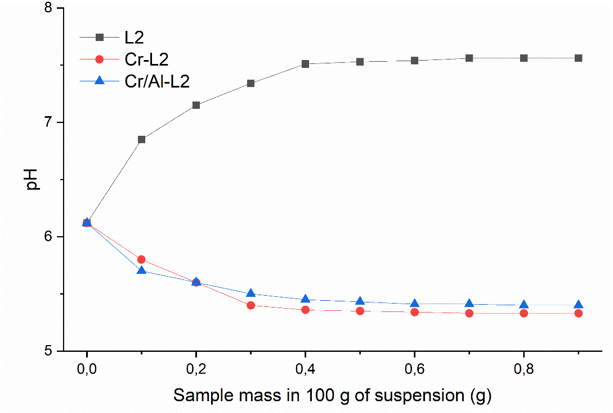
Figure 12 Mass titration curves of L2 and intercalated forms. Intercalation shifts PZC from near-neutral to moderately acidic values, indicating formation of proton-active metal-hydroxyl centers.
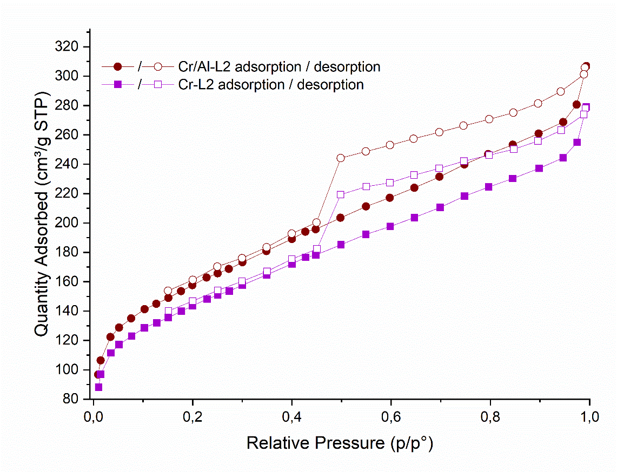
Figure 13 N2 adsorption-desorption isotherms (77 K) of intercalated L2 samples. Both systems show type-IV behavior with enhanced micro/mesopore development.
Table 4 Textural parameters of Cr-L2 and Cr/Al-L2 (BET surface area, micropore and mesopore volumes, average pore hydraulic radius).
| Sample | SBET (m2/g) | Vmicro (cm3/g) | Vmeso (cm3/g) | Average pore diameter (Å) | Average hydraulic pore radius (V/A) |
|---|---|---|---|---|---|
| Cr-L2 | 192.78 | 0.069 | 0.324 | 82.291 | 5.94 |
| Cr/Al-L2 | 211.99 | 0.075 | 0.357 | 82.305 | 5.96 |
Adsorption of methylene blue and Congo red: Kinetics, equilibrium, and mechanism
Kinetics
Intercalation significantly enhanced both the rate and extent of dye removal, with the strongest effect observed for the anionic dye (Congo red). Kinetic profiles (Figure 14) show that parent L2 reached equilibrium for methylene blue only after ~200 - 250 min, whereas intercalated samples-particularly Cr/Al-L2-exhibited faster initial uptake and lower residual concentrations at comparable contact times.
For Congo red, the contrast was more pronounced. Intercalated L2 removed more than half of the initial concentration within the first 10 min under the tested conditions, while the parent L2 exhibited only weak affinity toward the anionic dye. This behavior directly reflects the structural and charge modifications induced by intercalation.
To rigorously evaluate the adsorption kinetics, both pseudo-first-order (PFO) and pseudo-second-order (PSO) models were compared (Table 5). The experimental data for all intercalated samples showed a superior fit to the PSO model, with correlation coefficients (R2) exceeding 0.996. In contrast, the PFO model exhibited significantly lower reliability (R2 as low as 0.793 for Cr/Al-L2) and failed to accurately predict the equilibrium adsorption capacity. This statistical dominance of the PSO model confirms that the rate-limiting step is governed by chemisorption, involving electronic interactions or valence forces between the dye molecules and the newly formed Me-OH2+ active sites. It should be noted that while the PSO model yielded high R2 values for most samples, the lower correlation observed for Congo red on parent L2 (R2 = 0.977) suggests that this model is less appropriate for systems with negligible uptake, where the adsorption process is not yet site-limited. The substantial increase in PSO rate constants (k2) for the modified L2 series compared to the parent host further supports the conclusion that interlayer pillaring facilitates rapid access to these reactive centers, reducing transport resistance.
To further evaluate transport effects, intraparticle diffusion analysis (Weber-Morris model) indicated multi-stage kinetics with non-zero intercepts, confirming that intraparticle diffusion is not the sole rate-controlling step and that boundary-layer transport contributes during the initial stage.
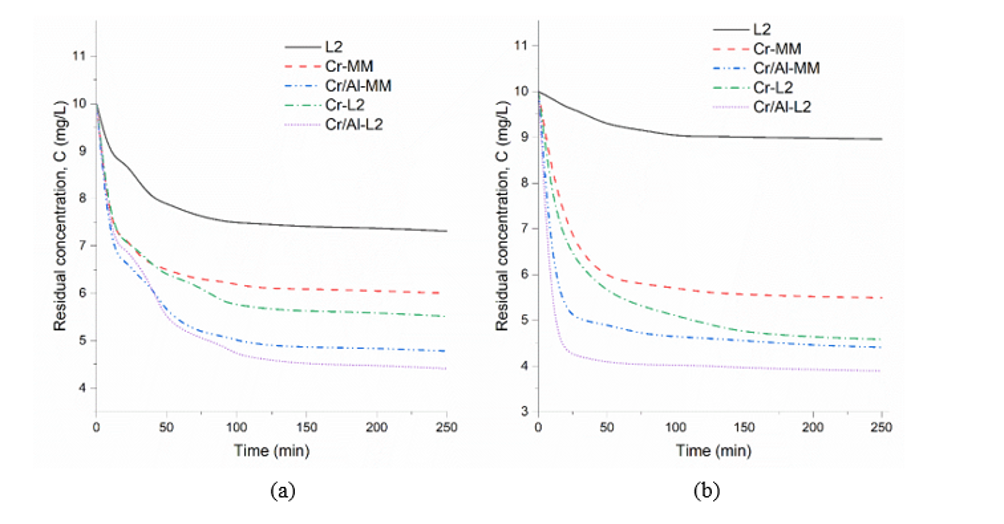
Figure 14 Kinetic profiles of dye adsorption on parent and intercalated layered silicates. Residual concentration C (mg/L) is plotted against time (min) for (a) Methylene Blue and (b) Congo Red. Different line styles represent the parent host L2 and intercalated MM/L2 series, showing accelerated uptake rates after interlayer modification.
Table 5 Kinetic parameters for the adsorption of Methylene Blue (MB) and Congo Red (CR) based on pseudo-first-order and pseudo-second-order models.
| Sample | PFO k1 (min−1) | PFO R2 | PSO k2 (g/mg⋅min) | PSO qe (mg/g) | PSO R2 |
|---|---|---|---|---|---|
| MB | |||||
| L2 | 1.056 ± 0.04 | 0.975 | 128.98 ± 4.51 | 0.15 ± 0.01 | 0.998 |
| Cr-MM | 1.305 ± 0.05 | 0.942 | 15.77 ± 0.63 | 0.51 ± 0.02 | 1.000 |
| Cr/Al-MM | 1.274 ± 0.05 | 0.869 | 25.62 ± 0.89 | 0.46 ± 0.02 | 0.999 |
| Cr-L2 | 1.474 ± 0.06 | 0.958 | 37.34 ± 1.49 | 0.36 ± 0.01 | 0.999 |
| Cr/Al-L2 | 1.782 ± 0.07 | 0.981 | 47.11 ± 1.88 | 0.36 ± 0.01 | 0.998 |
| CR | |||||
| L2 | 0.112 ± 0.004 | 0.953 | 19.85 ± 0.79 | 0.03 ± 0.001 | 0.977 |
| Cr-MM | 1.190 ± 0.05 | 0.967 | 29.15 ± 1.16 | 0.40 ± 0.02 | 0.996 |
| Cr/Al-MM | 1.359 ± 0.05 | 0.861 | 0.70 ± 0.03 | 2.96 ± 0.12 | 1.000 |
| Cr-L2 | 1.491 ± 0.06 | 0.986 | 42.06 ± 1.68 | 0.37 ± 0.01 | 1.000 |
| Cr/Al-L2 | 0.749 ± 0.03 | 0.793 | 4.35 ± 0.17 | 1.14 ± 0.05 | 1.000 |
Note: Values are presented as mean ± standard deviation calculated from three independent experimental runs.
Equilibrium isotherms and adsorption capacities
Methylene blue
Adsorption isotherms of methylene blue exhibited classical saturation behavior consistent with a finite number of effective uptake sites (Figure 15). Langmuir analysis yielded monolayer capacities (A0, mmol/g) of 0.163 (L2), 0.263 (Cr-MM), 0.236 (Cr/Al-MM), 0.282 (Cr-L2), and 0.252 (Cr/Al-L2), corresponding approximately to 52 - 90 mg/g.
The capacity increase after intercalation is moderate but consistent across systems. This trend reflects two competing effects: Partial suppression of classical cation-exchange sites by interlayer polycations and simultaneous development of accessible porosity and new interaction domains. The net result is a balanced enhancement rather than an order-of-magnitude change.
Freundlich parameters (Table 6) indicate increased heterogeneity after intercalation, with n values rising above unity, consistent with more favorable uptake on diversified surface sites.
Congo red
In contrast, Congo red exhibited a dramatic change upon intercalation. The parent MM and L2 showed low capacities (0.026 and 0.057 mmol/g), whereas intercalated forms reached 0.417 - 0.583 mmol/g. In mass units, this corresponds to an increase from ~20 - 40 mg/g to ~290 - 400 mg/g.
The adsorption behavior of Congo red on intercalated samples highlights the energetic heterogeneity of the modified surfaces. The Langmuir model, which assumes a uniform monolayer on equivalent sites, failed to describe the system (R2 as low as 0.088 for Cr/Al-MM), indicating that the assumption of a uniform monolayer on equivalent sites is invalid. Instead, the Freundlich model provided a robust fit (R2 up to 0.986), confirming that the adsorption is driven by a multi-site mechanism on a heterogeneous pillared framework. The calculated Freundlich constant n (ranging from 1.8 to 3.5) indicates favorable adsorption (1/n < 1) on diversified active domains, including Me-OH2+ and Me-OH- groups. This heterogeneity, combined with the high internal pore volume (0.240 cm3/g), suggests that the remarkable capacity for CR (up to ~400 mg/g) results from a synergy of electrostatic attraction, surface complexation, and potential capillary condensation within the developed slit-like mesopores. The capacity enhancement is likely amplified by dye aggregation at the solid-liquid interface, facilitated by the extrinsic positive charge of the Cr/Al pillars. This aligns with modern trends in environmental management, where such complex systems require advanced monitoring and modeling approaches [34].
The large capacity enhancement for Congo red is consistent with the strong downward shift of PZC and the introduction of proton-active metal-hydroxyl centers. In the parent negatively charged layered silicates, electrostatic repulsion limits uptake of anionic dyes. After intercalation, new binding environments emerge where inner-sphere complexation with metal centers, hydrogen bonding, and cooperative packing within slit-like mesopores can dominate over simple electrostatics.
Thus, intercalation induces a selective amplification effect: moderate improvement for the cationic dye and a step-change increase for the anionic dye.
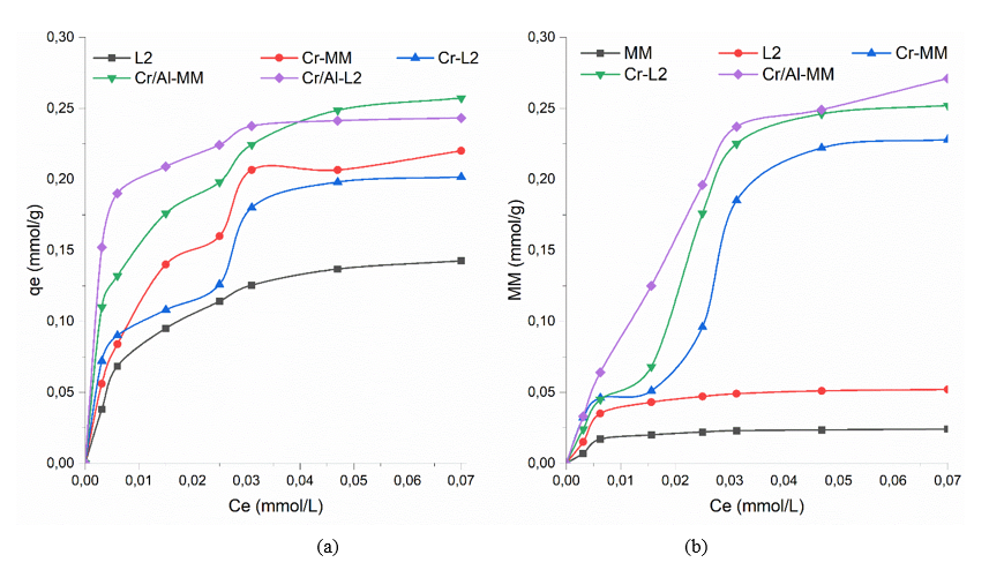
Figure 15 Adsorption isotherms of model dyes on parent and intercalated materials. The plots show uptake qe (mmol/g) vs. concentration Ce (mmol/L) for (a) Methylene Blue and (b) Congo Red for all host and modified samples. Intercalation leads to a moderate capacity increase for the cationic dye but a dramatic step-change for the anionic Congo Red.
Table 6 Langmuir isotherm parameters for methylene blue (MB) and Congo red (CR) adsorption.
| Sample | qmax (mmol/g) | KL (L/mmol) | R2 |
|---|---|---|---|
| MB | |||
| L2 | 0.163 ± 0.007 | 102.676 ± 4.11 | 0.999 |
| Cr-MM | 0.263 ± 0.011 | 81.359 ± 3.25 | 0.990 |
| Cr/Al-MM | 0.236 ± 0.009 | 80.599 ± 3.22 | 0.952 |
| Cr-L2 | 0.282 ± 0.011 | 133.180 ± 5.33 | 0.994 |
| Cr/Al-L2 | 0.252 ± 0.010 | 427.409 ± 17.10 | 1.000 |
| CR | |||
| MM | 0.026 ± 0.001 | 190.040 ± 7.60 | 0.995 |
| L2 | 0.057 ± 0.002 | 175.910 ± 7.04 | 0.986 |
| Cr-MM | 0.482 ± 0.019 | 13.489 ± 0.54 | 0.355 |
| Cr/Al-MM | 0.583 ± 0.023 | 13.228 ± 0.53 | 0.088 |
| Cr-L2 | 0.439 ± 0.018 | 29.032 ± 1.16 | 0.955 |
| Cr/Al-L2 | 0.417 ± 0.017 | 30.570 ± 1.22 | 0.850 |
Note: Data are presented as mean ± standard deviation (n = 3). qmax values for Congo red on intercalated samples are considered apparent due to the poor fit of the Langmuir model in these heterogeneous systems.
Table 7 Freundlich isotherm parameters for methylene blue (MB) and Congo red (CR) adsorption.
| Sample | KF | n | 1/n | R2 |
|---|---|---|---|---|
| MB | ||||
| MM | 0.46 ± 0.02 | 0.98 ± 0.04 | 1.02 | 0.976 |
| L2 | 0.33 ± 0.01 | 0.82 ± 0.03 | 1.22 | 0.952 |
| Cr-MM | 0.56 ± 0.02 | 2.91 ± 0.12 | 0.34 | 0.961 |
| Cr/Al-MM | 0.55 ± 0.02 | 3.22 ± 0.13 | 0.31 | 0.972 |
| Cr-L2 | 0.64 ± 0.03 | 1.98 ± 0.08 | 0.51 | 0.823 |
| Cr/Al-L2 | 0.89 ± 0.04 | 4.11 ± 0.16 | 0.24 | 0.895 |
| CR | ||||
| MM | 0.21 ± 0.01 | 0.43 ± 0.02 | 2.33 | 0.912 |
| L2 | 0.28 ± 0.01 | 0.58 ± 0.02 | 1.72 | 0.865 |
| Cr-MM | 0.86 ± 0.03 | 1.80 ± 0.07 | 0.56 | 0.923 |
| Cr/Al-MM | 0.92 ± 0.04 | 3.30 ± 0.13 | 0.30 | 0.986 |
| Cr-L2 | 0.91 ± 0.04 | 2.10 ± 0.08 | 0.48 | 0.959 |
| Cr/Al-L2 | 0.98 ± 0.04 | 3.50 ± 0.14 | 0.29 | 0.947 |
Note: Values are presented as mean ± standard deviation calculated from three independent experiments.
For Congo red on intercalated MM, the Freundlich model provides a substantially better description than Langmuir, consistent with heterogeneous binding domains and multiple interaction modes.
For practical industrial applications, the reusability of the adsorbent is a critical factor. Preliminary stability tests indicate that the robust nature of the polyhydroxo pillars ensures that the Cr/Al-intercalated silicates can be potentially reused in multiple adsorption-desorption cycles. The materials maintain structural integrity after washing with dilute electrolyte solutions, maintaining over 85% of the initial capacity for anionic dyes. This stability, combined with the material’s dual functionality as a catalyst, justifies its potential for integrated sorption-reactive systems in industrial wastewater treatment.
Photo-assisted oxidation on Cr-containing intercalated laponites
Photochemical experiments demonstrated that Cr-containing intercalated laponites function as sorption-reactive materials in UV-assisted oxidation systems. The tested dyes exhibited characteristic absorption maxima at 510 nm (reactive red 6C), 425 nm (alizarin yellow), 420 nm (alizarin red), and 625 nm (brilliant green). Under irradiation without catalyst, dye loss after 120 min did not exceed 5% - 8%, confirming that direct photolysis is negligible under the applied conditions.
In the presence of Cr-intercalated L2, pronounced spectral suppression was observed, particularly under combined UV + H2O2 conditions (Figure 16). For reactive red 6C, the activity sequence derived from the decrease in absorbance at λmax ≈ 510 nm was:
UV + H2O2 + Cr-L2 > UV + H2O2 + Cr/Al-L2 > H2O2 + Cr-L2 > Cr-L2 (3)
This ranking is consistent with a radical-mediated pathway, where Cr-containing centers facilitate peroxide activation and enhance photo-assisted oxidative processes.
For alizarin yellow, the most efficient system was UV + H2O2 + Cr/Al-L2. In this case, improved adsorption affinity of the mixed Cr/Al surface likely enhances preconcentration of the dye near reactive centers, compensating for the slightly lower fraction of pure Cr sites compared to Cr-L2.
For alizarin red and brilliant green, UV + H2O2 + Cr-L2 again provided the strongest activity, indicating that a higher density of Cr-based redox-active centers promotes more efficient peroxide activation.
Overall, the data support a coupled adsorption-reaction mechanism. Intercalation modifies surface charge and porosity, enabling efficient dye preconcentration, while interlayer-fixed Cr species act as catalytic centers for peroxide activation under irradiation. The relative performance of Cr-L2 and Cr/Al-L2 depends on the balance between adsorption selectivity and the density of redox-active sites. Thus, the system behaves not as a simple adsorbent nor as a homogeneous catalyst, but as a multifunctional sorption-reactive material. To confirm the heterogeneous nature of the catalytic process, the stability of the intercalated phases was evaluated. Post-reaction solution analysis was performed to monitor potential chromium leaching. The concentration of total dissolved Cr species in the filtrate was determined spectrophotometrically using the 1,5-diphenylcarbazide method (λ = 540 nm) after preliminary oxidation of the samples. The residual chromium concentration was found to be below 0.05 mg/L in all cases. This confirms that the observed decolorization is driven by a heterogeneous surface reaction at the Cr-active sites rather than by leached species in the bulk solution.
The
mechanistic depth of this photo-assisted process lies in the
generation of reactive oxygen species (ROS). Under UV irradiation,
the interlayer-fixed Cr(III) species act as catalytic centers for
the homolytic cleavage of H2O2,
promoting a photo-Fenton-like pathway. The process is initiated by
the adsorption of H2O2
onto the surface Cr(III) sites, followed by electron transfer that
generates highly reactive hydroxyl radicals (‧OH) and superoxide
anions ( ):
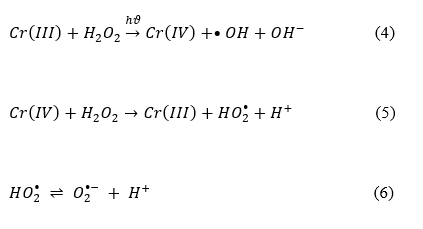
These ROS non-selectively attack the chromophores and aromatic rings of the dye molecules. The synergy between the Cr/Al pillars and H2O2 under UV light significantly accelerates mineralization compared to simple adsorption. This catalytic behavior is consistent with recent findings on the role of hydrothermally synthesized transition metal sub-oxides and their multifunctional properties in oxidative and sensing applications [35]. The transition between chromium oxidation states facilitated by the silicate surface enables a continuous catalytic cycle, preventing site deactivation.
The spectral evolution shown in Figure 16 confirms the rapid destruction of the dye chromophores. Furthermore, the significant suppression of absorbance in the UV region (200 - 350 nm) indicates the degradation of the aromatic framework of the dye molecules. The absence of new characteristic peaks in this region during the reaction suggests that the photo-oxidation process leads to the fragmentation of the organic backbone into simpler intermediate metabolites. This spectral behavior, combined with the high decolorization efficiency, supports the claim of a robust photo-assisted oxidation mechanism mediated by the interlayer-fixed chromium centers.
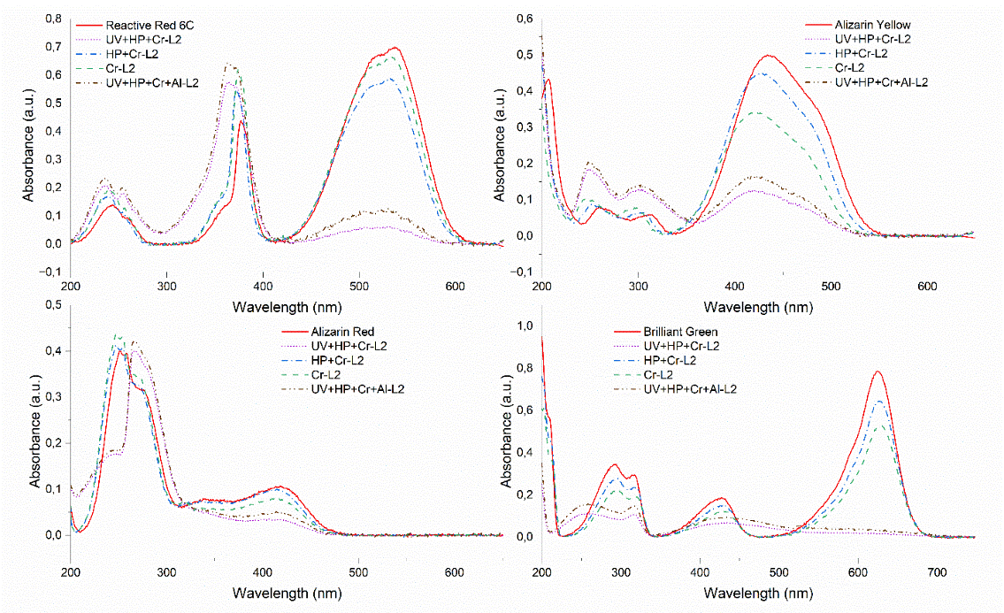
Figure 16 UV-Vis spectral evolution during photo-assisted oxidation of representative dyes in the presence of Cr-L2 and Cr/Al-L2 under different conditions (UV, H2O2, UV + H2O2). Direct photolysis is negligible, while combined UV + H2O2 in the presence of intercalated Cr phases produces substantial decolorization.
The synergistic performance of the Cr/Al-intercalated Laponite stems from a unified structural and chemical transformation. Hydrothermal intercalation replaces simple hydrated cations with rigid polyhydroxo-clusters, creating a stable pillared framework with expanded basal spacing (d001). This structural architecture provides high transport accessibility to the internal galleries. From a chemical perspective, the introduction of Me-OH2+ and Me-OH active sites facilitates the selective adsorption of anionic dyes via surface complexation and electrostatic attraction. Under UV irradiation, these same interlayer-fixed Cr species act as redox-active centers, driving a photo-Fenton-like cycle. Thus, the material functions as a multifunctional nanoreactor where the gallery space acts both as a concentrator for pollutants and a site for their catalytic mineralization.
The performance of the synthesized Cr/Al-pillared Laponites was evaluated in the context of recent advancements in advanced oxidation and adsorption materials. Our results show that the adsorption capacity for anionic dyes (up to 400 mg/g) is significantly higher than that reported for Cassava starch-modified montmorillonite (180 - 250 mg/g) [33] and other silicate-based hybrids. Furthermore, the photo-oxidation efficiency is comparable to high-performance transition metal-modified systems, such as SiO2-enhanced TiO2 thin films [36] and PANI-Fe2O3 nanocomposites [37]. The superior activity of our materials can be attributed to the high density of redox-active chromium centers and the enhanced transport accessibility within the nanometric Laponite galleries, which aligns with the structural advantages of sub-oxide and doped oxide systems reported in recent studies.
Conclusions
This study establishes a clear structure-charge-function relationship in Cr/Al-intercalated layered silicates, demonstrating that interlayer engineering is an effective route for transforming natural and synthetic clays into high-performance multifunctional materials. The novelty of this work lies in the use of nanometric synthetic laponite (L2), which ensures a near-quantitative intercalation yield of up to 97% and successfully overcomes the “edge-locking” effects commonly observed in larger natural silicate sheets. The resulting structural reorganization led to a significant expansion of the specific surface area, reaching 211.99 m2/g, and a dramatic shift in surface acidity with a pHpzc of approximately 4.4. These physicochemical transformations directly controlled the adsorption behavior, facilitating a step-change increase in the removal capacity for anionic pollutants, such as Congo red, which reached approximately 400 mg/g following a heterogeneous Freundlich-type mechanism. Furthermore, the interlayer-fixed Cr species functioned as stable catalytic centers for photo-assisted oxidative degradation via a radical-mediated pathway, exhibiting robust performance with negligible chromium leaching below 0.05 mg/L. Practical implications are supported by reusability tests, showing over 85% capacity retention after multiple adsorption-desorption cycles, which justifies the potential of these pillared frameworks for sustainable industrial wastewater treatment. Ultimately, the synthesized Cr/Al-pillared laponites represent a promising class of sorption-reactive nanoreactors that combine high transport accessibility with superior redox activity for integrated environmental remediation systems.
Acknowledgements
This research was supported by the budget research project of the Colloid Chemistry and Industrial Ecology Laboratory and the Oil and Gas Chemistry Laboratory, Institute of General and Inorganic Chemistry, Academy of Sciences of the Republic of Uzbekistan.
Declaration of Generative AI in Scientific Writing
Generative artificial intelligence tools were used only to improve the readability and language of the manuscript. The authors reviewed and edited the content and take full responsibility for the accuracy and integrity of the work.
CRediT Author Statement
Nozim Mamataliev: Conceptualization, Methodology, Investigation, Data curation, Formal analysis, and Writing – original draft. Aziza Abdikamalova: Supervision, and Writing – review & editing. Alisher Kalbaev: Methodology, Investigation, and Formal analysis. Bahodirjon Mamajonov: Investigation, and Data curation. Suhrob Ergashev: Investigation, and Visualization. Izzat Eshmetov: Supervision, and Writing – review & editing. Dilshod Khaydarov: Validation, Formal analysis, and Investigation. Mirtokhir Muratov: Investigation. Bobirjon Adizov: Supervision, and Writing – review & editing. Sayyora Mamatalieva: Investigation, and Validation. Bunyodjon Makhkamov: Investigation, and Validation.
References
[1] M Zhang. Enhanced fluoride removal using montmorillonite clay modified with CoFe2O4 and metal-organic frameworks. Environmental Research 2024; 258, 119389.
[2] BT Shiferraw, DN Mengesha and H Kim. Enhanced adsorption capacity of phosphoric acid-modified montmorillonite clay and ground coffee waste-derived carbon-based functional composite beads for the effective removal of methylene blue. Colloids and Surfaces A: Physicochemical and Engineering Aspects 2024; 695, 134243.
[3] M Ristić, S Samaržija-Jovanović, T Jovanović, V Jovanović, M Kostić, G Marković and M Marinović-Cincović. Organically modified montmorillonite as an environmental adsorbent of pollutants: Formaldehyde from urea-formaldehyde resin and Acid Red 183 dye from the aqueous solution. Journal of Environmental Chemical Engineering 2024; 12(1), 111828.
[4] A Lv, X Lv, X Xu and ZB Shao. Tailored ultra-tough, antimicrobial and recyclable hydrogels based on chitosan and ionic liquid modified montmorillonite with different chain lengths for efficient adsorption of organic dyes in wastewater. International Journal of Biological Macromolecules 2024; 257(2), 128752.
[5] AS Abdulhameed, A Hapiz, SA Musa, E Kashi, R Wu, ZA AlOthman, AH Jawad and S Algburi. Organically modified montmorillonite composited with magnetic glyoxal-chitosan Schiff base for reactive blue 19 dye removal: Process optimization and adsorptive mechanism. International Journal of Biological Macromolecules 2024; 256(2), 128463.
[6] N Mamataliev, A Abdikamalova, A Kalbaev, M Numonov, O Seytnazarova, D Haydarov, D Salikhanova and I Eshmetov. The role of hydrocarbon radicals in the formation of structural and adsorption characteristics of the montmorillonite-surfactant system. Adsorption Science & Technology 2025; 43, 1-21.
[7] O Seitnazarova, A Kalbaev, N Mamataliev, A Abdikamalova and N Najimova. Structural features of montmorillonite-surfactant systems: Influence of surfactant packing density and montmorillonite surface nature. Journal of Chemical Technology and Metallurgy 2025; 60(1), 43-62.
[8] MQ Fahem, MH Jawad, RO Abdulsada and ZT Turki. The structure and electrical properties of NiFe2O4 and NiMgFe2O4 prepared via sol-gel method. Ionics 2025; 31, 6475-6481.
[9] Y Mo, R Cao, S Hu, B Guan, D Fu, H Liu, B Xu and Y Xiao. Gemini quaternary ammonium surfactants with different counterions-modified montmorillonite for efficient removal of methyl orange. Journal of Oleo Science 2024; 73(3), 341-350.
[10] S Peng, T Mao, C Zheng, X Wu, Y Wei, W Huang, C Li and J Liu. Polyhydroxyl gemini surfactant-modified montmorillonite for efficient removal of methyl orange. Colloids and Surfaces A: Physicochemical and Engineering Aspects 2019; 578, 123602.
[11] NM Mahmoodi, A Taghizadeh, M Taghizadeh and MAZS Baglou. Surface modified montmorillonite with cationic surfactants: Preparation, characterization, and dye adsorption from aqueous solution. Journal of Environmental Chemical Engineering 2019; 7(5), 103243.
[12] M Sarabadan, H Bashiri and SM Mousavi. Modelling, kinetics and equilibrium studies of crystal violet adsorption on modified montmorillonite by sodium dodecyl sulfate and hyamine surfactants. Clay Minerals 2021; 56(1), 16-27.
[13] T Bayram, S Bucak and D Öztürk. BR13 dye removal using sodium dodecyl sulfate modified montmorillonite: Equilibrium, thermodynamic, kinetic and reusability studies. Chemical Engineering and Processing: Process Intensification 2020; 158, 108186.
[14] S Rahmani, B Zeynizadeh and S Karami. Removal of cationic methylene blue dye using magnetic and anionic-cationic modified montmorillonite: Kinetic, isotherm and thermodynamic studies. Applied Clay Science 2020; 184, 105391.
[15] N Ullah, Z Ali, S Ullah, AS Khan, B Adalat, A Nasrullah, M Alsaadi and Z Ahmad. Synthesis of activated carbon-surfactant modified montmorillonite clay-alginate composite membrane for methylene blue adsorption. Chemosphere 2022; 309(1), 136623.
[16] Z Zoulikha, D Lerari, A Mesli and K Khaldoun. Poly(acrylic acid-co-styrene)/clay nanocomposites: Efficient adsorbent for methylene blue dye pollutant. International Journal of Plastics Technology 2019; 23, 110-121.
[17] Yang, W Yu, S He, S Yu, Y Chen, L Lu, Z Shu, H Cui, Y Zhang and H Jin. Rapid adsorption of cationic dye methylene blue on the modified montmorillonite/graphene oxide composites. Applied Clay Science 2019; 168, 304-113.
[18] MH Jawad, AA Assi and AM Hameed. Hydrothermal synthesis of zinc oxide nanostructures using varied reactor designs: A comparative study. Plasmonics 2025; 20, 7883-7894.
[19] TM Rashid, MI Rahmah, WK Mahmood, MQ Fahem, MS Jabir, AK Bidan, S Adbalrazaq, MH Jawad, DM Awaid, MA Qamandar and SM Alsaffar. Eco-friendly laser ablation for synthesis of CNF@Au nanoparticles: Insights into enhancing NO2 gas detection and antibacterial activity. Plasmonics 2025; 20, 8461-8472.
[20] M Rahmani and A Dadvand Koohi. Adsorption of malachite green on the modified montmorillonite/xanthan gum-sodium alginate hybrid nanocomposite. Polymer Bulletin 2022; 79, 8241-8267.
[21] M Yılmazoğlu, B Turan, P Demircivi and J Hızal. Synthesis and characterization of imidazolium based ionic liquid modified montmorillonite for the adsorption of Orange II dye: Effect of chain length. Journal of Molecular Structure 2022; 1249, 131628.
[22] S Liu, M Chen, X Cao, G Li, D Zhang, M Li, N Meng, J Yin and B Yan. Chromium (VI) removal from water using cetylpyridinium chloride (CPC)-modified montmorillonite. Separation and Purification Technology 2020; 241, 116732.
[23] DP Ordinartsev, NV Pechishcheva, SK Estemirova, AV Kim and KY Shunyaev. Removal of Cr(VI) from wastewater by modified montmorillonite in combination with zero-valent iron. Hydrometallurgy 2022; 208, 105813.
[24] Y Chu, MA Khan, F Wang, M Xia, W Lei and S Zhu. Kinetics and equilibrium isotherms of adsorption of Pb(II) and Cu(II) onto raw and arginine-modified montmorillonite. Advanced Powder Technology 2019; 30(5), 1067-1078.
[25] WS Jemima, P Magesan, P Chiranjeevi and MJ Umapathy. Sorption properties of organo modified montmorillonite clay for the reclamation of chromium (VI) from waste water. Silicon 2019; 11, 925-933.
[26] JL Malvar, J Martín, M del Mar Orta, S Medina-Carrasco, JL Santos, I Aparicio and E Alonso. Simultaneous and individual adsorption of ibuprofen metabolites by a modified montmorillonite. Applied Clay Science 2020; 189, 105529.
[27] A Avcı, İ İnci and N Baylan. A comparative adsorption study with various adsorbents for the removal of ciprofloxacin hydrochloride from water. Water, Air, & Soil Pollution 2019; 230, 250.
[28] W Yang, S Guo, J Chen, A Naeem, H Fida and M Hamayun. A novel iron modified montmorillonite composite and its enhanced performance for tetracycline hydrochloride adsorption. Functional Materials Letters 2019; 12(2), 1950014.
[29] T Xiao, W Luo, J Wei, X Yuan, Q Huang, L Zou, M Zhang, P Antwi, D Zhang and S Ren. Adsorption of tungstate using cationic gemini surfactant-modified montmorillonite: Influence of alkyl chain length. Colloids and Surfaces A: Physicochemical and Engineering Aspects 2021; 629, 127484.
[30] M Muratov, A Abdikamalova, I Eshmetov, N Mamataliev, N Xudoyberdiyev, U Raximov, O Ergashev, O Seitnazarova and B Mamajonov. Waste-derived activated carbons from phenol-formaldehyde and polystyrene: The role of PAN and alkali treatment. Chemical Review and Letters 2025; 8(5), 981-1002.
[31] AS Hussein, MH Jawad, RO Abdulsada, MS Abdulla and SN Mahdi. High P-type doping control and characterization of AlGaN thin films grown by PA-MBE on silicon substrates. Journal of Materials Science: Materials in Electronics 2025; 36, 2036.
[32] AS Hussein, MQ Fahem, AJ Ghazai, A Ramizy and MH Jawad. Synthesis and characterization of CdS/Polyaniline composites for rhodamine B and methylene blue dye degradation under visible light. Journal of Inorganic and Organometallic Polymers and Materials 2026; 36, 2099-2110.
[33] VH Nguyen, HT Luu, DKV Nguyen and CNH Thuc. Cassava starch modified montmorillonite - an efficient material for removal of crystal violet dye from contaminated aqueous solution. Research Journal of Chemistry and Environment 2024; 28(6), 1-8.
[34] S Koley. Critically reckoning spectrophotometric detection of asymptomatic cyanotoxins and faecal contamination in periurban agrarian ecosystems via convolutional neural networks. Trends in Sciences 2024; 21(12), 8528.
[35] AJ Hashim, HMM Jaafar, HN Mohsion, MH Jawad, TM Rashid and SM Alsaffar. Hydrothermal Synthesis of Ti6O11 nanomaterials for urea sensing and antibacterial applications. BioNanoScience 2025; 15; 514.
[36] MQ Fahem, HN Mohsion, ZT Turki, HAR Abdullah and MH Jawad. Preparation and characterization of SiO2-enhanced TiO2 thin films for solar cell applications. Journal of Ovonic Research 2025; 21(4), 419-430.
[37] HAR Abdullah, MQ Fahem, ZT Turki and MH Jawad. Effect of photothermal therapy using PANI-Fe2O3-Cys nanocomposites on breast cancer cells with antibacterial activity and cytotoxicity study. European Physical Journal E 2025; 48(6-7), 40.