
Trends
Sci.
2026;
23(11):
13701
A Smoke Water-Mimetic Small Molecule Promotes Rice Root Elongation under Phosphorus Deficiency
Ananya Romyanon1,2, Sompop Pinit3 and Juthamas Chaiwanon1,*
1Center of Excellence in Environment and Plant Physiology, Department of Botany, Faculty of Science,
Chulalongkorn University, Bangkok 10330, Thailand
2Biological Science Program, Faculty of Science, Chulalongkorn University, Bangkok 10330, Thailand
3Department of Biochemistry, Faculty of Medical Science, Naresuan University, Phitsanulok 65000, Thailand
(*Corresponding author’s e-mail: [email protected])
Received: 2 March 2026, Revised: 6 May 2026, Accepted: 16 May 2026, Published: 20 June 2026
Abstract
Plant-derived smoke water enhances seedling growth across multiple species. However, the chemical basis of this activity remains poorly defined due to the complex mixtures and trace-level bioactives. The contribution of smoke-associated aromatic compounds to root responses under nutrient stress is particularly unclear. Here, we evaluated selected aromatic compounds in rice (Oryza sativa L. cv. Nipponbare) under phosphorus-sufficient and phosphorus-deficient conditions and performed structure-activity relationship (SAR) analyses across benzaldehyde and phenol derivatives. This study identified salicylaldehyde (SAL) as a defined bioactive that mimics smoke water-induced root elongation under phosphorus deficiency. SAR analysis indicated that low phosphorus-dependent root growth promotion may be associated with specific functional group combinations and substitution positions rather than general aromatic or phenolic properties. Antioxidant capacity did not correlate with root growth responses. Under salinity stress, SAL showed only modest root growth promotion and did not improve shoot growth or photosynthetic pigment status, indicating that its activity is strongly context dependent and does not confer enhanced performance under salinity stress. Together, these findings suggest that smoke-derived aromatic aldehydes, including SAL, can contribute to root developmental responses under nutrient-limiting conditions and provide a basis for further mechanistic investigation.
Keywords: Salicylaldehyde, Smoke water, Phosphorus deficiency, Root elongation, Structure-activity relationship, Rice
Introduction
Phosphorus (P) is an essential macronutrient required for fundamental plant processes, including energy metabolism, nucleic acid synthesis, and membrane biogenesis [1]. P deficiency is a prevalent and yield-limiting nutritional constraint in global agriculture, affecting over 40% of cultivated soils worldwide [2]; plant-available inorganic phosphate (Pi) is often scarce, and applied P fertilizers are inefficiently recovered by plants. Pi availability is further limited because it is readily immobilized through adsorption to soil particles and precipitation with cations, restricting uptake [3]. In response, plants adjust root growth and architecture to increase soil exploration and Pi acquisition, and root system plasticity is an important component of acclimation to Pi starvation [4].
Plant-derived smoke and its aqueous extract, smoke water, have long been recognized to influence plant development. This effect is observed across diverse species and environmental conditions [5,6]. Smoke water comprises chemically heterogeneous mixtures, including phenolics and aromatic derivatives with reported biological activity in plants [7,8]. Its composition depends on biomass type and combustion conditions, and preparations can differ substantially in chemical profiles and bioactivity [9,10]. This mixture complexity complicates mechanistic dissection because a given phenotype may reflect contributions from multiple constituents and their interactions rather than a single compound.
A further challenge is that smoke-associated bioactives can be highly potent and present at low abundance, making them difficult to detect or quantify using untargeted profiling of bulk smoke water. Functional assays with defined small molecules therefore provide a complementary route to pinpoint bioactive chemistry and to establish tractable molecular tools for mechanistic studies. In addition, structure-activity relationship (SAR) analyses can link chemical features (e.g., aldehyde, hydroxyl, and methoxy groups and their positional arrangements) to biological outcomes and help distinguish structure-dependent activity from nonspecific chemical effects [11].
In our previous study, rice straw-derived smoke water promoted rice root growth under both P-sufficient and P-deficient conditions, with the strongest stimulation observed under P deficiency [12,13]. Despite this clear bioactivity, the identity of the molecule(s) responsible for the low P-enhanced root elongation response remains unknown, limiting progress toward a mechanistic understanding of smoke water action on root development.
Here, we identified defined small molecules that phenocopy smoke water–induced root elongation under low P and characterized structural features associated with this activity. We conducted a limited functional comparison of candidate aromatics, followed by SAR analyses of benzaldehyde and phenol derivatives, and tested whether antioxidant capacity correlates with root growth responses using a DPPH assay. Finally, to assess whether root promotion extends beyond nutrient limitation, we evaluated the selected aromatic molecule candidates under salinity stress and quantified growth and photosynthetic pigment responses as physiological readouts.
Materials and methods
Smoke water and chemical treatments
Rice straw-derived smoke water was prepared as previously described [13] and used at a final concentration of 1% (v/v). The total P content of the smoke water stock was determined by ICP-OES (iCAP PRO XP, Thermo Fisher Scientific, Waltham, MA, USA) to be 0.039 mg/L; at a 1% (v/v) working concentration, this corresponds to approximately 0.013 µM P - negligible relative to the HP condition (320 µM Pi) and effectively equivalent to the LP condition (0 µM Pi).
Aromatic compounds (≥ 98% purity) were obtained from the following suppliers: TCI Chemicals (Tokyo, Japan): o-anisaldehyde (Cat# A0478), p-anisic acid (Cat# A0482), benzaldehyde (Cat# B2379), catechol (Cat# PO317), 2,4-dihydroxybenzaldehyde (Cat# D0564), 4-hydroxyacetophenone (Cat# H0193), 3-hydroxybenzaldehyde (Cat# H0197), 4-hydroxybenzaldehyde (Cat# H0198), salicylaldehyde (Cat# S0004), and o-tolualdehyde (Cat# T0566); Sigma-Aldrich (St. Louis, MO, USA): guaiacol (Cat# G5502), hydroquinone (Cat# H17902) and resorcinol (Cat# 398047); and Thermo Fisher Scientific (Waltham, MA, USA): phenol (Cat# P/2360/60) and toluene (Cat# T/2300/17). All aromatic compounds contain no phosphorus in their chemical structures and thus contribute no P to the treatment medium. Stock solutions were prepared in 80% ethanol and added into nutrient solution to achieve the indicated final concentrations. Mock controls received the same final concentration of ethanol as compound treatments.
Selection of candidate aromatic compounds
Candidate compounds were selected from MS/MS annotation of LC fractions of smoke water prioritized in an independent bioassay (manuscript in preparation). From the annotated compound list, we assembled an initial set of commercially available aromatics that could be obtained within the project timeline. Three compounds, 4-hydroxyacetophenone, p-anisic acid, and 2-hydroxybenzaldehyde (salicylaldehyde; SAL), were therefore selected and tested alongside 1% (v/v) smoke water under HP and LP conditions.
Plant material and growth conditions
Seeds of Oryza sativa L. cv. Nipponbare were surface sterilized in 2% (v/v) sodium hypochlorite for 30 min, rinsed thoroughly with distilled water. Seedlings were pre-germinated for 2 d in darkness, then transferred to half-strength Yoshida solution [14] for 2 d followed by full-strength solution for 4 d under controlled light conditions. After removal of the seed endosperm, seedlings were transferred to phosphorus-sufficient (HP; 320 µM NaH2PO4) or phosphorus-deficient (LP; phosphate-free, 0 µM NaH2PO4) Yoshida solution and treated with smoke water or aromatic compounds for 8 d.
For salinity experiments, seedlings were exposed to 75 mM NaCl in HP nutrient solution in the presence or absence of SAL or catechol (25 or 50 µM) for 6 d. Nutrient solutions were refreshed every 3 d. All experiments were conducted in a controlled growth room at 30 °C with a 12/12 h light/dark cycle; light intensity was maintained at 700 µmol m−2 s−1 during days 1 - 4 after pre-germination and increased to 1,000 µmol m−2 s−1 after transfer to treatment conditions.
Structure-activity relationship analysis
For SAR analysis, SAL and 12 structurally related aromatic derivatives were evaluated at 25, 50, and 100 µM. Compounds were selected to vary functional groups and substitution patterns on the aromatic ring (e.g., ortho, meta, and para). SAR experiments were performed under both HP and LP conditions as described above. Total root length was measured at harvest, and representative images were acquired.
DPPH radical scavenging assay
Antioxidant capacity was assessed using the 2,2-diphenyl-1-picrylhydrazyl (DPPH) radical scavenging assay [11], with minor modifications. Briefly, 200 µL of 0.15 mM DPPH solution (in 80% ethanol) was mixed with 22 µL of each compound solution. After 30 min incubation in darkness at room temperature, absorbance was measured at 517 nm using a microplate reader.
Photosynthetic pigment analysis
Chlorophyll and carotenoid contents were determined from leaf discs (3 mm diameter). Three discs per biological replicate were extracted in 80% ethanol for 48 h in darkness. Absorbance was measured at 470, 649, and 664 nm using a microplate reader, and chlorophyll a, chlorophyll b, and total carotenoids were calculated using published equations [15].
Statistical analysis
All data are presented as means ± standard deviation (SD). For the initial compound screening experiment, data were analyzed using 2-way ANOVA. For all other experiments, 1-way ANOVA was used. In both cases, post-hoc comparisons were performed using Tukey's HSD test (p < 0.05). All statistical analyses were performed in R (version 4.4.1). The number of biological replicates for each experiment is indicated in the corresponding figure legends. Graphs were generated using the R package ‘tidyplots’ [16] or Microsoft Excel.
Results and discussion
Salicylaldehyde phenocopies smoke water-induced root elongation under phosphorus deficiency
To identify molecules that could reproduce the root elongation-promoting activity of smoke water, we tested 3 annotated aromatic candidates selected from MS/MS-annotated smoke water fractions (4-hydroxyacetophenone, p-anisic acid, and salicylaldehyde; 25 µM) under HP and LP conditions (Figure 1). Among the tested compounds, only salicylaldehyde (SAL) reproduced the phosphorus-conditional growth pattern of smoke water - promoting root elongation preferentially under LP - whereas, 4-hydroxyacetophenone and p-anisic acid did not promote root elongation under either phosphorus condition (Figure 1). These data identify SAL as a selective LP-dependent root growth-promoting compound, leading to subsequent structure-activity analyses.
SAL (2-hydroxybenzaldehyde) has been detected among products generated during pyrolysis of lignocellulosic biomass [17], consistent with its potential formation during burning of plant material. Its abundance in smoke-derived preparations is expected to vary with biomass composition and processing conditions, including temperature and oxygen availability [18]. Benzaldehyde derivatives, including SAL, have also been reported to influence early plant development at low concentrations, with growth-promoting effects on germination and seedling roots in some species [19], supporting the broader view that aromatic aldehydes can contribute to smoke-associated bioactivity.
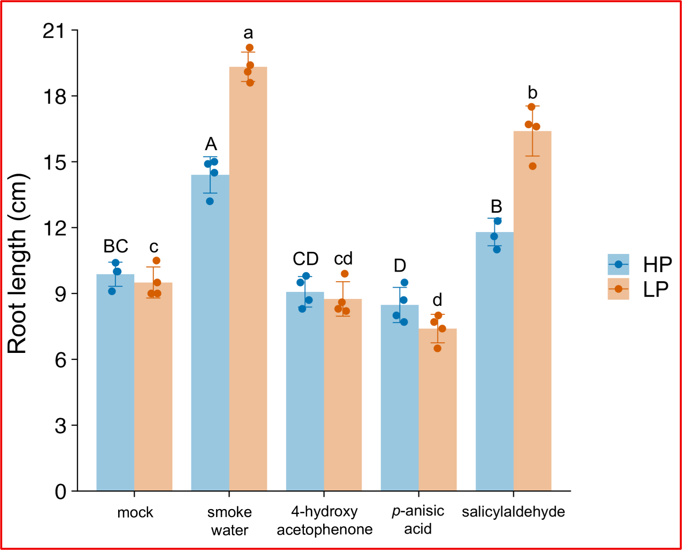
Figure 1 Smoke water and salicylaldehyde promote root elongation under phosphorus deficiency. Rice seedlings grown under phosphorus-sufficient (HP) or phosphorus-deficient (LP) conditions were treated with 1% (v/v) smoke water or candidate aromatic compounds (25 µM; 4-hydroxyacetophenone, p-anisic acid, salicylaldehyde) and compared with mock control. Root length is shown as means ± SD (n ≥ 4). Different letters indicate significant differences among all pairwise treatment comparisons within each phosphorus condition (p < 0.05; 2-way ANOVA, followed by Tukey’s HSD post-hoc test); uppercase and lowercase letters denote comparison within HP and LP conditions, respectively.
Structure-activity relationship analysis links LP-specific root promotion to substitution-dependent activity of aromatic aldehydes
To define structural features associated with LP-dependent root elongation, we performed a structure-activity relationship (SAR) analysis centered on SAL. Because SAL contains both an aldehyde (–CHO) and a hydroxyl (–OH) group, we compared paired analogs designed to probe functional group contributions - benzaldehyde versus SAL and phenol versus catechol - across concentrations under HP and LP conditions (Figure 2). We also summarized broader substitution-dependent trends across additional derivatives under LP (Table 1).
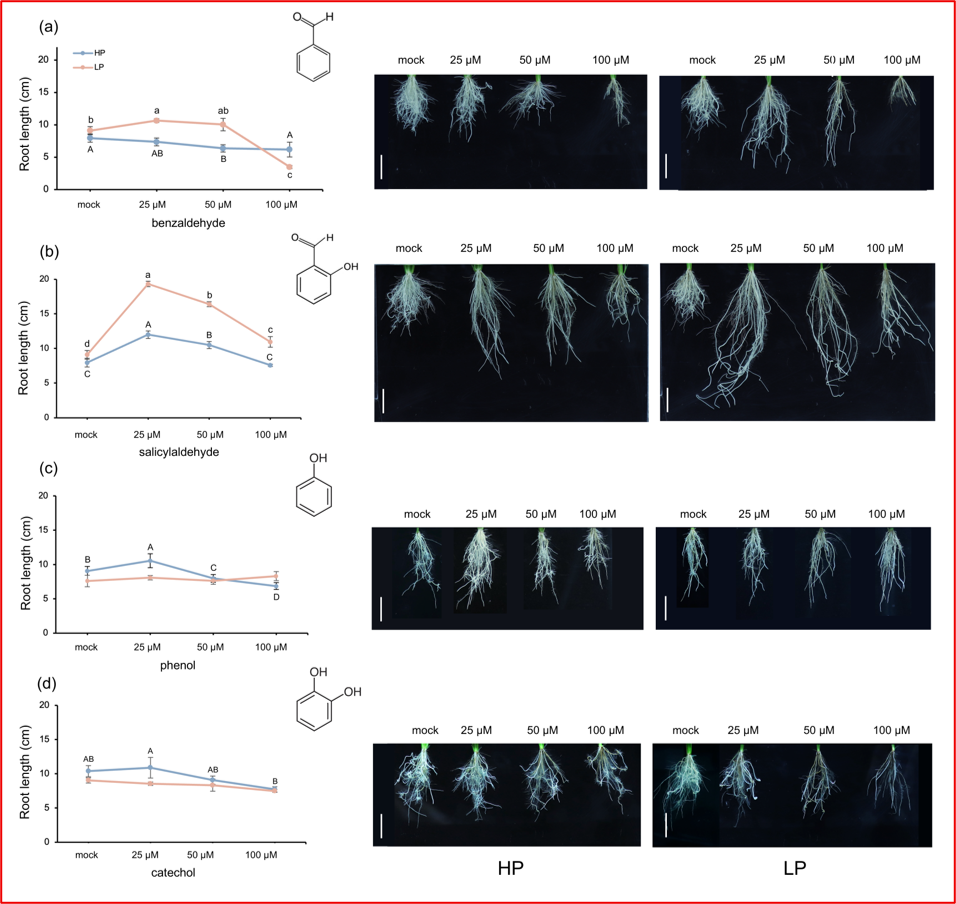
Figure 2 Dose responses of benzaldehyde- and phenol-based structures under HP and LP. Rice seedlings were treated with (a) benzaldehyde, (b) salicylaldehyde (SAL), (c) phenol, or (d) catechol at 25 - 100 µM or mock control (solvent only) for 8 d under HP (320 µM Pi) or LP (0 µM Pi). Representative root images are shown. Scale bar = 2 cm. Data are means ± SD (n ≥ 4). Different letters indicate significant differences among all pairwise concentrations within each phosphorus condition (p < 0.05; 1-way ANOVA followed by Tukey’s HSD test); uppercase and lowercase letters denote comparison within HP and LP conditions, respectively.
SAL robustly promoted root elongation under LP across 25 - 100 µM, with the strongest response at 25 µM, while remaining inactive under HP (Figure 2(b); Table 1). Benzaldehyde showed only modest stimulation at lower concentrations and became inhibitory at higher concentration (Figure 2(a); Table 1), indicating that aldehyde-containing aromatics can support LP-dependent activity, but that substitution strongly modulates potency and dose sensitivity. In contrast, phenol was largely inactive, and catechol tended to inhibit root growth (Figures 2(c) and 2(d); Table 1), indicating that hydroxyl substitution alone does not explain the strong promotive activity of SAL. Across the expanded compound set, aldehyde-containing derivatives more frequently promoted root elongation under LP than phenolic compounds, with clear dependence on substituent identity and position (Table 1). Derivatives bearing additional ring substituents adjacent to the aldehyde - such as 2,4-dihydroxybenzaldehyde (ortho + para –OH), which increased root length by ~50% at 100 µM, and o-anisaldehyde (2-methoxybenzaldehyde; ortho –OCH3), which increased root length by ~50% at 25 µM - support a strong positional effect within the benzaldehyde series.
Table 1 Structure-activity relationship of benzaldehyde and phenol derivatives under LP.
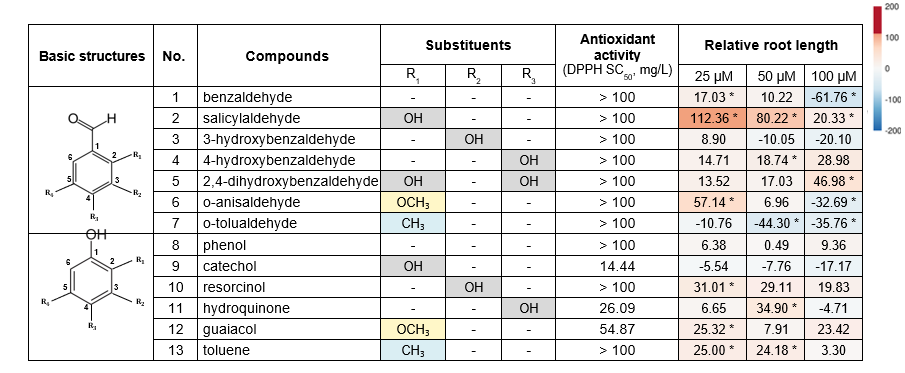
Relative root length (%) under LP is expressed as percent change from the mock control at 25, 50, and 100 µM. Antioxidant activity is reported as DPPH radical scavenging capacity (SC50, mg/L), where values > 100 mg/L indicate low activity. Heatmap colors denote growth promotion (red) or inhibition (blue). Asterisks indicate significant differences from the LP mock (p < 0.05; 1-way ANOVA followed by Tukey’s HSD test).
Phenolic compounds are well known for radical scavenging activity [20], and altered cellular redox status has been linked to root growth regulation [21]. We therefore tested whether antioxidant capacity could explain the LP-dependent root elongation responses by quantifying DPPH radical scavenging activity for the same compounds (Table 1). Antioxidant activity was strongly structure dependent and generally higher among phenolic derivatives, whereas all benzaldehyde derivatives, including SAL, showed low activity (SC50 > 100 mg/L). Antioxidant capacity did not correlate with root growth promotion under LP. Compounds with strong radical scavenging activity did not consistently enhance root elongation, whereas SAL promoted robust root growth despite negligible DPPH activity (Table 1). These results suggest that antioxidant capacity alone is unlikely to explain the root growth response to these compounds and point to additional, structure-dependent mechanisms operating under phosphorus deficiency. It should be noted, however, that the DPPH assay reflects only direct radical scavenging capacity in a cell-free system and cannot exclude the possibility that SAL modulates intracellular redox balance through indirect mechanisms in vivo, such as through antioxidant enzyme activity or redox signaling pathways [22].
The SAR results further indicate that LP-dependent root elongation is structure specific, with activity particularly associated with the combination and positional arrangement of hydroxyl and aldehyde groups, rather than a general response to aromatic or phenolic compounds. SAL displayed the most consistent promotion, whereas related aldehydes and phenols showed weaker or dose-restricted effects (Table 1). Several compounds exhibited biphasic dose responses, with promotion at low concentrations and inhibition at higher concentrations, a hormetic pattern commonly observed for plant hormones and other bioactive small molecules [23,24]. Consistent with this, growth-promoting effects of SAL and 2,4,5-trihydroxybenzaldehyde have been reported in Brassica campestris at low concentrations [19], and syringaldehyde has been identified as a smoke-derived germination cue in tobacco [25]. Together, these studies support the broader notion that aromatic aldehydes represent a biologically active class within smoke-associated compounds.
Salicylaldehyde enhances root growth under NaCl stress with dose-dependent tradeoffs
Plant-derived smoke solutions have been reported to improve seedling growth under salt stress, suggesting that smoke-associated molecules might mitigate salt-induced growth inhibition [26]. We therefore tested whether SAL could promote root growth under salinity and improve seedling performance. Rice seedlings were exposed to 75 mM NaCl with or without SAL or catechol (a phenolic comparator lacking the aldehyde group), and growth and photosynthetic pigment contents were quantified (Figure 3). Salt treatment reduced plant height and root length relative to non-salt controls (Figures 3(b) and 3(c)). SAL did not restore shoot growth at either concentration tested (Figure 3(b)); however, 25 µM SAL produced a modest but significant increase in primary root length compared with NaCl alone, whereas 50 µM SAL did not enhance root length (Figure 3(c)). Catechol did not improve growth under salt stress at either concentration (Figures 3(b) and 3(c)). Regarding photosynthetic pigment status, NaCl reduced chlorophyll b and carotenoids, and 25 µM SAL further decreased chlorophyll a and b, whereas 50 µM SAL resulted in pigment levels comparable to the salt-stressed control (Figures 3(d) - 3(f)). Thus, while SAL can promote root elongation under salinity at 25 µM, this is not accompanied by improved pigment status; instead, the dose-dependent pigment responses suggest a tradeoff between root growth stimulation and aboveground stress symptoms.
An increased root-to-shoot ratio is typically advantageous under P deficiency because greater root investment enhances soil exploration and P acquisition [27]. Under salinity, however, a larger root system may increase NaCl uptake and delivery to shoots, potentially exacerbating ionic toxicity and accelerating damage to photosynthetic tissues. Consistent with this tradeoff, rice genotypes with more exploratory root systems have been reported to exhibit greater salinity sensitivity [28,29]. In this context, SAL-induced root elongation under NaCl stress may not translate into improved performance and differs qualitatively from its beneficial effects under P deficiency. Moreover, although plant-derived smoke solutions have been reported to alleviate salt stress in other systems [26], neither SAL nor catechol reproduced a clear mitigation phenotype here. This discrepancy may reflect differences in species, developmental stage, growth conditions, or dose, and it also suggests that salt-stress alleviation by smoke solutions may depend on other smoke-derived compounds and/or mixture effects rather than SAL alone.

Figure 3 Salicylaldehyde promotes root elongation but does not alleviate salt-stress pigment responses. Rice seedlings were treated with 75 mM NaCl with or without salicylaldehyde (SAL) or catechol (CAT) at 25 or 50 µM. Plant height (b), root length (c), and pigment contents (d - f; chlorophyll a, chlorophyll b, carotenoids) were quantified. Scale bar = 2 cm. Data are means ± SD (n ≥ 5). Different letters indicate significant differences among all pairwise treatment comparisons (p < 0.05; 1-way ANOVA followed by Tukey’s HSD test).
Study scope and limitations
Smoke water bioactivity may arise from low-abundance constituents and mixture interactions [5,6,10], and functional phenocopying alone cannot establish which compounds are present or which components account for mixture activity. Importantly, SAL alone may not fully recapitulate smoke water activity, reinforcing that additional smoke-derived constituents may contribute. Accordingly, compounds undetected in bulk, untargeted profiling may still be functionally relevant because potent smoke signals can occur at trace abundance and fall below detection limits. For example, karrikins are highly bioactive yet occur at trace levels that typically require targeted UHPLC–MS/MS methods for reliable detection [30]. Confirming occurrence and abundance will therefore require targeted quantification using authentic standards and spike-in validation.
The initial compound comparison used a single concentration (25 µM) and a limited candidate set, such that dose-dependent activity or additional active chemistries could have been missed. The SAR analysis was similary limited to 12 derivatives, and broader analog coverage may reveal further structure-function relationships. Aromatic compound effects can also be species- and context-dependent. For example, catechol has been reported to promote root growth in tobacco [8] but did not promote rice root elongation under our experimental conditions. Whether SAL retains its root growth-promoting activity under intermediate Pi concentrations that more closely simulate field soil conditions also remains an important question for future investigation.
Together, these considerations emphasize that the primary contribution of this study is the identification of a defined smoke water-mimetic bioactive and its structure-dependent activity profile, providing a practical entry point for downstream mechanistic dissection. Future studies should prioritize identifying the molecular targets of SAL under LP conditions, including potential interactions with the OsPHR2-mediated Pi starvation signaling pathway [31]. All findings reported here were obtained in Oryza sativa cv. Nipponbare under defined hydroponic conditions, and cross-species and cross-system validation will be necessary to assess the generality of these responses. Finally, SAL should be regarded as a mechanistic research tool rather than an agrochemical candidate, as soil-system validation, stability, and field-scale dose-response relationships remain to be established.
Conclusions
Our findings indicate that a defined aromatic compound, salicylaldehyde (SAL), can phenocopy the root elongation-promoting effect of smoke water under phosphorus-deficient conditions in rice. Structure-activity relationship analyses suggest that this response depends on specific combinations and positional arrangements of functional groups rather than general aromatic or antioxidant properties. Moreover, the limited and context-dependent effects observed under salinity stress indicate that SAL activity is closely associated with phosphorus availability rather than representing a broad stress-mitigation response. Together, these results underscore the complexity of smoke water bioactivity and emphasize the importance of dissecting individual chemical components to better understand their roles in root developmental regulation. This work provides a foundation for future studies aimed at elucidating the molecular mechanisms underlying SAL-mediated signaling and assessing the broader relevance of aromatic smoke-derived compounds in plant adaptation to nutrient stress.
Acknowledgements
This research is supported by the 90th Anniversary of Chulalongkorn University Scholarship under the Ratchadaphiseksomphot Endowment Fund, and Science Achievement Scholarship of Thailand (SAST) scholarship to A.R.
Declaration of generative AI in scientific writing
During the preparation of this manuscript, the authors used ChatGPT to assist with language refinement and readability. The manuscript was subsequently reviewed and edited by the authors, who take full responsibility for the final content.
CRediT author statement
Ananya Romyanon: Conceptualization; Methodology; Validation; Formal analysis; Investigation; Writing - Original Draft; Writing - Review & Editing. Sompop Pinit: Conceptualization; Resources; Investigation. Juthamas Chaiwanon: Conceptualization; Writing - Original Draft; Writing - Review & Editing; Supervision; Project administration; Funding acquisition.
References
[1] H Malhotra, Vandana, S Sharma and R Pandey. Phosphorus nutrition: Plant growth in response to deficiency and excess. In: M Hasanuzzaman, M Fujita, H Oku, K Nahar and B Hawrylak-Nowak (Eds.). Plant nutrients and abiotic stress tolerance. Springer, Singapore, 2018, p. 171-190.
[2] F Solangi, X Zhu, S Khan, N Rais, A Majeed, MA Sabir, R Iqbal, S Ali, A Hafeez, B Ali, S Ercisli and ET Kayabasi. The global dilemma of soil legacy phosphorus and its improvement strategies under recent changes in agro-ecosystem sustainability. ACS Omega 2023; 8(26), 23271-23282.
[3] H Rouached, AB Arpat and Y Poirier. Regulation of phosphate starvation responses in plants: Signaling players and cross-talks. Molecular Plant 2010; 3(2), 288-299.
[4] Z Zhang, H Liao and WJ Lucas. Molecular mechanisms underlying phosphate sensing, signaling, and adaptation in plants. Journal of Integrative Plant Biology 2014; 56(3), 192-220.
[5] ME Light, BV Burger, D Staerk, L Kohout and J Van Staden. Butenolides from plant-derived smoke: Natural plant-growth regulators with antagonistic actions on seed germination. Journal of Natural Products 2010; 73(2), 267-269.
[6] DC Nelson, GR Flematti, EL Ghisalberti, KW Dixon and SM Smith. Regulation of seed germination and seedling growth by chemical signals from burning vegetation. Annual Review of Plant Biology 2012; 63, 107-130.
[7] M Kamran, AL Khan, L Ali, J Hussain, M Waqas, A Al-Harrasi, QM Imran, YH Kim, SM Kang, BW Yun and IJ Lee. Hydroquinone; a novel bioactive compound from plant-derived smoke can cue seed germination of lettuce. Frontiers in Chemistry 2017; 5, 30.
[8] M Wang, M Schoettner, S Xu, C Paetz, J Wilde, IT Baldwin and K Groten. Catechol, a major component of smoke, influences primary root growth and root hair elongation through reactive oxygen species-mediated redox signaling. New Phytologist 2017; 213(4), 1755-1770.
[9] NAC Brown and J van Staden. Smoke as a germination cue: A review. Plant Growth Regulation 1997; 22(2), 115-124.
[10] GR Flematti, EL Ghisalberti, KW Dixon and RD Trengove. A compound from smoke that promotes seed germination. Science 2004; 305(5686), 977.
[11] J Chen, J Yang, L Ma, J Li, N Shahzad and CK Kim. Structure-antioxidant activity relationship of methoxy, phenolic hydroxyl, and carboxylic acid groups of phenolic acids. Scientific Reports 2020; 10(1), 2611.
[12] L Ariyakulkiat, S Pinit and J Chaiwanon. Smoke water promotes root meristem activity and cell elongation but inhibits root hair growth under phosphorus deficiency in rice. South African Journal of Botany 2026; 191, 12-19.
[13] S Pinit, L Ariyakulkiat and J Chaiwanon. Rice straw-derived smoke water promotes rice root growth under phosphorus deficiency by modulating oxidative stress and photosynthetic gene expression. Scientific Reports 2023; 13(1), 14802.
[14] S Yoshida. Routine procedure for growing rice plants in culture solution. In: S Yoshida, DA Forno and JH Cock (Eds.). Laboratory manual for physiological studies of rice. International Rice Research Institute, Los Baños, Philippines, 1976, p. 61-66.
[15] N
Younes and S Cain. Analysis of chlorophyll and carotenoid compounds
in eucalyptus leaves v.1. Available at:
https://www.protocols.io/view/ana
lysis-of-chlorophyll-and-carotenoid-compounds-i-e6nvwb3m2vmk/v1,
accessed February 2026.
[16] JB Engler. Tidyplots empowers life scientists with easy code-based data visualization. iMeta 2025; 4(2), e70018.
[17] J Yun, Q Yang and G Liu. Mechanisms of lignin degradation and persistent free radical formation under light or thermal exposure. Cell Reports Sustainability 2025; 2(1), 100267.
[18] BRT Simoneit. Biomass burning - a review of organic tracers for smoke from incomplete combustion. Applied Geochemistry 2002; 17(3), 129-162.
[19] GH Choi, JH Ro, BJ Park, DY Lee, MS Cheong, DY Lee, WD Seo and JH Kim. Benzaldehyde as a new class plant growth regulator on Brassica campestris. Journal of Applied Biological Chemistry 2016; 59(2), 159-164.
[20] MC Foti. Antioxidant properties of phenols. Journal of Pharmacy and Pharmacology 2007; 59(12), 1673-1685.
[21] A Eljebbawi, YDCR Guerrero, C Dunand and JM Estevez. Highlighting reactive oxygen species as multitaskers in root development. iScience 2021; 24(1), 101978.
[22] F Shahidi and A Samarasinghe. How to assess antioxidant activity? Advances, limitations, and applications of in vitro, in vivo, and ex vivo approaches. Food Production, Processing and Nutrition 2025; 7, 50.
[23] RG Belz and SO Duke. Modelling biphasic hormetic dose responses to predict sub-NOAEL effects using plant biology as an example. Current Opinion in Toxicology 2022; 29, 36-42.
[24] CD Garzon and FJ Flores. Hormesis: Biphasic dose-responses to fungicides in plant pathogens and their potential threat to agriculture. In: CD Garzon and FJ Flores (Eds.). Fungicides: Showcases of integrated plant disease management from around the world. IntechOpen, London, 2013.
[25] D Cao, M Schöttner, R Halitschke, D Li, G Baldwin, C Rocha and IT Baldwin. Syringaldehyde is a novel smoke-derived germination cue for the native fire-chasing tobacco, Nicotiana attenuata. Seed Science Research 2021; 31(4), 292-299.
[26] S Komatsu, A Diniyah, W Zhu, M Nakano, SU Rehman, H Yamaguchi, K Hitachi and K Tsuchida. Metabolomic and proteomic analyses to reveal the role of plant-derived smoke solution on wheat under salt stress. International Journal of Molecular Sciences 2024; 25(15), 8216.
[27] C Hermans, JP Hammond, PJ White and N Verbruggen. How do plants respond to nutrient shortage by biomass allocation? Trends in Plant Science 2006; 11(12), 610-617.
[28] R Munns and M Tester. Mechanisms of salinity tolerance. Annual Review of Plant Biology 2008; 59, 651-681.
[29] A Vázquez-Glaría, B Eichler-Löbermann, FG Loiret, E Ortega and M Kavka. Root-system architectures of two cuban rice cultivars with salt stress at early development stages. Plants 2021; 10(6), 1194.
[30] J Hrdlička, T Gucký, O Novák, M Kulkarni, S Gupta, J van Staden and K Doležal. Quantification of karrikins in smoke water using ultra-high performance liquid chromatography-tandem mass spectrometry. Plant Methods 2019; 15(1), 81.
[31] K Yuan, H Zhang, C Yu, N Luo, J Yan, S Zheng, Q Hu, D Zhang, L Kou, X Meng, Y Jing, M Chen, X Ban, Z Yan, Z Lu, J Wu, Y Zhao, Y Liang, Y Wang, …, B Wang. Low phosphorus promotes NSP1-NSP2 heterodimerization to enhance strigolactone biosynthesis and regulate shoot and root architecture in rice. Molecular Plant 2023; 16(11), 1811-1831.