
Trends
Sci.
2026;
23(11):
13662
Integrated Dose-Response Modeling and Phytochemical Profiling Reveal the Bioherbicidal Potential of Mimosa Pigra Leaf Extract against Eleusine indica
Le
Huu Phuoc1,2,*,
 ,
Nguyen Thi Thanh Xuan4,
Vo Thi Huong Duong1,2,
Nguyen Xuan Binh2,3 and Pham Van Quang1,2
1Faculty of Agriculture and Natural Resources, An Giang University, An Giang, Vietnam
2Vietnam National University Ho Chi Minh City, Vietnam
3Experimental-Practical Area, An Giang University, An Giang, Vietnam
4Faculty of Agriculture and Fishery, Mekong University, Vinh Long, Vietnam
(*Corresponding author’s e-mail: [email protected])
Received: 22 February 2026, Revised: 25 March 2026, Accepted: 2 April 2026, Published: 1 June 2026
Abstract
Eleusine indica (goosegrass) is a globally problematic grass weed with increasing herbicide resistance, highlighting the need for sustainable plant-derived alternatives. This study evaluated the bioherbicidal potential of an ethanolic leaf extract of Mimosa pigra through an integrated approach combining dose–response modeling, phytochemical profiling, and soil-based validation. In Petri-dish assays (0 - 160 mg mL⁻¹), the extract significantly inhibited germination and early seedling growth in a concentration-dependent manner. Four-parameter logistic modeling identified root growth as the most sensitive endpoint (IC₅₀ = 34.9 mg mL⁻¹), followed by germination inhibition (IC₅₀ = 46.8 mg mL⁻¹) and shoot inhibition (IC₅₀ = 57.6 mg mL⁻¹). The extract contained high levels of total phenolics and flavonoids (TPC = 128.6 ± 6.4 mg GAE g⁻¹; TFC = 71.8 ± 4.1 mg QE g⁻¹) and exhibited a polyphenol-rich profile dominated by flavan-3-ols/proanthocyanidins and flavonol glycosides. Phytochemical indices were strongly positively correlated with phytotoxicity (r = 0.83 - 0.94, p < 0.01). Under net-house pot conditions (21 DAT), the extract markedly reduced weed emergence, plant height, and shoot biomass, with biomass reduction reaching 77.4% at 160 mg mL⁻¹. By integrating quantitative bioassays with phytochemical characterization and soil-based validation, this study provides a more comprehensive basis for advancing M. pigra leaf extract as a natural bioherbicidal candidate. Future studies should focus on large-scale field trials to further evaluate the practical applicability of Mimosa pigra leaf extract as a bioherbicidal agent.
Keywords: Mimosa pigra, Eleusine indica, Allelopathy, Bioherbicide, Dose-response modeling, HPLC-UV-DAD, Phytotoxicity, Phenolic compounds, Weed management
Introduction
Eleusine indica (L.) Gaertn., commonly known as goosegrass, is a widely distributed annual grass weed occurring in tropical and subtropical regions worldwide [1]. It is frequently reported in upland crops, orchards, vegetable systems, and non-crop habitats, where it competes aggressively for light, water, and nutrients. The species is characterized by rapid growth, high seed production, and strong adaptability to compacted soils and disturbed environments [2]. In recent decades, E.
indica has gained particular attention due to the evolution of resistance to multiple herbicide modes of action, including glyphosate and ACCase inhibitors in several regions [1,3]. The increasing occurrence of herbicide-resistant populations poses serious challenges to conventional chemical weed management and highlights the need for alternative, sustainable control strategies [4].
Bioherbicides derived from plant secondary metabolites represent a promising component of integrated weed management [5]. Compared with synthetic herbicides, plant-based phytotoxic compounds are generally considered environmentally safer, biodegradable, and potentially less prone to resistance development due to their complex chemical composition [6]. Some studies have reported the inhibitory effects of phenolic- and flavonoid-rich extracts from allelopathic species on weed germination and growth [7]. However, the translation of laboratory findings into practical application remains limited, partly due to variability in extract potency, lack of quantitative dose–response assessment, and insufficient validation under soil or greenhouse conditions. Systematic evaluation combining bioassays, chemical profiling, and modeling approaches is therefore essential to identify reliable bioherbicidal candidates.
Mimosa pigra L., a perennial invasive shrub native to Central and South America, has become a major ecological concern in many tropical regions due to its rapid spread and dense thicket formation [8]. Beyond its competitive growth habit, M. pigra has been suggested to possess allelopathic properties, potentially contributing to its ecological dominance [9]. Previous phytochemical investigations have revealed the presence of diverse phenolic acids, flavonoids, and tannin-related compounds in various Mimosa species [10]. Such compounds are frequently associated with phytotoxic and growth-inhibitory effects in plant-plant interactions [11]. Nevertheless, the bioherbicidal potential of M. pigra, particularly against problematic grass weeds such as E. indica, remains insufficiently characterized.
Although several studies have examined the allelopathic effects of plant extracts on weed species, many investigations rely solely on germination bioassays without integrating quantitative dose-response modeling or chemical characterization. Moreover, comparative evaluation of germination and seedling growth sensitivity, including IC₅₀ estimation and correlation with phytochemical content, is often lacking. For M. pigra, existing literature primarily focuses on ecological impact and invasion biology, with limited systematic assessment of its phytotoxic activity against economically important weeds. The present study aimed to (i) evaluate the inhibitory effects of M. pigra leaf extract on germination and early seedling growth of E. indica; (ii) quantify phytotoxic potency using 4-parameter logistic dose-response modeling and IC₅₀ estimation; (iii) characterize the extract’s phenolic and flavonoid composition using spectrophotometric and HPLC-UV-DAD analyses; (iv) assess correlations between phytochemical content and biological inhibition; and (v) validate laboratory findings under greenhouse pot conditions. By integrating biological assays, quantitative modeling, phytochemical profiling, and soil-based validation, this study provides a comprehensive assessment of M. pigra as a potential source of natural bioherbicidal compounds.
Therefore, this study aims to evaluate the bioherbicidal potential of Mimosa pigra leaf extract against Eleusine indica through an integrated approach combining dose-response modeling, phytochemical profiling, and net-house validation. This integrated framework provides a more comprehensive understanding of phytotoxic effects and supports the development of plant-based bioherbicides. This study is novel in integrating dose-response modeling, phytochemical profiling, and net-house validation to comprehensively evaluate the bioherbicidal potential of Mimosa pigra.
Materials and methods
Plant material collection and authentication
Fresh leaves of M. pigra L. were collected from naturally established populations distributed along irrigation canals and the Hau River banks in Chau Thanh commune, An Giang Province, Vietnam (10°23′N, 105°16′E; elevation about 2 m above sea level) during the dry season (March - April 2025). The species was taxonomically identified by the Weed Science Research Group of An Giang University. A voucher specimen (No. AGU-Mp-2025-02) was prepared and deposited at the institutional herbarium of An Giang University for future reference.
Leaves were washed with distilled water to remove debris, air-dried at 40 °C in a forced-air oven until constant weight, and ground into fine powder using a laboratory mill. The powdered material was stored in airtight containers at room temperature until extraction.
Preparation of plant extract
Dried leaf powder (100 g) was extracted with 1 L of 70% (w/v) ethanol using maceration at room temperature for 72 h with intermittent shaking. The extract was filtered through Whatman No. 1 filter paper and concentrated under reduced pressure using a rotary evaporator at 40 °C. The crude extract was further dried to constant weight and stored at 4 °C [12].
Stock solutions were prepared by dissolving the crude extract in distilled water to obtain concentrations of 0, 10, 20, 40, 80, and 160 mg mL⁻¹. These concentrations were used for germination, seedling growth, and dose-response assays.
Extraction yield determination
The extraction yield was determined after solvent evaporation. Briefly, a known amount of dried leaf powder (100 g) was subjected to ethanolic extraction as described above. After filtration and solvent removal under reduced pressure, the crude extract was further dried to constant weight at 40 °C. The extraction yield (%) was calculated using the following equation [13]:

where
 is
the weight of dried crude extract (g) and
 is
the initial dry weight of plant material (g).
All
extractions were performed in triplicate, and the mean yield value
was reported.
Weed seed material and pre-treatment
Seeds of E. indica (L.) Gaertn. were collected from mature plants in agricultural fields free from recent herbicide application. Seeds were cleaned and stored at room temperature until use. Prior to experiments, seeds were surface-sterilized in 1% sodium hypochlorite for 5 min and rinsed thoroughly with sterile distilled water [14].
Germination bioassay
Twenty sterilized seeds were placed in 9-cm Petri dishes lined with 2 layers of Whatman No. 1 filter paper. Five milliliters of extract solution at the designated concentration were added to each dish [15]. Distilled water served as the control. Petri dishes were incubated in a growth chamber at 25 ± 2 °C with a 12h photoperiod. Each treatment was replicated 4 times (n = 4). Germination was recorded daily for 7 days.
Measurement of germination and growth indices
Germination and seedling performance were evaluated using standard germination indices. Germination percentage (GP) was calculated as the proportion of germinated seeds relative to the total number of seeds sown in each Petri dish. Germination index (GI) [16] was determined to assess both the speed and uniformity of germination, according to the formula:

where
 is the number of seeds germinated on day
 ,
and
 is the corresponding day of counting.
Mean germination time (MGT) [17] was calculated to estimate the average time required for seed germination, using the following equation:

Seed vigor index (SVI) [18] was calculated as:

where mean seedling length represents the sum of root and shoot lengths (cm).
All germination parameters were recorded over a 7-day incubation period, and calculations were performed using mean values from 4 replicates per treatment.
Germination inhibition (%) [19] was calculated as:

where
 is
germination in control and
 is
germination under treatment.
Seedling growth assessment
Seedling growth parameters were evaluated seven days after incubation. From each replicate, ten randomly selected seedlings were measured for root length and shoot length (cm) using a digital caliper. Fresh weight (mg seedling⁻¹) was determined immediately after measurement using an analytical balance. Subsequently, seedlings were oven-dried at 70 °C for 48 h to constant weight, and dry weight (mg seedling⁻¹) was recorded [20].
Dose-response modeling
Dose-response curves for germination inhibition, root inhibition, and shoot inhibition were fitted using a 4-parameter logistic (4PL) nonlinear regression model [21]. The model was described as:

where
 is the observed response expressed as percentage inhibition (%),
 is
the extract concentration (mg mL⁻¹),
 and
 represent the lower and upper asymptotes of the response curve,
respectively,
 is the slope (Hill coefficient), and
 is
the concentration causing 50% inhibition relative to the untreated
control. The
 values
were estimated together with their 95% confidence intervals (CIs).
The goodness-of-fit of the model was evaluated using the coefficient
of determination (R²).
Determination of total phenolic and flavonoid contents
Total phenolic content (TPC)
Total phenolic content (TPC) was determined using the Folin–Ciocalteu colorimetric method with slight modifications. Briefly, 0.5 mL of appropriately diluted extract solution was mixed with 2.5 mL of 10% (v/v) Folin–Ciocalteu reagent. After 5 min of incubation at room temperature, 2.0 mL of 7.5% (w/v) sodium carbonate (Na₂CO₃) solution was added to the mixture [22]. The reaction mixture was vortexed and incubated in the dark at room temperature for 30 min. Absorbance was measured at 765 nm using a UV-Vis spectrophotometer (UV Vis Jasco V730) [23]. Gallic acid (0.02, 0.04, 0.06, 0.08, 0.10 and 0.12 mg mL⁻¹) was used to construct the standard calibration curve (R² > 0.99). TPC was calculated from the calibration equation and expressed as milligrams of gallic acid equivalents per gram of dry extract (mg GAE g⁻¹ extract). All measurements were performed in triplicate, and results were expressed as mean ± standard error (SE).
Total flavonoid content (TFC)
Total flavonoid content (TFC) was determined using the aluminum chloride (AlCl₃) colorimetric method. Briefly, 0.5 mL of diluted extract was mixed with 1.5 mL of methanol, 0.1 mL of 10% (w/v) aluminum chloride solution, 0.1 mL of 1 M potassium acetate, and 2.8 mL of distilled water. The reaction mixture was incubated at room temperature for 30 min. Absorbance was recorded at 415 nm using the same UV-Vis spectrophotometer. Quercetin (0.02, 0.04, 0.06, 0.08 and 0.10 mg mL⁻¹) was used to generate the standard curve (R² > 0.99). TFC was calculated based on the calibration equation and expressed as milligrams of quercetin equivalents per gram of dry extract (mg QE g⁻¹ extract). All analyses were conducted in triplicate. Total phenolic content (TPC) was determined using the Folin-Ciocalteu method and expressed as mg gallic acid equivalents (GAE) g⁻¹ extract. Total flavonoid content (TFC) was determined using the aluminum chloride colorimetric method and expressed as mg quercetin equivalents (QE) g⁻¹ extract [24]. All measurements were performed in triplicate.
HPLC-UV DAD analysis
Chromatographic analysis of phenolic and flavonoid constituents in M. pigra leaf extract was performed using an HPLC system (Agilent 1260 Infinity II, Agilent Technologies, Santa Clara, CA, USA) equipped with a diode array detector (DAD) and controlled by Agilent ChemStation software (version B.04.03) [25]. Separation was carried out on a reverse-phase C18 column (ZORBAX Eclipse Plus C18, 250×4.6 mm2 i.d., 5 µm particle size) [26]. The column temperature was maintained at 30 °C.
The mobile phase consisted of solvent A (0.1% formic acid in distilled water, v/v) and solvent B (acetonitrile). The gradient elution program was set as follows: 5% B (0 - 5 min), 5% - 20% B (5 - 15 min), 20% - 40% B (15 - 25 min), 40% - 60% B (25 - 30 min), followed by a washing step at 90% B (30 - 33 min) and re-equilibration to initial conditions (5% B) from 33 to 38 min. The flow rate was 1.0 mL min⁻¹, and the injection volume was 20 µL [27]. The total run time was 38 min per sample. Detection was performed at 280 nm, 320 nm, and 360 nm, and UV spectra were recorded in the range of 200 - 600 nm for peak characterization. Compounds were tentatively identified by comparing retention times and UV spectra with authentic standards and published literature. Quantification of selected compounds was performed using external calibration curves constructed from reference standards (R² ≥ 0.99). All analyses were conducted in triplicate.
Pot experiment setup
A net house pot experiment was conducted to evaluate phytotoxic responses of Mimosa pigra leaf extract under soil conditions. Plastic pots (15 cm diameter, 18 cm height) were filled with 2.0 kg of sterilized loamy soil (pH 6.5 - 6.8; organic matter 2.3%).
Twenty viable seeds of Eleusine indica were evenly sown at a depth of 0.5 cm, consistent with the recommended emergence depth for small seeded grass weeds. Immediately after sowing, aqueous solutions of M. pigra leaf extract at concentrations of 0 (distilled water control), 40, 80, and 160 mg mL⁻¹ were applied as soil drench treatments at a volume of 50 mL pot⁻¹, ensuring uniform soil saturation without surface runoff.
Each treatment consisted of 4 biological replicates arranged in a completely randomized design (CRD). Pots were maintained under natural daylight conditions in a net house (mean temperature 25 - 30 °C; relative humidity 65% - 85%). Soil moisture was maintained at approximately 70% - 80% of field capacity by daily watering as required.
Twenty one days after treatment (21 DAT), emergence percentage (%), plant height (cm), and shoot dry biomass (g plant⁻¹) were recorded. Emergence was determined as the proportion of seedlings visible above the soil surface relative to the number of seeds sown. Shoot biomass was measured after oven-drying samples at 65 °C to constant weight. Weed control efficacy (%) was calculated based on shoot biomass reduction relative to the untreated control.
Statistical analysis
Data was expressed as mean ± standard error (SE). Normality and homogeneity of variance were tested prior to analysis. One-way ANOVA was performed, followed by Tukey’s HSD test at p < 0.05. Pearson correlation coefficients were calculated between phytochemical contents (TPC, TFC) and inhibition parameters. Statistical analyses were conducted using R software (version 4.2.1). Data visualization was performed using Python (Matplotlib library, version 3.10.8). Nonlinear regression analysis was conducted using SciPy.
Results and discussion
Extraction yield and germination inhibition responses
The ethanolic extraction of M. pigra leaves resulted in a crude extract yield of 18.4 ± 0.9% (w/w) based on dry weight of plant material. This yield indicates a relatively high recovery of soluble secondary metabolites compared with values commonly reported for phenolic-rich shrub species.
The leaf extract of M. pigra exerted a clear dose-dependent inhibitory effect on the germination performance of E. indica (Table 1; Figure 1). Germination percentage declined progressively with increasing extract concentration, and all treated groups differed significantly from the control according to Tukey’s test (p < 0.05). The reduction became particularly pronounced at concentrations ≥ 40 mg mL⁻¹, where germination dropped sharply, and at 160 mg mL⁻¹ only a small fraction of seeds germinated. This pattern was consistent with the increasing germination inhibition observed in Figure 1.
Similarly, the germination index (GI) decreased significantly as extract concentration increased, indicating suppression of both germination speed and uniformity. In contrast, mean germination time (MGT) increased significantly with rising extract concentration, considering delayed germination under extract exposure. The delay was most evident at higher concentrations (80 - 160 mg mL⁻¹), where MGT reached its maximum values. Seed vigor index (SVI) exhibited the greatest sensitivity, showing a marked and significant decline across treatments, particularly at concentrations ≥ 40 mg mL⁻¹. Collectively, these results demonstrate that M. pigra leaf extract significantly reduced germination capacity, slowed germination dynamics, and impaired early seedling vigor of E. indica in a concentration-dependent manner (Table 1; Figure 1).
Table 1 Effects of M. pigra leaf extract on germination parameters of E. indica, 7 days after treatment.
| Concentration (mg mL⁻¹) | Germination (%) | Germination Index (GI) | Mean Germination Time (days) | Seed Vigor Index (SVI) |
|---|---|---|---|---|
| 0 (Control) | 95.8 ± 1.7a | 18.6 ± 0.7a | 2.2 ± 0.1e | 1445 ± 62a |
| 10 | 87.4 ± 2.3b | 16.4 ± 0.6b | 2.4 ± 0.1de | 1215 ± 55b |
| 20 | 76.1 ± 2.6c | 14.0 ± 0.5c | 2.6 ± 0.1cd | 980 ± 48c |
| 40 | 58.3 ± 2.5d | 10.5 ± 0.4d | 3.0 ± 0.2bc | 610 ± 40d |
| 80 | 31.6 ± 2.1e | 5.9 ± 0.3e | 3.6 ± 0.2ab | 240 ± 22e |
| 160 | 9.8 ± 1.4f | 1.8 ± 0.2f | 4.0 ± 0.3a | 62 ± 9f |
Values are mean ± SE (n = 4). Different letters indicate significant differences (Tukey, p < 0.05).
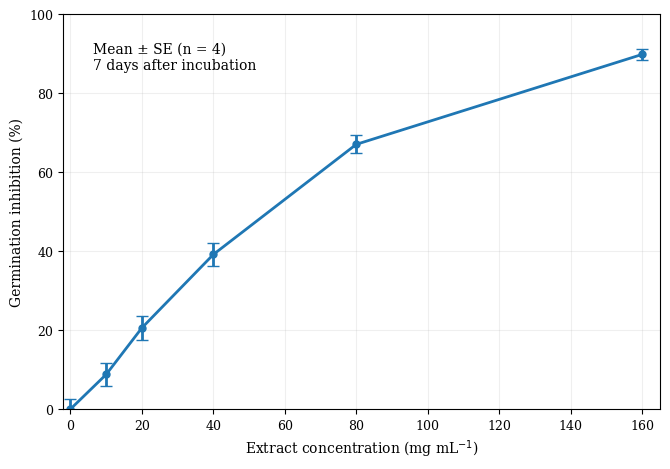
Figure 1 Concentration-dependent inhibition of Eleusine indica seed germination by Mimosa pigra leaf extract under laboratory conditions, evaluated 7 days after treatment. Seeds were exposed to 0 - 160 mg mL⁻¹ extract, and germination inhibition (%) was calculated relative to the distilled-water control. Points represent mean ± SE (n = 4).
Seedling growth suppression
The M. pigra leaf extract significantly inhibited early seedling growth of E. indica in a clear dose-dependent manner (Table 2). Root and shoot lengths decreased progressively with increasing extract concentration, and all treatments differed significantly from the control according to Tukey’s HSD test (p < 0.05). Root length declined from 5.7 cm in the control to only 0.5 cm at 160 mg mL⁻¹, corresponding to a root inhibition of 91.2%. Shoot length also decreased markedly, from 6.5 cm in the control to 1.7 cm at 160 mg mL⁻¹ (73.8% inhibition). Notably, root growth was consistently more sensitive than shoot growth across all concentrations, as also illustrated in Table 2. In parallel with the reduction in seedling elongation, biomass accumulation [28] was strongly suppressed. Fresh weight and dry weight both declined significantly as extract concentration increased, suggesting that the extract impaired overall seedling development and vigor rather than simply limiting elongation growth.
Table 2 Effects of M. pigra leaf extract on early seedling growth of E. indica, 7 days after treatment.
| Concentration (mg mL⁻¹) | Root length (cm) | Shoot length (cm) | Root inhibition (%) | Shoot inhibition (%) | Fresh weight (mg seedling⁻¹) |
Dry weight (mg seedling⁻¹) |
|---|---|---|---|---|---|---|
| 0 (Control) | 5.7 ± 0.2a | 6.5 ± 0.3a | 0.0f | 0.0f | 84.2 ± 3.6a | 15.1 ± 0.7a |
| 10 | 4.9 ± 0.2b | 6.0 ± 0.2b | 14.0e | 7.7e | 75.6 ± 3.2b | 13.6 ± 0.6b |
| 20 | 4.0 ± 0.2c | 5.3 ± 0.2c | 29.8d | 18.5d | 63.8 ± 2.8c | 11.4 ± 0.5c |
| 40 | 2.6 ± 0.1d | 4.1 ± 0.2d | 54.4c | 36.9c | 48.5 ± 2.5d | 8.7 ± 0.4d |
| 80 | 1.3 ± 0.1e | 2.9 ± 0.1e | 77.2b | 55.4b | 30.4 ± 2.1e | 5.3 ± 0.3e |
| 160 | 0.5 ± 0.1f | 1.7 ± 0.1f | 91.2a | 73.8a | 18.2 ± 1.6f | 3.1 ± 0.2f |
Values are mean ± SE (n = 4). Different letters within a column indicate significant differences according to Tukey’s HSD test (p < 0.05). Root and shoot inhibition (%) were calculated relative to the control.
The stronger inhibition of root growth compared with shoot growth is consistent with patterns widely reported in allelopathic screening and bioherbicide research. Root elongation is commonly recognized as a highly sensitive indicator of phytotoxic stress because roots directly contact allelochemicals in the germination substrate and respond rapidly through reduced cell division and elongation [29]. Similar root-dominant suppression has been reported in studies evaluating phytotoxic extracts from invasive and allelopathic plants [30] such as A. conyzoides, I. cylindrica, and Mimosa spp. against grass weeds. In those studies, inhibition of root growth often occurred at lower concentrations than shoot inhibition, supporting the present observation that root tissues represent a primary target for phytotoxic compounds. Furthermore, the marked decline in both fresh and dry biomass observed here aligns with previous findings where phenolic-rich plant extracts caused substantial reductions in seedling weight and establishment capacity. Biomass suppression is particularly important in weed management, as reduced dry matter accumulation reflects impaired growth and diminished competitive ability, which may ultimately lead to lower survival under greenhouse or field conditions [31].
The present study demonstrated that M. pigra leaf extract exerted potent phytotoxic effects on E. indica at both germination and early seedling stages [32]. Germination percentage, germination index, and seed vigor index declined significantly with increasing extract concentration, while mean germination time increased, indicating delayed and suppressed germination [33]. These trends indicate that the extract not only reduced final germination capacity but also delayed the germination process. Similar inhibitory patterns have been reported in allelopathy and bioherbicide studies, where early germination traits are often regarded as sensitive indicators of phytotoxic stress [34]. Moreover, the marked reduction in seed vigor index suggests that the extract severely impaired seedling establishment potential, which is critical for weed population recruitment.
Dose-response curves and IC50
Dose-response relationships of M. pigra leaf extract against E. indica were successfully described using the 4-parameter logistic (4PL) model for germination inhibition, root inhibition, and shoot inhibition (Table 3; Figure 2). The fitted curves showed a clear concentration-dependent increase in inhibitory responses across all measured traits, confirming that the extract exhibited strong phytotoxic activity within the tested range (0 - 160 mg mL⁻¹). Model performance was high, with coefficients of determination (R²) ranging from 0.96 to 0.98, indicating good agreement between observed and predicted values.
The estimated IC₅₀ values revealed differential sensitivity among the evaluated endpoints. Root inhibition showed the lowest IC₅₀ value (34.9 mg mL⁻¹), indicating that root growth was the most sensitive parameter to extract exposure. Germination inhibition had an intermediate IC₅₀ value of 46.8 mg mL⁻¹, while shoot inhibition exhibited the highest IC₅₀ value (57.6 mg mL⁻¹), suggesting comparatively greater tolerance of shoot elongation. The 95% confidence intervals of IC₅₀ estimates were relatively narrow (Table 3), reflecting consistent responses across replicates and supporting the reliability of the fitted model. These results are consistent with the growth bioassay findings (Table 2), where root inhibition was consistently stronger than shoot inhibition at all concentrations.
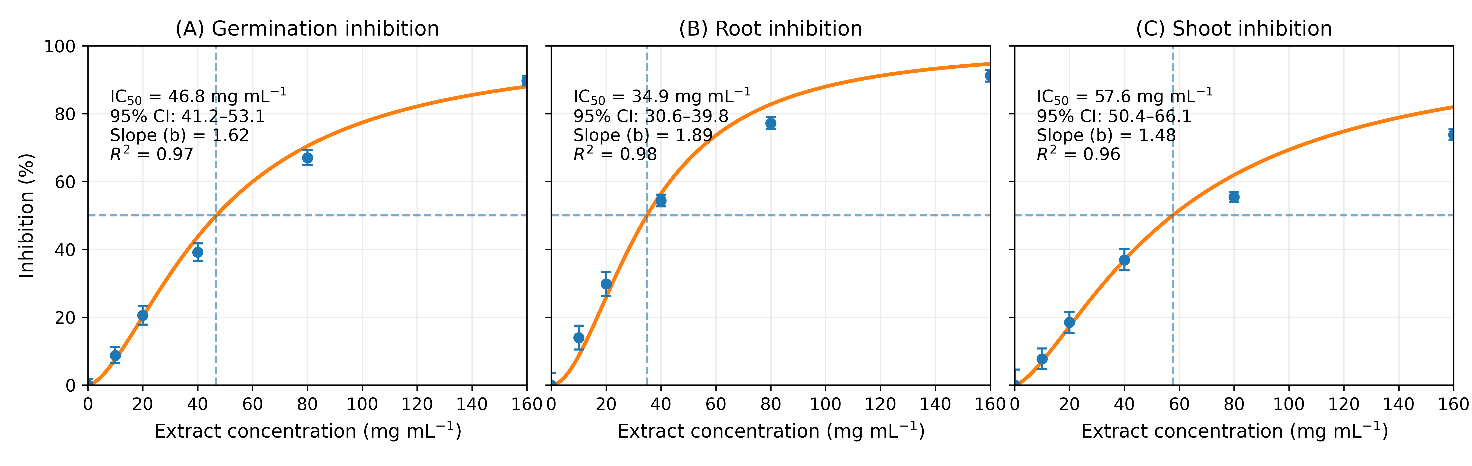
Figure 2 Dose-response relationships for the inhibitory effects of Mimosa pigra leaf extract on Eleusine indica under laboratory conditions, fitted with a 4-parameter logistic (4PL) model. Panels show (A) germination inhibition, (B) root inhibition, and (C) shoot inhibition across the tested concentration range (0 - 160 mg mL⁻¹). Symbols with error bars represent observed mean ± SE values (n = 4), solid lines indicate model-fitted responses, and dashed lines mark the estimated IC₅₀ values for each parameter.
Table 3 Estimated IC50 values from 4PL model.
| Parameter | IC50 (mg mL⁻¹) | 95% CI (mg mL⁻¹) | Slope (b) | R² |
|---|---|---|---|---|
| Germination inhibition | 46.8 | 41.2 - 53.1 | 1.62 | 0.97 |
| Root inhibition | 34.9 | 30.6 - 39.8 | 1.89 | 0.98 |
| Shoot inhibition | 57.6 | 50.4 - 66.1 | 1.48 | 0.96 |
The IC₅₀ values obtained in this study are within the range reported for several plant-derived extracts evaluated as potential bioherbicides against grass weeds. Previous studies on allelopathic invasive species, including A. conyzoides and I. cylindrica, have similarly reported lower IC₅₀ values for root inhibition compared with shoot inhibition, highlighting root elongation as a sensitive indicator of phytotoxicity [35]. Moreover, the extract achieved more than 50% inhibition at relatively moderate concentrations (< 60 mg mL⁻¹), indicating relatively strong phytotoxic potential. This level of activity compares favorably with many crude extracts reported in the literature, which often require higher concentrations to produce similar effects [36]. Therefore, the dose–response analysis provides quantitative evidence supporting the bioherbicidal potential of M. pigra leaf extract and confirms that root growth inhibition is the most responsive endpoint for evaluating its phytotoxic effects on E. indica (Table 3; Figure 2).
Dose-response modeling provided quantitative evidence supporting the bioherbicidal potential of M. pigra. The IC₅₀ values derived from the 4PL model indicated that root growth was the most sensitive endpoint, followed by germination inhibition, whereas shoot inhibition required higher concentrations to reach 50% suppression. These IC₅₀ values are particularly important for comparing extract potency with other plant-derived bioherbicide candidates and for guiding formulation development. The relatively narrow confidence intervals and high R² values further confirm that the extract responses were consistent and reliably modeled, strengthening the robustness of the bioassay outcomes.
Phytochemical profiles
The ethanolic leaf extract of M. pigra showed substantial polyphenolic richness, with TPC of 128.6 ± 6.4 mg GAE g⁻¹ and TFC of 71.8 ± 4.1 mg QE g⁻¹ (mean ± SE, n = 3). These values are in the same order of magnitude as those reported for other invasive or allelopathic weeds. For instance, 70% ethanolic extracts of A. conyzoides have been reported to reach 114.07 ± 1.27 mg GAE g⁻¹ depending on plant part and extraction conditions [37]. In I. cylindrica leaf extracts, total phenolics and flavonoids have been reported as about 9% (GAE) and about 2.1% (QE), respectively, supporting that invasive grasses or shrubs can also maintain significant polyphenolic pools [38]. Because Folin–Ciocalteu and AlCl₃ assays are sensitive to experimental conditions and may vary between studies, these values should be interpreted as comparative indices of reducing capacity. Chromatographic profiling is therefore needed to better link composition with phytotoxicity [39].
The HPLC-DAD chromatogram recorded at 280 nm (Figure 3) revealed a chemically diverse polyphenolic fingerprint dominated by flavan-3-ols/proanthocyanidins and flavonol glycosides. Several peaks were tentatively assigned to catechin-related compounds, epicatechin, epigallocatechin gallate (EGCG), procyanidin oligomers, and quercetin/kaempferol glycosides (Table 4). Notably, procyanidin B2 represented a relatively abundant peak (area% > 12%), indicating a condensed-tannin-rich profile. This pattern is consistent with phytochemical reports on Mimosa species, which are known to accumulate flavonoids and tannins, including procyanidin-type constituents [40].
Quantitative HPLC-UV analysis (Table 5) confirmed the presence of multiple phenolic subclasses in the crude ethanolic extract. Flavonols (e.g., rutin, quercetin, and kaempferol) were detected at moderate levels, along with flavan-3-ols (epicatechin and EGCG) and gallic acid. Previous compound-isolation studies on Mimosa pigra leaves have reported flavonoid-O-glycosides and quercetin-derived structures, supporting the plausibility of the present flavonol assignments [41,42].
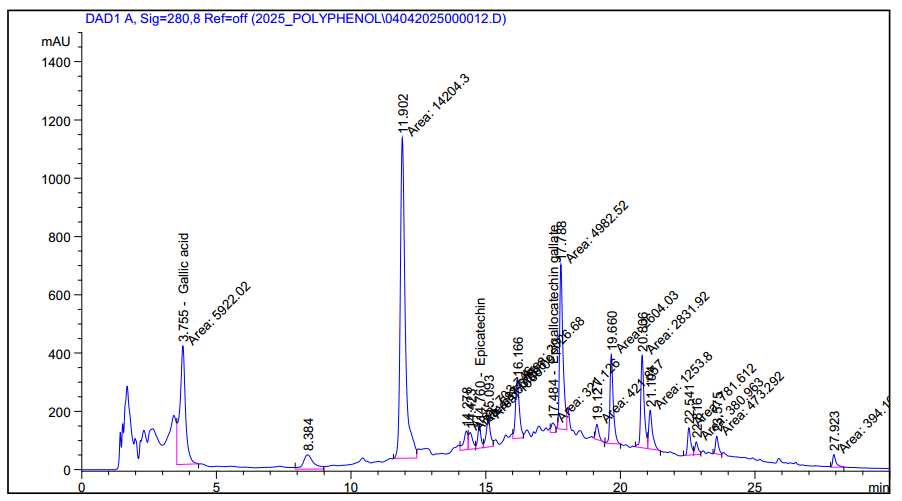
Figure 3 HPLC-UV-DAD chromatogram of the ethanolic leaf extract of Mimosa pigra recorded at 280 nm, showing the major phenolic and flavonoid peaks detected in the extract. Peak labels correspond to compounds tentatively identified from retention behavior and UV spectral characteristics, as summarized in Table 4.
Table 4 Phenolic and flavonoid compounds tentatively identified in M. pigra extract by HPLC-UV-DAD.
| Peak# | RetTime (min) | Type | Width (min) | Area (mAU·s) | Area % | Tentatively identified |
|---|---|---|---|---|---|---|
| 5 | 14.278 | MF | 0.1831 | 703.74567 | 1.7181 | Catechin |
| 6 | 14.423 | FM | 0.1703 | 587.60541 | 1.4346 | Gallocatechin |
| 7 | 14.760 | MF | 0.1397 | 663.69629 | 1.6203 | Epicatechin |
| 8 | 15.093 | FM | 0.1841 | 1066.08667 | 2.6027 | Catechin gallate |
| 9 | 16.166 | MM | 0.1699 | 2026.67822 | 4.9478 | Epicatechin gallate |
| 10 | 17.484 | MM | 0.1648 | 321.12604 | 0.7840 | Epigallocatechin gallate |
| 11 | 17.788 | MF | 0.1471 | 4982.52100 | 12.1641 | Procyanidin B2 |
| 12 | 19.127 | MM | 0.1337 | 421.85703 | 1.0299 | Procyanidin dimer isomer |
| 13 | 19.660 | MM | 0.1422 | 2604.03247 | 6.3574 | Procyanidin trimer |
| 14 | 20.806 | MF | 0.1489 | 2831.91821 | 6.9137 | Quercetin-3-O‑glucoside (Isoquercitrin) |
| 15 | 21.104 | FM | 0.1572 | 1253.80310 | 3.0610 | Quercetin-3-O‑rutinoside (Rutin) |
| 16 | 22.541 | MF | 0.1379 | 781.61212 | 1.9082 | Kaempferol-3-O‑glucoside |
| 17 | 22.816 | FM | 0.1441 | 380.96317 | 0.9301 | Kaempferol-3-O‑rutinoside |
| 18 | 23.575 | MM | 0.1294 | 473.29163 | 1.1555 | Myricetin-3-O‑glucoside |
| 19 | 27.923 | MM | 0.1491 | 394.16617 | 0.9623 | Quercetin (aglycone) |
Table 5 Quantitative determination of selected phenolic compounds in M. pigra extract by HPLC-UV.
| Compound | Sigma-Aldrich reference standard (catalog style) | Concentration (mg mL⁻¹ extract) |
|---|---|---|
| Gallic acid | Gallic acid (analytical standard) | 4.77 |
| Catechin | (+)-Catechin hydrate (analytical standard) | n.d |
| Epicatechin | (−)-Epicatechin (analytical standard) | 1.9 |
| Epigallocatechin gallate (EGCG) | (−)-Epigallocatechin gallate (≥95%, HPLC) | 3.1 |
| Rutin | Rutin hydrate (analytical standard) | 17.76 |
| Quercetin | Quercetin dihydrate (analytical standard) | 9.70 |
| Kaempferol | Kaempferol (≥97%, HPLC) | 6.46 |
Concentrations represent the amount of each compound quantified in the crude ethanolic extract of M. pigra. Compounds were quantified using external calibration curves constructed from authentic standards. n.d: not detected.
From a bioherbicidal perspective, the coexistence of condensed tannins, flavan-3-ols, phenolic acids, and flavonol glycosides provides a mechanistically coherent explanation for the strong inhibition observed in germination and seedling assays (Tables 1 and 2). Plant-derived polyphenols are widely recognized to interfere with seed germination and early seedling development through oxidative stress induction, membrane destabilization, and inhibition of mitotic processes [43]. Supporting this linkage specifically for M. pigra, phytotoxicity assays have demonstrated concentration dependent growth inhibition associated with cellular damage in target species [44]. Collectively, the chromatographic and quantitative evidence indicates that M. pigra leaves constitute a polyphenol-rich extract with chemical features consistent with reported mechanisms of plant-derived bioherbicides.
Correlation analysis
Pearson correlation analysis revealed significant positive relationships between phytochemical contents (TPC and TFC) and the inhibitory effects on E. indica (Table 6, Figures 4 and 5). Total phenolic content (TPC) showed high correlations with germination inhibition (r = 0.91, p < 0.01) and root inhibition (r = 0.94, p < 0.01), while total flavonoid content (TFC) was also significantly correlated with both germination (r = 0.84, p < 0.01) and root inhibition (r = 0.89, p < 0.01). Among the biological parameters, germination, root, and shoot inhibition were strongly intercorrelated (r = 0.92 - 0.95), indicating consistent phytotoxic responses across developmental stages.
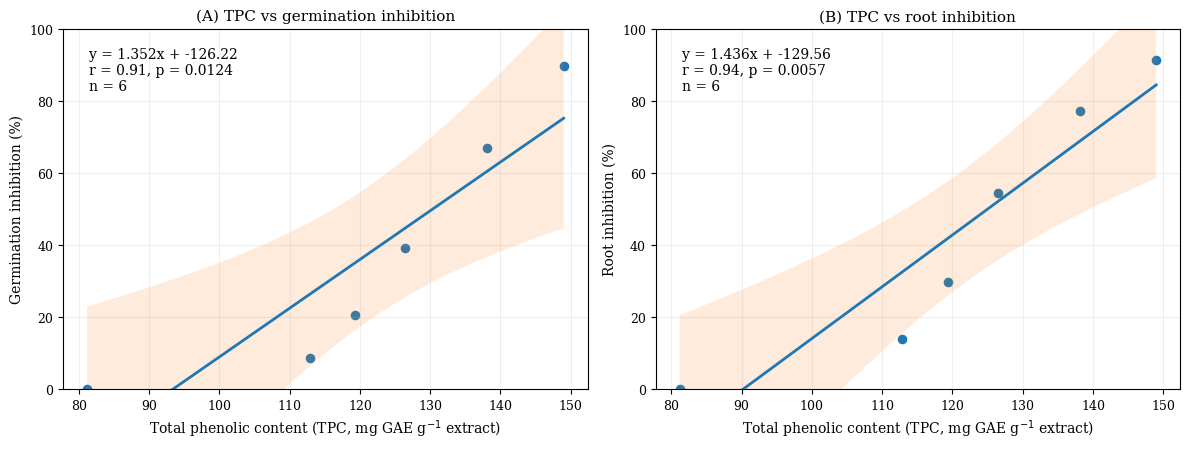
Figure 4 Linear regression analysis of total phenolic content (TPC) in relation to germination and root inhibition of E. indica. Scatter points represent mean values obtained at different extract concentrations (n = 6). Solid lines indicate linear regression fits, and shaded areas represent the 95% confidence intervals of the regression models.
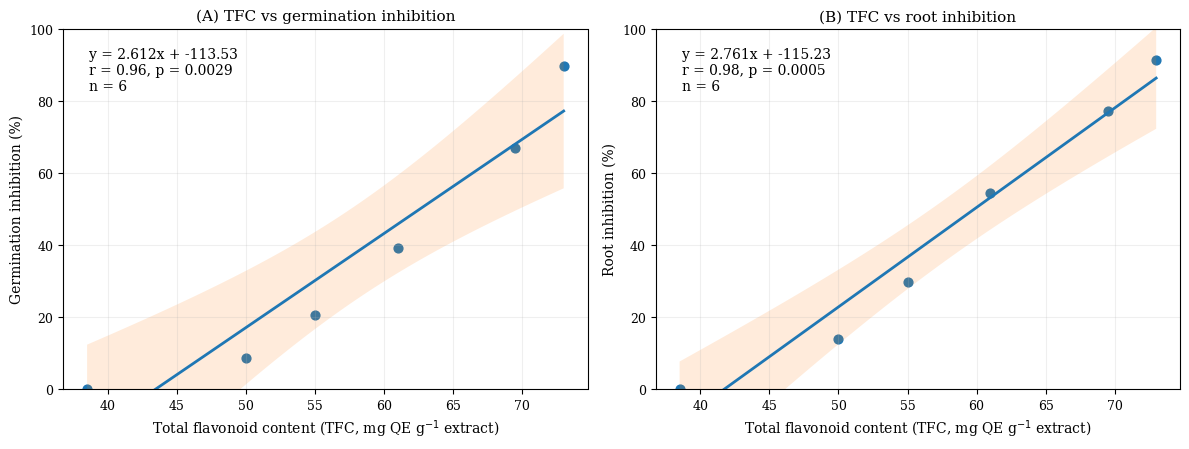
Figure 5 Linear regression analysis of total flavonoid content (TFC) in relation to germination and root inhibition of E. indica. Scatter points represent mean values obtained at different extract concentrations (n = 6). Solid lines indicate linear regression fits, and shaded areas represent the 95% confidence intervals of the regression models.
Table 6 Pearson correlation matrix among phytochemical contents and phytotoxicity parameters of M. pigra leaf extract.
| Variable | TPC | TFC | Germination inhibition (%) | Root inhibition (%) | Shoot inhibition (%) |
|---|---|---|---|---|---|
| TPC | 1 | 0.86** | 0.91** | 0.94** | 0.88** |
| TFC | 0.86** | 1 | 0.84** | 0.89** | 0.83** |
| Germination inhibition | 0.91** | 0.84** | 1 | 0.92** | 0.95** |
| Root inhibition | 0.94** | 0.89** | 0.92** | 1 | 0.93** |
| Shoot inhibition | 0.88** | 0.83** | 0.95** | 0.93** | 1 |
Values represent Pearson correlation coefficients (r). ** Significant at p < 0.01.
The stronger association between TPC and root inhibition compared with TFC suggests that the overall phenolic pool may be a more reliable predictor of phytotoxic intensity than flavonoids alone [45]. In many cases, root elongation has been identified as the most sensitive endpoint and the parameter most closely linked to phenolic concentration. The correlation patterns observed in the present study are therefore consistent with previous reports, supporting the relevance of phenolic compounds as key contributors to phytotoxic activity [29]. While correlation does not confirm causation, the strong statistical associations provide quantitative support for the role of phenolic and flavonoid constituents in the inhibitory effects [46] of M. pigra extract on E. indica.
Pot experiment results
Under greenhouse pot conditions, M. pigra leaf extract significantly suppressed the emergence and growth of E. indica 21 days after treatment (Table 7). Emergence percentage decreased progressively with increasing extract concentration, from over 90% in the control to approximately 23% at 160 mg mL⁻¹, with all treatments differing significantly from the control (p < 0.05). Plant height and shoot biomass showed similar dose-dependent declines. At 80 and 160 mg mL⁻¹, plant height was reduced by nearly 50%, while shoot biomass decreased by more than 70% compared with the control. These reductions corresponded to weed control efficacy exceeding 50% at both concentrations.
Table 7 Effects of Mimosa pigra leaf extract on emergence and growth of Eleusine indica under pot conditions, 21 days after treatment.
| Concentration (mg mL⁻¹) | Emergence (%) | Emergence inhibition (%) | Plant height (cm) | Height reduction (%) | Shoot biomass (g plant⁻¹) | Shoot biomass reduction (%) |
|---|---|---|---|---|---|---|
| 0 (Control) | 93.6 ± 3.1a | 0.0d | 18.9 ± 1.2a | 0.0d | 3.72 ± 0.28a | 0.0d |
| 40 | 72.4 ± 3.6b | 22.6c | 14.7 ± 0.9b | 22.2c | 2.65 ± 0.21b | 28.8c |
| 80 | 48.3 ± 3.2c | 48.4b | 10.3 ± 0.8c | 45.5b | 1.62 ± 0.17c | 56.5b |
| 160 | 22.7 ± 2.9d | 75.7a | 6.1 ± 0.6d | 67.7a | 0.84 ± 0.10d | 77.4a |
The greenhouse pot experiment further validated the phytotoxic responses previously observed in Petri dish bioassays, although the inhibitory magnitude was moderately attenuated under soil conditions. This attenuation of activity is a common phenomenon in bioherbicide evaluations, often attributed to soil adsorption, microbial degradation, or the buffering capacity of the soil matrix [33]. Similar patterns have been documented in studies of other allelopathic species, where inhibitory effects observed in Petri dish assays were reduced but remained statistically significant when applied to soil-grown weeds [36]. The persistence of strong growth suppression under pot conditions [47] suggests that the bioactive constituents of M. pigra leaf extract retain sufficient bioavailability and stability within a complex substrate environment to exert their herbicidal effects.
The marked reduction in shoot biomass and plant height of E. indica observed in this study is indicative of impaired competitive ability. In practical weed management, such growth retardation is critical as it allows the main crop to gain a competitive advantage over the weed [48]. The inhibitory effects of M. pigra extract are comparable to those of other allelopathic species. For example, extracts from A. conyzoides and I. cylindrica have shown similar dose-dependent reductions in germination and biomass, with root growth generally more sensitive than shoot growth [49]. The dose-dependent suppression and consistent greenhouse validation reinforce the potential of M. pigra as a competitive candidate for natural herbicide development.
Furthermore, the utilization of M. pigra, a widespread invasive species with high biomass availability, presents a dual advantage: It provides a sustainable source for bioherbicides while simultaneously contributing to the management of invasive plant populations [33]. Our results suggest that this extract could be integrated into weed management systems, particularly for pre-emergence or early post-emergence control of E. indica. However, despite these promising findings, the transition from controlled environments to field applications remains a challenge. Environmental variability and the complexity of crude extracts require further research to identify key active metabolites and develop more stable formulations that enhance field performance and ensure crop safety [50]. One limitation of this study is the use of sterilized soil in the pot experiment, which excludes the potential influence of soil microbial activity on the stability and degradation of phytotoxic compounds. While sterilization was applied to minimize variability and isolate the direct effects of the extract, future studies should compare sterilized and non-sterilized soils to better understand the role of soil microorganisms under more realistic conditions.
Conclusions
The ethanolic leaf extract of M. pigra exhibited promising, concentration-dependent phytotoxic effects against E. indica at both germination and early growth stages. Dose-response modeling using a 4-parameter logistic equation confirmed differential endpoint sensitivity, with root inhibition showing the greatest potency (IC₅₀ = 34.9 mg mL⁻¹), followed by germination inhibition (IC₅₀ = 46.8 mg mL⁻¹) and shoot inhibition (IC₅₀ = 57.6 mg mL⁻¹). Phytochemical analyses demonstrated a polyphenol-rich extract (TPC = 128.6 ± 6.4 mg GAE g⁻¹; TFC = 71.8 ± 4.1 mg QE g⁻¹). Quantitative HPLC-UV-DAD confirmed measurable levels of rutin, quercetin, kaempferol, EGCG, epicatechin, and gallic acid. Positive correlations between phytochemical indices and phytotoxicity further supported the association between phenolic richness and inhibitory intensity. Besides, net-house pot validation indicated that phytotoxic effects were retained under soil conditions, resulting in marked reductions in emergence and biomass (up to 77.4% biomass reduction at 160 mg mL⁻¹). Collectively, the integration of biological assays, quantitative potency estimates, and chemical profiling suggests that M. pigra leaves are a promising source of natural phytotoxic compounds for bioherbicide development. Future studies should focus on formulation development, selectivity testing, and field-scale validation to facilitate practical application.
Acknowledgements
This research is funded by Vietnam National University Ho Chi Minh City (VNU-HCM) under grant number C2024-16-21.
Declaration of Generative AI in Scientific Writing
During the preparation of this manuscript, the authors used Google Translate, QuillBot, Grammarly and ChatGPT (OpenAI) to improve language clarity and readability. After using these tools, the author(s) critically reviewed and edited the manuscript and take full responsibility for the accuracy, originality, and integrity of the content.
CRediT Author Statement
Le Huu Phuoc: Conceptualization; Methodology; Investigation; Data curation; Writing -Original Draft; Review & Editing; Project coordinator; Corresponding author. Nguyen Thi Thanh Xuan: Writing - Review & Editing; Language editing; Validation. Vo Thi Huong Duong: Investigation; Validation; Writing - Review & Editing. Nguyen Xuan Binh: Investigation; Resources; Data curation. Pham Van Quang: Formal analysis; Data curation; Visualization.
References
[1] RLC Alcantara-De, LBXD Silva, HK Takano, LHB Junior and KF Mendes. The rise of Eleusine indica as Brazil’s most troublesome weed. Agronomy 2025; 15(8), 1759.
[2] F Sarghini, M Esposito and A Maggio. Use of new weed management approaches and artificial intelligence to obtain neutral weed communities, Available at: http://www.fedoa.unina.it/15054/1/Esposito_Marco_35.pdf, accessed December 2025.
[3] L da Silva Araujo, NM Correia, VL Tornisielo, MTV Labate, SM Tsai, CA Carbonari and RV Filho. Goosegrass (Eleusine indica) resistant to multiple herbicide modes of action in Brazil. Weed Science 2023; 71(3), 189-197.
[4] CP Nath, RG Singh, VK Choudhary, D Datta, R Nandan and SS Singh. Challenges and alternatives of herbicide-based weed management. Agronomy 2024; 14(1), 126.
[5] J Roberts, S Florentine, WGD Fernando and KU Tennakoon. Achievements, developments and future challenges in the field of bioherbicides for weed control: A global review. Plants 2022; 11(17), 2242.
[6] AM Islam, SMR Karim, SA Kheya and S Yeasmin. Unlocking the potential of bioherbicides for sustainable and environment friendly weed management. Heliyon 2024; 10(16), e36088.
[7] GR Ximenez, M Bianchin, JMP Carmona, SM de Oliveira, Ferrarese-Filho and LH Pastorini. Reduction of weed growth under the influence of extracts and metabolites isolated from Miconia spp. Molecules 2022; 27(17), 5356.
[8] A Welgama, S Florentine and J Roberts. A global review of the woody invasive alien species Mimosa pigra (Giant sensitive plant): Its biology and management implications. Plants 2022; 11(18), 2366.
[9] H Kato-Noguchi. Invasive mechanisms of one of the world’s worst alien plant species Mimosa pigra and its management. Plants 2023; 12(10), 1960.
[10] C Kuwabara, D Wang, K Endoh, Y Fukushi, K Arakawa and S Fujikawa. Analysis of supercooling activity of tannin-related polyphenols. Cryobiology 2013; 67(1), 40-49.
[11] Y Yu, Y Du, J Dong, Z Yin, P Chen, L Cao and Z Yan. Phytotoxic effects of the aqueous extracts of Magnolia biondii Pamp. flower litter and the joint action of allelochemicals. Plants 2025; 14(11), 1577.
[12] N Bahrin, N Muhammad, N Abdullah, BHA Talip, S Jusoh and SW Theng. Effect of processing temperature on antioxidant activity of Ficus carica leaves extract. Journal of Science and Technology 2018; 10(2), 99-103.
[13] DH Truong, DH Nguyen, NTA Ta, AV Bui, TH Do and HC Nguyen. Evaluation of the use of different solvents for phytochemical constituents, antioxidants, and in vitro anti-inflammatory activities of Severinia buxifolia. Journal of Food Quality 2019; 2019, 8178294.
[14] JU Agogbua, BE Okoli and JO Osuji. Procedure for in vitro seed sterilization, germination and aseptic seedling establishment of Zehneria capillacea (Schumach) C. jeffrey. GSC Biological and Pharmaceutical Sciences 2022; 19(1), 143-148.
[15] BS Chauhan and DE Johnson. Germination ecology of goosegrass (Eleusine indica): An important grass weed of rainfed rice. Weed Science 2008; 56(5), 699-706.
[16] Y Yang, G Wang, L Li, R Ma, Y Kong and J Yuan. Selection of sensitive seeds for evaluation of compost maturity with the seed germination index. Waste Management 2021; 136, 238-243.
[17] W Khan, S Shah, A Ullah, S Ullah, F Amin, B Iqbal, N Ahmad, MA Abdel-Maksoud, MK Okla and M El-Zaidy. Utilizing hydrothermal time models to assess the effects of temperature and osmotic stress on maize (Zea mays L.) germination and physiological responses. BMC Plant Biology 2023; 23(1), 414.
[18] S Kumari, SK Chakrabarty & D Paul. Assessment of genetic diversity for seed vigor traits in rice (Oryza sativa L.) through principal component and cluster analysis. The Indian Journal of Genetics and Plant Breeding 2023, 83(3), 343-354.
[19] Y Jiang, CH Zhu, ZH Xia and HQ Zhao. Novel quinoxalinone-1, 2, 3-triazole derivatives as potential antifungal agents for plant anthrax disease: Design, synthesis, antifungal activity and SAR study. Advanced Agrochem 2024; 3(3), 222-228.
[20] M Alamgir and MK Hossain. Effect of pre-sowing treatments on germination and initial seedling development of Albizia saman in the nursery. Journal of Forestry Research 2005; 16(3), 200-204.
[21] SS Ramanathan, TW Gannon and PJ Maxwell. Dose-response of five weed species to indaziflam and oxadiazon. Weed Technology 2023; 37(3), 303-312.
[22] PO Rinthong, T Katisart and S Maneechai. Evaluation of the phytochemical profiling, tyrosinase inhibitory activity, and antioxidant potential of various extracts of Acacia concinna (Willd.) DC. Trends in Sciences 2024; 21(10), 8334-8334.
[23] RNS Yadav and M Agarwala. Phytochemical analysis of some medicinal plants. Journal of Phytology 2011; 3(12), 10-14.
[24] CC Chang, MH Yang, HM Wen and JC Chern. Estimation of total flavonoid content in propolis by two complementary colorimetric methods. Journal of Food and Drug Analysis 2002; 10(3), 178-182.
[25] NSM Hanapi, SA Amraa, AL Anis, N Zaini, WNW Ibrahim and NN Bonnia. Rapid and sensitive determination of polycyclic aromatic hydrocarbons in green tea samples by dispersive liquid-liquid microextraction coupled to high-performance liquid chromatography-diode array detection. Trends in Sciences 2022; 19(20), 6232-6232.
[26] Z Spacil, L Novakova and P Solich. Analysis of phenolic compounds by high performance liquid chromatography and ultra performance liquid chromatography. Talanta 2008; 76(1), 189-199.
[27] L Novakova, Z Spacil, M Seifrtova, L Opletal and P Solich. Rapid qualitative and quantitative ultra high performance liquid chromatography method for simultaneous analysis of twenty nine common phenolic compounds of various structures. Talanta 2010; 80(5), 1970-1979.
[28] I Suliansyah, F Arlius, I Chaniago, NTT Xuan, VTH Duong, NP Dung and PV Quang. Simulation of maize biomass and yield in An Giang, Vietnam, under climate variabilities. Trends in Sciences 2024; 21(3), 7490-7490.
[29] X Wang, C Sun, S Gao, L Wang and H Shuokui. Validation of germination rate and root elongation as indicator to assess phytotoxicity with Cucumis sativus. Chemosphere 2001; 44(8), 1711-1721.
[30] H Kato-Noguchi. Allelopathy and allelochemicals of Imperata cylindrica as an invasive plant species. Plants 2022; 11(19), 2551.
[31] MM Williams, RA Boydston and AS Davis. Crop competitive ability contributes to herbicide performance in sweet corn. Weed Research 2008; 48(1), 58-67.
[32] HMK Bashar, AS Juraimi, MS Ahmad-Hamdani, MK Uddin, N Asib, MP Anwar, SMR Karim, F Rahaman, MA Haque and A Hossain. Documentation of phytotoxic compounds existing in Parthenium hysterophorus L. leaf and their phytotoxicity on Eleusine indica (L.) Gaertn. and Digitaria sanguinalis (L.) Scop. Toxins 2022; 14(8), 561.
[33] M Hasan, MS Ahmad-Hamdani, AM Rosli and H Hamdan. Bioherbicides: An eco-friendly tool for sustainable weed management. Plants 2021; 10(6), 1212.
[34] MJB Ashraf, M Zubair, N Azam, N Zahra, R Nisar, BE Ayomide, S Abbas and MM Khan. Unlocking the allelopathic and phytotoxic potential of indigenous bio-herbicide weeds (Withania coagulans and Achyranthes aspera) against staple crops. International Journal of Science and Research Archive 2025; 16(3), 653-665.
[35] P Akter and R Begum. Allelopathic effects of aqueous and methanolic extracts from Ageratum conyzoides L. on the germination of selected vegetables. Tropical Agroecosystems 2024; 5(1), 01-09.
[36] AM Islam and H Kato-Noguchi. Phytotoxic activity of Ocimum tenuiflorum extracts on germination and seedling growth of different plant species. The Scientific World Journal 2014; 2014, 676242.
[37] A Windarsih, MF Ahla, AW Indrianingsih, Suratno, E Noviana, DK Bhattacharjya and MI Sulistyowaty. In vitro evaluation of antioxidant, antibacterial, and antidiabetes of billygoat weed leaves, stem, and flower (Ageratum conyzoides L.) concurrent with its phytochemical constituents. Waste and Biomass Valorization 2025; 16(9), 4711-4725.
[38] D Dhianawaty, RG Dwiwina and W Mayasari. Quantification of four phytochemical parameters of Imperata cylindrica leaves to promote its use as a medicinal plant. Pharmacognosy Journal 2024; 16(1), 108-117.
[39] F Raposo, R Borja and JA Gutierrez-Gonzalez. A comprehensive and critical review of the unstandardized Folin-Ciocalteu assay to determine the total content of polyphenols: The conundrum of the experimental factors and method validation. Talanta 2024; 272, 125771.
[40] K Rizwan, I Majeed, M Bilal, T Rasheed, A Shakeel and S Iqbal. Phytochemistry and diverse pharmacology of genus Mimosa: A review. Biomolecules 2022; 12(1), 83.
[41] CJ Okonkwo, OU Njoku, TJ Okonkwo, OE Afieroho and P Proksch. Two new acylated flavonol glycosides from mimosa pigra L. Leaves Sub-Family mimosoideae. Future Journal of Pharmaceutical Sciences 2016; 2(2), 71-75.
[42] MF Hawwal, Z Ali, OI Fantoukh, AG Chittiboyina and IA Khan. Phytochemical investigation of Mimosa pigra leaves, a sensitive species. Biochemical Systematics and Ecology 2021; 99, 104354.
[43] R Radhakrishnan, AA Alqarawi and EFA Allah. Bioherbicides: Current knowledge on weed control mechanism. Ecotoxicology and Environmental Safety 2018; 158, 131-138.
[44] I Koodkaew, C Senaphan, N Sengseang and S Suwanwong. Characterization of phytochemical profile and phytotoxic activity of Mimosa pigra L. Agriculture and Natural Resources 2018; 52(2), 162-168.
[45] HP Singh, DR Batish, S Kaur and RK Kohli. Phytotoxic interference of Ageratum conyzoides with wheat (Triticum aestivum). Journal of Agronomy and Crop Science 2003; 189(5), 341-346.
[46] YM Muflihah, G Gollavelli and YC Ling. Correlation study of antioxidant activity with phenolic and flavonoid compounds in 12 Indonesian indigenous herbs. Antioxidants 2021; 10(10), 1530.
[47] PV Quang, DV Nha, NTT Hang, LH Phuoc and NTT Xuan. Effects of accumulated growing degree days (GDDs) on sesame (Sesamum indicum) growth and yield under greenhouse condition in the Mekong Delta, Vietnam. IOP Conference Series: Earth and Environmental Science 2024; 1306(1), 012012.
[48] ACD Wandscheer, MA Rizzardi and M Reichert. Competitive ability of corn in coexistence with goosegrass. Planta Daninha 2013; 31(2), 281-289.
[49] DT Khang, HD Dieu, NK Dung, BT Giang, TLN Thao, LTT Tien, TT Men, HV Loi, NT Tuan, NV Ay and NP Thuy. Anticancer and antioxidant of chloroform extracts from medical plants in the Mekong Delta, Vietnam. Asian Journal of Plant Sciences 2020; 19, 398-405.
[50] WT Gao and WH Su. Weed management methods for herbaceous field crops: A review. Agronomy 2024; 14(3), 486.