
Trends
Sci. 2026; 23(9):
12854
Phytochemical Composition, Acute Toxicity, and Antidiarrheal Effects of Hydroethanolic Extract of Thymus saturejoides Coss. from Demnate
(Central High Atlas, Morocco)
Mohamed El Hassan Bouchari1,2, Abdelilah Meddich2,3,*, Abdeljalil Elmahdaoui4,
Lansine Diakité4, Ridwane Ghanimi4, Hassan Abd‑Dada1,
Zahra Sokar4 and Abdelmajid Haddioui1
1Laboratory of Agro-industrial and Medical Biotechnologies, Faculty of Sciences and Techniques,
Sultan Moulay Slimane University, Beni Mellal, Morocco
2Faculty of Sciences Semlalia Marrakech, Laboratory of Excellence in Agrobiotechnology and Bioengineering, AgroBiotech Center, CNRST-Accredited Research Unit (URL05-CNRST), Cadi Ayyad University, Marrakech, Morocco
3African Sustainable Agriculture Research Institute (ASARI), University Mohammed VI Polytechnic (UM6P),
Laayoune, Morocco
4Laboratory of Pharmacology, Neurobiology, Anthropobiology, Environment, and Behaviour, Department of Biology, Faculty of Sciences Semlalia, Cadi Ayyad University, Marrakech, Morocco
(*Corresponding author’s e-mail: [email protected])
Received: 30 November 2025, Revised: 3 February 2026, Accepted: 10 February 2026, Published: 1 April 2026
Abstract
The medicinal plant Thymus saturejoides Coss, is traditionally used by the people of the Moroccan High Atlas for a wide range of therapeutic indications, and is particularly recognized for its gastroprotective effects. However, despite its widespread use in traditional pharmacopoeia, in vivo investigations dedicated to evaluating its gastroprotective activities remain limited. This research aimed to examine the protective potency of the hydroethanolic extract of this species against diarrhea. The hydroethanolic extract of the plant’s aerial parts was analyzed by HPLC. Swiss mice were used as a castor oil-induced diarrhea model to assess antidiarrheal effects. Markers of intestinal oxidative stress were evaluated photometrically. Hydroethanolic extracts of T. saturejoides demonstrated a significant anti-diarrheal efficacy in mice, with dose-dependent inhibition of symptoms (39.39% and 58.77% at 50 and 100 mg/kg respectively). These effects were manifested by a decrease in intestinal motility and an improvement in the anti-diarrheal index. In addition, the extract exerted a protective action against oxidative damage by reducing lipid peroxidation (MDA) and recovering catalase and peroxidase activities. Histological analyses confirmed a dose-dependent protective effect, with almost complete restoration of intestinal architecture at 100 mg/kg. Results underline the pharmacological potential of T. saturejoides in the treatment of gastrointestinal disorders, combining antidiarrheal, antioxidant and mucosa-protective properties.
Keywords: T. saturejoides, Antidiarrheal, In vivo, Oxidative stress, Castor oil, Polyphenol, Mice
Introduction
Diarrhea is associated with enteric infections and inflammation. It is mainly characterized by a disturbance in the absorption and/or secretion of fluids and electrolytes in the intestine. [1]. Diarrhea is defined by the WHO as having at least 3 loose or liquid stools in
a single day or having more bowel movements than normal. Diarrhea is the third most common cause of death for children aged less than 5 years, resulting in approximately 444,000 deaths annually [2]. The main causes of illness are the enteroaggregating bacteria Escherichia coli and Giardia lamblia [3]. Although diarrhea is largely preventable and manageable, it remains a major public health concern, primarily due to the limitations and adverse effects associated with conventional therapeutic strategies [4]. Antibiotic-based treatments are known to disrupt the homeostasis of the gastrointestinal microbiota [5], and the escalating emergence of antibiotic-resistant strains further underscores the urgent need for effective and sustainable alternative therapies [6]. These constraints have stimulated increasing scientific interest in the investigation of plant-derived medicinal interventions as promising complementary or alternative approaches.
In Morocco, aromatic and medicinal plants play a central role in traditional pharmacopoeia and are a major resource for many local communities [7]. Among them, the Thymus genus, belonging to the Lamiaceae family, stands out for its specific richness, with over 200 species widely distributed in the Mediterranean basin [8]. Morocco, renowned for its floral biodiversity [9], is home to 15 species of this genus, including Thymus saturejoides Cosson, known locally as “Zaitra” or “Azkuni, an endemic species [10] particularly valued for its medicinal uses. It is traditionally used to ameliorate several disorders, particularly those of a digestive nature [11-16]. Although widely used in folk medicine, scientific investigations into its biological activity and pharmacological effects remain limited. Most research has focused on the in vitro evaluation of its antimicrobial properties [17-21], while in vivo studies remain rare.
Accordingly, this work is concerned with assaying for the first time the anti-diarrheal effect of 70% hydroethanolic extracts of T. saturejoides (HETS) from the Central High Atlas of Morocco at an experimental model of castor oil-induced diarrhea on mice.
Materials and methods
Plant material
The aerial parts of T. saturejoides were harvested in May 2024 from the Demnate region, located in the Central High Atlas of Morocco, at an altitude of 1,446 m (31°38′00.4″ N, 7°08′23.6″ W). The area is characterized by a semi-arid climate, with winter temperatures occasionally falling below 0 °C and summer temperatures frequently exceeding 40 °C. From a geological standpoint, this sector of the High Atlas is dominated by a thick, folded Meso-Cenozoic sedimentary cover that largely overlies the Paleozoic basement. Moreover, the region displays a highly heterogeneous geological substrate, comprising limestone, clay, dolomite, marl, volcanic rocks, and detrital formations [22]. The taxonomic identification of the plant material was verified by Professor Rachid Ait Babahmad (Department of Biology, Faculty of Sciences Semlalia (FSS), Morocco), and a voucher specimen (MARK-14871) was deposited in the Mark Herbarium of FSS.
Extract preparation
The aerial parts of T. saturejoides were dried in the shade at ambient temperature. The 100 g of dry matter powder was macerated in 70% ethanol for 72 h. The solution was then filtered and vaporized under diminished pressure at 40 °C. Next, the extract (Yield: 28.46%) was freeze-dried and stored in the dark at 4 ± 1 °C.
Phytochemical analysis (HPLC-UV)
The bioactive compound profile of HETS (1 mg/mL) was investigated using chromatographic separation on an EC NUCLEOSIL C18 column (5 μm, 100 - 250 mm ×4.6 mm; Macherey-Nagel, Germany). The analysis was carried out according to the method described by Tikent et al. [23] with slight methodological adaptations. The mobile phase consisted of 2 solvents: Water-phosphoric acid (0.01%) (A) and acetonitrile (B), starting with 5% B and using a gradient to obtain 15% B at 3 min, 25% B at 13 min, 30% at 25 min, 35% at 35 min, 45% at 39 min, 30% at 25 min, 45% at 42 min, 55% at 47 min, 75% at 56 min, 100% at 60 min, 100% at 65 min, 5% at 73 min and 5% at 80 min. UV detection was performed at 280 nm. The injection volume was 20 μL, and the flow rate was 0.9 mL/min. The HPLC system is controlled by the HPLC software Chrom NAV2.0 - JASCO. Sixteen reference standards were analyzed separately under identical chromatographic conditions, using 4 concentrations ranging from 0 to 1 mg/mL to construct calibration curves, with coefficients of determination (R²) ranging between 0.995 and 0.998. Identification was performed by comparing the retention times of detected peaks with those of the corresponding standards.
Animal
The experiments were conducted on male Swiss albino mice weighing between 26 and 32 g (age 7 weeks), provided by the animal facility of the Biology Department in FSS, Marrakech, Morocco, which were adapted to the laboratory environment for 7 days before experimentation under standard living conditions with a 12-hour light/dark cycle and unrestricted access to food and water. All experimental procedures were carried out within an academic research framework and in accordance with the Guide for the Care and Use of Laboratory Animals (8th ed., 2011) issued by the National Institutes of Health (NIH, USA), and were approved by the Institutional Ethics Committee of the Faculty (approval number: BA-05/2025). The principles of the 3Rs (Replacement, Reduction, and Refinement) were strictly applied to minimize animal use and suffering.
Oral acute toxicity test
The acute toxicity assay was carried out on 5 healthy mice, in accordance with the OECD guideline for the limit test. After a week of acclimatization and a 4-hour fast, each mouse received 2,000 mg/kg of the extract via gavage [24]. They were then closely monitored for the first 4 h, followed by 14 days to detect any signs of toxicity or behavioral changes.
Castor oil-induced diarrhea
Twenty albino mice were used in this study. After an 18-hour fasting period, during which they had free access to water but no access to food, they were arbitrarily assigned to 4 groups of 5 animals each. Group 1 was administered 0.5 ml of distilled water, while group 2 received Loperamide drug (2 mg/kg). The 3rd and 4th groups received orally, and respectively, the 2 tested doses (50 and 100 mg/kg) of the HETS [25]. One h after treatment, each animal received 0.5 ml of castor oil by gavage. The mice were then placed in cages lined with white paper and assessed for diarrheal defecation during a 4-hour period [26].
Gastrointestinal transit time
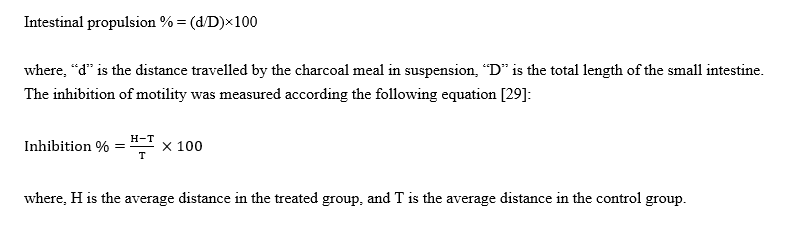
The charcoal protocol outlined by Capasso et al. [27] was used to evaluate gastrointestinal transit. After an 18-hour fast, the animals were given either Loperamide, the HETS, or the vehicle. Each mouse was given 0.2 mL of castor oil after 45 min. A charcoal meal (0.5 mL of a 3% aqueous suspension in 0.5% gum arabic) was given orally 30 min later. Thirty min following this final administration, the mice were sacrificed. As soon as the abdominal cavity was opened, the small intestine was extracted. Using the method of Rao et al. [28], the distance covered by charcoal from the pylorus to the cecum was determined as follows:
Anti-diarrheal index
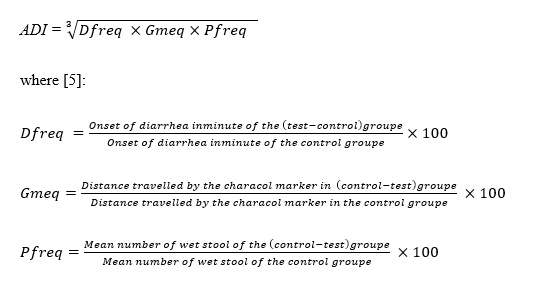
The anti-diarrheal index (ADI) was calculated based on the data obtained from the castor oil-induced diarrhea test, the charcoal meal gastrointestinal motility test, and the number of wet stools. The ADI was determined using the formula described by Than et al. [30]:
Oxidative stress markers and antioxidant enzymes
Malondialdehyde level
The quantity of intestinal tissue (50 - 100 mg) was homogenized in 1 mL of 10% TCA (W/V) and 1 mL of 90% acetone (V/V). The broth was centrifuged at 8,000 g for 15 min. 0.5 mL 0.1% (V/V) H3PO4 and 0.5 mL 0.6% (W/V) TBA were combined with 250 µL of supernatant. Following 30 min of incubation at 100 °C, the reaction was finished using an ice bath. and 0.75 mL of 1-butanol was added. A second centrifugation at 8,000 g was carried out to recover the butanol layer. The absorbance was read at 532 and 600 nm [31].
Catalase activity (CAT)
Samples of intestinal tissue were ground in cold PBS (pH 7.4), and the extracts were centrifuged for 15 min at 10,000×g. The supernatants obtained were used for the enzymatic assay. The reaction solution consisted of 1.0 mL of PBS (0.01 M, pH 7.0), 0.1 mL of tissue extract, and 0.4 mL of hydrogen peroxide 1 M. dichromate-acetic acid (2.0 mL) was used to stop the reaction.
Catalase activity was determined calorimetrically at 620 nm and presented in µmol of H2O2 disintegrated per minute per gram of fresh tissue [32].
Peroxidase activity
PBS (pH 7.4) was used to homogenize 100 mg of intestinal tissue in order to calculate peroxidase activity (POD). At 4 °C, the extract was centrifuged for 10 min at 12,000×g. The assay was conducted in a spectrophotometric cuvette that contained 0.1 mL of the enzyme extract, 2.9 mL of PBS (pH 7.4), 0.5 mL of guaiacol (0.05 M), and 0.5 mL of H2O2 (0.03%). The absorbance was Dignified at 470 nm for 5 to 10 min [32].
Histological assessment
Intestinal tissues were fixed in formalin solution (10%) for 48 h, then dehydrated using a series of ethanol grades, embedded in paraffin wax, and sectioning into 5 μm slices. The sections were stained with hematoxylin and eosin.
Statistical analysis
The mean ± SEM (standard error of the mean) was used to calculate the results. For statistical analysis, GraphPad Prism 8 software was used to conduct a 1-way analysis of variance (ANOVA) with a Tukey post-hoc test. At p-values below 0.05, differences were deemed statistically significant.
Results and discussion
HETS was evaluated for the first time in this study for its antidiarrheal properties using castor oil-induced diarrhea and gastrointestinal motility assays. These investigations were motivated by the traditional use of T. saturejoides, commonly prepared as an aqueous decoction to treat digestive ailments. To optimize the extraction of bioactive compounds, the present study employed a hydroethanolic extract containing 70% ethanol, which yielded a high extraction efficiency (28.46%), markedly exceeding that previously reported for the aqueous extract [33]. This choice is justified by the fact that ethanol concentration is a key factor influencing extraction yield, with increasing ethanol proportions up to 70% significantly enhancing extraction efficiency [34]. Hydroethanolic solvents with higher ethanol content exhibit an improved capacity to solubilize both polar and non-polar compounds, thereby promoting a more comprehensive recovery of bioactive molecules [34-36].
This superiority was further substantiated by HPLC-UV analysis (Table 1 and Figure 1), which revealed a phytochemical profile dominated by flavonoids and phenolic acids, with the identification of 4 major bioactive compounds: Rutin (184.32 µg/mL), p-coumaric acid (173.70 µg/mL), vanillic acid (138.94 µg/mL), and trans-ferulic acid (71.08 µg/mL). These compounds are widely distributed in medicinal plants and are well recognized for their broad biological activities [37]. Rutin, a flavonoid glycoside, exhibits antioxidant, anti-inflammatory, anti-ulcer, and vasoprotective properties and has been associated with gastrointestinal protection through the modulation of inflammatory mediators [38,39]. p-Coumaric acid, a hydroxycinnamic acid, is known for its free radical scavenging, anti-inflammatory, and antimicrobial activities, as well as its role in maintaining intestinal barrier function [40,41]. Vanillic acid exerts antioxidant, anti-inflammatory, hepatoprotective, and gastroprotective effects by attenuating oxidative stress and inflammatory responses [6,7,42,43], while ferulic acid displays potent antioxidant and anti-inflammatory properties and contributes to mucosal defense by inhibiting lipid peroxidation and preserving intestinal epithelial integrity [44-46]. In addition to these identified constituents, the chromatographic profile revealed several unresolved peaks that could not be unequivocally assigned due to the lack of appropriate reference standards, which represents a limitation of the present study and suggests the presence of additional bioactive compounds that may contribute to the observed antidiarrheal activity through individual or synergistic effects. Notably, the phytochemical composition obtained here differs from that reported for the aqueous extract by Khouya et al. [33], underscoring the influence of solvent polarity on both the qualitative and quantitative extraction of secondary metabolites and, consequently, on the resulting biological activity. The characteristics of the chromatographic peaks numbered 1 to 8 are presented in Table 1.
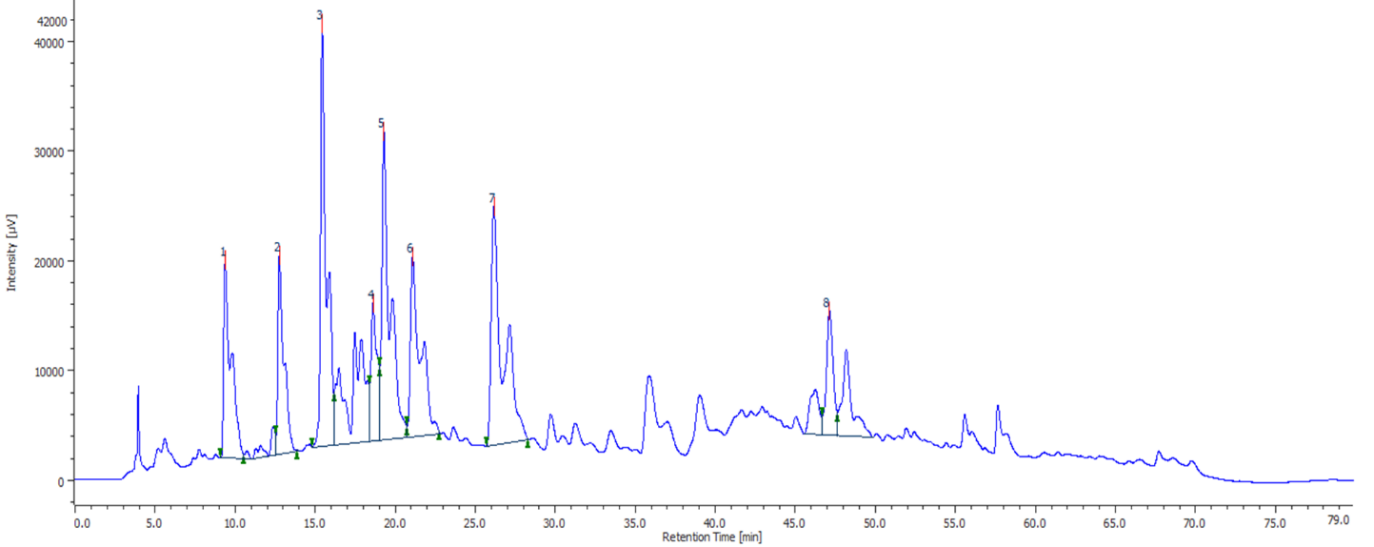
Figure 1 Chromatographic profile of 70% hydroethanolic extract of T. Saturejoides.
Table 1 Chromatographic parameters of the main compounds detected by HPLC-UV.
Compound number |
Compound name |
RT (min) |
Area (µV·s) |
Height (µV) |
Concentration (µg/mg) |
% of total area |
1 |
NI |
9.37 |
579.82 |
17.95 |
NQ |
10.65% |
2 |
Vanillic acid |
12.80 |
475.87 |
18.06 |
138.94 |
8.74% |
3 |
Trans-ferulic acid |
15.40 |
997.95 |
38.43 |
71.08 |
18.33% |
4 |
p-Coumaric acid |
18.60 |
334.06 |
12.52 |
173.70 |
6.14% |
5 |
Rutin |
19.30 |
978.13 |
27.99 |
184.32 |
17.97% |
6 |
NI |
21.10 |
714.44 |
16.42 |
NQ |
13.13% |
7 |
NI |
26.20 |
1084.05 |
21.71 |
NQ |
19.91% |
8 |
NI |
47.10 |
339.90 |
11.33 |
NQ |
6.24% |
Total |
- |
5442.22 |
- |
- |
100.00% |
|
RT: Retention times, NI: Not identified, NQ: Non-quantified.
An acute toxicity test was conducted to evaluate the safety of HETS. During the 4 h’ observation period following oral administration of 2,000 mg/kg, no mortality or signs of severe toxicity (vomiting, dyspnea, or altered respiration) were observed in treated mice compared to controls. Behaviors such as urination, grooming, and licking were present at similar levels in both groups (Table 2), indicating the absence of abnormal behavioral responses. No mortality was observed during the 14-day follow-up period. These findings, which are consistent with those reported by Khouya et al. [24] using the crude extract of the same species, suggest that the extract does not induce acute toxic effects at the tested dose.
Table 2 Behavioral and physiological parameters observed in mice after administration of HETS (2,000 mg/kg).
Signs |
HETS 2,000 mg/kg |
Control |
Mortality |
- |
- |
Defecation |
- |
- |
Urination |
++ |
++ |
Grooming |
+++ |
+++ |
Licking |
++ |
++ |
Grooming (alt) |
- |
- |
Respiration |
- |
- |
Dyspnea |
- |
- |
Vomiting |
- |
- |
(–) no activity; (+) increasing activity intensity.
Our results demonstrate that the hydroethanolic extract of Thymus saturejoides (HETS) exerts a significant antidiarrheal effect in established in vivo models (Table 3). In the castor oil-induced diarrhea assay, HETS markedly reduced both the frequency and weight of wet stools in a dose-dependent manner, with inhibition rates of 39.39% and 58.77% at 50 and 100 mg/kg, respectively. Although Loperamide showed the highest inhibitory effect (73.48%), the activity of HETS, particularly at 100 mg/kg, indicates a strong pharmacological potential and supports its traditional use in gastrointestinal disorders.
Table 3 The effect of hydroethanolic extract of T. Saturejoides on the castor oil-induced diarrhea model.
Types of treatment |
OD (min) |
NWF |
WWF (g) |
% ID |
NC |
20 ± 2.94a |
24 ± 3.46a |
2.32 ± 0.19a |
- |
HETS 50mg/Kg |
21 ± 0.82a |
14.33 ± 0.58b |
0.91 ± 0.12b |
39.39 ± 0.09a |
HETS 100mg/Kg |
29 ± 4.55b |
10 ± 3.00c |
1.40 ± 0.25c |
58.77 ± 0.08b |
LOP |
38 ± 6.24c |
6.33 ± 1.15d |
1.29 ± 0.12c
|
73.48 ± 0.05c |
OD: Onset of Diarrhea; NWF: Number of Wet Feces; WWF: Weight of Wet Feces; % ID: Percentage Inhibition of Diarrhea, NC: Negative Control; HETS: Hydroethanolic Extract of T. Saturejoides; LOP: Loperamide Drug. Values are presented as mean ± SEM (n = 5). Different letters (a, b, c) within the same column indicate statistically significant differences at p < 0.05.
The antidiarrheal efficacy observed in the castor oil model was further corroborated by the charcoal meal test, where HETS significantly attenuated gastrointestinal motility (Table 4), The extract reduced the intestinal transit progression to 69.25% and 71.49% at 50 and 100 mg/kg, corresponding to motility inhibition rates of 30.75% and 28.51%, respectively. This reduction is comparable to that induced by loperamide (71.12%), suggesting that HETS may exert its antidiarrheal action, at least in part, through modulation of intestinal motility. Since castor oil-induced diarrhea is closely associated with enhanced intestinal secretion and hypermotility mediated by ricinoleic acid, the dual inhibitory effect of HETS on stool output and intestinal transit highlights a broad antidiarrheal profile.
Table 4 Effects of hydroethanolic extract of T. Saturejoides on gastrointestinal transit in castor oil-induced diarrhea.
Types of treatment |
The total length of the intestine (cm) |
Length of intestine marked with charcoal (cm) |
PI (%) |
Inhibition of motility (%) |
|
NC |
45.10 ± 1.56 |
39.65 ± 3.32a |
87.84 ± 0.04a |
12.16 ± 0.04a |
|
HETS 50mg/Kg |
49.00 ± 1.41 |
34.00 ± 5.66ab |
69.25 ± 0.10b |
30.75 ± 0.10b |
|
HETS 100mg/Kg |
45.25 ± 5.30 |
32.50 ± 6.36ab |
71.49 ± 0.06b |
28.51 ± 0.06b |
|
LOP |
50.30 ± 11.31 |
14.55 ± 3.46b |
28.88 ± 0.00c |
71.12 ± 0.00c |
|
NC: Negative control; HETS: Hydroethanolic extract of T. Saturejoides; LOP: Loperamide drug. PI: The progression index. Values are presented as mean ± SEM (n = 5). Different letters (a, b, c) within the same column indicate statistically significant differences at p < 0.05.
To provide an integrative assessment of antidiarrheal efficacy, the Antidiarrheal Index (ADI) was calculated (Table 5), combining effects on diarrhea onset, stool frequency, and intestinal transit. HETS displayed a clear dose-dependent increase in ADI values, reaching 42.29 at 100 mg/kg, compared with 18.49 at 50 mg/kg. Although this value remains lower than that of Loperamide (77.76), it reflects a pronounced antidiarrheal activity for a plant extract administered at a relatively low dose.
Notably, the ADI value obtained for HETS at 100 mg/kg (ADI = 42.29) is substantially higher than that reported for the methanolic leaf extract of Olinia rochetiana administered at the same dose (ADI = 20.08). Moreover, the antidiarrheal performance of HETS at 100 mg/kg is comparable to that of O. rochetiana methanolic extract at 200 mg/kg (ADI = 43.06) [5]. This finding indicates that HETS achieves similar therapeutic efficacy at half the dose, suggesting a higher pharmacological potency and a more favorable efficacy-dose relationship.
Table 5 In vivo anti-diarrheal index of hydroethanolic extract of T. Saturejoides.
|
Dfreq (%) |
Gmeq (%) |
Pfreq (%) |
ADI |
LOP |
91.67 |
71.12 |
73.48 |
77.76 |
HETS 50mg |
5.00 |
30.75 |
40.28 |
18.49 |
HETS 100mg |
45.00 |
28.51 |
58.33 |
42.29 |
Dfreq: Delay in the onset of diarrhea, Gmeq: Reduction in intestinal transit, Pfreq: Reduction in the number of wet stools, ADI: in vivo Anti-Diarrheal Index, LOP: Loperamide drug, HETS: Hydroethanolic extract of T. Saturejoides.
When compared with other species of the genus Thymus, the antidiarrheal activity of HETS remains consistent with previously reported data, while exhibiting some distinctive features. For instance, the aqueous extract of Thymus algeriensis showed inhibition rates of 71.9% and 68.62% at 50 and 100 mg/kg, respectively [47]. Although these inhibition percentages are higher than those observed for HETS in the present study, differences in extraction solvent, phytochemical composition, and experimental conditions may account for this variability. Importantly, the hydroethanolic solvent used in this study is known to efficiently extract a broader spectrum of bioactive compounds, which may act synergistically to produce the observed antidiarrheal effects.
This functional activity aligns with the pharmacological processes underlying castor oil-induced diarrhea. Ricinoleic acid, the active metabolite of castor oil, activates prostaglandin EP3 receptors and the nitric oxide (NO) pathway, triggering intestinal hypersecretion and hypermotility. The antioxidant and anti-inflammatory properties of HETS may counteract this overstimulation, thereby reducing diarrheal output and improving intestinal function [48].
On a mechanistic level, this activity is further supported by the extract’s anti-inflammatory constituents. Rutin likely contributes substantially by inhibiting the NF-κB and MAPK signaling pathways, leading to decreased expression of COX-2 and iNOS and to reduced secretion of key pro-inflammatory cytokines, including TNF-α, IL-6 and IL-8 [49]. Other phenolic compounds may act synergistically: p-coumaric acid suppresses TNF-α and IL-6 [50], vanillic acid reduces TNF-α and IL-8 [42], and ferulic acid limits NF-κB activation and COX-2/PGE2 expression [51]. This coordinated modulation of inflammatory mediators likely contributes to preserving epithelial barrier integrity and reducing mucosal permeability.
Overall, the findings suggest that the antidiarrheal effect of T. saturejoides extract is mediated through a multifaceted mechanism involving the modulation of oxidative, inflammatory, and motility-related pathways.
Histological examination further substantiated the protective effects of HETS against castor oil-induced intestinal injury (Figure 2). Treatment with 50 mg/kg produced moderate preservation of the mucosal architecture (Figure 2(D)), characterized by partially maintained villous structures and a modest reduction in inflammatory infiltration. In contrast, administration of 100 mg/kg resulted in an almost complete restoration of intestinal morphology (Figure 2(E)), as evidenced by elongated and well-organized villi, an intact epithelial lining, and markedly reduced inflammation. This dose-dependent improvement confirms the extract’s ability to preserve mucosal integrity and attenuate tissue injury. At the higher dose, HETS provided protection comparable, and in some aspects superior, to Loperamide (Figure 2(C)), notably in restoring villous height and reducing inflammatory lesions, highlighting its therapeutic potential against diarrheal disorders.
Overall, the histological findings provide clear visual support for the biochemical and functional outcomes. Whereas castor oil caused severe villous atrophy, mucosal erosion, and pronounced inflammatory infiltration, HETS treatment mitigated these alterations and preserved the structural integrity of the mucosa. This protection likely reflects the combined antioxidant, anti-inflammatory, and motility-modulating actions of the extract, which collectively contribute to maintaining epithelial stability and limiting the progression of intestinal damage.
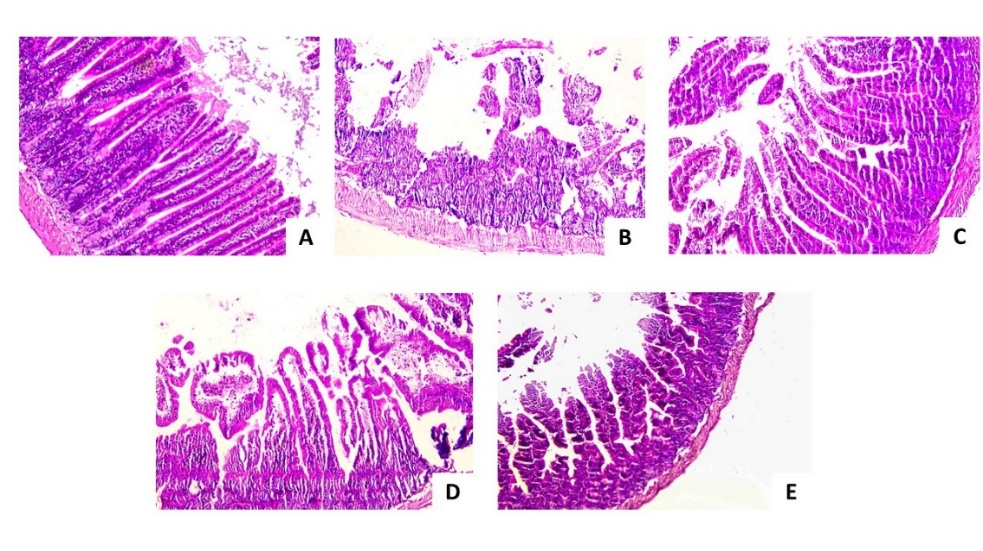
Figure 2 Histological features of small intestine segments stained with hematoxylin and eosin (×100); (A) Normal control, (B) Negative control, (C): Loperamide drug, (D) HETS 50 mg and (E) HETS 100 mg.
The evaluation of oxidative stress markers in intestinal tissues revealed pronounced alterations following castor oil administration and their modulation by loperamide and HETS treatment (Figure 3). Compared with the negative control (NC), the Loperamide (LOP) group exhibited a significant reduction in malondialdehyde (MDA) levels (p < 0.001). Treatment with HETS at 50 and 100 mg/kg further decreased MDA concentrations in a clear dose-dependent manner (p < 0.01 and p < 0.001, respectively) (Figure 3(A)). In parallel, catalase (CAT) activity was significantly increased in the LOP group (p < 0.01) and remained markedly elevated in mice treated with HETS at both doses (p < 0.01 and p < 0.05), although to a slightly lower extent than in the LOP group (Figure 3(B)). By contrast, peroxidase (POD) activity followed a non-linear pattern: While LOP induced a strong increase (p < 0.001), HETS at 50 mg/kg produced the highest POD activity among all groups (p < 0.001), whereas the 100 mg/kg dose led to a significant reduction in POD activity (Figure 3(C)).
These findings suggest that oxidative stress may represent a potential mechanistic contributor to castor oil-induced diarrhea. The elevation of MDA levels, combined with alterations in antioxidant enzyme activities, reflects a disturbed redox balance that may compromise intestinal mucosal integrity and favor tissue damage [52]. The ability of HETS to markedly reduce lipid peroxidation and enhance CAT activity supports the involvement of antioxidant-related mechanisms in its protective effect. The dose-dependent inhibition of MDA further indicates an effective attenuation of oxidative injury at higher extract concentrations. The non-linear response observed for POD activity may be indicative of a hormetic effect, in which moderate doses of plant-derived bioactive compounds optimally stimulate antioxidant enzymes, whereas higher doses trigger regulatory feedback mechanisms, enzyme saturation, or reduced enzymatic demand due to more efficient suppression of oxidative stress. Similar biphasic responses of antioxidant enzymes have been widely reported for phenolic-rich plant extracts, lending support to this interpretation [53].
Taken together, these findings show that HETS effectively counters oxidative imbalance by reducing MDA levels and modulating antioxidant enzymes, suggesting activation of the Nrf2/HO-1 signaling pathway, a central regulator of cellular antioxidant responses. This effect is likely attributable to the extract’s rich polyphenolic profile, particularly rutin, well-known for its potent antioxidant activity [54-56], as well as p-coumaric, vanillic, and ferulic acids, which may act synergistically to neutralize ROS and prevent lipid degradation [42,50,51,57].
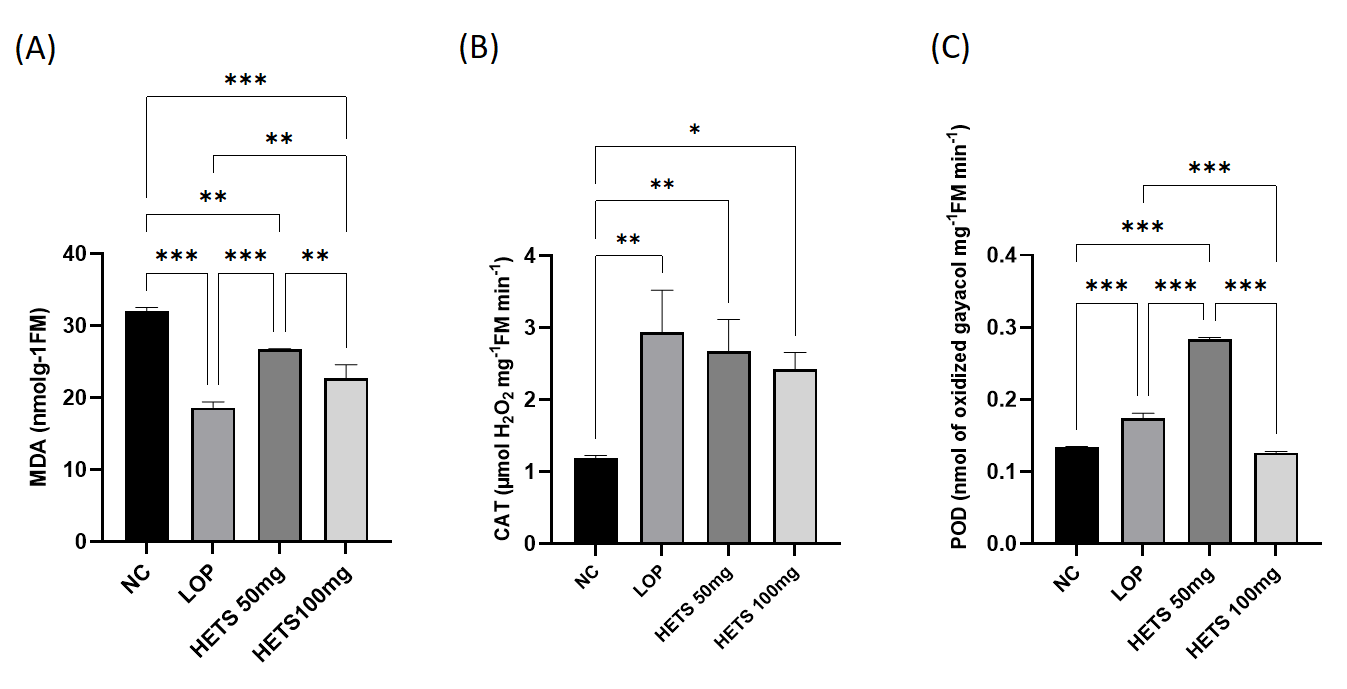
Figure
3
(A) Malondyaldehyde (MDA), (B) Catalase (CAT), and (C) pyroxydase
(POD) levels.
NC:
Negative
control,
LOP: Loperamide
drug, HETS: Hydroethanolic extract of T.Saturejoides. Values
are presented as mean ± SEM, *: p < 0.05; **p
< 0.01; ***: p < 0.001.
In summary, the anti-diarrheal activity of HETS may involve a combination of complementary mechanisms. The observed attenuation of oxidative damage suggests a possible involvement of antioxidant pathways, potentially related to Nrf2/HO-1 activation, while the reduction of inflammatory markers may hypothetically reflect modulation of NF-κB and MAPK signaling. In addition, the regulation of intestinal motility could be partly associated with prostaglandin- and NO-mediated pathways, and the histological findings indicate a protective effect on the intestinal mucosa. Although these mechanistic interpretations remain speculative and were not directly investigated in the present study, the overall findings support the pharmacological relevance of this plant and are consistent with its traditional use in the management of digestive disorders, including diarrhea, particularly in conditions associated with oxidative stress and inflammation.
Conclusions
This research revealed a significant anti-diarrheal activity of HETS possesses, resulting in a dose-dependent inhibition of diarrhea and a reduction in intestinal motility. At the same time, the extract showed an ability to attenuate intestinal oxidative damage by decreasing lipid peroxidation and Reestablishing the activity of antioxidant enzymes. Histological observations also confirmed a marked protective effect on the mucosa, particularly at high doses, with almost complete restoration of intestinal architecture. Overall, these results support the relevance of the traditional use of T. saturejoides in the treatment of gastrointestinal disorders, and pave the way for further investigations aimed at isolating the responsible bioactive compounds and elucidating their precise mechanisms of action. Furthermore, the implementation of a strategy for the conservation and/or domestication of this species’ genetic resources appears strongly justified, in view of its scientific importance and socio-economic potential.
Acknowledgements
We thank the members of the Al-Fadl laboratory (Marrakech, Morocco) for their cooperation in preparing the histological specimens, and Mr. Layachi El-Hadiri, a high school English teacher, for his valuable contribution to improving the English language of the manuscript.
Declaration of Generative AI in Scientific Writing
ChatGPT was employed to perform translation and enhance the linguistic quality of the text. Authors remain fully responsible for the content.
CRediT Author Statement
Mohamed El Hassan Bouchari: Conceptualization; Methodology; Software; Formal analysis; Writing - Original draft preparation. Abdelilah Meddich: Validation; Supervision. Abdeljalil Elmahdaoui: Investigation; Software; Formal analysis. Lansine Diakité: Investigation; Resources. Ridwane Ghanimi: Resources; Validation. Hassan Abd‑Dada: Software; Validation. Zahra Sokar: Validation; Supervision. Abdelmajid Haddioui: Validation; Supervision.
References
A Kumar, D Jayawardena, S Priyamvada, AN Anbazhagan, I Chatterjee, S Saksena and PK Dudeja. SLC26A3 (DRA, the congenital chloride diarrhea gene): A novel therapeutic target for diarrheal diseases. Cellular and Molecular Gastroenterology and Hepatology 2025; 19(6), 101452.
World Health Organization. Diarrhoeal disease, Available at: https://www.who.int/news-room/fact-sheets/detail/diarrhoeal-disease, accessed November 2025.
BS Workneh, EG Mekonen, MS Ali, AT Gonete, MA Techane, M Wassie, AT Kassie, MA Ahmed, SS Tsega and YA Wassie. Recommended homemade fluid utilization for the treatment of diarrhea and associated factors among children under five in sub-Saharan African countries: A multilevel analysis of the recent demographic and health survey. BMC Pediatrics 2024; 24(1), 322.
KI Kassaw, DZ Wondafrash, JS Yesuf and MG Mengistie. Evaluation of the antidiarrheal activity of the 80% hydromethanolic crude extract and solvent fractions of Terminalia brownii Fresen (Combretaceae) leaves in Swiss Albino mice. Frontiers in Pharmacology 2025; 15, 1510171.
L Terefe, A Nardos, A Debella, B Dereje, M Arega, AG Abebe, W Gemechu and S Woldekidan. Antidiarrheal activities of the methanol leaf extracts of Olinia rochetiana (Oliniaceae) against castor oil-induced diarrhea in mice. Journal of Experimental Pharmacology 2023; 15, 485-495.
AIO Noor and EM Terefe. Evaluation of the antidiarrheal activity of dichloromethane-methanol crude extract of the aerial parts of Croton kinondoensis (Euphorbiaceae) in mice. PLoS One 2025; 20(10), e0333527.
A Agour, T Chelouati, M Messkini, O Zouirech, A El Moussaoui, I Mssillou, A Bari and E Derwich. Status of the use of naturalized medicinal plants from the Tata region (southeast of Morocco) in traditional medicine. Tropical Journal of Natural Product Research 2025; 9(3), 1192-1203.
E Stahl-Biskup and F Saez. Thyme: The genus thymus. 1st ed. CRC Press, London, 2002.
A Benabid. Flore et écosystèmes du Maroc: Evaluation et préservation de la biodiversité (in French). Ibis Press, Paris, France, 2000.
M Fennane and M Ibn-Tattou. Flore pratique du Maroc (in French). Vol II. Angiospermae (Leguminosae-Lentibulariaceae). Institut Scientifique, Rabat, Morocco, 2007.
N Chaachouay, A Douira and L Zidane. Herbal medicine used in the treatment of human diseases in the Rif, Northern Morocco. Arabian Journal for Science and Engineering 2022; 47(1), 131-153.
F El-Ghazouani, N El-Ouahmani, I Teixidor-Toneu, B Yacoubi and A Zekhnini. A survey of medicinal plants used in traditional medicine by women and herbalists from the city of Agadir, southwest of Morocco. European Journal of Integrative Medicine 2021; 42, 101284.
J Hayat, A Mustapha, M Abdelmajid, B Mourad, S Ali, E Said and B Saadia. Ethnobotanical survey of medicinal plants growing in the region of “Oulad Daoud Zkhanine” (Nador Province), in Northeastern Morocco. Ethnobotany Research and Applications 2020; 19, 1-12.
EA Fatiha, A Nazha, Z Fouad, B Ouafae, H Maryama and Z Lahcen. Ethnomedicinal evaluation of medicinal plants used against gastrointestinal disorders in the western Middle Atlas region (Morocco). Annual Research & Review in Biology 2018; 28(2), 1-11.
A El Alami, L Farouk and A Chait. Etude ethnobotanique sur les plantes médicinales spontanées poussant dans le versant nord de l’Atlas d’Azilal (Maroc). Algerian Journal of Natural Products 2016; 4(2), 271-282.
S Belhaj and L Zidane. Ethnobotanical and ethnopharmacological study of medicinal plants used for the treatment of diseases of the digestive tract in the High Atlas Central of Morocco (North Africa). Journal of Analytical Sciences and Applied Biotechnology 2021; 3(1), 7-14.
A Elbouzidi, M Taibi, N El Hachlafi, M Haddou, M Jeddi, A Baraich, S Bougrine, RA Mothana, MF Hawwal and W Alobaid. Optimization of the antibacterial activity of a three-component essential oil mixture from Moroccan Thymus satureioides, Lavandula angustifolia, and Origanum majorana using a simplex–centroid design. Pharmaceuticals 2025; 18(1), 57.
KO Taarabt, R Ouaabou, R Lahlali and S Ennahli. Antimicrobial activity and chemical constitution of essential oil from Moroccan thyme (Thymus satureioides C.) on five microbial contaminants. Notulae Scientia Biologicae 2021; 13(3), 10975.
L El-Bouzidi, H Ouchtiti, W Ben-Bakrim, K Benbnidak, A Mounir, A Khadra, A El-Abbassi and K Bekkouche. Cytogenotoxicity assessment of the essential oils from aerial parts of Thymus pallidus Batt, Thymus satureioides Cosson, and Thymus broussonnetii Boiss. Journal of Essential Oil Bearing Plants 2025; 28(3), 579-590.
M Chraibi, M Fadil, A Farah, N Benkhaira, S Lebrazi and K Fikri-Benbrahim. Simplex-centroid design as innovative approach in the optimization of antimicrobial effect of Thymus satureioides, Myrtus communis and Artemisia herba alba essential oils against Escherichia coli, Staphylococcus aureus and Candida tropicalis. Experimental Parasitology 2023; 247, 108472.
EM Zahraoui, SA Ababou, B Ababou and K Boukachabine. Anticandidal activity of two essential oils from Morocco: Thymus satureioides and Mentha pulegium L. Romanian Journal of Biology - Plant Biology 2024; 69(1-2), 39-52.
A Outourakhte, Y Gharnit, A Moujane, K El Haddany, A Hasib and A Boulli. The floristic composition and phytoecological characterization of plant communities in the M’Goun Geopark, High Atlas, Morocco. Ecologies 2025; 6(2), 29.
A Tikent, S Laaraj, T Bouddine, M Chebaibi, M Bouhrim, K Elfazazi, AS Alqahtani, OM Noman, L Hajji and L Rhazi. Antioxidant potential, antimicrobial activity, polyphenol profile analysis, and cytotoxicity against breast cancer cell lines of hydro-ethanolic extracts of leaves of (Ficus carica L.) from Eastern Morocco. Frontiers in Chemistry 2024; 12, 1505473.
T Khouya, M Ramchoun, A Hmidani, S Amrani, H Harnafi, M Benlyas, YF Zegzouti, EH Nazih, K Ouguerram and C Alem. Acute toxicity and antiproliferative and procoagulant activities of fractions derived from Thymus satureioides of the Moroccan High Atlas. South African Journal of Botany 2019; 121, 568-576.
K Elhabazi, A Ouacherif, A Laroubi, R Aboufatima, A Abbad, A Benharref, A Zyad, A Chait and A Dalal. Analgesic activity of three thyme species, Thymus satureioides, Thymus maroccanus and Thymus leptobotrys. African Journal of Microbiology Research 2008; 2(10), 262-267.
F Awouters, CJE Niemegeers, FM Lenaerts and PAJ Janssen. Delay of castor oil diarrhoea in rats: A new way to evaluate inhibitors of prostaglandin biosynthesis. Journal of Pharmacy and Pharmacology 1978; 30(1), 41-45.
F Capasso, N Mascolo, G Autore and V Romano. Laxatives and the production of autacoids by rat colon. Journal of Pharmacy and Pharmacology 1986; 38(8), 627-629.
VSN Rao, FA Santos, TT Sobreira, MF Souza, CL Melo and ER Silveira. Investigations on the gastroprotective and antidiarrhoeal properties of ternatin, a tetramethoxyflavone from Egletes viscosa. Planta Medica 1997; 63(2), 146-149.
S Afroz, M Alamgir, MTH Khan, S Jabbar, N Nahar and MSK Choudhuri. Antidiarrhoeal activity of the ethanol extract of Paederia foetida Linn. (Rubiaceae). Journal of Ethnopharmacology 2006; 105(1-2), 125-130.
A Than, HJ Kulkarni, W Hmone and SJ Tha. Anti-diarrhoeal efficacy of some Burmese indigenous drug formulations in experimental diarrhoeal test models. International Journal of Crude Drug Research 1989; 27(4), 195-200.
KM Rao and TVS Sresty. Antioxidative parameters in the seedlings of pigeonpea (Cajanus cajan (L.) Millspaugh) in response to Zn and Ni stresses. Plant Science 2000; 157(1), 113-128.
B Chance and AC Maehly. Assay of catalases and peroxidases. Methods in Enzymology 1955; 2, 764-775.
T Khouya, M Ramchoun, A Hmidani, S Amrani, H Harnafi, M Benlyas, YF Zegzouti and C Alem. Anti-inflammatory, anticoagulant and antioxidant effects of aqueous extracts from Moroccan thyme varieties. Asian Pacific Journal of Tropical Biomedicine 2015; 5(8), 636-644.
J Rutkowska, M Godlewska, A Antoniewska-Krzeska and A Nawirska-Olszańska. Phenolic composition, volatile profile, and in vitro antioxidative potential of hydroethanolic flower extracts of Sambucus nigra L. as a valuable food ingredient. NFS Journal 2025; 41, 100248.
Mamoona, S Nosheen, S Riaz, SI Shah and S Shahid. Optimizing extraction methods: The role of solvent polarity in enhancing phenolic content and antioxidant activity in biowaste. Biomass Conversion and Biorefinery 2025; 15(11), 16721-16736.
M Tzanova, V Atanasov, Z Yaneva, D Ivanova and T Dinev. Selectivity of current extraction techniques for flavonoids from plant materials. Processes 2020; 8(10), 1222.
N Balasundram, K Sundram and S Samman. Phenolic compounds in plants and agri-industrial by-products: Antioxidant activity, occurrence, and potential uses. Food Chemistry 2006; 99(1), 191-203.
LDS Fideles, JALD Miranda, CDS Martins, MLL Barbosa, HB Pimenta, PVDS Pimentel, CS Teixeira, MAS Scafuri, SDO Façanha, JEF Barreto, PMDM Carvalho, AG Scafuri, JL Araújo, JA Rocha, IGP Vieira, NMPS Ricardo, MDS Campelo, MENP Ribeiro, GADC Brito and GS Cerqueira. Role of rutin in 5-fluorouracil-induced intestinal mucositis: Prevention of histological damage and reduction of inflammation and oxidative stress. Molecules 2020; 25(12), 2786.
SR Akash, A Tabassum, LM Aditee, A Rahman, MI Hossain, MA Hannan and MJ Uddin. Pharmacological insight of rutin as a potential candidate against peptic ulcer. Biomedicine & Pharmacotherapy 2024; 177, 116961.
S Roychoudhury, B Sinha, BP Choudhury, NK Jha, P Palit, S Kundu, SC Mandal, A Kolesarova, MI Yousef, J Ruokolainen, P Slama and KK Kesari. Scavenging properties of plant-derived natural biomolecule para-coumaric acid in the prevention of oxidative stress-induced diseases. Antioxidants 2021; 10(8), 1205.
ZY Wang, Y Yin, DN Li, DY Zhao and JQ Huang. Biological activities of p-hydroxycinnamic acids in maintaining gut barrier integrity and function. Foods 2023; 12(13), 2636.
A Magiera, J Kołodziejczyk-Czepas and MA Olszewska. Antioxidant and anti-inflammatory effects of vanillic acid in human plasma, human neutrophils, and non-cellular models in vitro. Molecules 2025; 30(3), 467.
S Arabacı Tamer, GG Eskiler and F Ercan. Gastroprotective effect of vanillic acid against ethanol-induced gastric injury in rats: Involvement of the NF-κB signalling and anti-apoptosis role. Molecular Biology Reports 2024; 51(1), 744.
HJ Hwang, SR Lee, JG Yoon, HR Moon, J Zhang, E Park, SI Yoon and JA Cho. Ferulic acid as a protective antioxidant of human intestinal epithelial cells. Antioxidants 2022; 11(8), 1448.
R Hu, S Wu, B Li, J Tan, J Yan, Y Wang, Z Tang, M Liu, C Fu, H Zhang and J He. Dietary ferulic acid and vanillic acid on inflammation, gut barrier function and growth performance in lipopolysaccharide-challenged piglets. Animal Nutrition 2022; 8, 144-152.
S Kiokias and V Oreopoulou. A review of the health protective effects of phenolic acids against a range of severe pathologic conditions (including coronavirus-based infections). Molecules 2021; 26(17), 5405.
L Beyi, M Aziz, H Makrane, A Karim, M Bnouham and A Ziyyat. Antidiarrheal activity of Thymus algeriensis Boiss. and Reut. aqueous extract on rats and mice. International Journal of Pharmacy and Pharmaceutical Sciences 2015; 7(3), 292-294.
S Tunaru, TF Althoff, RM Nüsing, M Diener and S Offermanns. Castor oil induces laxation and uterus contraction via ricinoleic acid activating prostaglandin EP3 receptors. Proceedings of the National Academy of Sciences 2012; 109(23), 9179-9184.
F Forouzanfar, T Sahranavard, A Tsatsakis, M Iranshahi and R Rezaee. Rutin: A pain-relieving flavonoid. Inflammopharmacology 2025; 33(3), 1289-1301.
M Moradi, Y Farbood, SA Mard, M Dianat, G Goudarzi, L Khorsandi and SS Seyedian. p-Coumaric acid has pure anti-inflammatory characteristics against hepatopathy caused by ischemia-reperfusion in the liver and dust exposure. Iranian Journal of Basic Medical Sciences 2023; 26(2), 164-171.
MG Dilshara, KT Lee, RGPT Jayasooriya, CH Kang, SR Park, YH Choi, IW Choi, JW Hyun, WY Chang, YS Kim, HJ Lee and GY Kim. Downregulation of NO and PGE2 in LPS-stimulated BV2 microglial cells by trans-isoferulic acid via suppression of PI3K/Akt-dependent NF-κB and activation of Nrf2-mediated HO-1. International Immunopharmacology 2014; 18(1), 203-211.
T Zhou, D Long, M Zhou, X Hu, Y Wang and X Wang. Pickle water ameliorates castor oil-induced diarrhea in mice by regulating the homeostasis of the gut microbiota and intestinal mucosal barrier. Frontiers in Nutrition 2024; 11, 1455091.
A Ignjatijević, T Anđić, M Lješević, B Nikolić, T Ganić, S Spasović and S Vuletić. Assessment of antioxidant activity and dose-dependent effect on genotoxicity/antigenotoxicity of Pulmonaria officinalis ethanolic extract. Pharmaceutics 2025; 17(9), 1134.
D Zielińska, M Starowicz, M Wronkowska and H Zieliński. Multifaceted biological activity of rutin, quercetin, and quercetin’s glucosides. Molecules 2025; 30(12), 2555.
VS Gautam, P Kumari, PK Jaiswara, A Kumar and RN Kharwar. Antioxidant and cytotoxic activity of rutin isolated from Nigrospora sphaerica, an Euphorbia hirta based endophytic fungus. Process Biochemistry 2024; 142, 184-193.
A Sharma, NV Tirpude, M Kumari and Y Padwad. Rutin prevents inflammation-associated colon damage via inhibiting the p38/MAPKAPK2 and PI3K/Akt/GSK3β/NF-κB signalling axes and enhancing splenic Tregs in DSS-induced murine chronic colitis. Food & Function 2021; 12(18), 8492-8506.
AS Ingole, MP Kadam, AP Dalu, SM Kute, PR Mange, VD Theng, OR Lahane, AP Nikas, YV Kawal, SU Nagrik and PA Patil. A review of the pharmacological characteristics of vanillic acid. Journal of Drug Delivery and Therapeutics 2021; 11(2-S), 200-204.