
Trends
Sci.
2026;
23(9):
13281
Immunological Consequences of Triploidy in Penaeus monodon: Evidence from Cellular and Humoral Effectors
Jareeporn Ruangsri1,*, Pattira Pongtippatee1,
Saowanit Poolpearbprom2 and Sunee Wanlem3
1Advanced Institute for Food Security, Prince of Songkla University, Surat Thani 84110, Thailand
2Innovative Fisheries Program, Faculty of Innovative Agriculture, Fisheries and Food,
Prince of Songkla University, Surat Thani Campus, Surat Thani 84000, Thailand
3Faculty of Veterinary Science, Prince of Songkla University, Songkhla 90110, Thailand
(*Corresponding author’s e-mail: [email protected])
Received: 7 January 2026, Revised: 19 February 2026, Accepted: 26 February 2026, Published: 10 April 2026
Abstract
Triploidization has been applied in aquaculture to enhance growth performance and production stability; however, its implications for immune competence in penaeid shrimp remain poorly understood. This study compared growth performance, hemocyte dynamics, and innate immune responses between diploid (2n) and triploid (3n) Penaeus monodon across 2 independent trials. Triploid shrimp consistently exhibited 30% - 40% greater body weight than diploids, indicating enhanced somatic growth. Despite this advantage, triploid shrimp displayed reduced total hemocyte counts, with a modest decrease of approximately 9% in Trial 1 and a pronounced reduction of 41.49% in Trial 2. These changes were accompanied by marked alterations in hemocyte composition, characterized by lower proportions of hyaline cells and increased proportions of semi-granular and granular hemocytes. Concurrently, hemocyte size increased significantly in triploids across all cell types, with cell areas enlarged by approximately 1.3 - 1.9-fold, indicating compensatory cellular hypertrophy. Collectively, these cellular patterns support immune reorganization rather than proportional numerical scaling following genome duplication. At the functional level, triploid shrimp exhibited altered humoral and enzymatic immune profiles, including phenoloxidase-related activities, consistent with compensatory immune regulation. Molecular analyses further revealed trial- and tissue-dependent modulation of immune-related genes, including ppae1 and crus, suggesting context-dependent transcriptional responses rather than constitutive immune upregulation. Overall, these findings demonstrate that triploid P. monodon maintains immune competence through coordinated cellular and molecular compensation despite reduced hemocyte abundance, highlighting triploidization as a promising strategy to enhance growth performance without compromising innate immunity, thereby supporting its potential application in sustainable shrimp aquaculture.
Keywords: Penaeus monodon, Black tiger shrimp, Triploid, Diploid, Cellular responses, Innate immunity
Introduction
Triploid induction has been increasingly applied in aquaculture to enhance growth performance and yield stability [1,2]. In penaeid shrimps, triploidy is associated with enhanced somatic growth and distinct physiological alterations [3-5]. Evidence indicates that triploid Penaeus monodon of both sexes develop incomplete germ cells, resulting in functional sterility
[6]. Collectively, these traits are advantageous for aquaculture, as improved somatic growth and reproductive impairment promote greater energy allocation towards biomass production, enhance production efficiency, and reduce biosafety risks by limiting uncontrolled reproduction and genetic introgression into wild populations. However, the implications of triploidy for immune competence remain poorly understood. This knowledge gap is critical, as innate immune robustness is a key determinant of shrimp survival under intensive culture conditions and high disease pressure.
Crustacean innate immunity relies primarily on circulating hemocytes and associated humoral factors, including the prophenoloxidase (proPO) system, antimicrobial peptides, respiratory burst activity, and immune-related enzymes [7-9]. Hemocytes—classified as hyaline, semi-granular, and granular cells—mediate complementary immune functions such as phagocytosis, encapsulation, melanization, and pathogen killing [10,11], and alterations in their abundance or functionality can markedly influence disease resistance [12,13]. At the molecular level, immune regulation is mediated by key effector genes. Prophenoloxidase-activating enzyme 1 (ppae1) is a central serine protease of the proPO cascade that catalyzes the activation of phenoloxidase, thereby driving melanization and pathogen encapsulation; variation in ppae1 expression reflects functional modulation of immune responses rather than constitutive immune enhancement [7, 8,14]. In parallel, crustins (crus), a family of cysteine-rich antimicrobial peptides predominantly expressed in hemocytes, contribute to direct pathogen killing and immune homeostasis, with expression patterns that are highly context-dependent and responsive to physiological and environmental cues [15,16]
Functional immune status is further reflected by enzyme activities such as alkaline phosphatase, peroxinectin, and lysozyme, as well as integrated bactericidal activity assays, which collectively capture both cellular and humoral immune performance. Alkaline phosphatase is a lysosomal and membrane-associated enzyme involved in dephosphorylation processes linked to hemocyte activation, phagocytosis, and pathogen clearance, and its activity is often correlated with immune status and stress resilience in penaeid shrimps [17]. Peroxinectin, a hemocyte-derived peroxidase functionally analogous to mammalian myeloperoxidase, plays a central role in cell adhesion, encapsulation, and the generation of reactive intermediates during pathogen killing [10,18,19]. Lysozyme is a conserved antimicrobial enzyme in hemocytes and plasma that hydrolyses bacterial peptidoglycan and, in addition to its immune role, is associated with improved growth rate, intestinal health, and disease resistance in shrimp [20,21]. Finally, bactericidal activity assays integrate multiple humoral and cellular mechanisms, including enzyme activity, antimicrobial peptides, and reactive oxygen species, providing a holistic measure of immune competence in crustaceans [18,22].
Although ploidy-associated alterations in hematological and immune traits have been documented in triploid fishes [23-25] and some oysters [26,27], equivalent evidence in crustaceans is extremely limited. For instance, triploid Fenneropenaeus chinensis has very few, large hemocytes compared to diploids [28]. To date, no comprehensive evaluation of hemocyte composition, immune enzyme activity, and immune gene expression has been reported for triploid P. monodon. Addressing this gap is essential to assess whether triploidization compromises or enhances immune defenses in this economically important species. This study aimed to test the hypothesis that triploid induction alters hemato-immunological architecture in P. monodon, leading to functional compensation via enlarged hemocytes and enhanced immune activities rather than numerical equivalence. To this end, we compared hemocyte profiles, immune enzyme activities, respiratory burst responses, and immune-related gene expression between diploid and triploid shrimps under controlled experimental conditions.
Materials and methods
Triploid induction and rearing
Triploid (3n) Penaeus monodon juveniles were produced using a validated cold-shock induction protocol for penaeid shrimps [4]. After reaching the post-larval stage (PL-15), triploid shrimp were reared in a 113-ton circular polyethylene pond under a biofloc system at the Advanced Institute for Food Security (AIFS), Prince of Songkla University, Chaiya District, Surat Thani, Thailand. Diploid (2n) shrimp, derived from the same egg batch without cold shock, were cultured in the same pond as controls. Water quality was maintained within optimal ranges: salinity 20 ppt, pH 8.2 - 8.5, alkalinity 120 - 150 mg L⁻¹, dissolved oxygen > 5 mg L⁻¹, and ammonia-N and nitrite-N < 0.5 mg L⁻¹. Shrimp were fed a commercial pellet diet (Star Feed, Charoen Pokphand, Thailand) at 10% of biomass during the first month, 5% during the second month, and approximately 3% thereafter for a total rearing period of approximately 6 months, until mean body weights reached 35 - 40 g for diploids (2n) and 55 - 60 g for triploids (3n) prior to sampling.
Two independent trials were conducted in different years to assess the reproducibility of growth and immune responses; data were not statistically compared between trials. As continuous temperature records were unavailable, both trials were conducted under routine farm and hatchery management conditions. No abnormal environmental fluctuations or disease outbreaks were observed during either trial. In Trial 1, prior to sampling diploid and triploid shrimp were transferred to 250-L polyethylene tanks (200 L seawater; 4 tanks per ploidy, 5 shrimp per tank) at the PSU Aquaculture Unit, Surat Thani Campus, and acclimated for one week under identical conditions without biofloc, with a 50% daily water exchange. In Trial 2, hemolymph and gill samples were collected directly from shrimp at the rearing pond.
Hemolymph sampling and ploidy confirmation
Shrimp were anaesthetized in ice-cold seawater (~10 - 15 °C), weighed, and hemolymph was aseptically collected using a 1 mL syringe fitted with a 23G needle. Approximately 500 µL hemolymph was immediately mixed 1:1 with chilled shrimp salt solution (SSS; 450 mM NaCl, 10 mM KCl, 10 mM EDTA, 10 mM HEPES) as anticoagulant and kept on ice for immediate cellular and immune analyses. An additional 500 µL hemolymph was collected without anticoagulant and allowed to clot on ice. Ploidy status was confirmed by flow cytometric analysis of hemocyte DNA content following established protocols [4].
Hemocyte profiling and cellular immune analyses
Hemolymph samples collected with anticoagulants were used to examine the hemocyte profile and cellular immune parameters. Total hemocyte count (THC) was determined using a hemocytometer after dilution in trypan blue solution. Differential hemocyte count (DHC) was assessed following Rose Bengal staining, classifying cells as hyaline, semi-granular, or large-granular cells [29]. Cell size was quantified from micrographs using ImageJ image analysis software. Phenoloxidase (PO) activity was measured in hemocyte lysate supernatants via L-DOPA oxidation, following the established modified method [30] and normalized to protein content determined by the Bradford assay [31]. Respiratory burst activity was quantified as superoxide anion (O₂⁻) production using the NBT reduction assay [32], expressed as spontaneous and zymosan-stimulated responses. Respiratory burst was assessed using samples from Trial 1 only.
Humoral and enzymatic immune parameters
Prior to analysis, serum sample from each shrimp was prepared from anticoagulant-free hemolymph by homogenization followed by centrifugation at 10,000×g for 15 min at 4 °C. Alkaline phosphatase and peroxinectin (equivalent to human myeloperoxidase) were assayed in duplicate as per the procedure described in Withyachumnarnkul et al. [33]. Lysozyme activity against Micrococcus lysodeikticus cell wall (ATCC 4698; Sigma-Aldrich, USA) was determined by spectrophotometrically following established microplate assays [30]. Bactericidal activity against Vibrio harveyi, a pathogenic strain affecting marine shrimp was assessed using an MTT assay [34].
Immune gene expression analysis
To assess molecular immune responses, the expressions of prophenoloxidase-activating enzyme 1 (ppae1) and crustin (crus) were quantified in hemolymph and gill tissues. Approximately 100 mg of hemolymph and gill samples were collected from each shrimp (N = 8 per group per trial), immediately preserved in TRIzol reagent, and snap-frozen in liquid N2. Total RNA was extracted and reverse-transcribed into cDNA using a commercial kit (QuantiTect RT Kit, Qiagen, USA) following the protocol of Fernandes et al. [35]. Gene expression was analyzed by quantitative real-time PCR (qPCR) using a CFX96 Touch Real-Time PCR System (Bio-Rad, USA) with KAPA SYBR® Fast qPCR Master Mix (Merck KGaA, Germany) and validated primers (Table 1). Amplification specificity and efficiency were verified by melting-curve analysis and standard-curve construction, respectively [36]. Relative transcript levels were normalized against elongation factor 1-alpha (ef1α) and β-actin using the geometric mean method described by Vandesompele et al. [37].
Table 1 Primer sequences, target genes, and amplicon sizes used for quantitative real-time PCR (qPCR) analysis of differential gene expression between triploid and diploid Penaeus monodon.
Gene |
Primer sequence (5’3) |
Amplicon size (bp) |
PCR efficiency (%) |
References |
ppae1 F ppae1 R |
AAGAAGAGGGAGCCCCAGCAAC TTACTCCTCCTCCCTGTCCAAG |
184 |
92.7 |
Charoensapsri et al. [14] |
crus F crus R |
ACTGCTGCGAGTCAAGGTAT TGCAAGAAAACGTACCGGTG |
101 |
105 |
FJ686014* |
elf1a F elf1a R |
GGTGCTGGACAAGCTGAAGGC CGTTCCGGTGATCATGTTCTTGATG |
150 |
94 |
Charoensapsri et al. [14] |
β-actin F β-actin R |
GAAGCTGTGCTACGTGGCTCTG GAACCTCTCGTTGCCGATGGTG |
124 |
96 |
* GenBank accession number.
Statistical analysis
Data were analyzed using GraphPad Prism 5 (GraphPad Software Inc., USA) and are presented as mean ± SD. Normality and homogeneity of variance were assessed using the Kolmogorov-Smirnov and F-tests, respectively. Group differences were evaluated using a 2-tailed t-test, with significance set at p < 0.05.
Ethical issues
All procedures involving shrimp collection, handling, and sampling were carried out in a manner designed to minimize stress, in accordance with established ethical principles for the care and use of aquatic animals in research. The experimental protocol was reviewed and approved by the Institutional Animal Care and Use Committee of Prince of Songkla University, Thailand (Approval No. Ref. 79/2021).
Results and discussion
Growth performance
Across 2 independent trials, triploid shrimp consistently exhibited significantly greater body weight (approximately 30% - 40%) than diploids (Figure 1). In Trial 1, triploids reached 50.44 ± 13.19 g compared with 38.76 ± 6.48 g in diploids (p < 0.05), a pattern reproduced in Trial 2 (57.25 ± 7.80 g vs. 41.33 ± 4.48 g; p < 0.01). The reproducibility of this response across trials indicates a robust ploidy-dependent growth advantage rather than trial-specific variability. Enhanced growth in triploids is commonly attributed to altered energy allocation, including reduced investment in gonadal development and increased somatic growth efficiency, as previously reported in penaeid shrimps [4,6,39]. Given these pronounced size differences, subsequent hematological and immune parameters should be interpreted within the context of ploidy-associated physiological scaling.
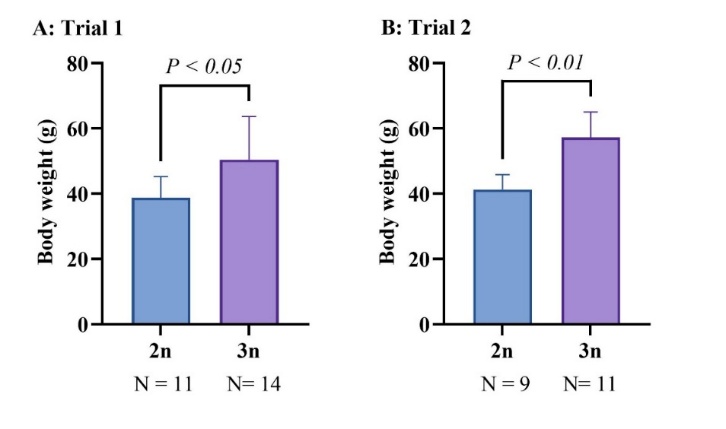
Figure 1 Body weights (g, mean ± SD) of diploid (2n) and triploid (3n) Penaeus monodon in Trial 1 (A) and Trial 2 (B). Sample sizes for each group are shown below the panels. Significant differences between ploidy groups were called when p < 0.05.
Hemocyte dynamics and cellular compensation
Triploid induction markedly altered the hemato-immunological architecture of P. monodon, supporting immune reorganization rather than proportional numerical scaling of hemocytes (Figure 2). Total hemocyte counts (THCs) showed a modest, non-significant reduction (~9%) in Trial 1, but a pronounced reduction of 41.49% in Trial 2 (Figures 2(A) and 2(B)). Notably, this decline was consistently accompanied by shifts in hemocyte composition, characterized by reduced proportions of hyaline cells and increased proportions of semi-granular and granular hemocytes across both trials (Figures 3(A) and 3(B)). Concurrently, hemocyte size increased significantly in triploid shrimp across all cell types, with the most pronounced enlargement observed in hyaline (1.27 - 1.49-fold), semi-granular (1.47 - 1.63-fold), and granular hemocytes (1.72 - 1.89-fold) (Figures 3(C) and 3(D)). Such increases in cell size are consistent with genome-dosage effects associated with polyploidy, which commonly result in fewer but larger cells and compensatory tissue-level restructuring rather than functional loss [40,41].
Given that granular hemocytes are primary mediators of the prophenoloxidase system, melanization, and antimicrobial responses in shrimp [7,9], the observed compositional shifts towards larger semi-granular and granular populations suggest qualitative immune rebalancing that may compensate for reduced hemocyte abundance and help preserve baseline immune competence in triploid shrimp. Granular hemocytes in triploid shrimp also exhibited altered morphology (Figure 3(E)), indicating qualitative as well as quantitative cellular changes. Although light micrographs were obtained at moderate resolution, consistent enlargement and morphological alterations of semi-granular and large granular hemocytes were repeatedly observed, corroborating the quantitative analyses of hemocyte size and immune parameters. While hemocyte morphology in triploid invertebrates remains poorly characterized, comparable cellular irregularities have been reported in triploid fishes, where enlarged or atypical erythrocytes and leukocytes do not necessarily impair innate immune functions such as phagocytosis or respiratory burst activity [42-44]. Similar hemocyte enlargement has also been reported in triploid F. chinensis and other triploid aquatic species without evidence of compromised innate immunity [24,28,45]. Collectively, these patterns likely reflect increased nuclear DNA content following genome duplication and represent a compensatory mechanism that preserves total immune cell biomass and intracellular immune capacity despite reduced cell numbers [4,39].
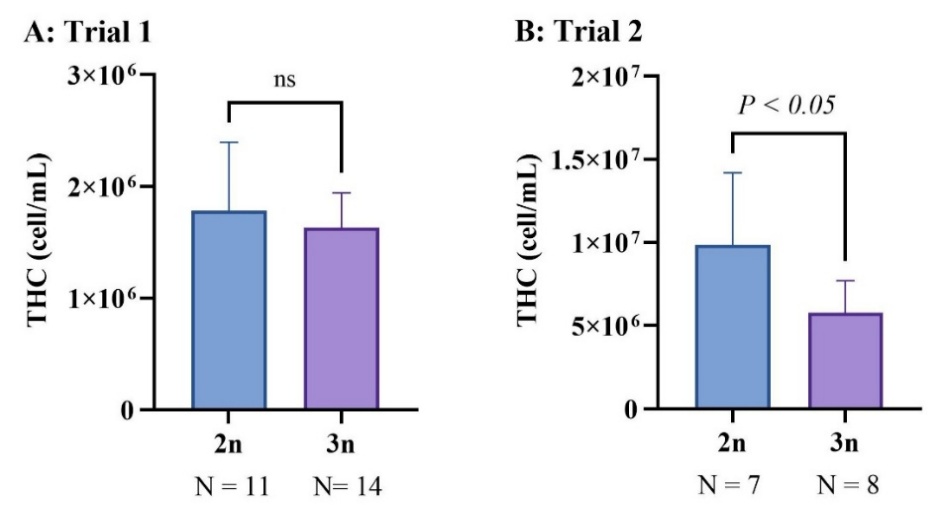
Figure 2 Total hemocyte counts (THC, mean ± SD) of diploid (2n) and triploid (3n) Penaeus monodon in Trial 1 (A) and Trial 2 (B). Sample sizes for each group are shown below the panels. Significant differences between ploidy groups were called when p < 0.05; ns denotes no significant difference.
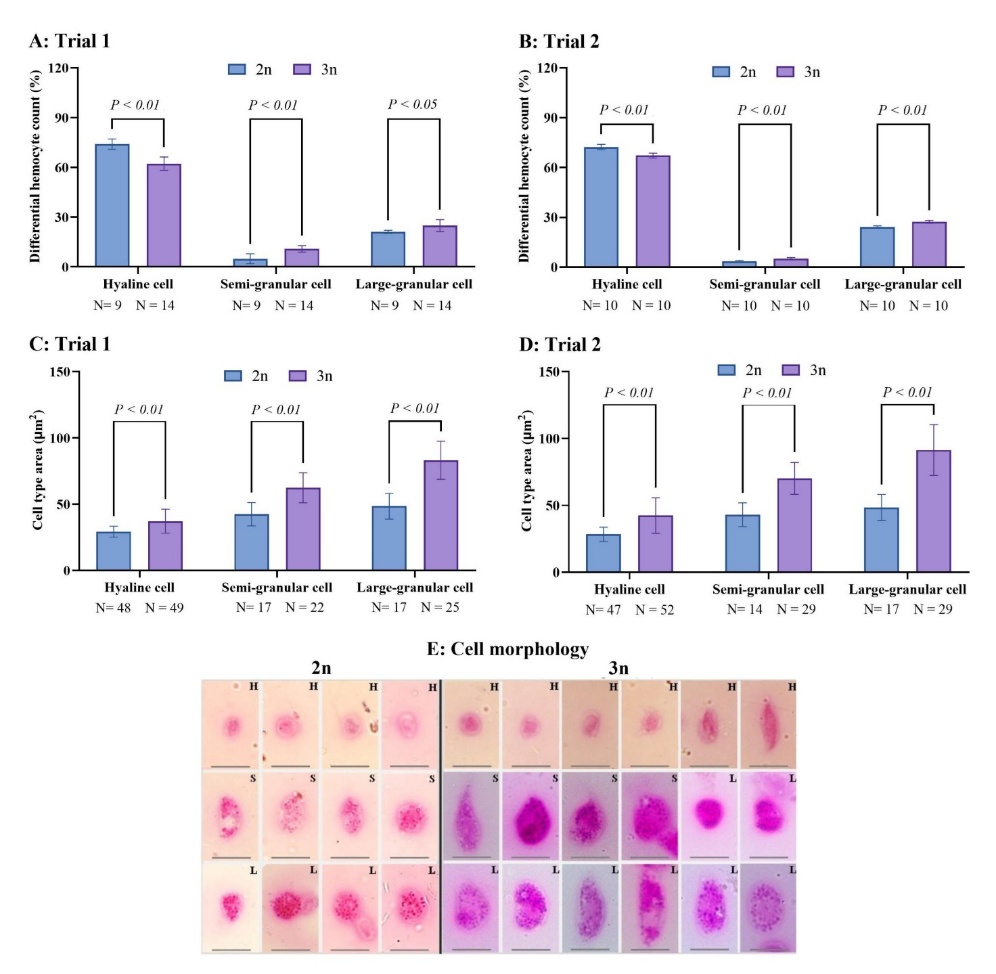
Figure 3 Hemocyte profiles and morphological characteristics of diploid (2n) and triploid (3n) Penaeus monodon. (A), (B) Differential hemocyte counts (DHC) in Trial 1 and Trial 2, respectively. (C), (D) comparison of hemocyte-type surface areas in Trial 1 and Trial 2. (E) Representative light micrographs illustrating the morphology of 3 major hemocyte types: Hyaline cells (H), semi-granular cells (S), and large granular cells (L). The images illustrate relative differences in cell size and shape between ploidy groups under identical light-microscopy and staining conditions and are presented for qualitative comparison. Sample sizes for each group are indicated beneath the panels. Statistical significance between ploidy groups was determined at p < 0.05. Scale bar = 10 µm.
Humoral and enzymatic immune responses
Triploid shrimp exhibited higher total PO activity, with a statistically significant increase detected in Trial 2 (Figure 4). This pattern corresponds to the increased proportion and size of granular and semi-granular hemocytes, the primary cellular reservoirs of the proPO system, supporting enhanced melanization potential [8,46]. Elevated PO activity has been associated with improved resistance to V. harveyi and WSSV in P. monodon, highlighting its functional relevance [14, 47]. Basal superoxide production did not differ between ploidy groups; however, zymosan-stimulated respiratory burst activity was significantly higher in triploid hemocytes, indicating preserved and potentially enhanced inducible immune responsiveness. Similar compensatory increases in respiratory burst activity have been reported in triploid fishes and may offset reduced immune cell abundance [43,48]. In contrast, alkaline phosphatase, peroxinectin, lysozyme, and bactericidal activities did not differ significantly between diploid and triploid shrimp across trials (Table 2), indicating that basal humoral and hemocyte-associated immune functions remain conserved under non-challenged conditions. These findings contrast with reports of altered immune or hematological traits in some triploid fishes [23,24], but align with limited crustacean evidence indicating that triploidy does not necessarily impair immune enzyme activity [28]. Collectively, these results suggest selective enhancement of inducible cellular defenses, rather than global immune upregulation, consistent with an immune compensation strategy that balances responsiveness with metabolic efficiency.
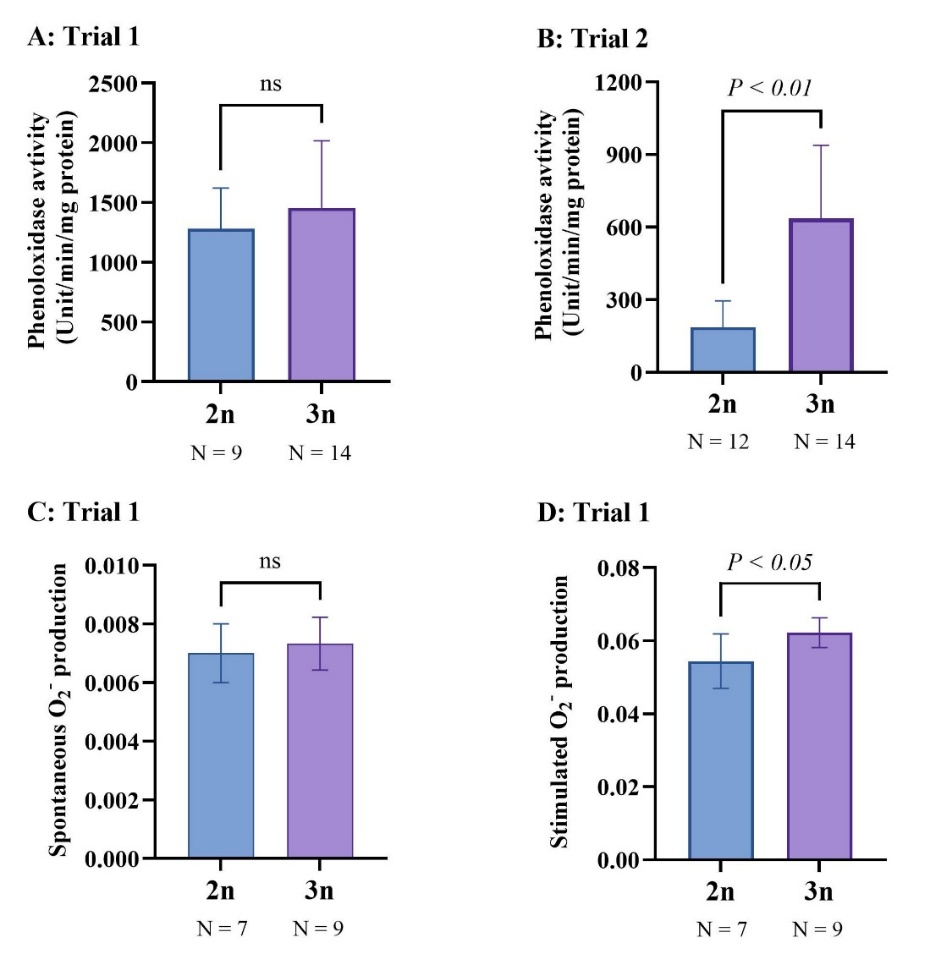
Figure 4 Phenoloxidase (PO) activities (A, Trial 1; B, Trial 2) and respiratory burst activities (Trial 1) in hemocytes of diploid (2n) and triploid (3n) Penaeus monodon, including spontaneous superoxide (O₂⁻) production (C) and zymosan-stimulated O₂⁻ production (D). Sample sizes for each group are indicated beneath the panels. Statistical significance between ploidy groups was called when p < 0.05; ns denotes no significant difference.
Table 2 Alkaline phosphatase, peroxinectin, lysozyme activity, and bactericidal activity (mean ± SD) in the serum of diploid (2n) and triploid (3n) Penaeus monodon.
Assayed quantity |
Trial 1 |
Trial 2 |
||
Diploid (2n) |
Triploid (3n) |
Diploid (2n) |
Triploid (3n) |
|
Alkaline phosphatase (OD405) |
0.52 ± 0.09ns (8) |
0.56 ± 0.08ns (10) |
0.46 ± 0.07ns (9) |
0.43 ± 0.05ns (11) |
Peroxinectin (Stimulation index) |
1.84 ± 0.58ns (10) |
1.94 ± 0.26ns (9) |
1.91 ± 0.25ns (11) |
|
Lysozyme activity (Unit mL−1) |
155.0 ± 86.68ns (8) |
137.78 ± 118.5ns (10) |
371.56 ± 261.61ns (9) |
324.0 ± 165.70ns (10) |
Bactericidal activity (%) |
26.75 ± 2.30ns (9) |
24.92 ± 2.54ns (10) |
27.21 ± 4.30ns (9) |
26.12 ± 5.20ns (11) |
ns indicates no statistically significant difference between groups within the same experiment. Sample sizes are shown in parentheses.
Gene expression patterns related to innate immunity
Triploid shrimp exhibited higher transcript levels of ppae1 in hemolymph and gill tissues, although statistical significance was detected only in hemolymph during Trial 1 (Figure 5). Upregulation of ppae1, a key serine protease activating the proPO cascade, aligns with the observed enhancement of PO activity and inducible cellular immune responses [7,8]. The trial-dependent nature of this response may reflect seasonal or contextual immune modulation associated with pre-sampling conditions between the 2 trials, rather than constitutive immune upregulation following genome duplication. Previous studies have demonstrated that environmental factors such as culture system, temperature fluctuations, and stressors can significantly influence immune gene expression in shrimp [49]. Similarly, crus expression was elevated in the hemolymph of triploid shrimp, with a significant increase observed in Trial 2, indicating preserved or enhanced antimicrobial preparedness. Crustins are cationic antimicrobial peptides involved in defence against Gram-positive and Gram-negative bacteria and the microsporidian fungi, Enterocytozoon hepatopenaei [15,16]. In contrast, crus expression in gill tissue did not differ between ploidy groups, consistent with reports of minimal crustin expression in gills under both normal and ammonia-stressed conditions [50]. This tissue-specific regulation likely reflects the multifunctional role of gills in respiration and osmoregulation, where excessive immune activation may impose physiological costs [50,51]. Overall, gene expression patterns mirrored enzymatic and cellular immune data, supporting a model of selective immune investment in triploid P. monodon, whereby inducible immune pathways are preferentially enhanced in circulating hemocytes while mucosal tissues maintain tightly regulated basal immunity.
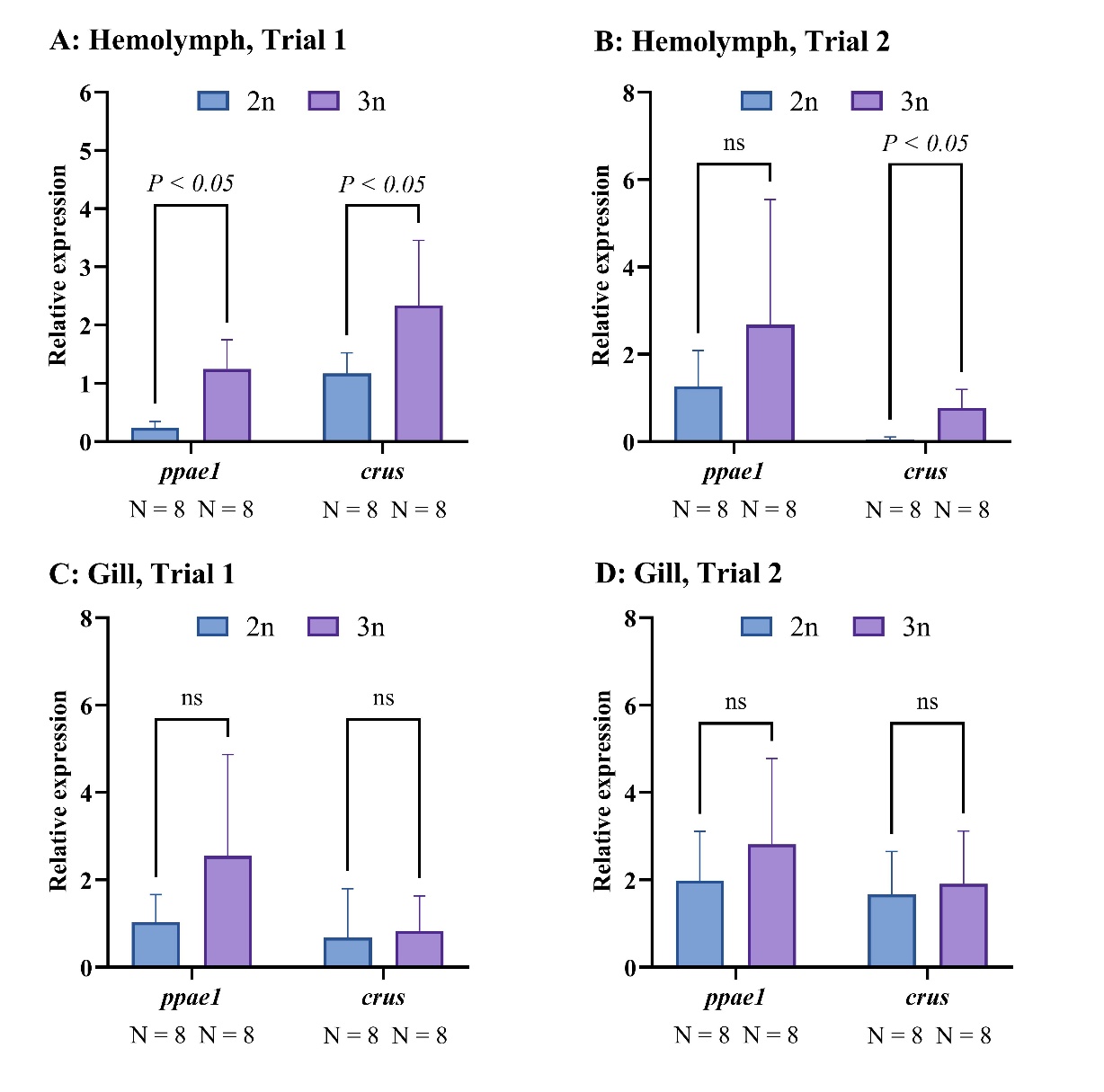
Figure 5 Relative expressions of ppae1 and crus genes in the hemolymph (A) and (B) and gills (C) and (D) of diploid (2n) and triploid (3n) Penaeus monodon. Sample sizes for each group are indicated beneath the panels. Statistical significance between ploidy groups was called when p < 0.05; ns denotes no significant difference.
Conclusions
This study provides the first comprehensive evidence that triploid induction in Penaeus monodon reshapes hemato-immunological organization through reduced hemocyte abundance coupled with compensatory cellular enlargement, while preserving baseline immune functionality. Enhanced PO activity, inducible respiratory burst responses, and the regulated expression of immune-related genes (ppae1 and crus) collectively indicate that triploid shrimp retain functional innate immune capacity rather than exhibiting immune impairment under non-challenged conditions. However, as the present findings are derived from baseline physiological and immunological indicators, further validation using controlled pathogen-challenge assays is warranted to determine whether these immune traits translate into enhanced or equivalent disease resistance relative to diploids. Such challenge-based experiments, together with farm-scale performance evaluations, will be essential to fully substantiate the practical applicability of triploid shrimp for sustainable aquaculture production.
Acknowledgements
This work was performed for the project “Biology of Triploid Black Tiger Shrimp, Penaeus monodon” (No. RSA5780052), with the grant from the Thailand Research Fund. The authorities of the Prince of Songkla University, Surat Thani Campus, Thailand are thanked for allowing us to use the research facilities for conducting the experiments. We thank Dr. Seppo Karrila for valuable assistance in improving the English language of this manuscript.
Declaration of Generative AI in Scientific Writing
During the preparation of this manuscript, the authors used ChatGPT to improve the readability and language of the text. The tool was applied with human oversight and control. The authors reviewed and approved all content and took full responsibility for the final manuscript.
CRediT Author Statement
Jareeporn Ruangsri: Conceptualization; Methodology; Validation; Formal analysis; Investigation; Resources; Writing - Original Draft; Writing - Review & Editing; Visualization; Project administration. Pattira Pongtippatee: Investigation; Funding acquisition. Saowanit Poolpearbprom: Investigation; Formal analysis. Sunee Wanlem: Investigation; Writing - Reviewing and Editing.
References
H Manan and M Ikhwanuddin. Triploid induction in penaeid shrimps aquaculture: A review. Reviews in Aquaculture 2021; 13(1), 619-631.
S Keyvanshokooh. The performance of triploids versus diploids in aquaculture: A review through the omics window. Aquaculture International 2025; 33(1), 36.
FE Coman, MJ Sellars, BJ Norris, GJ Coman and NP Preston. The effects of triploidy on Penaeus (Marsupenaeus) japonicus (Bate) survival, growth and gender when compared to diploid siblings. Aquaculture 2008; 276(1-4), 50-59.
P Pongtippatee, K Laburee, P Thaweethamsewee, R Hiranphan, S Asuvapongpatana, W Weerachatyanukul, T Srisawat and B Withyachumnarnkul. Triploid Penaeus monodon: Sex ratio and growth rate. Aquaculture 2012; 356, 7-13.
MJ Sellars, A Wood, B Murphy, RM McCulloch and NP Preston. Triploid Black Tiger shrimp (Penaeus monodon) performance from egg to harvest age. Aquaculture 2012; 324-325, 242-249.
M Saearlee, W Semchuchot, R Vanichviriyakit, B Withyachumnarnkul and P Pongtippatee. Oogenesis and spermatogenesis of the triploid black tiger shrimp, Penaeus monodon. Trends in Sciences 2024; 21(11), 8217.
K Söderhäll and L Cerenius. Crustacean immunity. Annual Review of Fish Diseases 1992; 2, 3-23.
P Amparyup, W Charoensapsri and A Tassanakajon. Prophenoloxidase system and its role in shrimp immune responses against major pathogens. Fish & Shellfish Immunology 2013; 34(4), 990-1001.
L Cerenius, BL Lee and K Söderhäll. The proPO-system: Pros and cons for its role in invertebrate immunity. Trends in Immunology 2008; 29(6), 263-271.
K Supamattaya, J Ruangsri, T Itami, V Chitiwan, W Phromkunthong and K Muroga. Morphology and immunological roles of hemocytes and fixed phagocytes in black tiger shrimp Penaeus monodon. Fish Pathology 2003; 38(2), 33-39.
I Söderhäll. Crustacean hematopoiesis. Developmental & Comparative Immunology 2016; 58, 129-141.
K Supamattaya, S Kiriratnikom, M Boonyaratpalin and L Borowitzka. Effect of a Dunaliella extract on growth performance, health condition, immune response and disease resistance in black tiger shrimp (Penaeus monodon). Aquaculture 2005; 248(1-4), 207-216.
SC Zheng, JY Xu and HP Liu. Cellular entry of white spot syndrome virus and antiviral immunity mediated by cellular receptors in crustaceans. Fish & Shellfish Immunology 2019; 93, 580-588.
W Charoensapsri, P Amparyup, I Hirono, T Aoki and A Tassanakajon. Gene silencing of a prophenoloxidase activating enzyme in the shrimp, Penaeus monodon, increases susceptibility to Vibrio harveyi infection. Developmental & Comparative Immunology 2009; 33(7), 811-820.
D Banerjee, B Maiti, SK Girisha, MN Venugopal and I Karunasagar. A crustin isoform from black tiger shrimp, Penaeus monodon exhibits broad spectrum anti-bacterial activity. Aquaculture Reports 2015; 2, 106-111.
K Xu, W Wang, D Liu, C Wang, J Zhu, B Yan, H Gao and G Hu. Characterization of a crustin-like peptide involved in shrimp immune response to bacteria and Enterocytozoon hepatopenaei (EHP) infection in Palaemon carinicauda. Fish & Shellfish Immunology 2023; 139, 108871.
Z Wang, Y Qu, X Zhuo, J Li, J Zou and L Fan. Investigating the physiological responses of Pacific white shrimp Litopenaeus vannamei to acute cold-stress. PeerJ 2019; 7, e7381.
L Li, C Zhang, Q Lin, M Zhu, F Mei, S Jian and D Zhao. Role of peroxinectin in the antibacterial immune response of the Chinese mitten crab, Eriocheir sinensis. Fish & Shellfish Immunology 2022; 123, 496-505.
K Sritunyalucksana, K Wongsuebsantati, MW Johansson and K Söderhäll. Peroxinectin, a cell adhesive protein associated with the proPO system from the black tiger shrimp, Penaeus monodon. Developmental & Comparative Immunology 2001; 25(5-6), 353-363.
Y Xing, G Feng-Ying, Z Qing-Mei, J Bai, H Wang, L Hai-Hua and J Qing. Cloning and characterization of the tiger shrimp lysozyme. Molecular Biology Reports 2009; 36(6), 1239-1246.
J Wu, S Tian, K Luo, Y Zhang, H Pan, W Zhang and K Mai. Dietary recombinant human lysozyme improves the growth, intestinal health, immunity and disease resistance of Pacific white shrimp Litopenaeus vannamei. Fish & Shellfish Immunology 2022; 121, 39-52.
K Sritunyalucksana, P Sithisarn, B Withayachumnarnkul and TW Flegel. Activation of prophenoloxidase, agglutinin and antibacterial activity in haemolymph of the black tiger prawn, Penaeus monodon, by immunostimulants. Fish & Shellfish Immunology 1999; 9(1), 21-30.
L Chalmers, JF Taylor, W Roy, A Preston, H Migaud and A Adams. A comparison of disease susceptibility and innate immune response between diploid and triploid Atlantic salmon (Salmo salar) siblings following experimental infection with Neoparamoeba perurans, causative agent of amoebic gill disease. Parasitology 2017; 144(9), 1229-1242.
CA Hyndman, JD Kieffer and TJ Benfey. The physiological response of diploid and triploid brook trout to exhaustive exercise. Comparative Biochemistry and Physiology Part A: Molecular & Integrative Physiology 2003; 134(1), 167-179.
R Mahmoudi, M Naderi, H Dopeikar, SA Khorasaninasab and SH Seyedalhosseini. Interactive effects of triploidy induction and culture densities on growth performance and stress, immune, and metabolic responses in juvenile rainbow trout (Oncorhynchus mykiss). Aquaculture Reports 2025; 40, 102540.
C Brianik. 2024, Evaluation of triploid eastern oysters (Crassostrea virginica) for northeastern waters: Assessment of growth, immunity, disease and survival. Ph. D. Dissertation. State University of New York, Stony Brook, USA.
S De Decker, J Normand, D Saulnier, F Pernet, S Castagnet and P Boudry. Responses of diploid and triploid Pacific oysters Crassostrea gigas to Vibrio infection in relation to their reproductive status. Journal of Invertebrate Pathology 2011; 106(2), 179-191.
J Xiang, F Li, C Zhang, X Zhang, K Yu, L Zhou and C Wu. Evaluation of induced triploid shrimp Penaeus (Fenneropenaeus) chinensis cultured under laboratory conditions. Aquaculture 2006; 259(1-4), 108-115.
N Bhagawati and R Mahanta. Changes in haemocyte count in haemolymph of different larval stages of Eri silkworm on application of dimethoate, organophosphorus pesticide. International Journal of Recent Scientific Research 2012; 5, 396-399.
J Ruangsri, J Thawonsuwan, S Wanlem and B Withyachumnarnkul. Effect of body size and sub-optimal water quality on some hemato-immunological parameters of spotted babylon snail Babylonia areolata. Fisheries Science 2018; 84(3), 513-522.
CL Kielkopf, W Bauer and IL Urbatsch. Bradford assay for determining protein concentration. Cold Spring Harbor Protocols 2020; 2020(4), 102269.
M Muñoz, R Cedeño, J Rodrı́guez, WPWVD Knaap, E Mialhe and E Bachère. Measurement of reactive oxygen intermediate production in haemocytes of the penaeid shrimp, Penaeus vannamei. Aquaculture 2000; 191, 89-107.
B Withyachumnarnkul, I Palang, J Ruangsri, S Sirithammajak, S Jitrakorn, W Kiatpathomchai, V Saksmerprome, P Pongtippatee and B Withyachumnarnkul. Nile tilapia reared under full-strength seawater: Hemato-immunological changes and susceptibility to pathogens. Aquaculture 2017; 480, 42-50.
B Yang, W Li, Y Mao, Y Zhao, Y Xue, X Xu, Y Zhao and K Liu. Study on antimicrobial activity of sturgeon skin mucus polypeptides (rational design, self-assembly and application). Food Chemistry: X 2024; 21, 101236.
JM Fernandes, J Ruangsri and V Kiron. Atlantic cod piscidin and its diversification through positive selection. PLoS One 2010; 5(3), e9501.
JM Fernandes, MG MacKenzie, PA Wright, SL Steele, Y Suzuki, JR Kinghorn and IA Johnston. Myogenin in model pufferfish species: Comparative genomic analysis and thermal plasticity of expression during early development. Comparative Biochemistry and Physiology Part D: Genomics and Proteomics 2006; 1(1), 35-45.
J Vandesompele, K De Preter, F Pattyn, B Poppe, NV Roy, AD Paepe and F Speleman. Accurate normalization of real-time quantitative RT-PCR data by geometric averaging of multiple internal control genes. Genome Biology 2002; 3(7), research0034.1.
S Ponprateep, S Tharntada, K Somboonwiwat and A Tassanakajon. Gene silencing reveals a crucial role for anti-lipopolysaccharide factors from Penaeus monodon in the protection against microbial infections. Fish & Shellfish Immunology 2012; 32(1), 26-34.
TJ Benfey. The physiology and behavior of triploid fishes. Reviews in Fisheries Science 1999; 7(1), 39-67.
SP Otto and J Whitton. Polyploid incidence and evolution. Annual Review of Genetics 2000; 34(1), 401-437.
TL Orr-Weaver. When bigger is better: The role of polyploidy in organogenesis. Trends in Genetics 2015; 31(6), 307-315.
MM Beyea, TJ Benfey and JD Kieffer. Hematology and stress physiology of juvenile diploid and triploid shortnose sturgeon (Acipenser brevirostrum). Fish Physiology and Biochemistry 2005; 31(4), 303-313.
B Budiño, RM Cal, MC Piazzon and J Lamas. The activity of several components of the innate immune system in diploid and triploid turbot. Comparative Biochemistry and Physiology Part A: Molecular & Integrative Physiology 2006; 145(1), 108-113.
S Dorafshan, MR Kalbassi, M Pourkazemi, BM Amiri and SS Karimi. Effects of triploidy on the Caspian salmon Salmo trutta caspius haematology. Fish Physiology and Biochemistry 2008; 34(3), 195-200.
L Chalmers, KD Thompson, JF Taylor, S Black, H Migaud, B North and A Adams. A comparison of the response of diploid and triploid Atlantic salmon (Salmo salar) siblings to a commercial furunculosis vaccine and subsequent experimental infection with Aeromonas salmonicida. Fish & Shellfish Immunology 2016; 57, 301-308.
M Jearaphunt, C Noonin, P Jiravanichpaisal, S Nakamura, A Tassanakajon, I Söderhäll and K Söderhäll. Caspase-1-like regulation of the proPO-system and role of ppA and caspase-1-like cleaved peptides from proPO in innate immunity. PLoS Pathogens 2014; 10(4), e1004059.
N Yuvaraj and V Arul. Immunomodulatory effects of seagrass Halophila ovalis polysaccharide mixed feed in adult black tiger shrimp Penaeus monodon and its protective efficacy against white spot syndrome virus infection. Iranian Journal of Fisheries Sciences 2017; 16(3), 993-1007.
L Chalmers, LM Vera, JF Taylor, A Adams and H Migaud. Comparative ploidy response to experimental hydrogen peroxide exposure in Atlantic salmon (Salmo salar). Fish & Shellfish Immunology 2018; 81, 354-367.
MR Pilotto, N Argenta, J M Forte, B Hostins, FGR Menezes, R Maggioni, OVD Sousa, WW Jr, RD Rosa and LM Perazzolo. Environmental rearing conditions are key determinants of changes in immune gene expression patterns in shrimp midgut. Developmental & Comparative Immunology 2020; 106, 103618.
L Yang, Q Yang, S Jiang, Y Li, F Zhou, T Li and J Huang. Metabolic, immune responses in prawn (Penaeus monodon) exposed to ambient ammonia. Aquaculture International 2015; 23(4), 1049-1062.
RP Henry, Č Lucu, H Onken and D Weihrauch. Multiple functions of the crustacean gill: Osmotic/ionic regulation, acid-base balance, ammonia excretion, and bioaccumulation of toxic metals. Frontiers in Physiology 2012; 3, 431.