
Trends
Sci.
2026;
23(9):
13231
Methanol-Tolerant Lipase from Newly Isolated Saprochaete clavata 17B: Production, Characterization, and Application in Green Biodiesel Synthesis
Fidia
Fibriana1
and Apichat Upaichit2,*,

1Cluster of Natural and Environmental Sciences, Faculty of Mathematics and Natural Sciences,
Universitas Negeri Semarang, Central Java 50229, Indonesia
2International Program of Biotechnology, Center of Excellence in Innovative Biotechnology for Sustainable Utilization of Bioresources, Faculty of Agro-Industry, Prince of Songkla University, Songkhla 90110, Thailand
(*Corresponding author’s e-mail: [email protected]; [email protected])
Received: 31 December 2025, Revised: 13 February 2026, Accepted: 20 February 2026, Published: 25 March 2026
Abstract
The increasing demand for sustainable energy has driven interest in enzymatic biodiesel production, where lipases offer an eco-friendly alternative to chemical catalysts. This study aimed to optimize methanol-tolerant lipase production from yeast for biodiesel synthesis. Among four yeast strains tested, Saprochaete clavata 17B exhibited the highest extracellular lipase (ECL) activity at 457 U/L. Sequential optimization using the Taguchi method followed by response surface methodology–central composite design (RSM-CCD) was performed. The optimization experiments were conducted in two experiments with two different media formulations, using vegetable and alternative oils, under shaking conditions (200 rpm, 30 ± 2 °C, 120 h). The use of vegetable and alternative oils enhanced the ECL production to 5,277 and 3,260 U/L, respectively. Concentrated ECL obtained through ammonium sulfate saturation at 60-80% (w/v) showed a 7.4-fold increase in specific activity and was stable in the presence of 10% and 30% methanol. The lipase displayed optimal activity at pH 8.0 and room temperature, and its catalytic efficiency was evaluated in the transesterification of palm oil and Jatropha curcas seed oil, yielding 98% and 63% fatty acid methyl esters (FAME), respectively, while esterification of oleic acid produced 62% FAME. In conclusion, S. clavata 17B lipase represents a promising methanol-tolerant biocatalyst for industrial biodiesel applications, offering a sustainable alternative to chemical processes.
Keywords: Biocatalyst, Biodiesel, Methanol-tolerant lipase, Saprochaete clavata, Statistical optimization
List of abbreviations
CBL = cell-bound lipase
CBM = cell biomass
CNO = cell number
CFO = crude fish oil
CPO = crude palm oil
JCSO = Jatropha curcas seed oil
ECL = extracellular lipase
FAME/s = fatty acid methyl ester/s
OO = olive oil
PO = palm oil
RSM-CCD = response surface methodology-central composite design
RT = room temperature
SO = soybean oil
WFO = waste frying oil
Introduction
The increasing demand for sustainable energy has driven interest in enzymatic biodiesel production, where lipases offer an eco-friendly alternative to chemical catalysts. Lipases (EC 3.1.1.3) catalyze the oils to biodiesel via esterification and transesterification reactions [1]. The application of lipases in organic solvent-containing systems has been made in recent years, as in green biodiesel synthesis [2]. Additionally, lipases do not require cofactors and do not catalyze side reactions, making them highly valuable biocatalysts in this biofuel industry [3]. A key challenge in this process is the tolerance of biocatalysts to methanol in the chemical reactions, which is essential for synthesizing fatty acid methyl esters (FAME). Methanol is beneficial for transforming unstable or poorly water-soluble substrates, with its functional groups significantly affecting lipase esterification activity. The methanol-tolerant lipases are therefore critical for efficient and sustainable green biodiesel production [4].
Microorganisms are preferred sources of lipases due to their industrial potential. They can be cultured quickly on a large scale via fermentation, reducing production costs and yielding abundant enzymes. Microorganisms offer diverse physical and chemical traits, genetic manipulation, rapid culture development, and no seasonal effects, making them ideal biocatalysts [5,6]. Fungal lipases, especially in the form of extracellular lipases (ECLs), are commercially valuable for their ease of extraction and purification, thermal and pH stability, substrate specificity, and activity in organic solvents. Yeast such as Candida antarctica, Candida rugosa, and Yarrowia lipolytica are well-studied lipase producers that can adapt to fat-rich substrates and secrete extracellular lipolytic enzymes [7-9]. Magnusiomyces capitatus A4C has been reported to produce ECL with Jatropha curcas oil as an inducer [10]. Although Saprochaete clavata is recognized for its ability to produce lipase, reports on its lipase activity remain limited [11]. Importantly, the potential of S. clavata for methanol-tolerant lipase production, optimization, characterization, and its application in biodiesel synthesis remains underexplored and has not been performed yet.
To address this challenge, the production of methanol-tolerant lipase from S. clavata and its efficient optimization are required to maximize enzyme yield and activity. The conventional optimization method requires more experimental data sets, which is time-consuming and laborious. In contrast, statistical experimental designs are systematic and more efficient for bioprocess optimization in terms of time and cost [12]. For instance, Taguchi experimental design involves fewer experiments, serving as a screening filter to examine and identify factors that have a significant effect on the process [13]. Response surface methodology (RSM) can be applied to optimize the desirable responses [14]. The idea of a sequential experiment combining the Taguchi method and RSM-CCD can provide a powerful approach that not only enhances lipase yield but also shortens the overall time required for optimization. In addition, lipase characterization is essential to confirm its methanol tolerance and ensure suitability for biodiesel synthesis. Furthermore, exploring the use of vegetable oils and alternative oils as carbon sources for lipase production is valuable, as they influence the enzyme yield and cost-effectiveness.
This study focused on confirming the selection of yeast strains, including S. clavata, for active methanol-tolerant extracellular lipase (ECL) production and on optimizing enzyme yield using vegetable and alternative oils by combining sequential statistical approaches (Taguchi method and RSM-CCD). The lipase was partially purified and characterized to validate its methanol tolerance, a critical property for efficient esterification and transesterification reactions in biodiesel production. Finally, its catalytic performance was evaluated using palm oil, non-edible Jatropha curcas seed oil, and oleic acid as feedstocks, demonstrating the enzyme’s potential as a sustainable biocatalyst for biodiesel application.
Materials and methods
Materials and chemicals
Refined soybean, palm, and olive oils (Morakot Industries, Thailand) were bought locally. Waste frying oil (WFO) came from a fried chicken stall in Hat Yai, Thailand. Crude palm oil (CPO) was from Thaksin Palm, The Southern Palm Oil Co., Ltd., and crude fish oil (CFO) was from Songkhla Canning, Plc., both in Thailand. All media and reagents were obtained from local suppliers. Jatropha curcas seed oil for biodiesel synthesis was kindly provided by the Center of Excellence for Jatropha, Kasetsart University, Bangkok, Thailand.
Yeast strains, culture media, and seed culture preparation
Yeast strains, Saprochaete clavata 17B (GenBank accession number KT716431), S. clavata AgB (MF135609), Magnusiomyces capitatus 18B (MF135606), and Magnusiomyces capitatus 10F (MF135604) were previously isolated from palm oil-contaminated wastes [15] and kept in the culture collection of Molecular Biotechnology Laboratory, Faculty of Agro-Industry, Prince of Songkla University, Thailand. Yeast malt medium (YM) containing 10% (w/v) glucose, 0.5% (w/v) peptone, 0.3% (w/v) yeast extract, and 0.3% (w/v) malt extract was used as medium for seed culture preparation. Lipase production medium (LPM) contained 2.0% (w/v) palm oil (PO), 0.4% (w/v) NH4NO3, 0.47% (w/v) KH2PO4, 0.03% (w/v) Na2HPO4.12H2O, 0.1% (w/v) MgSO4.7H2O, 0.001% (w/v) FeSO4.7H2O, 0.001% (w/v) CaCl2.2H2O, 0.001% (w/v) MnSO4.4H2O, 0.01% (w/v) yeast extract, 0.1% (w/v) gum arabic, pH 5.0. The alternative oils at 2.0% (w/v), including WFO, CPO, and CFO, were used to substitute refined vegetable oils in the same pattern as in the experimental setup. Rhodamine B agar medium was a modified LPM supplemented with 0.001% (w/v) Rhodamine B and 1.5% (w/v) agar. Yeast malt agar (YMA) and yeast malt broth (YMB) were prepared for seed culture growth media. One loopful of the yeast colony was inoculated into 10 mL YMB and incubated at room temperature (RT; 30 ± 2 °C) with shaking (150 rpm) for 24 h. Finally, the culture broth (107 cells/mL) was inoculated into the LPM growth medium to obtain a final concentration of 10% (v/v).
Screening of a potential yeast strain with high extracellular lipase activity
The qualitative analysis was performed using Rhodamine B agar for all strains, whereas the quantitative evaluation was conducted by inoculating 107 cells/mL into LPM and incubating at RT (30 ± 2 °C) with shaking (150 rpm) for 120 h. The culture broth was measured for extracellular lipase (ECL) activity (U/L), cell biomass (CBM) (g/L), and cell number (CNO) (cells/mL). The yeast strain exhibiting the highest ECL activity (U/L) was selected as the final candidate for optimization, distinguishing it from the initial qualitative screening step. This strain was then subjected to optimization using the Taguchi method and continued by response surface methodology-central composite design (RSM-CCD).
Optimization of extracellular lipase production using statistical approaches
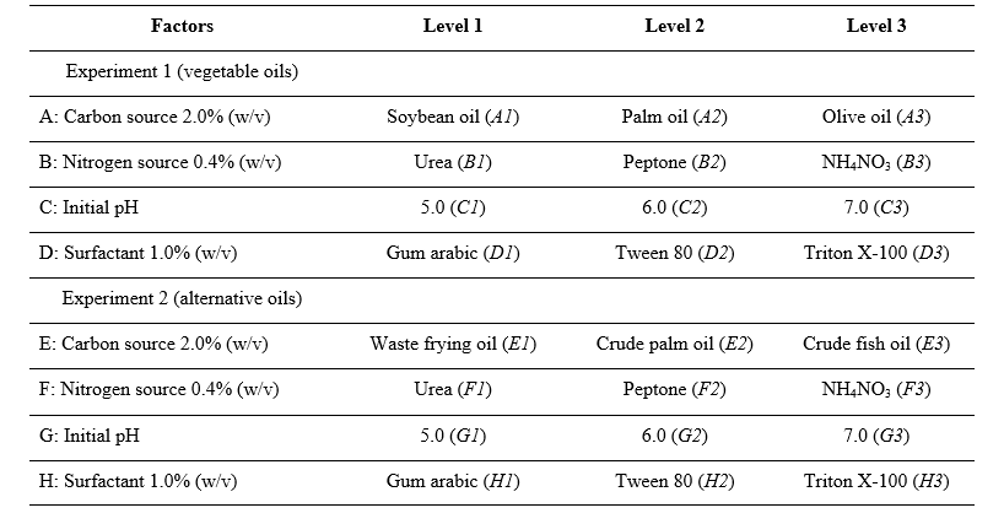
The Taguchi method was performed to examine the factors that significantly affected ECL production by the selected yeast strain, as shown in Table 1. A standard orthogonal array (OA) L-9 (34) was designed using a statistical program with 8 degrees of freedom (Table 2). All experiments were performed at RT (30 ± 2 °C) with shaking (150 rpm) for 120 h. RSM-CCD was employed to study parameter interactions and further optimize ECL production [16]. A set of experiments was designed using Design Expert® 7.0 software. All experiments were performed independently in triplicate.
Production and time course study of extracellular lipase by a selected yeast strain under optimum conditions
Firstly, the seed culture was prepared and added to the modified LPM broth. Then, it was cultivated at RT (30 ± 2 °C) with shaking (150 rpm) for 120 h. Cultivation of yeast cells in the LPM growth medium was carried out in triplicate. Crude lipase produced by the selected yeast strain culture was separated from yeast cells by centrifugation at 10,000×g (4 °C) for 15 min. Cell-free supernatants and cell pellets were used for ECL activity (U/L) and CBM (g/L) determination.
Preparation of concentrated extracellular lipase
Lipase was partially purified by standard protein purification procedures, including ammonium sulfate precipitation and dialysis. The partial purification was performed by continuous ammonium sulfate fractionation at 0-20%, 20-40%, 40-60%, and 60-80% saturation. The protein precipitate was resuspended in 0.1 M Tris-HCl buffer, pH 7.5. The protein fraction exhibiting the highest lipase activity was dialyzed (cut-off value: 12 kDa) against 0.05 M Tris-HCl buffer (pH 7.5) for 24 h at 4 °C, with six changes of the same buffer. Subsequently, the partially purified crude lipase was dialyzed and concentrated by freeze-drying.
Table 1 Factors and their levels employed in the Taguchi experimental design for extracellular lipase production using vegetable oils and alternative oils by S. clavata 17B.
Characterization of concentrated extracellular lipase
The concentrated ECL (cECL) activity from ammonium sulfate precipitation was determined using the two-phase emulsion (cupric acetate) method [17]. Whereas the characterization of concentrated extracellular lipase cECL was performed using the hydrolysis of p-nitrophenyl palmitate (pNPP) by preparing 30 mg substrate in 1 mL isopropanol and 9 mL of 50 mM Tris-HCl buffer, pH 8.0, containing 0.4% (w/v) Triton X-100 and 0.1% (w/v) gum arabic. The reaction was conducted by adding 10 U of cECL to 0.9 mL of the substrate mixture and measuring the absorbance at 410 nm. The residual and relative activities were calculated [18].
Effect of pHs and temperatures on cECL activity and stability
The effect of pHs on freeze-dried lipase activity was determined at the pH range of 2.0 - 11.0 using 50 mM of different buffers. For pH stability and relative activity determination, one volume of cECL solution was mixed with two buffers (250 mM) and incubated at RT (30 ± 2 °C) for 3 h before activity assay. The effect of temperatures was determined at 4, 25, 37, 45, 60, 70, 80, and 90 °C. The assay condition was determined at pH 8.0. For the stability test, the enzyme was incubated for 3 h at pH 8.0 before the activity assay, and then residual activity was determined.
Effect of metal ions and organic solvents on cECL activity and stability
The effect of various metal ions on cECL was evaluated by incubating the enzyme reaction mixture in various metal ions i.e. Na+, Ca2+, Mg2+, Zn2+, K+, Cu2+, Fe3+, Mn2+, Co2-, Li+, and Ag3+ in the enzyme reaction mixture at pH 8.0 and temperature at 30 °C for 30 min followed by measuring the residual activity of the enzyme. The effects of various organic solvents on cECL activity were measured. Enzyme stability was measured after pre-incubation of the enzyme solution at pH 8.0, 30 °C, and 300 rpm for 3 h in 10, 30, and 60% (v/v) organic solvents. The enzymatic reaction without any organic solvent was performed as a control. The residual activity was measured.
Effect of various surfactants, inhibitors, oxidizing agents, and laundry detergents on cECL stability
The surfactants used in this experiment were Triton X-100, Tween 80, SDS, PEG, CTAB, and gum arabic, with concentrations ranging from 0.5, 1, 3, 5, 8, and 10% (v/v or w/v). After incubation at pH 8.0, 30 °C, and 300 rpm for 3 h, the residual enzyme activity was measured. The stability of cECL in the presence of reducing agents was studied by measuring the residual activity after incubating the enzyme solution with 1 and 10 mM of 2-mercaptoethanol, PMSF, EDTA, and DTT at pH 8.0, 30 °C, and 300 rpm for 3 h. The stability of cECL towards oxidizing agents, including hydrogen peroxide (H2O2) and sodium hypochlorite (NaClO), as well as commercial laundry detergents, was studied by measuring the residual activity after incubation at pH 8.0, 30 °C, and 300 rpm for 3 h.
Kinetic studies of cECL
The partially purified enzyme was subjected to kinetic studies to determine the Km and Vmax. Km, the substrate concentration at which the reaction velocity is half maximum, and Vmax, the maximum velocity of the enzyme reaction, were determined by incubating 50 µl of cECL at different concentrations of pNPP in Tris-HCl buffer pH 8.0 with molarity ranging from 0.25 to 4 mM at 30 °C for 10 min. The enzyme activity assay was performed spectrophotometrically at 410 nm.
Lipase hydrolytic activity assay and growth measurement
The modified cupric acetate method was used to determine the lipolytic activities of ECL and CBL. For each assay, 200 µL of culture supernatant (ECL) or 108 cells/mL pellets (CBL) were mixed with 0.5 mL phosphate buffer (50 mM, pH 7.0) and 1.0 mL substrate solution (palm oil emulsion, 10% (v/v)). The reaction mixture was incubated at 30 ± 2 °C with vigorous shaking (300 rpm) for 30 min. The reaction was terminated by adding 300 µL of 6N HCl. One milliliter of the upper layer was then mixed with 400 µL of the cupric acetate reagent for 15 s, and the absorbance was measured at 715 nm against a control in which the enzyme was deactivated by adding HCl at the start of the reaction. Fatty acid release was quantified using a palmitic acid standard curve. One unit of enzyme activity (U) was defined as the amount of enzyme required to release 1 µmol of palmitic acid per minute under the specified assay conditions [15,19]. The ECL activity was also determined based on the hydrolysis of p-nitrophenyl palmitate (pNPP) for enzyme characterization [18]. The assay mixture contained 1 mL of enzyme solution and 1 mL of pNPP substrate solution (1 mM pNPP dissolved in isopropanol and emulsified in 50 mM phosphate buffer, pH 8.0, containing 0.5% (w/v) Triton X-100 or gum arabic as a stabilizer). The reaction was incubated at 30 ± 2 °C for 15 min. Hydrolysis of pNPP released p-nitrophenol (pNP), which was measured spectrophotometrically at 410 nm against a blank control (substrate solution without enzyme). One unit of enzyme activity (U) was defined as the amount of enzyme required to release 1 µmol of pNP per minute under the specified assay conditions.
Growth analysis was determined by using total dry cell weight as cell biomass (CBM) and total cell numbers (CNO) [19]. For CBM determination, 2.0 mL microtubes were pre-weighed to obtain the tare weight. The culture broth was mixed vigorously to ensure a homogeneous suspension, and 2 mL aliquots were transferred into the tubes. Samples were centrifuged at 8,000×g for 10 min at 4 °C, and the supernatant was discarded. The cell pellets were washed twice with sterile distilled water, then centrifuged under the same conditions. The pellets were then dried at 60 °C until a constant weight was obtained, and the final dry weight was recorded as CBM (g/L). Total cell numbers (CNO) were determined using a hemocytometer. The counting chamber and cover slip were cleaned with lint-free tissue (Kim wipes) to remove dust and debris. A cover slip was placed over the grid area, and a small volume of culture broth (10 µl) was pipetted onto the chamber to obtain approximately 5-10 cells per small square. The counting chamber dimensions were 0.2×0.2×0.1 mm³ per square. The slide was examined under a light microscope at ×400 magnification. The number of cells was calculated by averaging the counts across multiple small squares (sum of all cells counted divided by the number of squares observed), multiplying by the dilution factor, and dividing by the chamber volume (mL) of a small square. Results were expressed as cells/mL of culture broth.
The protein concentration of ECL was measured by Bradford assay using Bovine Serum Albumin (BSA) as a standard (Bio-Rad Laboratories, Singapore) [20]. Briefly, 100 µL of enzyme solution was mixed with 5 mL of Bradford reagent. The mixture was incubated at room temperature for 5 min to allow color development. Absorbance was measured at 595 nm using a spectrophotometer. A standard calibration curve was prepared using serial dilutions of BSA (0-1 mg/mL), and the protein concentration of ECL samples was calculated from the linear regression of the standard curve. Results were expressed as mg/mL of protein in the enzyme solution.
Application of lipase in biodiesel synthesis
The 40 U of cECL was employed to catalyze the transesterification of 0.2 g of palm oil and methanol (molar ratio 1:3), added with 0.2 M phosphate buffer at 10% (v/v), as well as 0.2 g Jatropha curcas seed oil and methanol (molar ratio 1:3) added with buffer at 10% (v/v). The esterification of oleic acid using the cECL was attempted by mixing the substrate mixture (0.55 g oleic acid and methanol, 1:1 molar ratio) with 0.2 M phosphate buffer at 10% (v/v). The reaction was done in a thermo-mixer for 72 h (300 rpm) at 30 °C. After vigorous mixing, the mixture was centrifuged at 5,000×g for 5 min at RT (30 ± 2 °C) to separate the upper fatty acid methyl ester (FAME) phase. Then, samples were analyzed using gas chromatography [15].
Data analysis
Statistical analysis was performed using one-way analysis of variance (ANOVA) and Duncan’s multiple-range tests (p < 0.05) to evaluate significance in IBM SPSS Statistics [15].
Results and discussion
Selection of a potential lipase producer
All yeast strains grown on oil and rhodamine B-containing agar plate medium showed pink colonies under daylight and moderate orange fluorescence under UV illumination (350 nm) (Figure 1(A)). Rhodamine B forms complexes with fatty acids (rhodamine B-LCFA) as evidence of lipase excretion by microbial colonies [21].
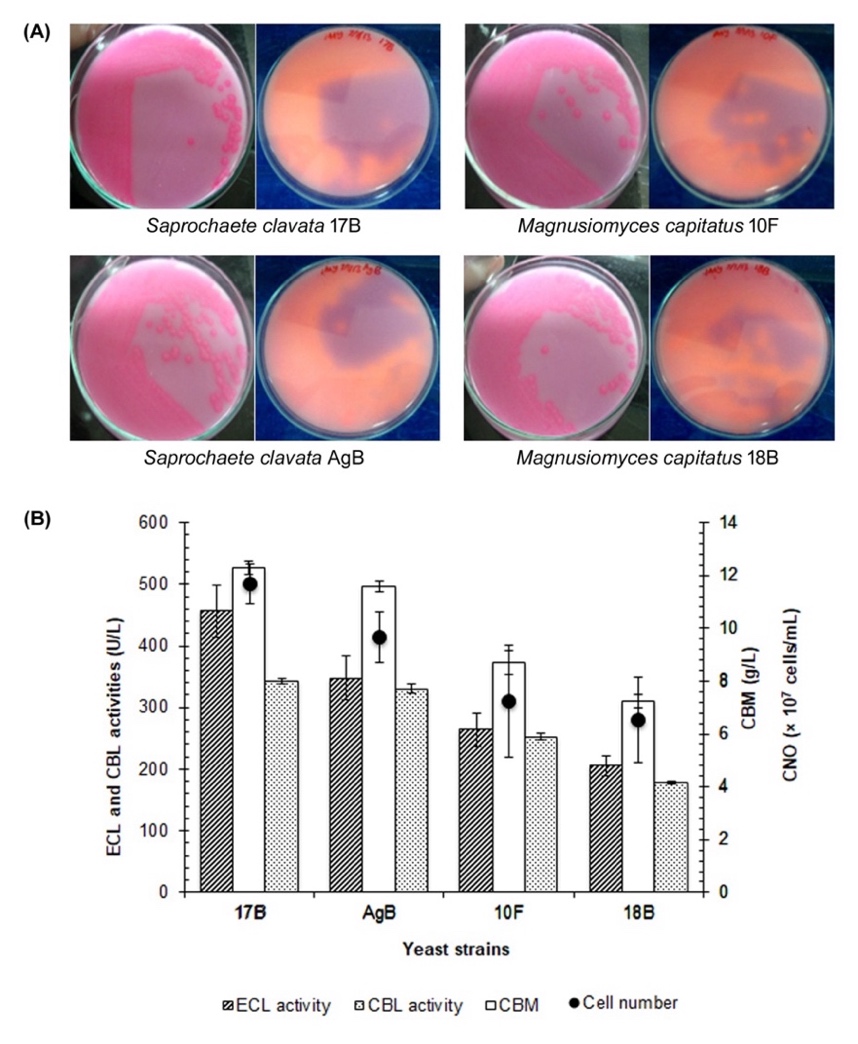
Figure 1 Qualitative assay of lipase-producing strains on modified LPM agar medium containing rhodamine B; strains with pink and orange fluorescent colonies (A); and quantitative assay of lipase-producing strains, including ECL activity, CBL activity, CBM, and CNO (B).
Then, the quantitative experiment using a palm oil-containing medium was performed to determine the ECL activity of all strains. It was found that Saprochaete clavata 17B was the highest one among yeast strains (457 U/L), followed by S. clavata AgB (348 U/L), Magnusiomyces capitatus 10F (264 U/L), and M. capitatus 18B (206 U/L) (Figure 1(B)). CBL activity, CBM, and CNO of S. clavata 17B were 342 U/L, 12.32 g/L, and 11.71×10⁷ cells/mL, respectively. These values are notably higher than those reported for other yeast lipase producers, such as Candida rugosa and Yarrowia lipolytica, which typically range from 150 to 300 U/L under similar conditions [22-27]. The activity of S. clavata 17B highlights its strong potential as a methanol-tolerant lipase producer, an essential trait for biodiesel synthesis, where methanol is a critical reactant. The combination of high ECL activity and robust biomass production suggests that S. clavata 17B can serve as a cost-effective and industrially relevant biocatalyst compared to previously studied strains. Therefore, S. clavata 17B was selected for the next experiment due to its potential as a lipase producer among the 4 yeast strains in the current study.
Statistical optimization of extracellular lipase production using the Taguchi method and Response Surface Methodology-Central Composite Design
Optimization of extracellular lipase production by a selected strain using the Taguchi method
Nine runs of the Taguchi L-9 orthogonal array (34) were conducted to determine the significant factors influencing ECL production by S. clavata 17B, and the results are shown in Table 2. Using vegetable oils, the ECL production ranged from 362 to 1590 U/L, whereas using alternative oils as a carbon source, the ECL ranged from 345 to 1059 U/L. The results in Table 2 are used to calculate the delta value (Ϫ) and the optimal level of each factor in experiments 1 and 2, as shown in Table 3. This calculation is to identify the main factors in ECL production. The impact of factors on ECL production in experiment 1 decreased in significant order as follows: Carbon source/OO (A3) > surfactant/Triton X-100 (D3) > nitrogen source/peptone (B2) > pH/6.0 (C2), whereas in experiment 2: Nitrogen source/peptone (F2) > carbon source/waste frying oil (E1) > surfactant/Tween 80 (H2) > initial pH/6.0 (G2).
Table 2 L9 (34) orthogonal array of the Taguchi experimental design for extracellular lipase and cell-bound lipase production by S. clavata 17B.

 *Experiment
1—A1;
soybean oil, A2;
palm oil, A3;
olive oil, B1;
urea, B2;
peptone, B3;
NH4NO3,
C1;
pH 5.0, C2;
pH 6.0, C3;
pH 7.0, D1;
gum arabic, D2;
Tween 80, D3; Triton X-100.
*Experiment
1—A1;
soybean oil, A2;
palm oil, A3;
olive oil, B1;
urea, B2;
peptone, B3;
NH4NO3,
C1;
pH 5.0, C2;
pH 6.0, C3;
pH 7.0, D1;
gum arabic, D2;
Tween 80, D3; Triton X-100.
**Experiment 2—E1; waste frying oil, E2; crude palm oil, E3; crude fish oil, F1; urea, F2; peptone, F3; NH4NO3, G1; pH 5.0, G2; pH 6.0, G3; pH 7.0, H1; gum arabic, H2; Tween 80, H3; Triton X-100.
Table 3 The range analysis of extracellular lipase production from S. clavata 17B obtained from the Taguchi experimental design using vegetable oils and alternative oils.
 Ϫ
= max value
– min
value of one
factor.
Ϫ
= max value
– min
value of one
factor.
In experiment 2, WFO at 2.0% (v/v) induced ECL production more than CPO and CFO. WFO improved lipase yield to 988 U/L, and Tween 80 significantly impacted lipase yield to 949 U/L. The ECL production was found to be highly dependent on the composition and levels of the culture medium.
Table 4 presents the results of the Analysis of variance (ANOVA) to examine the significance of the models in experiments 1 and 2. The p-value of the model in experiment 1 (0.029) indicates that the model was significant. The presence of 1.0% (v/v) Triton X-100 in the medium significantly increased ECL production by 1590 U/L (Table 2). Moreover, the results showed that OO at 2.0% (v/v) was the best carbon source, likely enhancing ECL production due to its high levels of unsaturated free fatty acids, particularly oleic and linoleic acids. Also, 0.4% (w/v) peptone was the best nitrogen source, yielding 1590 U/L of lipase. In addition, the initial pH was found to be an insignificant factor in ECL production. It was reported that S. clavata 17B exhibits a broad pH adaptation range [11]. The presence of 0.4% (w/v) peptone as a nitrogen source had the most significant impact on lipase production, reaching 1017 U/L. ANOVA results show that the model is significant (p-value = 0.038). Therefore, in experiment 1, OO (A3), peptone (B2), and Triton X-100 (D3) were selected, whereas in experiment 2, WFO (E1), peptone (F2), and Tween 80 (H2) were finally selected (1059 U/L). The formula was further optimized using response surface methodology (RSM), and an initial pH of 6.0 was used in all experiments.
Table 4 Analysis of variance (ANOVA) to examine the significance of the models.
 *
The values indicate the significance at or above a 95% confidence
level.
*
The values indicate the significance at or above a 95% confidence
level.
Optimization of extracellular lipase production by selected strain using RSM-CCD
The lipase optimization process using RSM-CCD was conducted at room temperature (RT, 30 ± 2 °C) with shaking at 200 rpm for 120 h. Two experimental designs were tested: In experiment 1, RSM-CCD was employed using OO (A3), peptone (B2), and Triton X-100 (D3), whereas in experiment 2, WFO (E1), peptone (F2), and Tween-80 (H2) were used. The ECL production was expressed in terms of ECL activity (U/L) (P1), and the growth was expressed in CBM (g/L) (P2). The initial pH of the culture medium was set constant at 6.0. The coded and actual values of the variable levels are given in Table 5.
Table 5 Maximum and minimum levels of variables used in RSM-CCD.

The experimental results of RSM-CCD for both experiments are listed in Table 6. The statistical significance of the model equation was evaluated by the F-test analysis of variance (ANOVA), which yielded the following regression equation for the level of ECL production P1 (U/L) in experiment 1 as a function of OO (A3), peptone (B2), and Triton X-100 (D3):
P1 = 4655.15 + 0.23A3 + 128.62B2 + 500.08D3 - 25.23A3B2 + 120.45A3D3 + 219.95B2D3 - 193.25A32 - 552.11B22 + 57.88D32
The response of P2 is expressed for CBM production (g/L):
P2 = 35.05 + 1.48A3 + 0.22B2 + 6.16D3 - 1.00A3B2 + 1.73A3D3 + 2.62B2D3 + 1.13A32 - 4.41B22 - 0.64D32
whereas in experiment 2, P1 (U/L) as a function of WFO (E1), peptone (F2), and Tween 80 (H2) is as follows:
P1 = 3199.28 - 14.46E1 - 11.48F2 - 14.18H2 + 7.18E1F2 + 38.05E1H2 + 30.51F2H2 - 31.80Y12 + 0.18 F22 - 29.78H22
The response of P2 is expressed for CBM production (g/L):
P2 = 32.40 + 0.19E1 + 0.94F2 + 0.69H2 + 0.20E1F2 - 0.62E1H2 + 0.38F2H2 - 2.08E12 - 2.32F22 - 1.15H22
The ANOVA for response surface quadratic models is shown in Table 7, and the three-dimensional response surface plots are illustrated in Figure 2. The p-value is a tool for assessing the significance of each coefficient. In experiment 1, the p-values < F-values of the models indicate that they were significant for both responses (P1 = 0.001 and P2 = 0.0036). R² values were 0.9613 and 0.8540, respectively, indicating that the model explained 96.13% and 85.40% of the variability in the responses. Also, the quadratic coefficients A32 and B22, and the interaction between factors B2D3, were confirmed as significant, and the linear coefficient of D3 (Triton X-100) was the most significant factor (p-value = 0.0001). Overall, Triton X-100 emerged as the most influential factor for cultivating yeast cells, enhancing ECL activity by up to 12-fold. Triton X-100 (p-t-octylphenyl polyoxyethylene ether) is a non-ionic surfactant widely used to increase lipase production.
Table 6 RSM-CCD matrix with experimental and predicted values of extracellular lipase production (U/L) and cell biomass (g/L) by S. clavata 17B.

This is consistent with the previous reports of surfactants acting as activators. Adding Triton X-100 to the system increased enzyme production, potentially by acting as a positive activator of the lipase gene, modifying plasma membrane permeability, and enhancing oxygen transfer [28]. Triton X-100 was used to optimize lipase production by Burkholderia multivorans V2, resulting in a 2.2-fold enhancement [29]. Additionally, Triton X-100 could inhibit some enzymes, such as NADH-ubiquinone oxidoreductase and heterodimeric phospholipases [30-32]. Figures 2(A(i)) and 2(A(ii)) show the interaction between olive oil (OO) and peptone. The ECL activity was enhanced by the increase of OO concentration between 5.0 and 6.5% (w/v). Regarding Figure 2(A(v)), the factor interaction between peptone and Triton X-100 (B2D3) was significant in terms of extracellular hydrolytic activities (p-value = 0.0086). In the present study, Triton X-100 and OO enhanced the lipase production by S. clavata 17B (Figure 2(A(iii)). Lipase and lipid droplets interact at the surface of yeast cells. Therefore, free fatty acids can be directly absorbed through the membrane [9,33].
In experiment 2, Table 7 shows the coefficient of determination (R2) for responses P1 and P2. The R2 for P1 is 0.8876, and for P2 it is 0.9217, indicating that the statistical model explains 88.76% and 92.17% of the variability in the responses. Waste frying oil and Tween-80 synergistically increased lipase secretion, highlighting the potential of low-cost substrates and surfactants to boost enzyme yield.
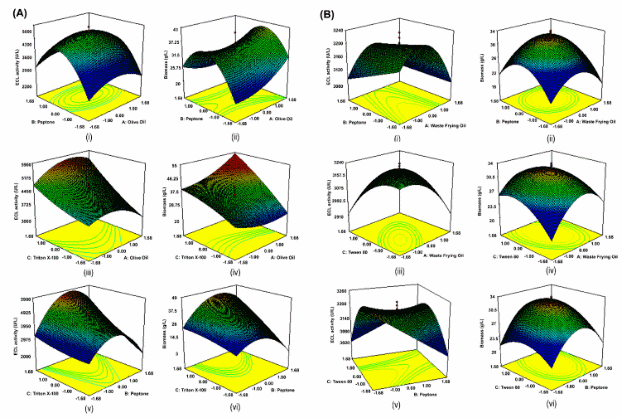
Figure 2 Response surface plots described by the model P1 and P2 obtained in experiment 1 (A) and experiment 2 (B), which represent the interactive effect between variables on ECL activity (i, iii, v) and CBM (ii, iv, vi), respectively.
Similar synergistic effects have been reported in Y. lipolytica, where Tween 80 supplementation with oil substrates significantly improved lipase yield [23]. The quadratic coefficients E12 and H22, and the interactions E1H2 and F2H2, indicate the significance of the model terms for ECL production. The models hold one variable constant at the optimum level. Figure 2(B(i)) shows an increase in ECL production as the concentration of waste frying oil (WFO) increased to 6.0% (v/v) and when the peptone concentration decreased to 0.2%. These results showed that peptone supported cell growth rather than lipase production, due to the range of micronutrients and minerals required for yeast growth [34]. According to Figure 2(B(iii)), the maximum lipase yield was achieved when WFO and Tween 80 reached 6.0% and 1.5%, respectively. Figures 2(B(iii)) and 2(B(iv)) show the interaction between WFO and peptone. A significant interaction between WFO and Tween 80 enhanced lipase production (p-value = 0.0019). Tween-80 could decrease the interfacial tension between oils and water. Moreover, it could increase cell permeability. Thus, facilitating the secretion and export of lipase across the cell membranes was provided [35]. Tween 80 is a non-ionic polyoxyethylene detergent, and the hydrophobic part usually consists of an alkyl chain, and the hydrophilic part is made of uncharged ethylene oxide units [36]. Moreover, the ECL activity was enhanced by increasing the WFO concentration from 4.0 to 6.5% (w/v). A further increase in WFO concentration led to a decrease in ECL responses. An increase in peptone concentration exhibited a negative influence, reducing lipase activity by 70 U/L (Figure 2(B(v)). This result showed that some yeast strains like to grow with peptone in concentrations from 0.3-1.0% (w/v) (Figure 2(B(vi)). This effect indicated that nitrogen sources primarily supported biomass rather than lipase activity [37].
Furthermore, the linear effect of F2 (peptone) was the most significant, indicating that peptone is a good nitrogen source for enhancing biomass production. Using waste frying oil (WFO) as an alternative carbon source can reduce the high operational costs of lipase production, as it has been successfully utilized in biotechnological processes to produce lipase [16].
Table 7 Analysis of variance (ANOVA) for response surface quadratic model obtained from experimental designs (P1 and P2).
 aA3,
Olive oil; B2,
Peptone;
D3,
Triton
X-100. The bold
values indicate the significance at or above a 95% confidence level.
aA3,
Olive oil; B2,
Peptone;
D3,
Triton
X-100. The bold
values indicate the significance at or above a 95% confidence level.

 aE1,
Waste frying oil; F2,
Peptone;
H2,
Tween
80. The bold
values
indicate the significance at or above a 95% confidence level.
aE1,
Waste frying oil; F2,
Peptone;
H2,
Tween
80. The bold
values
indicate the significance at or above a 95% confidence level.

Due to its complex composition, WFO is a potential substrate source for lipase production. WFO was found to be a more suitable carbon source than PO for lipase production by S. clavata 17B, with notable differences in fatty acid composition, including a decrease in oleic acid and the presence of linolenic and behenic acids (Supplementary Materials Table S1). Undefined fatty acids resulted from the frying process, while the viscosity of fresh palm oil and waste frying oil, or WFO, was similar, the acid value effectively differentiated them (Supplementary Materials Table S2). The iodine value, an indicator of overall unsaturation, was 53.65 for fresh PO, 48.2 for WFO, and 75.33 for OO. Water, steam, and oxygen initiated chemical reactions in frying oil, leading to an increase in di- and monoacylglycerols, glycerol, and free fatty acids, with short and unsaturated fatty acids being more prone to hydrolysis and oxidation, resulting in a 10.15% decrease in iodine value and changes in C18:2/C16:0 ratios [38]. Variables dependent on polyunsaturated fatty acid (PUFA) content showed poor correlations with other determinations, indicating low degradation of unsaturated fatty acids during continuous frying; additionally, WFO interacted positively with Tween 80, and peptone primarily provided nutrients rather than accumulating osmolytes [34,39].
Taken together, the RSM-CCD optimization demonstrated that combining suitable oils with non-ionic surfactants significantly enhances extracellular lipase production by S. clavata 17B. This outcome not only validates the statistical approach but also underscores the practical implication that methanol-tolerant lipase can be efficiently produced using inexpensive substrates (e.g., waste frying oil), making the process more sustainable and industrially relevant for biodiesel synthesis.
Lipase production under optimal conditions and time course study
The confirmation steps of the Taguchi design were conducted by comparing the ECL activity before and after the optimization process (Figure 3). The maximum ECL production of 1680 U/l (4-fold activity gain) was obtained in the modified LPM medium containing 2.0% (v/v) OO, 0.4% (w/v) peptone, and 1.0% (v/v) Triton X-100. Also, the maximum ECL production was achieved, increasing from 414 U/l to 1413 U/l (3.5-fold) in the modified LPM medium containing 2.0% (v/v) WFO, 0.4% (w/v) peptone, and 1% (v/v) Tween 80. The experimental values were very close to the predicted values. Hence, the model was successfully validated (Table 8). The optimized conditions obtained from RSM-CCD for ECL production by S. clavata 17B are shown in Table 9. The time course of ECL production was performed in the optimal medium (6.3% (v/v) olive oil, 0.66% (v/v) peptone, and 5.0% (v/v) Triton X-100) for 180 h.
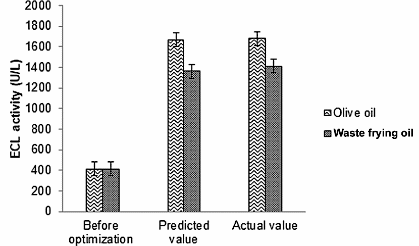
Figure 3 Improvement of extracellular lipase production from S. clavata 17B obtained from the Taguchi experimental design. 4-fold and 3.5-fold improvements were achieved in different compositions of media containing olive oil and waste frying oil, respectively.
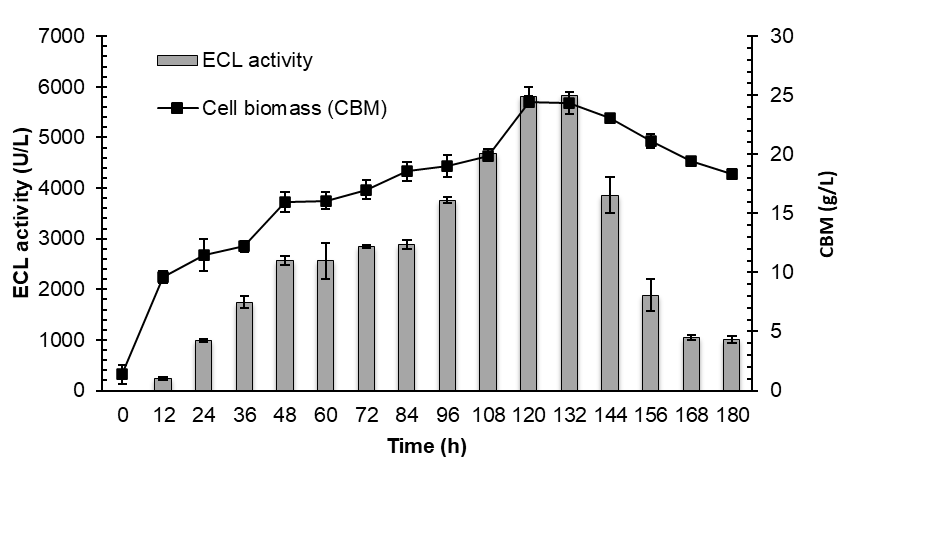
Figure 4 Time course study under optimized conditions for lipase production by S. clavata 17B performed at RT (30 ± 2 °C) on a rotary shaker (200 rpm) using modified LPM medium containing 6.3% (v/v) olive oil, 0.66% (w/v) peptone, and 5.0% (v/v) Triton X-100, pH 6.0.
Figure 4 shows that enzyme production commenced at a low level after 12 h of incubation, while maximal ECL activity was observed at 120 h (5819 U/L). Generally, after adding the inoculum, yeast cells undergo an environmental shock, leading to a lag phase. The length of this phase depends on the type of microorganisms, the age, the size of the inoculum, and changes in nutrient composition, pH, and temperature.
Moreover, once yeast cells have adapted to the new growth condition, they enter the exponential phase. Lipase activity was stable during the stationary phase of cell cultivation (120-132 h), and finally, ECL activity dropped. Further incubation beyond 132 h did not result in enhanced enzyme activity, leading to a decline. Maximum CBM (24.4 g/L) was attained within 120 h of incubation. Nutrient depletion and inhibitor formation slowed cell growth, leading yeast cells to enter the stationary phase and then the death phase. Lipase production by S. clavata 17B was growth-associated, similar to Geotrichum candidum 4013, which produced lipase activated by olive oil and reached maximum levels during the stationary phase [40].
Table 8 Predicted and experimental values of ECL production by S. clavata 17B obtained for validation of the RSM-CCD models.

Lipase partial purification to obtain concentrated extracellular lipase
The crude enzyme extract exhibited a specific activity of 13.2 U/mg. Following ammonium sulfate precipitation (60-80% saturation), the specific activity increased to 97.12 U/mg, representing a 7.4‑fold purification (Table 10). Although the yield decreased to 36.86%, this step effectively removed non‑lipase proteins and concentrated the enzyme. The reduction in volume from 4,000 mL to 210 mL highlights the efficiency of ammonium sulfate precipitation as a scalable concentration method. Such fold increases are consistent with or higher than those reported for other yeast lipases, including Hyphopichia wangnamkhiaoensis (6.2‑fold) and Yarrowia deformans (5.8‑fold) [41], and fall above the typical range of 4-6‑fold reported for microbial lipases in recent reviews [42]. The activity fold increase observed for S. clavata 17B suggests that its lipase responds particularly well to ammonium sulfate precipitation, highlighting favorable solubility and stability properties that make it a promising candidate for scalable downstream processing and industrial application.
Table 9 Factors influencing the optimum ECL production by S. clavata 17B obtained from RSM-CCD in the control (non-optimized), experiment 1, and experiment 2 conditions.
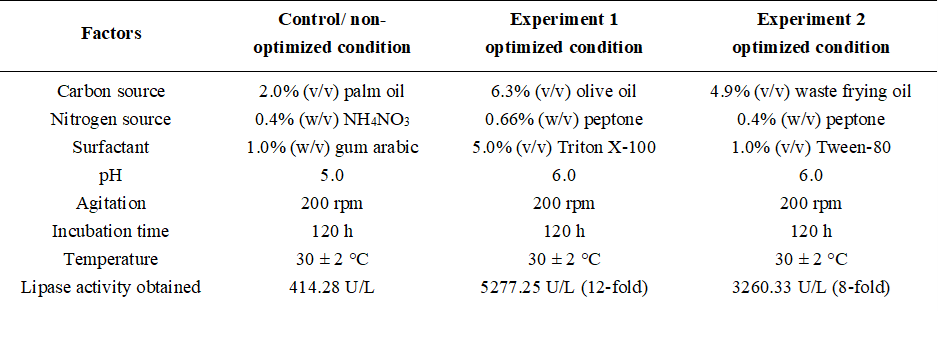
Table 10 Yield and fold of purification from each step of lipase produced by S. clavata 17B.

Characterization of concentrated extracellular lipase (cECL)
Effect of pHs and temperatures on cECL activity and stability
The cECL from S. clavata 17B was characterized at various pH values in the range of 2.0-11.0, and lipase showed high activity at pH 7.0-9.0, whereas the optimum pH was 8.0 (Figure 5(A)) and still showed high relative activity (39.8%) at pH 11.0. In contrast, cECL activity dropped dramatically at acidic conditions (pH 6.0). Based on this behavior, lipase from S. clavata 17B could be classified as alkaline lipase [29]. Residual activity was calculated as the percentage of enzyme activity retained after incubation under specific pH or temperature conditions compared to the untreated control (100%). The cECL showed good stability over a broad pH range, retaining more than 30% residual activity at pH 3.0-11.0. The enzyme showed the highest stability at pH 7.5 (94.4% residual activity) after incubation at RT for 3 h, while the lowest residual activity was observed at pH 3.0 (3.7%). The temperature effect on enzyme activity was assayed at the optimum pH of 8.0, and cECL showed 22.08% activity at 4 °C, increasing at 25 °C. Lipase activity at RT reached the maximum activity at 30 °C and remained quite good relative activity at 37, 45, and 60 °C (94.46%, 91.67%, and 75.45%, respectively). Lipase activity was then dramatically decreased at 70 °C (54.26%) and was completely inactivated at 90 °C (Figure 5(B)). The cECL activity was retained at around 90% after incubation at 4 °C, 25, RT, and 37 °C. The enzyme was comparatively thermostable, retaining 87.87% and 49.78% of its activity after 3 h of pre-incubation at 45 and 60 °C, respectively. The lipase remained at 21.16% and 18.61% of enzyme activity at 70 and 80 °C, respectively. It was then completely inactivated at 90 °C. The cECL from S. clavata 17B retained high activity at neutral pH and moderate temperatures, but activity decreased at extremes. This pattern is consistent with yeast lipases such as Y. lipolytica, which show optimal stability near pH 6.0-7.0 and up to 40 °C, and with microbial lipases from Burkholderia cepacia and Rhizomucor miehei, which lose stability above 50 °C [43,44]. The relatively high residual activity observed for S. clavata 17B under these conditions underscores its potential as a robust biocatalyst for industrial applications.
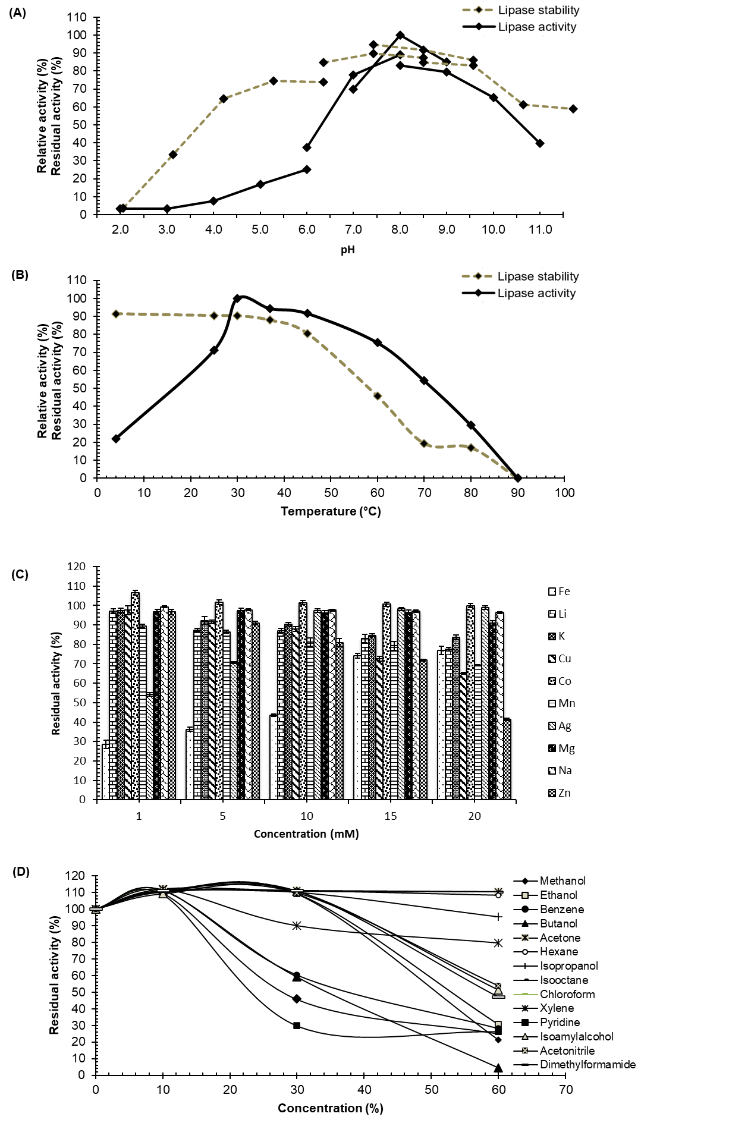
Figure 5 Characterization of concentrated extracellular lipase from S. clavata 17B, including the effect of pHs (A), temperatures (B), metal ions (C), organic solvents (D), surfactants (E), inhibitors (F), oxidizing agents (G), and laundry detergents (H) on the optimum activity and enzyme stability.
Effect of metal ions and organic solvents on cECL activity
Based on the results, only Co2+ enhanced lipase activity at all the concentrations tested up to 20 mM (Figure 5(C)). Co²⁺ likely interacts with the active site residues, promoting favorable conformational changes and stabilizing enzyme–substrate complexes. Mechanistically, Co²⁺ may promote conformational changes that increase accessibility of the hydrophobic pocket, thereby improving catalytic activity. This effect is consistent with reports that Co2+ often acts as a cofactor, stabilizing catalytic residues and improving substrate binding in microbial lipases [42]. In yeast systems such as Y. lipolytica, Co²⁺ supplementation has been shown to modulate lipase activity, likely through active‑site interactions and conformational stabilization [23]. Ca2+ enhanced the lipase activity at concentrations of 1 and 5 mM. Ca²⁺ binds to specific structural motifs in lipases, reducing conformational flexibility and stabilizing the lid region, thereby improving enzyme stability and catalytic efficiency. Similar enhancements have been reported in microbial lipases, where Ca²⁺ supplementation increased thermostability and activity, and Co²⁺ improved active-site interactions. The immobilized CALB (C. antarctica lipase B) demonstrated remarkable thermal stability when supplemented with Ca²⁺, retaining residual activity values above 500% after prolonged storage, while immobilized CRL-OF (C. rugosa lipase) lost nearly all activity under similar conditions [45]. All other metals tested had an adverse effect on lipase, leading to a decline in residual activity at all concentrations tested. The increased concentration of metal ions led to a proportionate decrease in enzyme activity. Even at 1 mM concentration, lipase activity was considerably decreased in the presence of Fe3+ and Ag3+. As shown in Figure 5(D), the remaining lipase activity was relative to the control (0%), which was set to 100% residual activity on the Y axis. The study results indicated that all non-polar solvents at 10% concentration enhanced enzyme activity by more than 100%. Butanol was found to be a strong lipase inhibitor at 60% concentration. The results clearly showed that, at 10% and 30% concentrations of solvents, including methanol, ethanol, acetone, isopropanol, isooctane, isoamyl alcohol, acetonitrile, and dimethylformamide, the enzyme remained stable for 3 h. The use of organic solvents in enzymology is advantageous for transforming unstable or poorly soluble substrates and minimizing water-dependent side reactions and lipase denaturation. The functional group of organic solvents significantly affects lipase esterification activity, likely due to variations in water retention at the enzyme’s active site [46-48].
Effect of various surfactants, inhibitors, oxidizing agents, and laundry detergents on cECL stability
As presented in Figure 5(E), cECL was inhibited up to 20% in the presence of Tween 80 after 1 h of incubation at RT, indicating partial inhibition rather than complete inactivation, while Triton X-100 showed an effect to improve lipase activity. This behavior is consistent with other lipases, where non‑ionic surfactants can either enhance or inhibit activity depending on concentration and incubation time; excessive surfactant can mask the hydrophobic interface or alter lid dynamics, reducing substrate access [36,49,50]. Lipase was insensitive to PMSF (Figure 5(F)). The active-site serine-specific inhibitor had no pronounced effect on enzyme activity when pre-incubated with lipase at 10 mM. DTT in 1 mM concentration moderately inhibited (35%) lipase. The thiol compound 2-mercaptoethanol positively affected enzyme activity except at the highest concentration tried. EDTA, a metal-chelating agent, did not affect the activity, suggesting that the enzyme was not a metalloenzyme [51]. Enzyme activity (96%) was retained in the presence of 1% H2O2 and remained active at 42% at this chemical concentration after incubation for 3 h (Figure 5(G)). In lipase stability under the oxidizing agent sodium perchlorate (NaClO), 57% of enzyme activity was retained in the presence of 1% NaClO and remained stable until 3% concentration. The presence of hydrogen peroxide improved the enzyme solubility in organic media [51]. Bleaching agent stability is an important property of an enzyme that has been achieved by mutagenesis and protein engineering on Lipolase®, marketed by Novo Nordisk, Denmark. Figure 5H shows the cECL stability in the presence of laundry detergent in various concentrations. The lipase remained stable at 3-11% detergent, retaining >60% activity. This result indicates that it can be applied in detergent formulation, supported by its alkaline stability [52].
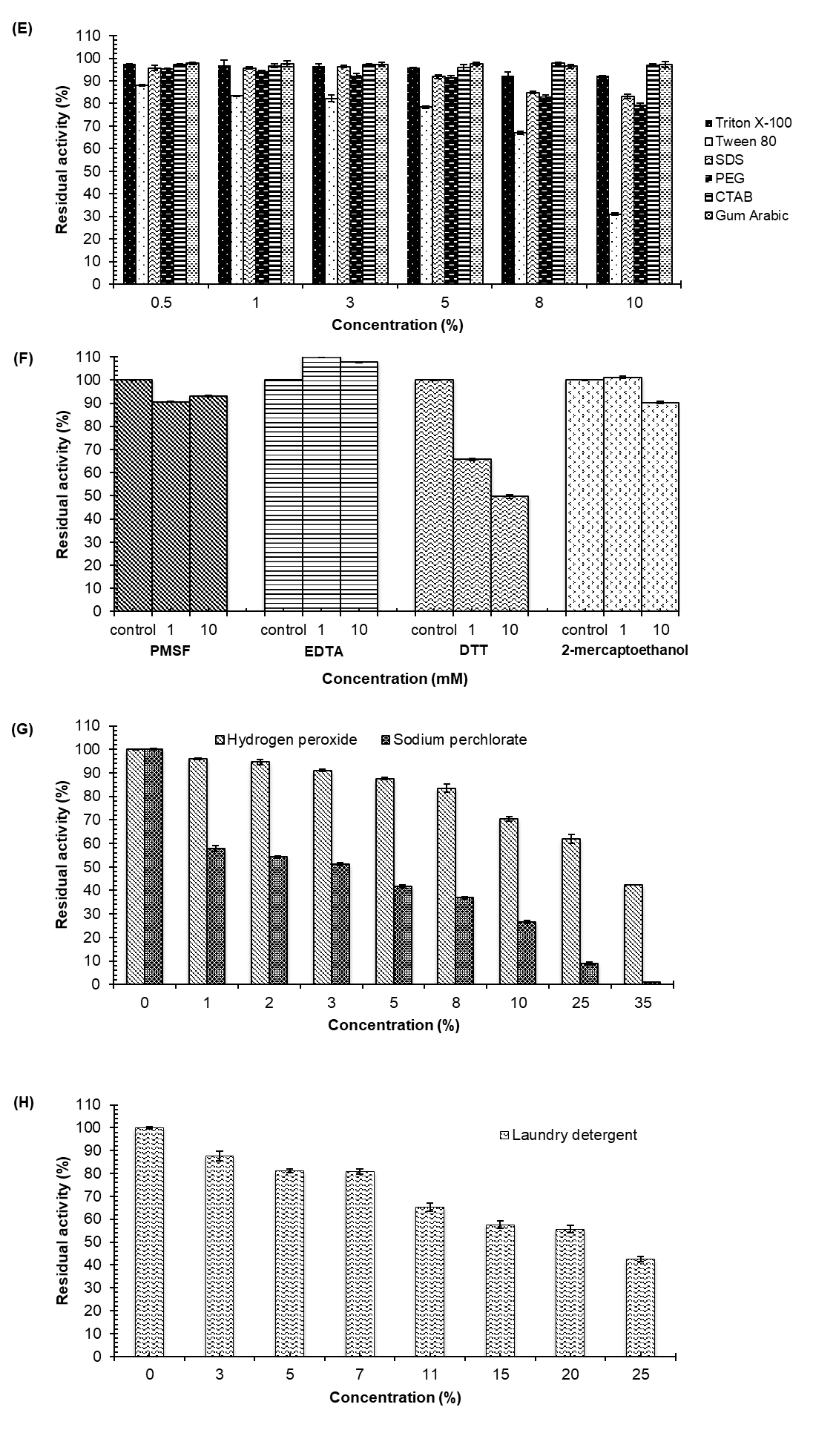
Figure 5 [continued] Characterization of concentrated extracellular lipase from S. clavata 17B, including the effect of pHs (A), temperatures (B), metal ions (C), organic solvents (D), surfactants (E), inhibitors (F), oxidizing agents (G), and laundry detergents (H) on the optimum activity and enzyme stability.
Kinetic studies
The Km and Vmax values of the partially purified lipase from S. clavata 17B, calculated from Michaelis–Menten and Lineweaver–Burk plots using pNPP as substrate at pH 8.0, were 2.46 mM and 22.49 U/mL, respectively (Figure 6). A low Km indicates high affinity for the substrate, while a high Vmax reflects efficient catalytic turnover [53]. Yeast lipases are reported to exhibit Km values of 3-5 mM and Vmax values of 15-20 U/mL under similar assay conditions. For example, extracellular lipases from Y. lipolytica exhibited Km values of 3.2 mM with pNPP, while C. rugosa lipase showed Km and Vmax values of 4.1 mM and 18 U/mL, respectively [31,54,55]. More recently, lipases from H. wangnamkhiaoensis and Y. deformans reported Km values of 3-4 mM [41]. Compared to these, the lower Km and higher Vmax of S. clavata 17B lipase demonstrate superior catalytic efficiency toward pNPP, underscoring its potential as a robust biocatalyst.

Figure 6 Kinetic study of S. clavata 17B lipase, Michaelis-Menten graph (A) and Lineweaver-Burk plot (B) of the partially purified lipase using pNPP as a substrate.
Application of lipase in biodiesel production
The cECL was employed in the fatty acid methyl ester (FAME) synthesis of Jatropha curcas seed oil and palm oil via transesterification, and oleic acid was used to investigate the enzyme’s capability via an esterification reaction [15] (Table 11). The chromatograms of FAMEs obtained from the reactions are presented in Figure 7. The cECL transesterified palm oil better than J. curcas seed oil, yielding 98.5% and 63.7% FAMEs from the substrates within 96 h, respectively. After 72 h of methanol and oleic acid reaction, adding cECL to the system resulted in 62.6% esterification of the substrate to FAME. Extending the esterification reaction to 96 h resulted in a yield of 61.2%, which was not significantly different from the 72 h value (p > 0.05). This indicates that the system had reached equilibrium by 72 h, and prolonging the reaction time did not improve conversion.
Table 11 Fatty acid methyl esters (FAMEs) synthesis using cECL from S. clavata 17B via transesterification and esterification reactions.
 Values
are presented as mean ± SD (n = 3).
Values
are presented as mean ± SD (n = 3).
Different superscript letters in the same column and row indicate significant differences (p < 0.05).
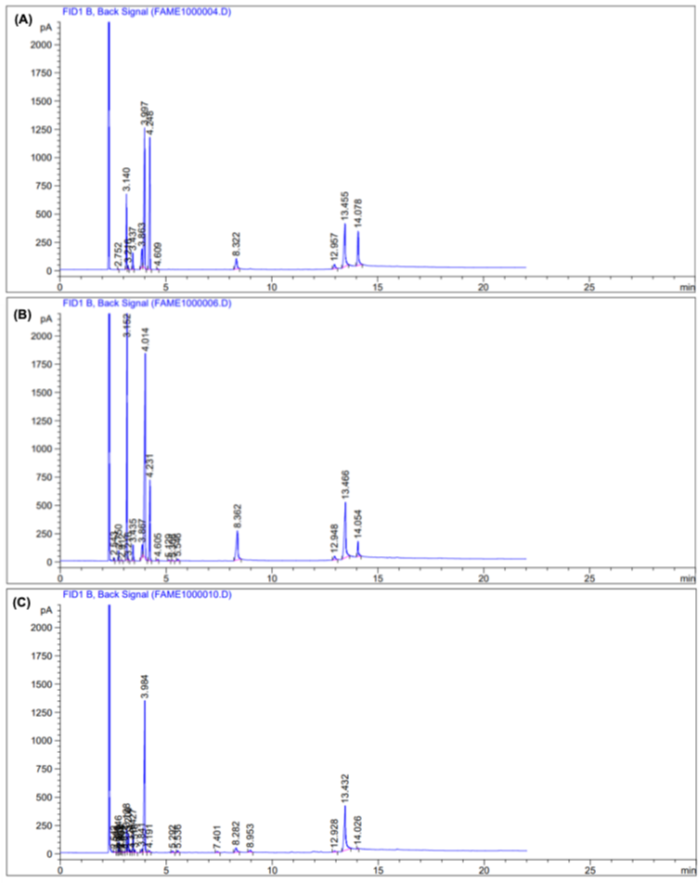
Figure 7 Chromatogram of gas chromatography analysis on fatty acid methyl esters (FAMEs) from the transesterification reaction (96 h) of Jatropha curcas seed oil (A) and palm oil (B), as well as the esterification reaction (72 h) of oleic acid (C) using S. clavata 17B concentrated extracellular lipase (cECL).
In contrast, transesterification of palm oil yielded 98.5% FAMEs within 96 h, while J. curcas seed oil produced 63.7% FAMEs under the same conditions. The higher yield with palm oil suggests that cECL preferentially acts on palmitic acid residues in triacylglycerols, consistent with the substrate specificity of the lipase, which acts by hydrolyzing the triacylglycerol [55]. The fatty acid composition of palm oil and J. curcas seed oil used in this study is shown in Table S2. The enzyme’s tolerance to methanol and ability to catalyze both hydrolysis and synthesis reactions further support its suitability for biodiesel production, where stability in organic solvents and dual catalytic action are critical. The lipase capacity depends on inducers, substrates, lipase supply, and ambient factors for specific enzymatic activities, such as hydrolysis and synthesis. Therefore, a methanol-tolerant lipase with specific characteristics could optimize the system. In this case, lipase from S. clavata 17B exhibited dual catalytic activity on oil substrates [15].
Conclusions
S. clavata 17B (KT716431) was identified as the most promising yeast strain for extracellular lipase (ECL) production, which was optimized using the Taguchi method and RSM-CCD. Lipase production increased 12-fold in a modified LPM medium with olive oil, peptone, and Triton X-100, and 8-fold using waste frying oil as a carbon source. The ECL exhibited unique characteristics, including alkalinity, methanol tolerance, and detergent tolerance. These innovative traits highlight the enzyme’s potential for practical applications in biocatalysis, particularly in biodiesel synthesis and detergent formulation. However, this study was limited to laboratory‑scale optimization and characterization, and further work is needed to evaluate enzyme performance under industrial conditions. Further research should explore large‑scale fermentation, immobilization strategies, and protein engineering to enhance catalytic efficiency and broaden substrate specificity. These directions can deliver cECL into practical applications in sustainable biodiesel production and the detergent industry in the future. By demonstrating both high production yields and functional robustness, this study provides a foundation for translating laboratory findings into industrial processes that support renewable energy and sustainable consumer products.
Acknowledgments
The authors would like to express their sincere gratitude to the Indonesian Ministry of Education, Culture, Research, and Technology for providing financial support to the first author for this research project. This research was also supported by the National Science, Research, and Innovation Fund (NSRF) and Prince of Songkla University (Ref. No. AGR6701350S). The Graduate School, Prince of Songkla University, Thailand, is also gratefully acknowledged for funding this research.
Declaration of Generative AI in Scientific Writing
During the preparation of this manuscript, the author(s) used Grammarly to improve the readability and language of the manuscript. The content was thoroughly reviewed, edited, and is the final responsibility of the authors.
CRediT Author Statement
Fidia Fibriana: Data Curation; Writing–Original Draft Preparation; Funding Acquisition. Apichat Upaichit: Conceptualization; Methodology; Funding Acquisition; Supervision; Writing–Reviewing and Editing.
References
[1] R Joshi and A Kuila. Lipase and their different industrial applications: A review. Brazilian Journal of Biology 2018; 5(10), 237-247.
[2] X Fan, X Niehus and G Sandoval. Lipases as biocatalyst for biodiesel production. Methods in Molecular Biology 2012; 861, 471-83.
[3] P Chandra, Enespa, R Singh and PK Arora. Microbial lipases and their industrial applications: a comprehensive review. Microbial Cell Factories 2020; 19, 169.
[4] BH Cadirci and I Yasa. An organic solvents tolerant and thermotolerant lipase from Pseudomonas fluorescens P21. Journal of Molecular Catalysis B: Enzymatic 2010; 64(3-4), 155-161.
[5] MM Pérez, ECS Gonçalves, AC Vici, JCS Salgado and MDLTDM Polizeli. Fungal lipases: Versatile tools for white biotechnology. In: A Yadav, S Mishra, S Singh and A Gupta (Eds.). Recent Advancement in White Biotechnology Through Fungi. Fungal Biology. Springer, Cham, 2019.
[6] M Athenaki, C Gardeli, P Diamantopoulou, SS Tchakouteu, D Sarris, A Philippoussis and S Papanikolaou. Lipids from yeasts and fungi: Physiology, production and analytical considerations. Journal of Applied Microbiology 2018; 124(2), 336-367.
[7] J Vakhlu and A Kour. Yeast lipases: Enzyme purification, biochemical properties and gene cloning. Electronic Journal of Biotechnology 2006; 9(1), 69-85.
[8] K Tongboriboon, B Cheirsilp and A H-Kittikun. Mixed lipases for efficient enzymatic synthesis of biodiesel from used palm oil and ethanol in a solvent-free system. Journal of Molecular Catalysis B: Enzymatic 2010. https://doi.org/10.1016/j.molcatb.2010.07.005
[9] ASM Omar, ŽG Sanja, ASM Walid, DL Nevena, LP Olivera, MJ Sonja and ZD Knežević-Jugović. Lipase production by Yarrowia lipolytica using olive oil processing wastes as substrates. Journal of the Serbian Chemical Society 2013; 78(6), 781-794.
[10] KA Baloch, A Upaichit and B Cheirsilp. Use of low-cost substrates for cost-effective production of extracellular and cell-bound lipases by a newly isolated yeast Dipodascus capitatus A4C. Biocatalysis and Agricultural Biotechnology 2019; 19, 101102.
[11] M Desnos-Ollivier, C Blanc, D Garcia-Hermoso, D Hoinard, A Alanio and F Dromer. Misidentification of Saprochaete clavata as Magnusiomyces capitatus in clinical isolates: utility of internal transcribed spacer sequencing and matrix-assisted laser desorption ionization-time of flight mass spectrometry and importance of reliable databases. Journal of Clinical Microbiology 2014; 52(6), 2196-2198.
[12] R Kaushik, RG Marwah, P Gupta, S Saran, L Saso, VS Parmar and RK Saxena. Optimization of lipase production from Aspergillus terreus by response surface methodology and its potential for synthesis of partial glycerides under solvent free conditions. Indian Journal of Microbiology 2010; 50, 456-462.
[13] TK Gündoğdu, I Deniz, G Çalışkan, ES Şahin and N Azbar. Experimental design methods for bioengineering applications. Critical Reviews in Biotechnology 2016; 36(2), 368-388.
[14] VL Pachapur, P Kutty, SK Brar and AA Ramirez. Enrichment of secondary wastewater sludge for production of hydrogen from crude glycerol and comparative evaluation of mono-, co- and mixed-culture systems. International Journal of Molecular Sciences 2016; 17(1), 92.
[15] K Baloch, A Upaichit, B Cheirsilp and F Fibriana. The occurrence of triple catalytic characteristics of yeast lipases and their application prospects in biodiesel production from non-edible Jatropha curcas oil in a solvent-free system. Current Microbiology 2021; 78(5), 1914-1925.
[16] F Fibriana, A Upaichit and B Cheirsilp. Statistical optimization for cost-effective production of yeast-bacterium cell-bound lipases using blended oily wastes and their potential applications in biodiesel synthesis and wastewater bioremediation. Fermentation 2022; 8(8), 411.
[17] SY Lee and JS Rhee. Hydrolysis of triglyceride by the whole cell of Pseudomonas putida 3SK in two-phase batch and continuous reactor systems. Biotechnology and Bioengineering 1994; 44(4), 437-443.
[18] S Javed, F Azeem, S Hussain, I Rasul, MH Siddique, M Riaz, M Afzal, A Kouser and H Nadeem. Bacterial lipases: A review on purification and characterization. Progress in Biophysics &Molecular Biology 2018; 132, 23-34.
[19] F Fibriana, A Upaichit and B Cheirsilp. Low-cost production of cell-bound lipases by pure and co-culture of yeast and bacteria in palm oil mill effluent and the applications in bioremediation and biodiesel synthesis. Biomass Conversion and Biorefinery 2021; 13, 10823-10844.
[20] MM Bradford. A rapid and sensitive method for the quantitation of microgram quantities of protein utilizing the principle of protein-dye binding. Analytical Biochemistry 1976; 72(1-2), 248-254.
[21] GN Jarvis and JH Thiele. Qualitative Rhodamine B assay which uses tallow as a substrate for lipolytic obligately anaerobic bacteria. Journal of Microbiological Methods 1997; 29(1), 41-47.
[22] ADS Pereira, GC Fontes-Sant’Ana and PFF Amaral. Mango agro-industrial wastes for lipase production from Yarrowia lipolytica and the potential of the fermented solid as a biocatalyst. Food and Bioproducts Processing 2019; 115, 68-77.
[23] A Fabiszewska, B Zieniuk, K Jasińska, D Nowak, K Sasa, J Kobus and U Jankiewicz. Extracellular lipases of Yarrowia lipolytica yeast in media containing plant oils—studies supported by the design of experiment methodology. Applied Sciences 2024; 14(23), 11449.
[24] JL Fraga, CPL Souza, ADS Pereira, ECG Aguieiras, LO de Silva, AG Torres, DG Freire and PFF Amaral. Palm oil wastes as feedstock for lipase production by Yarrowia lipolytica and biocatalyst application/reuse. 3 Biotech 2021; 11(4), 191.
[25] JC Moreno-Pirajàn and L Giraldo. Study of immobilized Candida rugosa lipase for biodiesel fuel production from palm oil by flow microcalorimetry. Arabian Journal of Chemistry 2011; 4(1), 55-62.
[26] TC Kuo, JF Shaw and GC Lee. Conversion of crude Jatropha curcas seed oil into biodiesel using liquid recombinant Candida rugosa lipase isozymes. Bioresource Technology 2015; 192, 54-59.
[27] M Aghababaie, M Beheshti, A Razmjou and AK Bordbar. Enzymatic biodiesel production from crude Eruca sativa oil using Candida rugosa lipase in a solvent-free system using response surface methodology. Biofuels 2020; 11(1), 93-99.
[28] WM Correa, WR Osório, AD Bortolozo, E Poloni and GS Padilha. Stability of Burkholderia cepacia lipase immobilized on styrene–divinylbenzene activated with glutaraldehyde, Triton X-100, and polyethylene glycol for the green synthesis of hexyl acetate. Applied Biochemistry and Biotechnology 2025; 197, 5344-5361.
[29] V Dandavate, J Jinjala, H Keharia and D Madamwar. Production, partial purification and characterization of organic solvent tolerant lipase from Burkholderia multivorans V2 and its application for ester synthesis. Bioresource Technology 2009; 100(13), 3374-3381.
[30] V Delorme, R Dhouib, S Canaan, F Fotiadu, F Carrière and JF Cavalier. Effects of surfactants on lipase structure, activity, and inhibition. Pharmaceutical Research 2011; 28, 1831-1842.
[31] A Domínguez, FJ Deive, MA Sanromán and MA Longo. Effect of lipids and surfactants on extracellular lipase production by Yarrowia lipolytica. Journal of Chemical Technology and Biotechnology 2003; 78(11), 1166-1170.
[32] S Hama, H Noda and A Kondo. How lipase technology contributes to evolution of biodiesel production using multiple feedstocks. Current Opinion in Biotechnology 2018; 50, 57-64.
[33] S Papanikolaou, A Dimou, S Fakas, P Diamantopoulou, A Philippoussis, M Galiotou-Panayotou and G Aggelis. Biotechnological conversion of waste cooking olive oil into lipid-rich biomass using Aspergillus and Penicillium strains. Journal of Applied Microbiology 2011; 110(5), 1138-1150.
[34] VMG Lima, N Krieger, MIM Sarquis, DA Mitchell, LP Ramos and JD Fontana. Effect of nitrogen and carbon sources on lipase production by Penicillium aurantiogriseum. Food Technology and Biotechnology 2003; 41(2), 105-110.
[35] Ü Açıkel, M Erşan and YS Açıkel. Optimization of critical medium components using response surface methodology for lipase production by Rhizopus delemar. Food and Bioproducts Processing 2010; 88(1), 31-39.
[36] G Sipiczki, SS Micevic, C Kohari-Farkas, ES Nagy, QD Nguyen, A Gere, and E Bujna. Effects of olive oil and Tween 80 on production of lipase by Yarrowia yeast strains. Processes 2024; 12(6), 1206.
[37] P Thota, BP Kumar, VP Rao and V Srirangam. Studies on optimization of extracellular lipase from potential fungal strain (s) isolated from oil contaminated soil. Journal of Microbiology and Biotechnology Research 2012; 2(3), 418-425.
[38] SM Abdulkarim and HM Ghazali. Fatty acid ratios and their relative amounts as indicators of oil stability and extent of oil deterioration during frying. Journal of Food Agriculture and Environment 2012; 10(2), 33-38.
[39] Y Li, J Chen, DF Liang and SY Lun. Effect of nitrogen source and nitrogen concentration on the production of pyruvate by Torulopsis glabrata. Journal of Biotechnology 2000; 81(1), 27-34.
[40] K Hlavsová, M Zarevúcka, Z Wimmer, M Macková and H Sovová. Geotrichum candidum 4013: Extracellular lipase versus cell-bound lipase from the single strain. Journal of Molecular Catalysis B: Enzymatic 2009; 61(3-4), 188-193.
[41] M Romo-Silva, EO Flores-Camargo, GM Chávez-Camarillo and E Cristiani-Urbina. Production, purification, and characterization of extracellular lipases from Hyphopichia wangnamkhiaoensis and Yarrowia deformans. Fermentation 2024; 10(12), 595.
[42] AA Abdelaziz, AM Abo-Kamar, ES Elkotb and LA Al-Madboly. Microbial lipases: Advances in production, purification, biochemical characterization, and multifaceted applications in industry and medicine. Microbial Cell Factories 2025; 24(1), 40.
[43] MA Dar, MAC Loedji, AT Lunggani, TP Napitupulu, A Kanti and IM Sudiana. Statistical optimization of culture media components for enhanced production of lipase by lipolytic yeasts, Pichia sp. and Trichosporon coremiiforme using response surface methodology. Biomass Conversion and Biorefinery 2025; 15(11), 17869-17885.
[44] TND Rocha, D Carballares, JR Guimarães, J Rocha-Martin, PW Tardioli, LRB Gonçalves and R Fernandez-Lafuente. Determination of immobilized lipase stability depends on the substrate and activity determination condition: Stress inactivations and optimal temperature as biocatalysts stability indicators. Sustainable Chemistry and Pharmacy 2022; 29, 100823.
[45] T Siódmiak, J Dulęba, GG Haraldsson, J Siódmiak and MP Marszałł. The studies of sepharose-immobilized lipases: Combining techniques for the enhancement of activity and thermal stability. Catalysts 2023; 13(5), 887.
[46] KN Ingenbosch, JC Vieyto-Nuñez, YB Ruiz-Blanco, C Mayer, K Hoffmann-Jacobsen and E Sanchez-Garcia. Effect of organic solvents on the structure and activity of a minimal lipase. The Journal of Organic Chemistry 2022; 87(3), 1669-1678.
[47] SCAraujo, MRMF Ramos, ELDE Santo, LHS de Menezes, MS de Carvalho, IMDC Tavares, M Franco and JR de Oliveira. Optimization of lipase production by Penicillium roqueforti ATCC 10110 through solid-state fermentation using agro-industrial residue based on a univariate analysis. Preparative Biochemistry & Biotechnology 2022; 52(3), 325-330.
[48] A Kumar, K Dhar, SS Kanwar and PK Arora. Lipase catalysis in organic solvents: Advantages and applications. Biological Procedures Online 2016; 18, 2.
[49] S Hama, A Yoshida, K Nakashima, H Noda, H Fukuda and A Kondo. Surfactant-modified yeast whole-cell biocatalyst displaying lipase on cell surface for enzymatic production of structured lipids in organic media. Applied Microbiology and Biotechnology 2010; 87(2), 537-543.
[50] ZH Nafaee, B Hajdu, É Hunyadi-Gulyás and B Gyurcsik. Hydrolytic mechanism of a metalloenzyme is modified by the nature of the coordinated metal ion. Molecules 2023; 28(14), 5511.
[51] K Sellami, A Couvert, N Nasrallah, R Maachi, M Abouseoud and A Amrane. Peroxidase enzymes as green catalysts for bioremediation and biotechnological applications: A review. Science of The Total Environment 2022; 806, 150500.
[52] S Sahay and D Chouhan. Study on the potential of cold-active lipases from psychrotrophic fungi for detergent formulation. Journal of Genetic Engineering and Biotechnology 2018; 16(2), 319-325.
[53] SE Helal, HM Abdelhady, KA Abou-Taleb, MG Hassan and MM Amer. Lipase from Rhizopus oryzae R1: In-depth characterization, immobilization, and evaluation in biodiesel production. Journal of Genetic Engineering and Biotechnology 2021; 19(1), 1.
[54] X Li, C Zhang, S Li, H Huang and Y Hu. Improving catalytic performance of Candida rugosa lipase by chemical modification with polyethylene glycol functional ionic liquids. Industrial & Engineering Chemistry Research 2015; 54(33), 8072-8079.
[55] KE Jaeger and T Eggert. Lipases for biotechnology. Current Opinion in Biotechnology 2002; 13(4), 390-397.
Supplementary material
Table S1 Fatty acids composition of palm oil, waste frying oil, olive oil, and Jatropha curcas seed oil used in this study.

Table S2 Chemical properties of palm oil, waste frying oil, and olive oil used in this study.